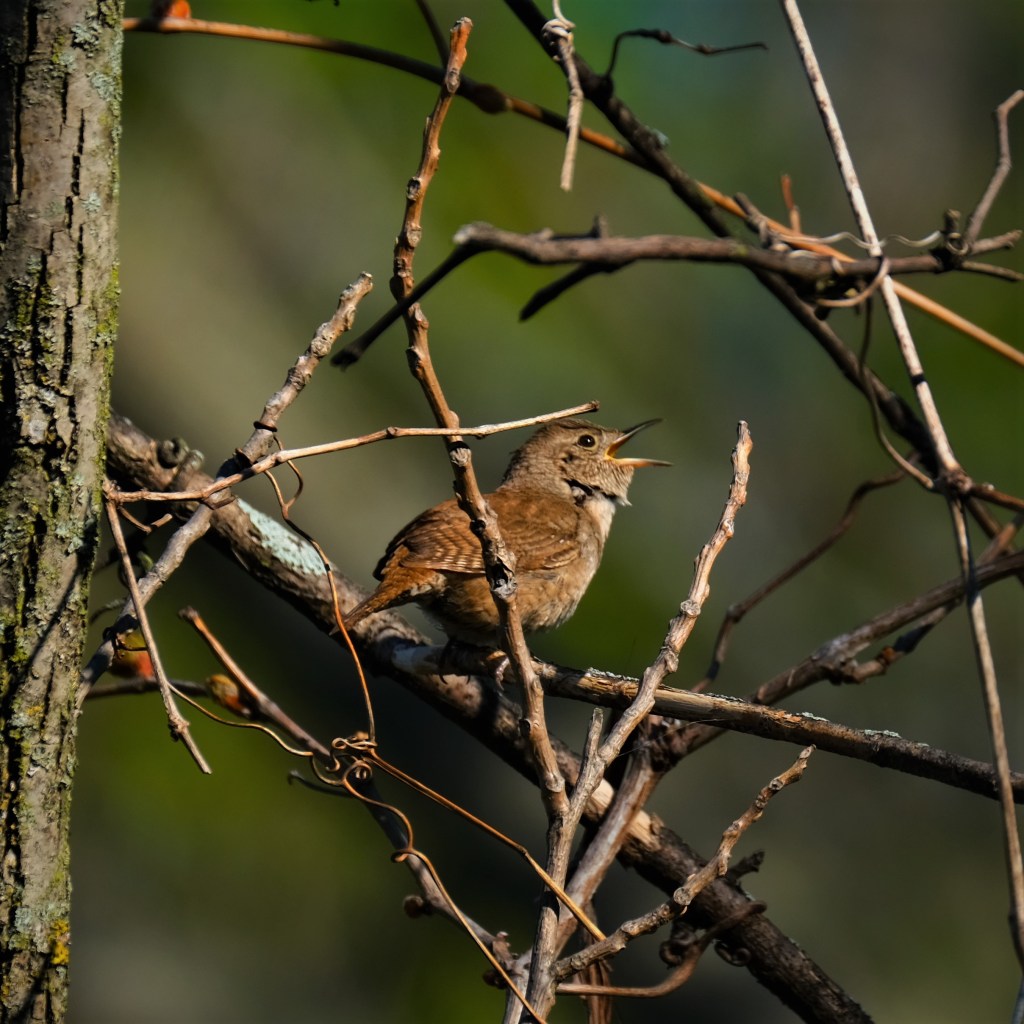
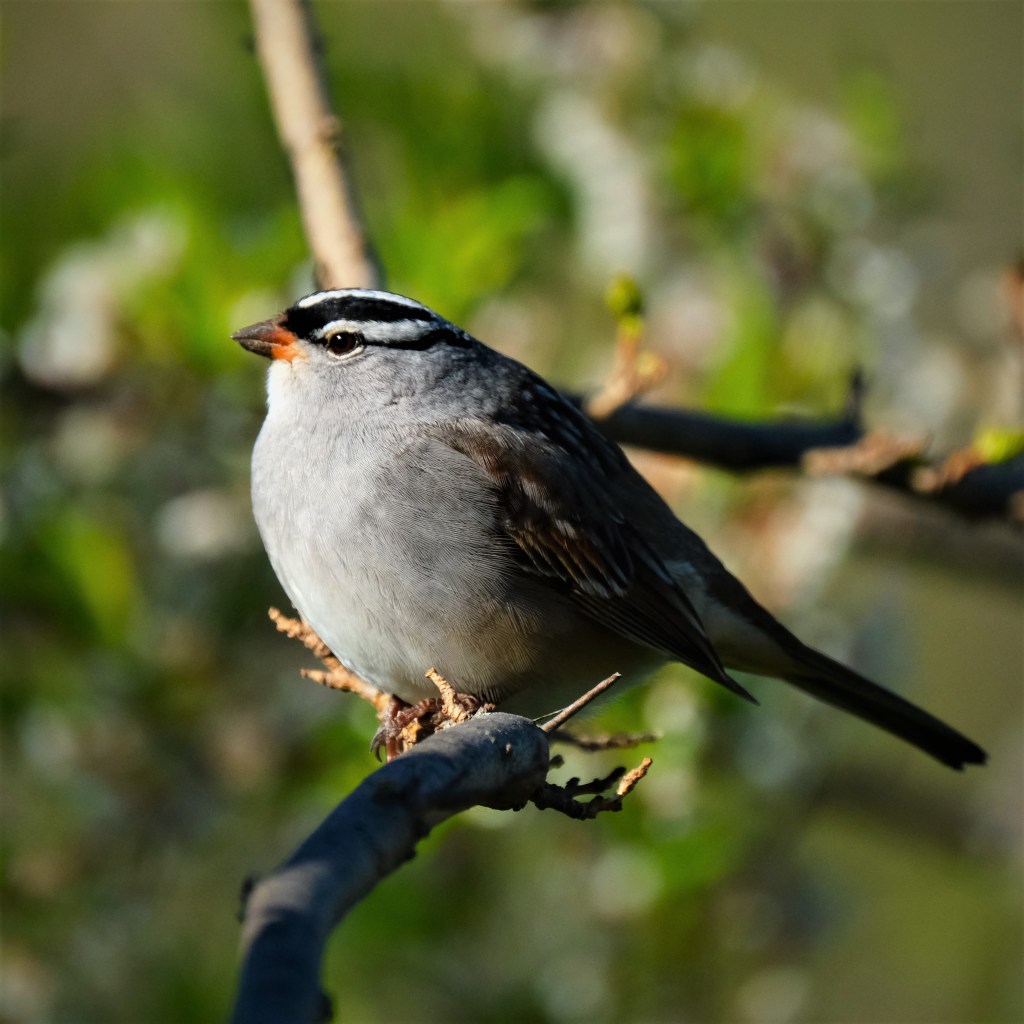
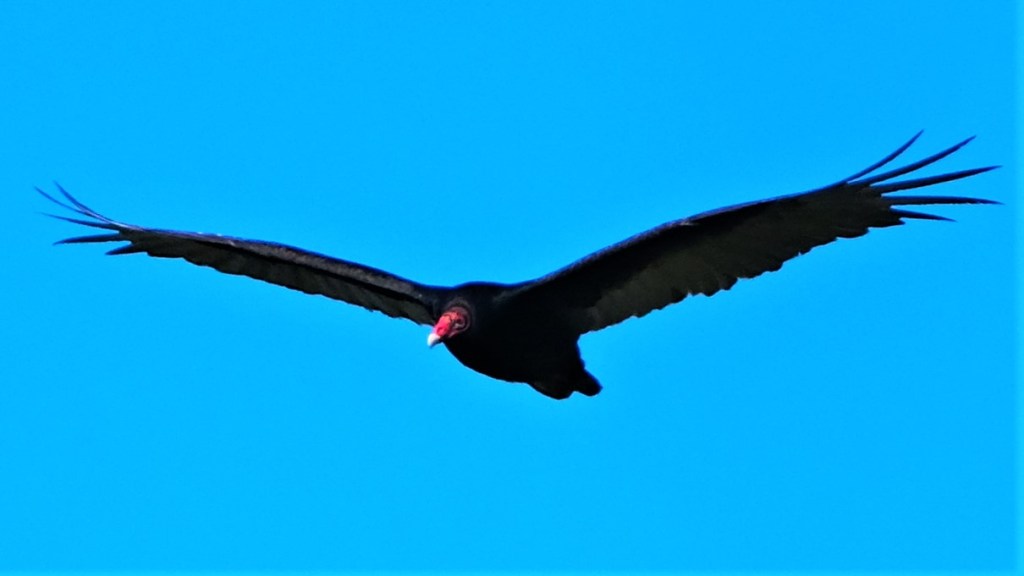
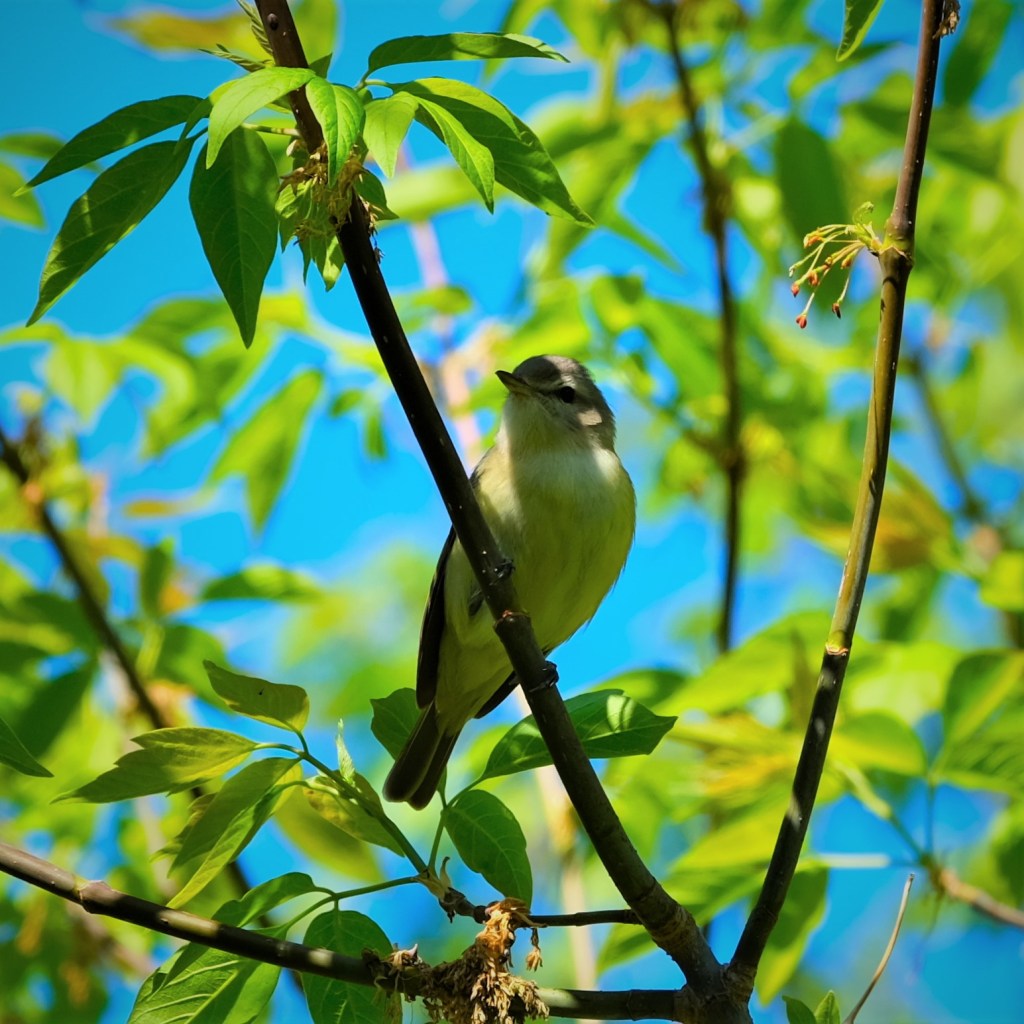
Anne didn’t get the jigsaw puzzle finished last night, so I didn’t get to the park till after lunch today. The pair of buffleheads were there again, but even more shy than yesterday, so I didn’t even both with a new picture. There were three goldeneyes today, which makes for a fun scene.
There were at least three female common mergansers, and they even hopped up onto the ice. I’ve never seen a merganser walk before, so that was fun for me.
Finally, a raptor soared by and stopped in a tree over the far side of the river. At first I thought it was the merlin we’ve seen before, but once I got the pictures home, I could see that’s not right. Neither that Cooper’s hawk nor the sharp-shinned hawk has such a finely bared tail, and it is surely the the solid red of the red-tailed hawk we just saw. Here are my two best pictures. Can anyone identify this raptor? Maybe some red-tailed hawk variant, such as the “juvenile dark morph“
Well, some snow did finally arrived, but it was mostly melted already by the time it got here, and I blame De Joy for that. Luckily, the birds don’t seem to care one way or the other, and this little cutie, an American goldfinch by the river in its winter coat of “drab, unstreaked brown, with blackish wings and two pale wingbars”, was singing the same hopeful little song I’ve heard since the spring.
Further north, above the falls, there was yet another new arrival chillin’ with the mallards, this time a pair of buffleheads (Bucephala albeola), and yes that’s their real name, click the link to see for yourself.
They were diving just like the goldeneye, of which there were two today that didn’t get along with each other. The buffleheads were shy like the goldeneye, too, so I was not able to get very close. Maybe I’ll have better luck next time.
As I got north of the second island, a couple of crows got excited, so my heart swelled with hope, and it didn’t take me long to spot the source of their excitement, in a tree clear across the river. Happily, just as I figured I had gotten the best picture I could, it must have decided the fishing was no good there, took to its wings, circled twice that wide spot of the river where the damn used to be, and headed back north from whence it had come. Ta da!
Finally, at the risk of igniting a firestorm, I stopped by the pond on my way home and found this little guy sitting by itself on a branch over the water, and this time, based on the clearly-visible reddish patches on its cheeks, head, and rump, I’m going to go with purple finch (Haemorhous purpureus). I look forward to your well-reasoned contradictions in the comments.
Well, the snow I ordered did not arrive, I blame De Joy for that, and it has really warmed up, so the river trail surface has the consistency of butter than hasn’t felt the inside of a fridge in a week. Luckily for us, some parts are still serviceable, a helpful tip from eagle-eyed and long-time-reader Lou Miller enabled me to focus my searching this morning, and here’s what we’ve got to show for it: a very shy and aptly-named male common goldeneye (Bucephala clangula).
He’s a diving duck, at the north edge of his winter range, and, besides always drifting to the far side of the river so my image is not too clear, he was really good at always drifting opposite of the way I would step, either up or down stream. I even got him to sit still for a moment by faking left and then quickly right.
At one point, all the mallards took off, leaving him behind, and I couldn’t see the eagle that I suspect flushed them, but I bumped into a fellow observer later by the falls who had a camera, lens, and tripod that looked like they cost more than my bike, yikes!, who explained that the river being frozen over further north, in Lincoln Park, has pushed the eagles south to hunt over open water. Lucky us! Right?
Lastly, Mr. De Sisti was kind enough to reply yesterday and included both the black-and-white and the color originals of his amazing picture of a coyote, so feast your eyes on this!
A coyote is seen standing on the iced over Milwaukee River near West Brown Deer Road in Brown Deer, Sunday, Jan. 10, 2021 . – Photo by Mike De Sisti / Milwaukee Journal Sentinel via USA TODAY NETWORK ORG XMIT: DBY1
What a magnificent creature, and thanks to the artist and gentleman for sharing, eh?
Not a lot going on today. Maybe everyone’s just waiting for the coming rain to pass through. Trails could sure use more snow, but that’s not what the hourly forecast is predicting, unfortunately.
The mergansers were back on the river this morning, and this time I counted 5 altogether: 1 male and 1 female common, and 1 male and 2 female red-breasted. Here they all are together:
Long-time reader Lou came to Estabrook looking for American black ducks yesterday, but he had no luck. Instead he reports seeing a goldeneye “upstream of the mallards” so maybe we’ve got that to look forward to.
Also, if you get the print Journal Sentinel, as Anne and I do, you were treated today to a stunning picture by Mike De Sisti on page 3A of a coyote standing on the frozen Milwaukee River near West Brown Deer Road. Here’s a link to the picture in today’s e-edition, and I’ve asked Mr. De Sisti if he’d send in a guest photo that I can share with you directly.
Finally, Donna and Robert wrote to me to assert that my song sparrow pictures from yesterday are really of house finches or purple finches. Here are the pictures again.
Here’s the id info for song sparrows, house finches, and purple finches. In my opinion, color capture and color rendering in photography is imperfect, and so I find features that do not depend upon exact color rendering, such as streaking and the dark spot in the middle of the chest more convincing. What do you think? Decisions, decisions…
My luck continues with the weather in the park, and to sweeten the deal further, the sun came out a bit this morning, and the sky even had some blue patches.
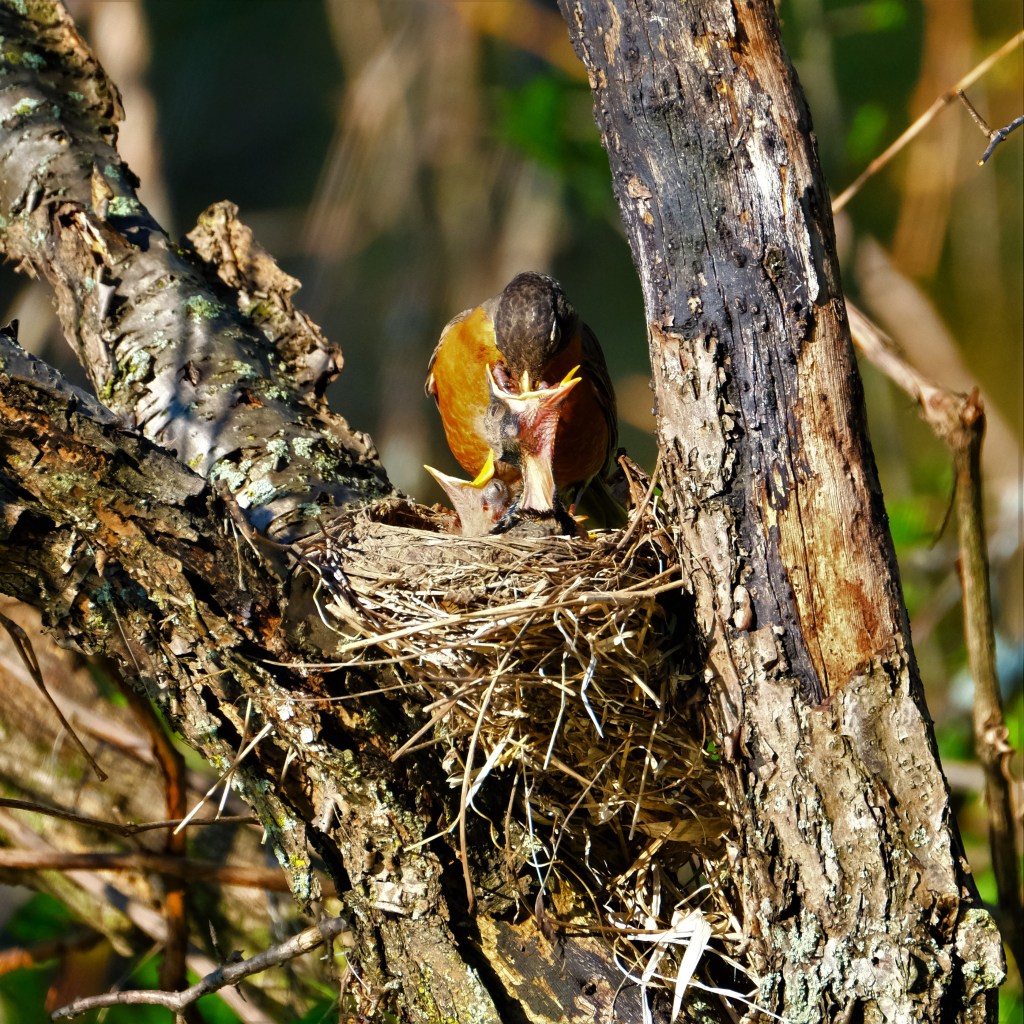
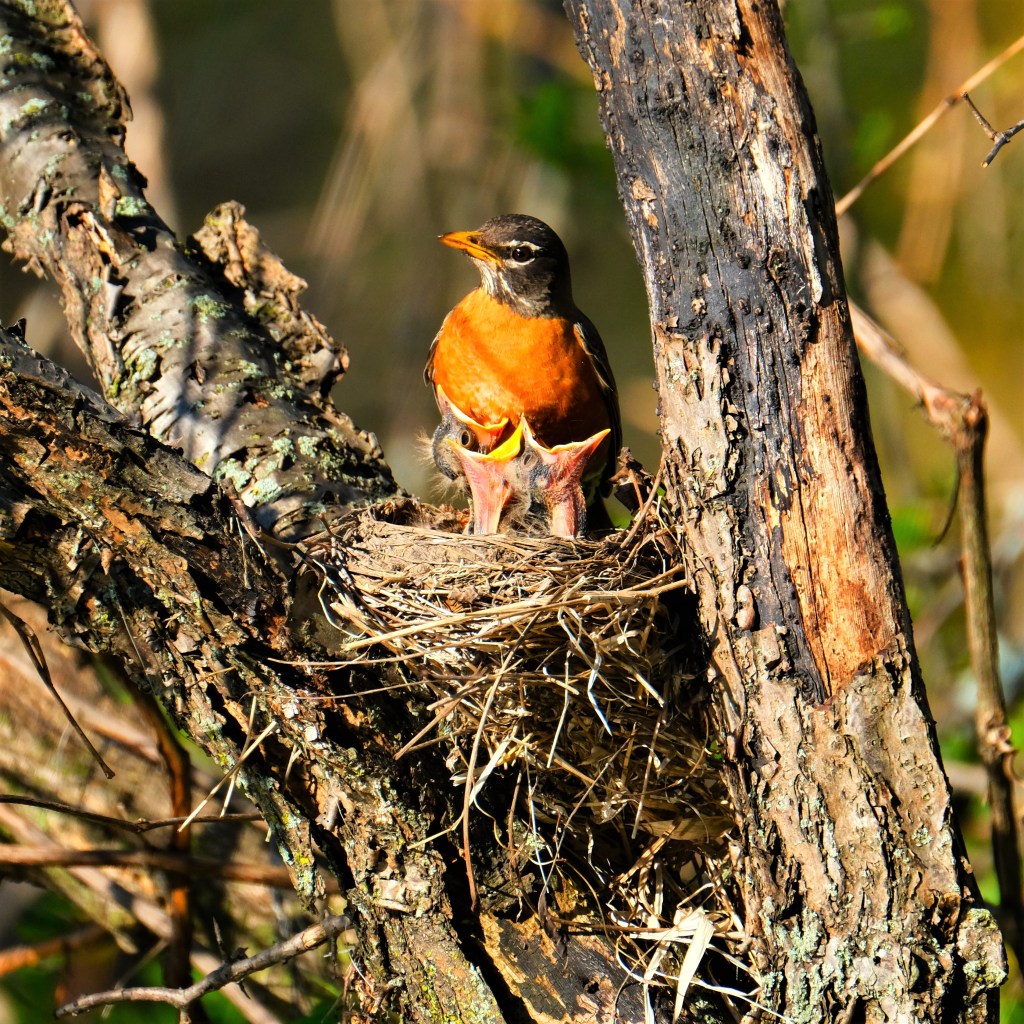
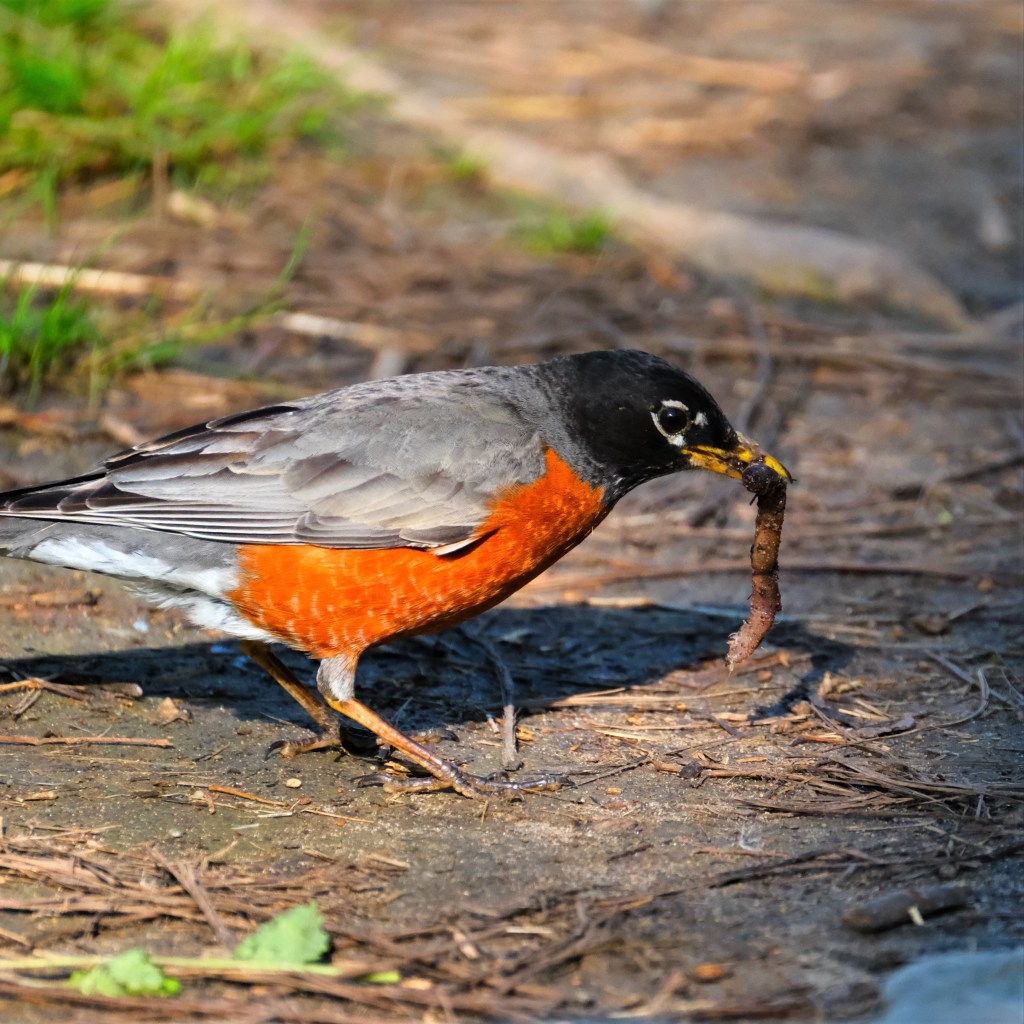
I finally captured a couple presentable images of the many American robins (Turdus migratorius) I see foraging together. Despite that “first robin of spring” phrase you may have heard, they are near the northern edge of their year-round range here. Maybe its just a Canadianism like “serviette” or “Smarties”, eh? Anyway, along with the more-skittish mourning doves, the robins like the steep, west-facing side of the bluff where moments of afternoon sun have mostly melted the snow to expose the fallen leaves amongst which tasty morsels can apparently be found.
Heck, even a black-capped chickadee (Poecile atricapillus) deigned to sit for a portrait, but my autofocus didn’t do such a great job. A pretty little nuthatch was not willing to be so accommodating.
I only saw mallards on the river today. No mergansers, no raptors, no black ducks, nothing new and exciting to report or show you, I am sad to say.
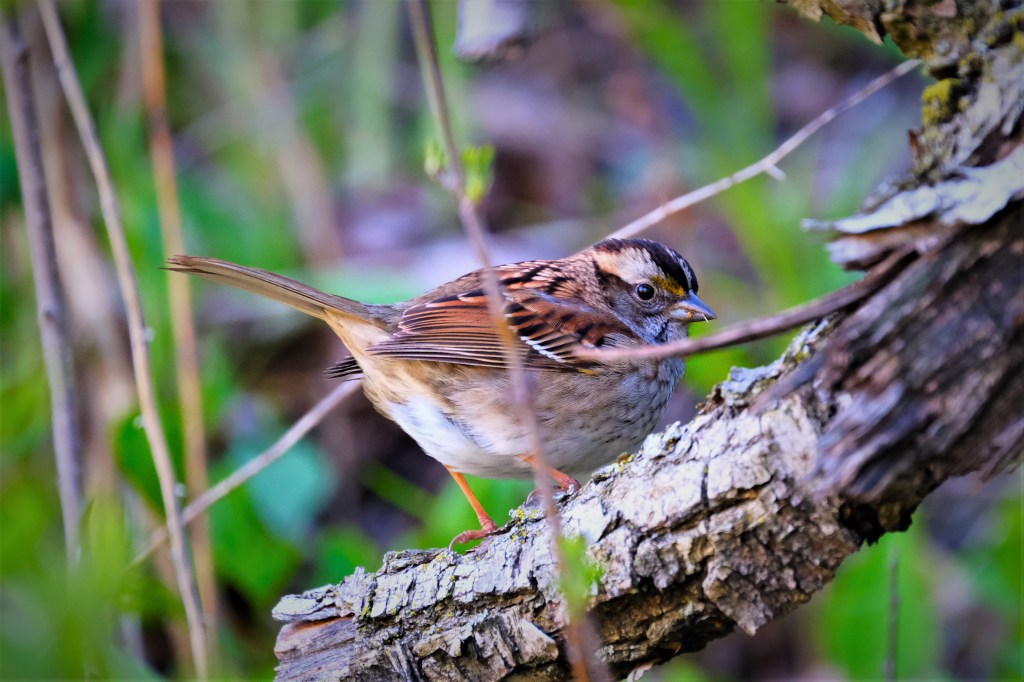
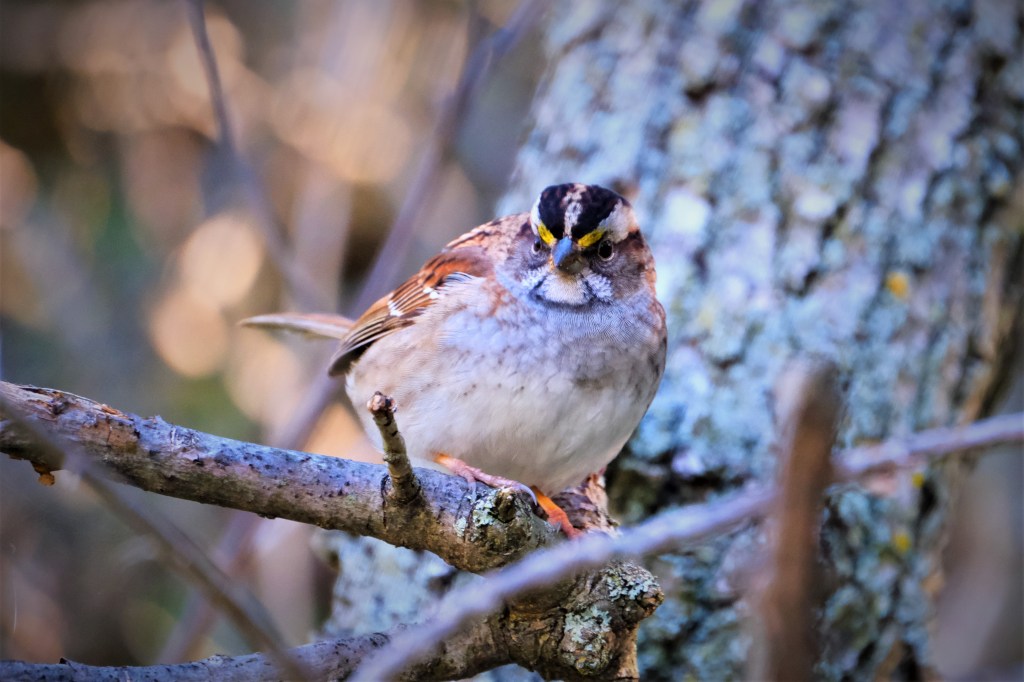
Finally, I swung by the pond, which is completely frozen over these days, and happened upon a few birds in a nearby tree that appear to be song sparrows (Melospiza melodia), as far as I can tell. At least they’ve got the characteristic course breast streaks and central spot. Plus someone was singing a pretty song all the while I struggled at my task.
And that’s it. That’s all I’ve got for you today. Maybe we’re entering the post-holiday slump.
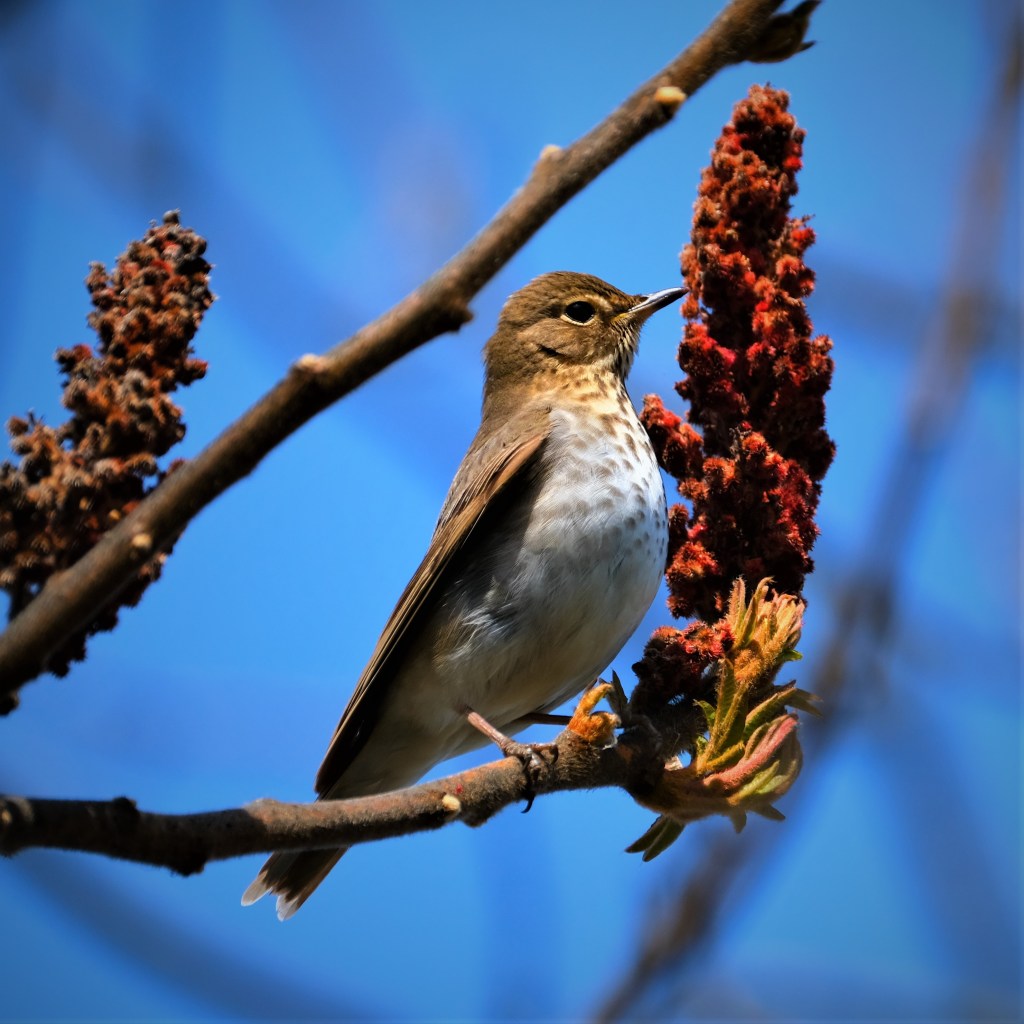
It was a surprisingly quite morning in Estabrook, nowhere near as cold as yesterday, but I still pretty much had the place to myself. Cool. I’d love to see more people out enjoying nature, but I’ll take the solitude when I can get it, too.
I finally almost caught a pair of ubiquitous and surprisingly skittish northern cardinals (Cardinalis cardinalis) feeding on the seeds of a staghorn sumac (Rhus typhina), but not quite. Can you imagine if they had deigned to look my way for a second? Add a blue sky, and we’d really be cooking with gas, right? Sigh, maybe next time.
The merlin is still around, and it apparently got stiff enough, waiting patiently in the top of a tall tree on an island in the river without the crows giving it a hard time as I hiked north all the way to Hampton and back, that it felt the need to stretch out. Pretty bird, eh?
Finally, the mergansers have moved on, at least for the moment, but the American black duck is still hiding in plain sight amongst the mallards. Clever bird, I’d say.
It was pretty cold this morning, with “real feel” temps in the mid teens, so the trail was in good shape, and I just about had it all to myself. The critters were keeping a low profile, and I didn’t see much more than a chickadee until I got to where the mallards hangout north of the falls. There, as I scanned the crowd for interlopers, I spotted one that looked darker than the rest.
American black duck in foreground with female mallard in background
Sure enough, it is an American black duck (Anas rubripes), which, as the good folks at the Cornell Lab of Ornithologyexplain, “hides in plain sight in shallow wetlands of eastern North America. They often flock with the ubiquitous Mallard, where they look quite similar to female Mallards. But take a second look through a group of brown ducks to notice the dark chocolate-brown flanks, pale grayish face, and olive-yellow bill of an American Black Duck.” Here’s another shot which is not quite as clear but shows off the pretty blue patch on its wing.
Anyway, as I was standing there on the shore, wondering if I was seeing something new or wasting my time and film while freezing my fingers and buns, just about all the mallards suddenly took flight, and it was such a stunning sight that I didn’t even think to take a picture. As I watched the spectacle unfold with my mouth agape, I saw the cause of all the commotion, an American bald eagle (Haliaeetus leucocephalus) gliding overhead, once again about even with the treetops. I guess a few dozen mallards in the air was not what it had in mind because it simply turned around and headed back north, and this is all I’ve got to show for it. If you squint, you can just make out the white tail and maybe even the white head.
Well, back in the here and now, the common mergansers were also back on the river, and this time there were four of them; three males and a female. “And furthermore Suzan, I wouldn’t be the least bit surprised to learn that all four of them habitually smoked marijuana cigarettes…” Just kidding. They don’t even have fingers, so that’s not very likely.
Well, there you have it. A cold-*ss day in January, and we get to add yet two more new species to our list. Who’d’ve thunk it? Certainly not me.
Well, the blue skies are long gone, but at least the ice cold temps have stuck around so the river trail is still nice and firm. As usual I startled the mourning doves from their recent favorite foraging spot on the ground near the abandoned railroad bridge abutment south of the falls, and they decamped to this branch across the river. Today I counted 10 of them in the tree, and these three were the most presentable.
I probably hadn’t gotten 50 feet further north, just past the abutment, when I spotted this little guy quite intent on finishing his lunch. Yup, that’s a muskrat alright, and maybe even the same one we saw at the pond last summer.
He did briefly duck under the ice, swim about 20 feet down river, hung out for maybe a minute, and then swam right back to where I first saw him. That must be some tasty lunch!
As super good luck would have it, long-time readers Dan and Emma just happened to come by, so they got to see today’s hero, too. I told them they are now my witnesses that I really am seeing at least some of the amazing sights I’m always telling you about.
Anyway, I continued north and got to see a crow seeming to checking out what the mallards are all chowing down.
Then, as I approached the Port Washington Road bridge at the north end, there were three crows making a ruckus in a tree over the trail. Last summer, I was surprised to learn how skittish crows are in the wild, so when these three just kept cawing away like crazy as I approached their tree, I gave the whole scene a closer look. Holy Moly, I’m sure glad I did!
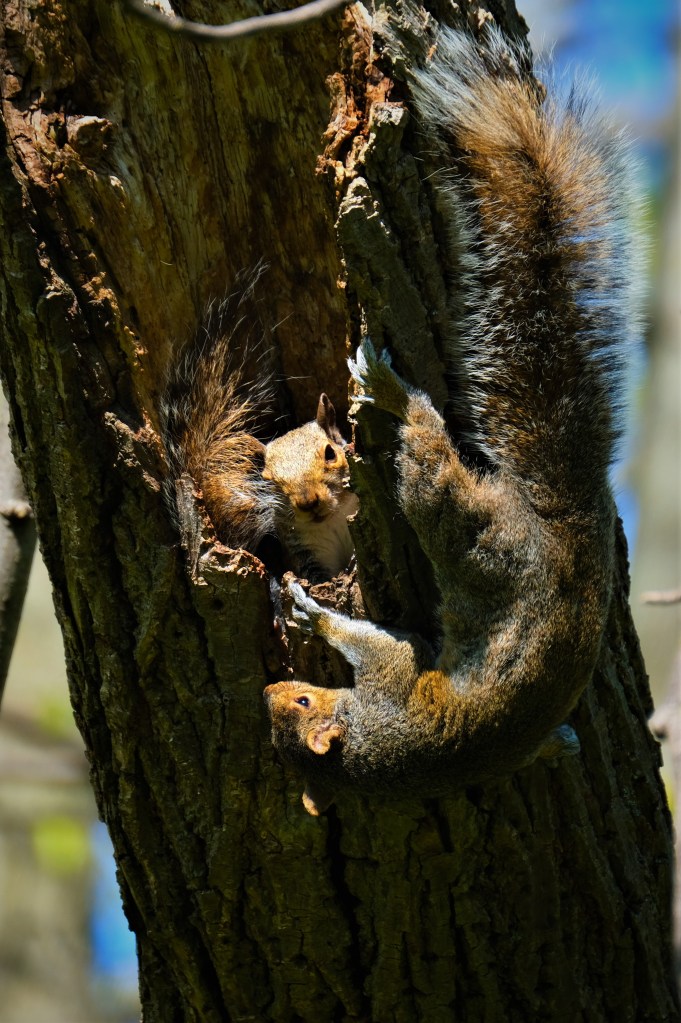
The red tail pretty much gives it away, don’t you think? As you can see, given the choice between posing for my camera or leaving that squirrel behind, it chose to pose and pose and pose. Too bad about that blue sky, eh? I wonder if those were the same three crows hassling the merlin just yesterday?
After all that excitement, I headed back south, toward the mallards, and took advantage of them hanging out on the east side of the river for the first time I’ve observered.
I wonder what it was that caused just about everybody I saw to be much more willing to sit still for my camera today than they have been heretofore. Maybe it was just my lucky day, eh?
What an absolutely gorgeous morning in Estabrook Park! The sun was finally out, and the sky was breathtakingly blue. Plus, it had been nice and cold yet again overnight so the snow and ice on the trail were nice and crunchy. I can’t believe my continued good luck.
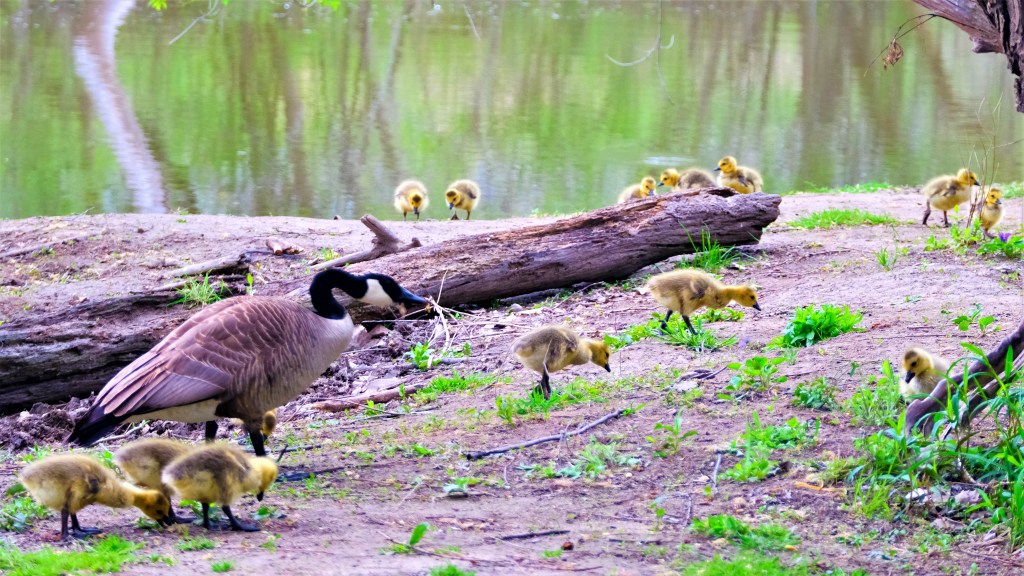
The mallards were at their usual spot, on the river just above the falls, and this morning they were joined by several familiar guests, some Canada geese and a red-breasted merganser, both of whom we saw a lot of on the pond last summer.
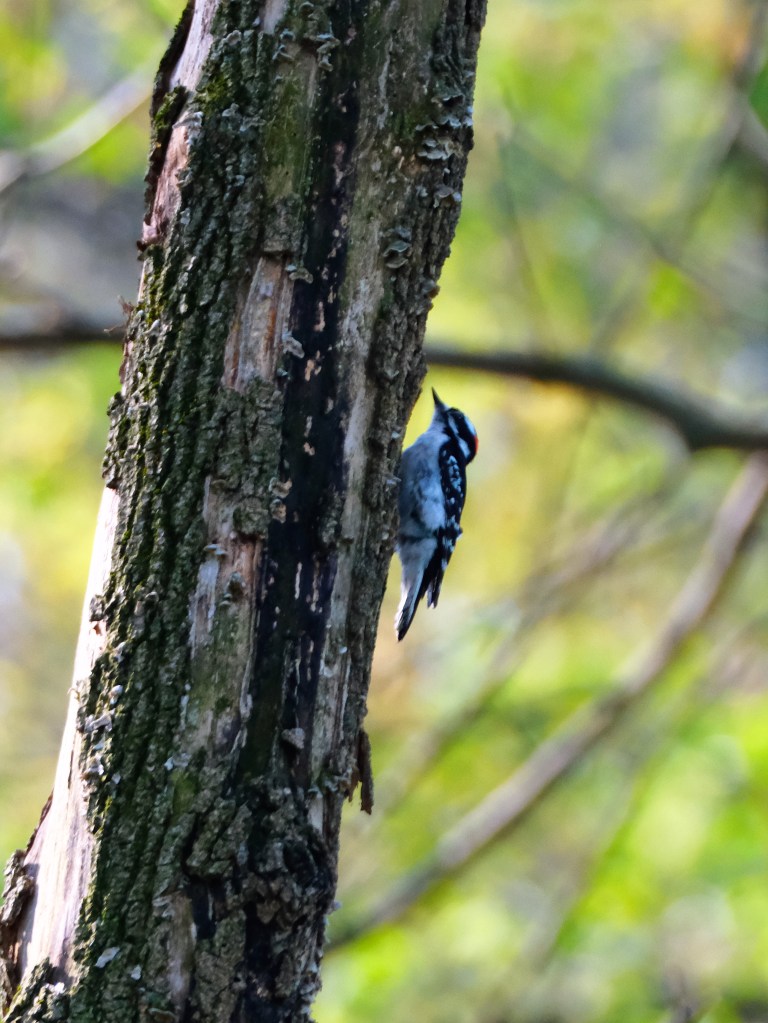
After all that excitement, it was nice to finally have an opportunity to get some pretty images of woodpeckers that have been keeping me company on the river trail all winter. Here’s a red-bellied and a female downy, as far as I can tell, intently looking for their lunches.
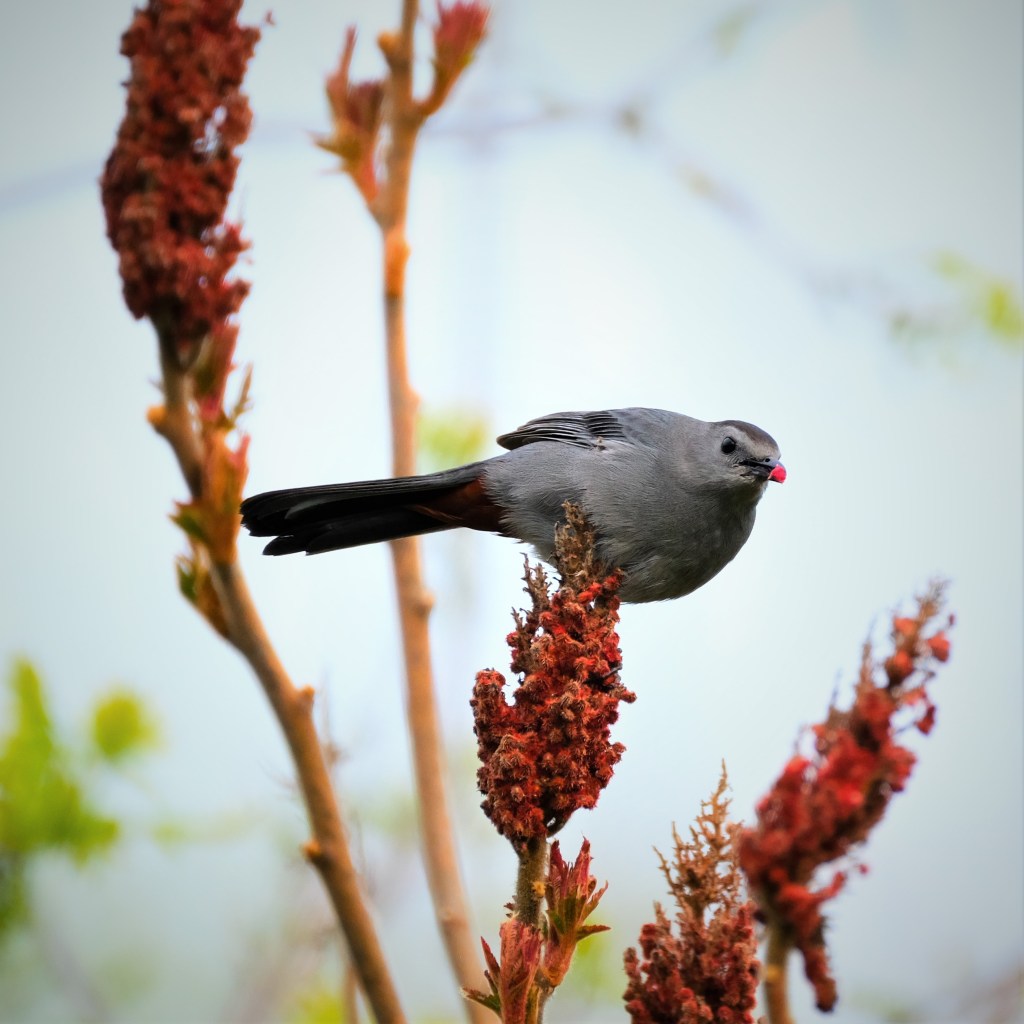
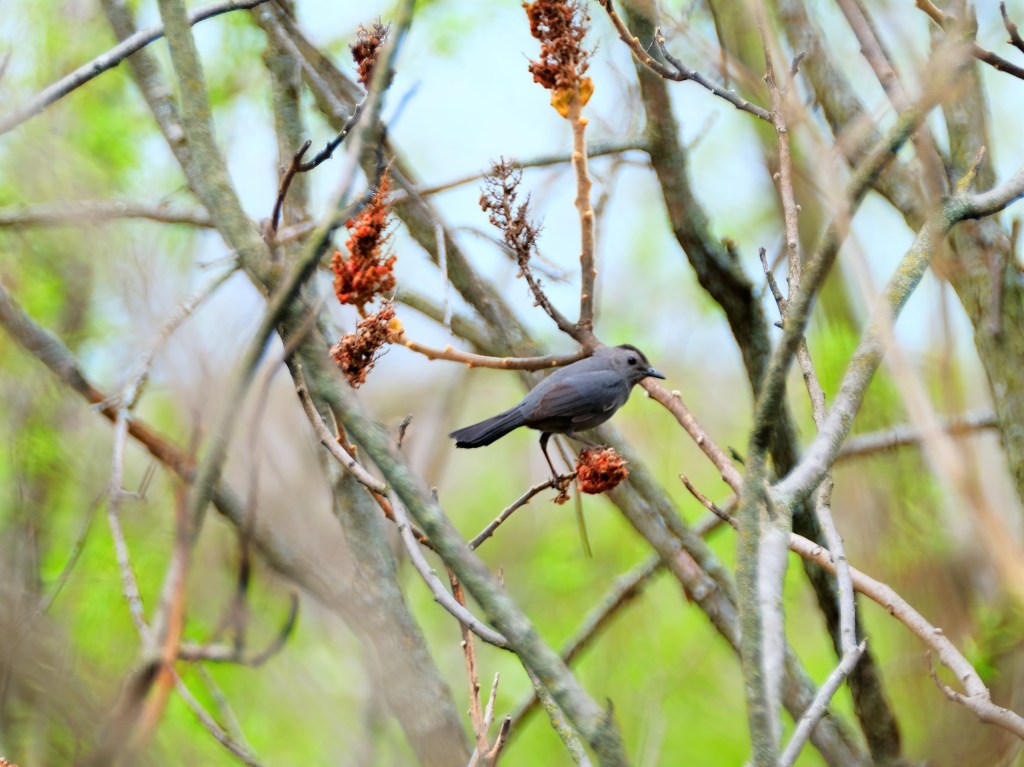
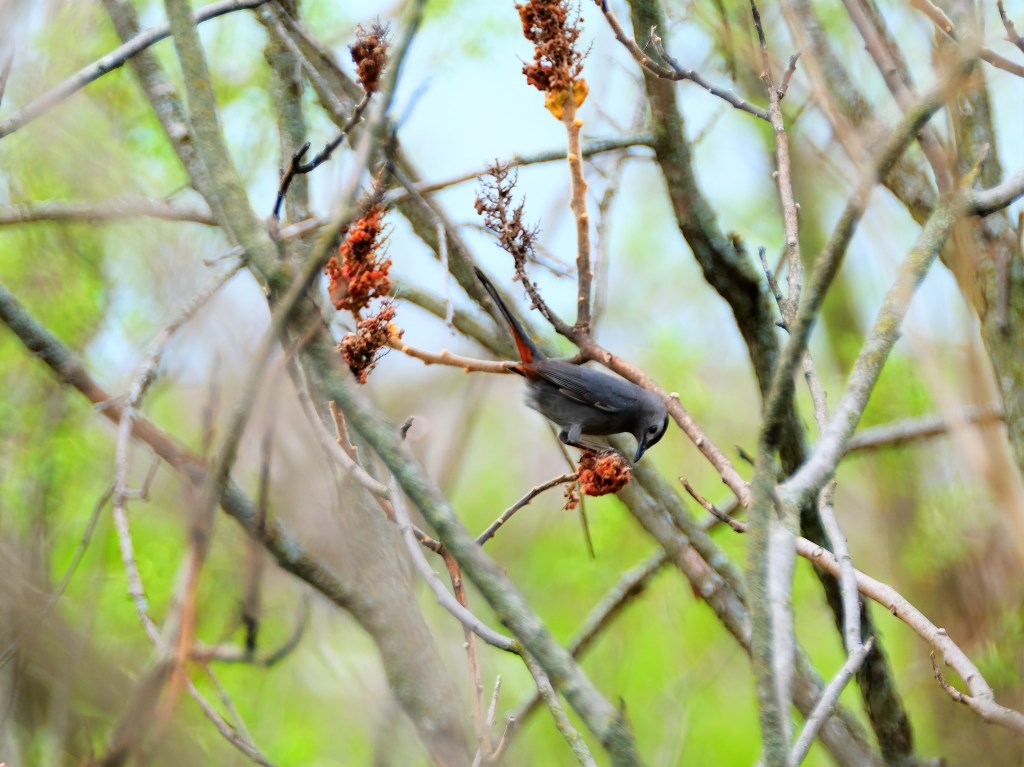
Last, and perhaps most surprising, is this little cutie, who appears for all the world to be a gray catbird, complete with “a darker cap and cinnamon under the tail”, way outside its winter range.
It continues to dip below freezing at night, so the snow is sticking around nicely and the trail along the river continues to be nice and firm in the morning. I saw no new critters to report today, but the mallards were back in their regular place, just above the falls, and showing off a trick that I have not seen them perform before: diving completely under the water for food.
I had to use my phone for the video because some knucklehead forgot to put the memory chip back into my camera, but it still came out not too bad.
So there you have it. Right there on the Milwaukee River in Estabrook Park on January 7, 2021, the conditions were just right to induce a raft of Mallards to resort to this rare and magical behavior.
Speaking of rare and magical behavior, Anne and I did finally get to catch a glimpse of the busted remains of The Great Conjunction of 2020. It has been cloudy around here in the evening since well before December 21, the moment of “their closest encounter since 1623“, until Tuesday evening. Unfortunately, in the 15 days since the 21st, they have already moved back apart quite a bit and gotten closer to the horizon, so the viewing was not great, and I didn’t even try to take any pictures. Nevertheless, it was still cool to see, and by the time we have grandkids to tell about it, we will remember it as the most amazing thing ever.