It really is right on the Lake Geneva shoreline, and there were no fires today, thank goodness, but that song is seriously stuck in my head right now.
Since we’re sitting in a train for much of today, here are some pictures from our excursion to the other end of Lake Geneva yesterday afternoon. Nearly as soon as we reached the aforementioned shoreline, look who was there to greet us, the fanciest great cormorant I have yet to see.
From Montreux, we hiked along the water to Chillon Castle, and we walked right under this rook’s actual rookery on the way. Besides the nest in the bottom of the picture, there were about another half dozen in the top of that tree along with about a dozen other rooks.
Closer to the water, here’s a pretty little grey wagtail.
There were a few vineyards that came right down to the path along the water, and they were popular with the common chaffinches, of which here is one.
Finally, here’s a black-headed gull out on the water.
Tomorrow morning, I hope to have a nice outing in or around Metz, so wish me luck!
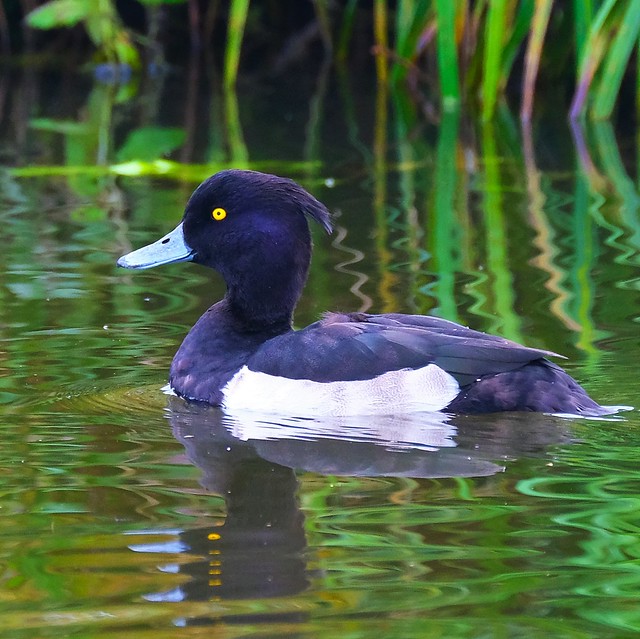
If you recognized the tufted duck in yesterday’s post and then guessed “Europe,” you were correct! Please wait six to eight weeks for your prize to arrive.
In any case, the particular spot in Europe to which Anne has dragged me this time is Geneva, Switzerland, and I am sad to say that I have yet to see a tufted duck. Instead, check out this handsome drake, my very first red-crested pochard (Netta rufina). Yowzah, eh? There were also a few mallards and a bunch of common mergansers on Lake Geneva, but I was a little surprised that this was the only other “duck” I’ve seen so far.
There was also this one common sandpiper, …
a female blackbird, …
a treecreeper, but I’m not sure yet if it’s of the short-toed or Eurasian variety, …
and a whole bunch of great crested grebes. Long-time readers should recognize these last four from my time in South Holland.
Tomorrow we’ll take the train up to Metz, France to meet some relatives. I’ve never been there, but I bet it’ll be nice, and if I find anything pretty or interesting, I’ll be sure to let you know.
But I do know exactly when I’ll be back again. Anne’s been off with her sister visiting their niece for a week, and when you read this, I’ll be just about there to join them for a few days. Instead of simply saying where, here’s a picture of a duck I hope to see. Can you guess where?
With any luck, I’ll have some current local pictures to show you tomorrow.
Flickr was having problems this afternoon, so if the pictures don’t come through, wait a while and try again later. That’s what I had to do just to get them into this post.
After the crazy warm-up yesterday afternoon, some normality has returned to the weather this morning, but before it did, I got to see our first turtle of the year, this painted turtle sunning itself at the pond. Woo hoo!
This morning was back to cloudy, cool, and windy, however, so here’s a fox sparrow staying out of the wind beside the river. We’ve had one by the pond for much of the winter, but I believe this and a few of its comrades are all new arrivals.
Farther upstream, near the two islands, the belted kingfisher that I’d been hearing and glimpsing for a few weeks finally sat still long enough for a picture. Maybe this time he’ll stick around.
Finally, I’d like to send a special thanks to Gene, who cleaned up and refurbished the wood duck nesting boxes I had collected from the island, back when the pond ice was thick. They had fallen to the ground and weren’t going to do the wood ducks any good. He brought his canoe and a bunch of tools to the pond yesterday afternoon, and we reinstalled the boxes back on the island. Phew! That was a job. Here’s hoping we get some wood duck ducklings on the pond this summer!
We had a gorgeous March morning for our weekly wildlife walk in Estabrook Park. The wind was blowing pretty good, but the temps were mild, and the sun was out, so it was very comfortable. After hitting the pond, which was pretty quiet, we headed down to the river, and the first great sight of the day was our first northern flicker of the year. “Welcome back, you handsome devil!”
The surprises continued once we got upstream of the falls, and here’s a pair of ring-necked ducks between the islands. After seeing my first drake in the park just on Friday, I can’t believe that I got to see my first pair so soon after.
Just on the other side of the upstream island, our first bufflehead of the month, and only our second of the winter, hopped up onto this rock, preened for a bit, and then appeared to settle down for a nap. “Rest up, Buddy. You’ve got a long flight ahead of you!”
Just as we were about to wrap up our walk and were back up on the bluff, look who soared overhead, a mature bald eagle. Woo hoo, and right on cue!
After the walkers headed off, I hiked back down to the river, and I arrived just in time to see a pair of geese land on top of the abandoned bridge abutment across the river. It’s not often that I get to take a picture of a stationary goose with blue sky in the background.
I see that the winds are supposed to be out of the north overnight, so we might not get any new arrivals, but I should have another day to search for ones that are already here and now waiting for favorable winds to return. Wish me luck!
There were also plenty of red-breasted mergansers in the lagoon, a few common goldeneyes, and even a couple of redheads, but we’ve seen plenty of the former, and the latter evaded me today, so here’s a pretty, male house finch I found watching the sun rise as I waited for the rest of the group to arrive.
Once the gang assembled, and we started making our way around the park, the first big surprise was spotting this snow bunting, only my second ever, and the first one close enough for us to determine that she’s a “nonbreeding female.”
That sighting was worth celebrating, and this guy got it!
But wait, there’s more! Plenty of gulls were resting on the ice that still covers much of the lagoon, but when I checked, all I could see were herring gulls. As we neared the end of the loop, I asked if anyone had seen anything else, and a birder with far more skill than me, and even works for Audubon, casually mentioned the young glaucous gull (Larus hyperboreus) right in front of us. Ha!
Then it was time for everyone to get on with their day, and I headed back to the north end where I had locked my bike, and on my way, I finally got a nice portrait of one of the dozens of song sparrows we had seen. When I was in Estabrook yesterday, I counted eight, including my first for the year, and it seemed as though a basket of them had been dumped in the park overnight, but that was nothing compared to the multitude we saw along the lakefront. I’ve seen this type of mass arrival before with white-throated sparrows, but this is the first time I’ve seen song sparrows do the same. Live and learn, eh? In any case, “Welcome back, sweeties!”
The forecast for tomorrow calls for more clear skies, much warmer temps than this morning, and a stiff breeze out of the southwest, so it should be a good time to see if anyone new rode that breeze into town. Join us at the beer garden parking lot at 8 for our weekly wildlife walk if you can.
I wrote this yesterday morning, but I somehow failed to publish it, and I only just found it now. Ugh!
The first line of thunderstorms has now rolled through, so the fog has thinned out a bit, but boy, it sure was thick earlier this morning.
As luck would have it, our latest visitor chose today to stop in and pay us a visit, but even the thick fog couldn’t hide that fancy pattern on his bill, which marks him as our first ring-necked duck of the year. I see them from time to time in Connecticut, but I’ve only ever seen them twice before in Estabrook, and both times they were hens, so this is our first drake in the park. Woo hoo!
Soon after that, the rain started in earnest, so I hurried home in hopes of getting not much wetter than I already was.
I see that tomorrow is forecast to deliver more of the same, but this gloomy weather can’t last forever, can it?
Well, we got our wish, assuming you had your fingers crossed as I did mine, and the rain mostly held off this morning. But you know the old saying, “be careful what you wish for.” Instead of falling as rain, the moisture stayed in the air, and we’ve been enjoying a crazy thick fog ever since the sun began its vain attempt to burn through it.
Luckily, there were still birds on the river, so I could keep my lens pointed below the horizon, in hopes of keeping it dry, and here’s the one goldeneye drake I saw today. There were also two hens upstream, but maybe they’re avoiding him.
Just beyond the goldeneye, I found this common merganser hen, up on one of the little patches of ice that still remain.
The big surprise of the morning, however, was this hooded merganser drake, who also happened to be the most skittish of the three. We’ve only seen hoodies in Estabrook once so far this year, and I sure hope this won’t be our last sighting.
Around the islands, along with the geese jockeying for nesting sites and mallards filling their bellies, there was a small gathering of gulls. Here’s one of the two herring gulls, with its conspicuously pink legs and feet.
And here’s a pair of aptly named ring-billed gulls, with black rings on the ends of their bills, of course, but also quite yellow legs and feet.
Lastly, the big surprise around the islands was not only that there were fourteen common mergansers, which I probably have seen before, but also that they all congregated so closely together that I could get a picture of thirteen of them. That also might be the most drakes I’ve seen together in the park.
As crazy as today’s weather has been, the fog is forecast to continue through the night and into tomorrow morning. At this point, I don’t even know what I’d dare wishing for.
We had a nearly perfect March morning in Estabrook Park today. The sky was clear, the air was still, and it froze overnight but temps were quickly on their way to the 40s, which I hear is good for making the sap flow. Anyway, sorry about missing yesterday. I had a string of non-park activities in the morning, didn’t get into Estabrook until midafternoon, and I was just too tired by the time I got back home to write anything up.
It was a bit gloomy yesterday afternoon, but I did manage one nice picture, of this red-breasted merganser drake on the river below what’s left of the falls.
The biggest treat of this morning, besides the weather itself, was spotting my first daffodil shoots of the season beside the river path and upstream of the islands, where the side of the bluff faces south.
I found another Cooper’s hawk today, but this one let me have only one shot, with a stick right across its face, but at least you can see that gorgeous yellow eye.
There were no new sights at the islands or the pond, but I did get a pretty nice hairy woodpecker at the far south end.
The forecast for tomorrow calls for showers all morning, but the precipitation amounts are pretty low, so maybe I’ll be able to sneak some pictures between the rain drops. Keep your fingers crossed!
It was another wonderful morning in Estabrook Park but in a very different way than yesterday. Instead of fresh snow, we had blue skies and bright sunshine. The skies were so clear, in fact, that there was enough light for me to venture into the park before 6:30 am, for the first time this year. Woo hoo!
Thus, I was able to check the whole river and even swing by the pond before our wildlife walkers started to arrive. Just as I headed to the beer garden parking lot, I found my first grackle at the pond for the year.
We had a nice turnout for our walk, and two folks claimed to be trying a group walk for the first time. What an honor that they chose ours! Meanwhile, one of our regulars had spotted a bald eagle over the river on their way in, so we set out in search of that first.
Along the way, we heard this guy, a red-bellied woodpecker, despite his red cap, announcing the availability of his new nesting cavity. “Good luck, Buddy!” Sure, I would have preferred to capture him looking our way, but I got my first good look at the back of his head instead, and I never knew they had such a ducktail going on back there.
Happily, we did get to see an eagle over the far riverbank by the islands. It was alone this time, so I can’t tell if this is the male or the female, but it was a nice treat for our newcomers either way.
Finally, since my recent picture count rollercoaster continues with another trough, here’s one more look at yesterday’s Oregon-type dark-eyed junco, but from the side this time.
I see that the blue skies are forecast to disappear by tomorrow morning, but so is the wind, so we’ll see soon enough if that deepens my picture trough or pulls me out of it. I did get a glimpse of my first chipmunk of the year, and maybe tomorrow it won’t be so shy.