It was a big last day at the vet clinic today, and I am both thrilled to have had the opportunity to participate and thrilled that that part of the trip is finished. Tomorrow we’re going on a boat ride around the island to see what there is to see.
Before we get out of town, however, here are a few more sights to be seen in the harbor just a few steps from our hostel. First, we have one of the many magnificent frigatebird that come to visit the harbor.
Next, we have one of three Elliot’s storm-petrels (Oceanites gracilis) we’ve seen fishing on the harbor for the last three days. They are one of the smallest seabirds, and their legs do a meager job of supporting them on land.
Finally, we have brown pelicans, whom we’ve seen before, but never quite this close.
That’s a wrap for today, and we have one more day in the clinic till we are set free to explore the island further. In the meantime, I’m sure I’ll come up with something for you.
Today was the first day of working at the WorldVets clinic here in town, and my job was cleaning the surgical instruments after use, packing them up into specific kits, and sterilizing those kits in an autoclave. It was a long day and we did our best to help reduce the number of feral animals threatening the endemic local critters.
Before breakfast, however, my sister and I hit the waterfront again, and this time we found this darling little semipalmated plover. You may recall that we just saw one in New Haven harbor, but this one let us have a much better look.
Yesterday, before we got to work, we all took a short tour of the island, and the first stop was Galapaguera de Cerro Colorado, a reserve for the Galápagos giant tortoise (Chelonoidis niger), specifically the chathamensis subspecies, which has “a wide, black shell, its shape intermediate between the saddle-backed and domed subspecies.” They are just as enormous as advertised and surprisingly active.
From there, we headed to the beach at Puerto Chino, and while Deb and I were searching for exotic and rare species, a pair of American oystercatchers flew in and began strutting around on the beach. This is another species we just saw in New Haven, where they really kept their distance. Here, on the other hand, I couldn’t back up fast enough to get the whole bird in the frame.
Finally, we stopped at the Biologial Reserve Of San Cristóbal to visit the Laguna El Junco in the caldera of a long-extinct volcano. It was mostly fogged/clouded in, which creates a unique biome, but doesn’t lend itself to spotting wildlife. As crazy luck would have it, though, on the climb back out of the caldera, I spotted this little cutie on the side of the trail. I had just joked a couple days ago with Deb about there being a “warbler-finch” here, and lo and behold, here it was, the grey warbler-finch (Certhidea fusca).
Lastly, I did manage a butterfly picture back at the beach, and this tiny creature turns out to be a Ramon blue (Hemiargus ramon).
Okay. Now it’s late, you’re probably asleep already, and I wish I was, so I’m gonna stick a fork in this post and hit the sack.
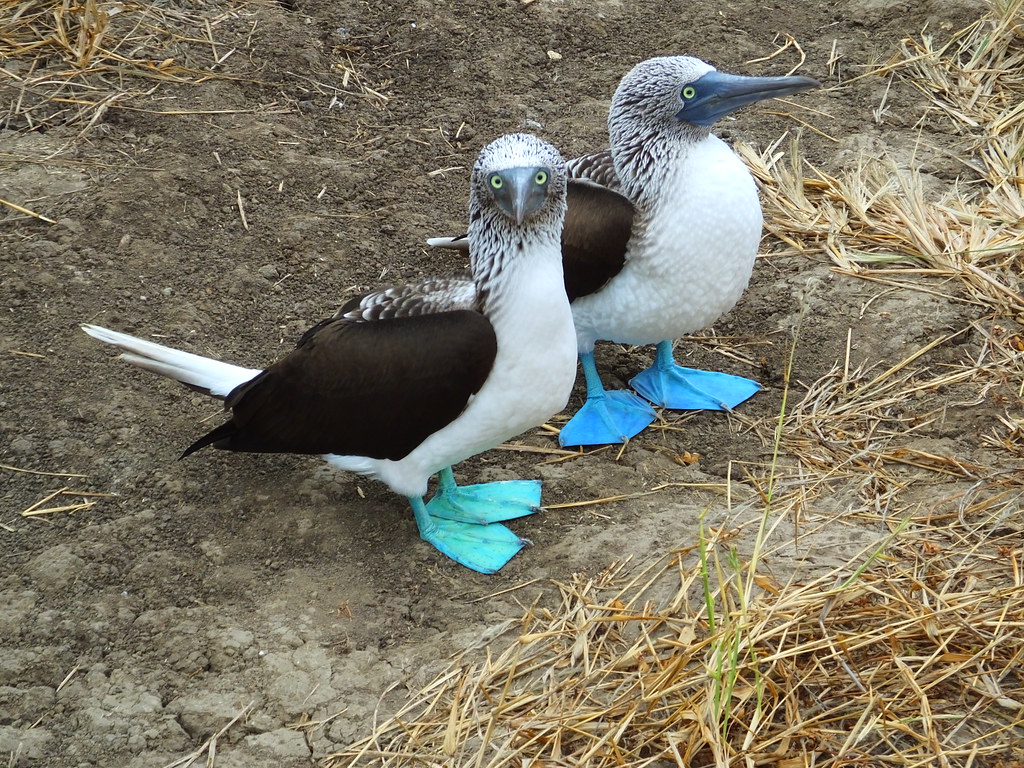
As promised, we have blue-footed boobies here, and this one is on break from fishing in the harbor. I was tempted to make a booby joke, but I’ve opted not to stoop so low, for once.
Less flashy, perhaps, but no less surprising in appearance is the lava gull (Leucophaeus fuliginosus), which are almost the same color, by some odd coincidence, as the lava heron I showed you yesterday. They are supposed to be the only gull with all dark plumage, and they are “endemic to Galápagos,” so there’s that.
Another creature “found only on the Galápagos Islands,” is the marine iguana (Amblyrhynchus cristatus). Like the sea lions I mentioned yesterday and many of the birds here, they seem totally unconcerned by people and lounge all along the waterfront here in town.
That’s gonna be it for fun and games for a while. Tomorrow we all start working at the nearby veterinary clinic, and I learned today that my responsibility will be cleaning, sorting, and sterilizing the surgical instruments. I’ve still got plenty of pictures to keep sending you daily posts, but wish me luck in my new role tomorrow.
Deb and I did both arrive safely on San Cristóbal Island in the Galapagos archipelago this morning, though my trip was less stressful than Deb’s. She had a seven-hour delay in Fort Lauderdale yesterday, but we had built enough buffer into our schedule to absorb that, thank goodness.
Once we arrived, we got right to work on seeing who we could find, and this little darling, a mangrove yellow warbler (Setophaga petechia), didn’t even wait until we had finished our lunch before starting the show. I’ve seen them before, in Belize, but I don’t believe I’ve had a picture to show you until now, so ta da!
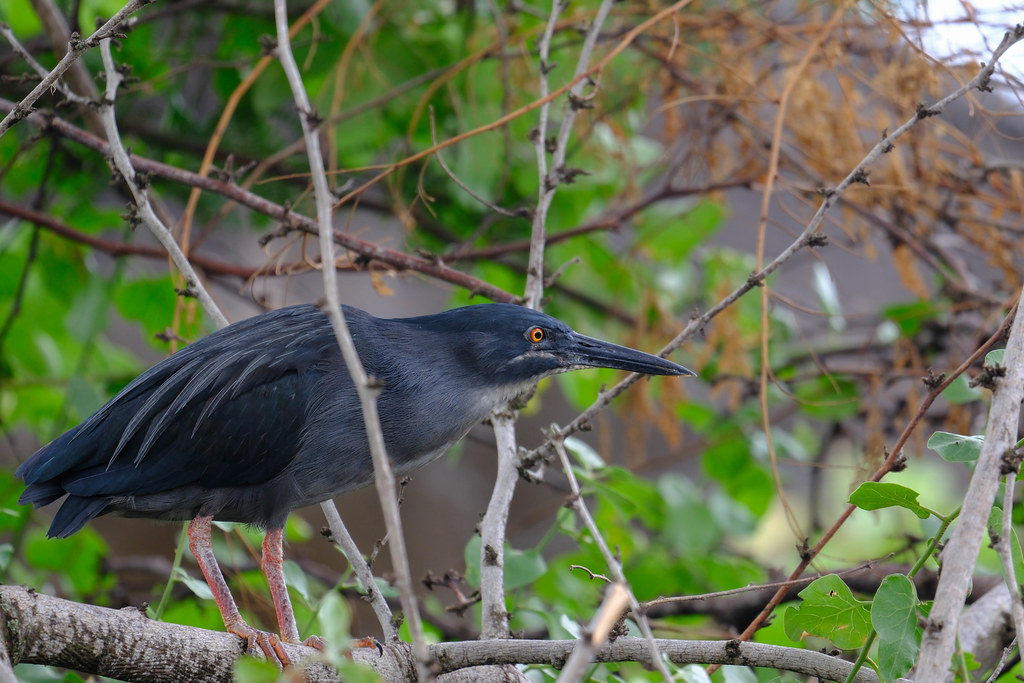
This next bird looks just like the green herons we see in Estabrook, but just a lot darker, and that makes it our very first lava heron (Butorides sundevalli), whose range does not extend beyond these islands. Wow!
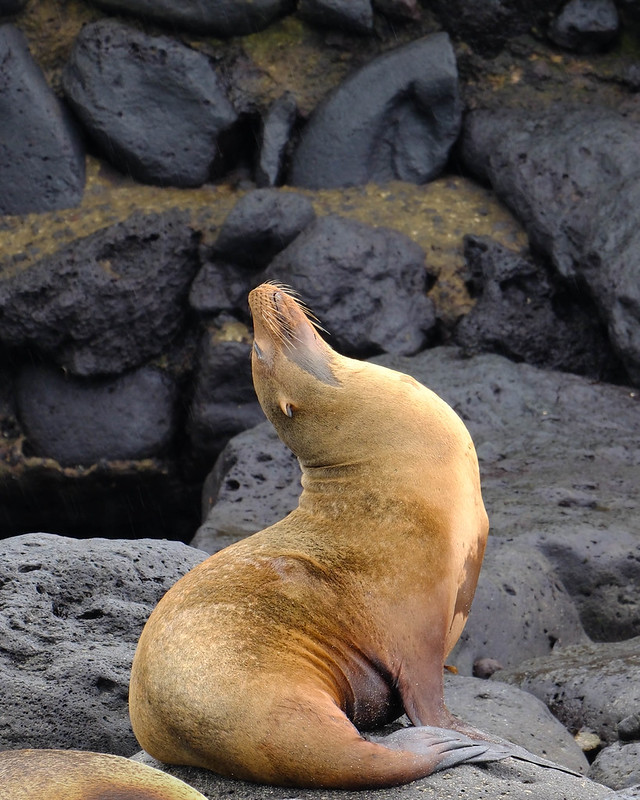
There are sea lions everywhere, on the beach, on the rocks, on the sidewalk, and even on the park benches. It is really wild. Here’s one on the beach who stayed in this pose long enough to make me think it was sleeping that way.
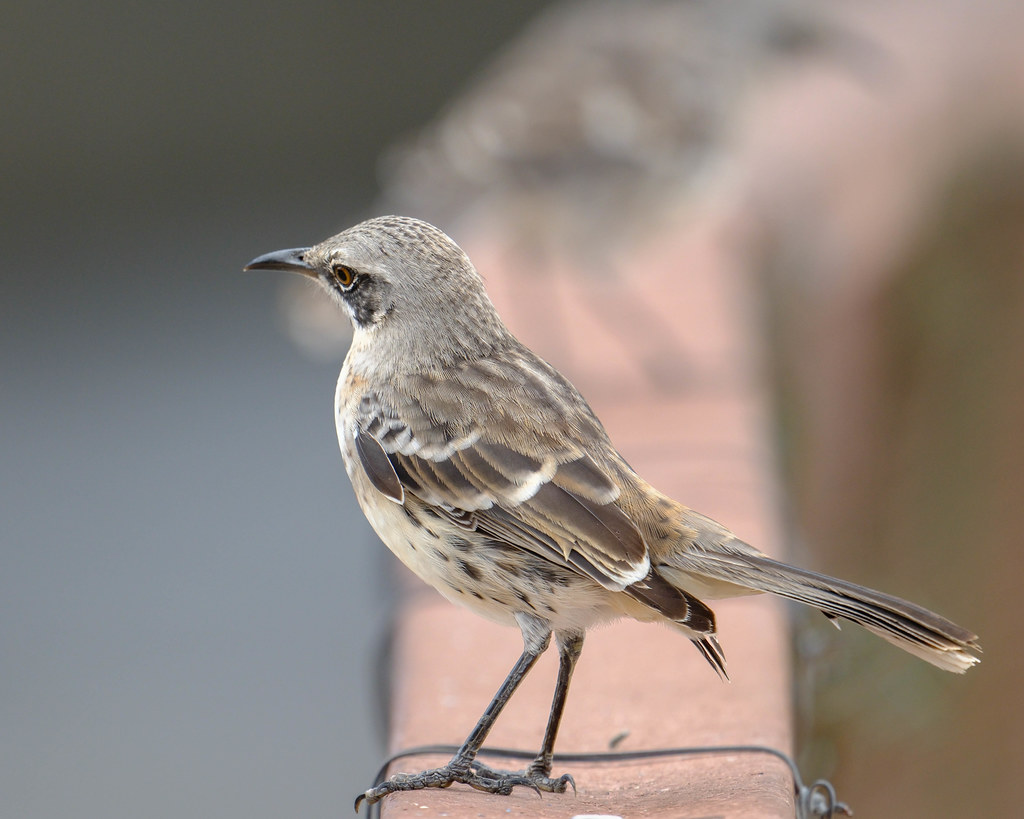
The sea lions and their pups make quite a racket, too, and they sound like goats and lambs, which really gives the place a barnyard or even petting zoo vibe. The noisiest bird, however, was this San Cristobal Mockingbird (Mimus melanotis). It is “endemic to Galápagos, [and] found only on San Cristóbal Island.” Yikes! That has got to be the smallest range of any bird I’ve ever seen.
Finally, I did see a couple of dragon flies and a couple of small blue butterflies, but none of them would sit for a picture. Happily, the rocks along the water were literally crawling with crabs, and some of them were this remarkably colored Sally Lightfoot crab (Grapsus grapsus), “one of the most common crabs along the western coast of the Americas.” Talk about extremes, eh?
I’ve got more to show, but it’s late already, and who knows what, if anything, we’ll see tomorrow, so I’ll just keep those in reserve for now.
Now that I’m waiting at my gate in Chicago, I’ve got some time to tap this out with my two thumbs. Any spelling or grammatical errors are strictly their fault.
As I mentioned yesterday, my sister is dragging me to San Cristobal in the Galapagos islands. This will be the first visit for the both of us, but we have been to Ecuador before.
Back in 2017, before this whole Estabrook project got started, Anne had research to do in Ecuador, so we spent the summer in fabulous Quito, the capital. While we were there, both my sisters came for a visit, and when a stop in the Galapagos became impractical, Anne suggested we try Isla de la Plata, the “poor man’s Galapagos.” Instead of an hour forty-five flight, it’s just a short speedboat ride from the mainland.
So, that’s what we did, and here is some of the spectacular wildlife we saw.
First up is the amazing blue-footed booby. There were several just standing around on the ground, and a couple of times we even got to skirt around them as we strolled down the trail.
Then there were nesting magnificent frigatebirds, and that adjective is actually part of their name, not an editorial judgement on my part.
Finally, for the avian world, we saw one long-tailed mockingbird, which might not be what you would call “magnificent”, but is no less wonderful, I’m sure.
If you’re wondering to yourself, “they took a boat ride at the equator, where’s the sealife?” Well, here you go. There were enormous sea turtles in the water around the island, and here’s one of them.
Finally, we got to see a few whales on the ride to and from the island, and my sister Deb scored a home run when she snapped this pic witb her cell phone. What a sight, eh?
So, now we’re gonna go and see if a real Galapagos island can beat that. I’ve packed my camera, and I’ll do my best to keep you posted.
Oof! It’s been a day. You’ll be stunned to learn that I’m taking off again first thing tomorrow morning, so I had a ton of things to get done today, and I suspect that I haven’t adulted like this since before the pandemic.
Anyway, I did get into Estabrook this morning, and the weather was quite nice. Even better, we had a few new warblers, mostly beside the river at the north end, and here’s a female or immature Blackpoll warbler.
This Swainson’s thrush caught me by surprise, not only for perching out in the open like this, but also for standing there long enough for me to bring my camera to my eye, adjust a setting or two, and get this nice picture. “Thanks, Darlin’!”
This female or immature magnolia warbler, on the other hand, was behaving the way most of the birds were this morning: frantically darting around in a leafy tree hunting for bugs.
This little cutie was also in and out of leafy trees more than I would have expected from an eastern wood-pewee, so I thought maybe it was a least flycatcher instead, but I was mistaken. An eastern wood-pewee it is.
There were several American redstarts, but they are about as flighty as they come, so I was thrilled to catch this one.
In what’s left of the weeds beside the soccer fields at the south end, the common yellowthroat I’ve been hearing and glimpsing for a few days finally relented and let me have a quick look, although he did manage to obscure his namesake yellow throat behind a leaf. Ah well. We take what we can get, right?
Finally, there are still plenty of monarchs around, and here’s one topping up on some goldenrod not far from the yellowthroat.
The thunderstorms had finished rolling through by sunrise this morning, so I was able to get out earlier than I had expected.
My first treat came very early, as I was crossing Wilson Dr, when I heard the call of a peregrine falcon high overhead. Happily, it wasn’t going anywhere fast, and I was able to catch sight of it as it glided in for a landing on the WITI TV tower at the far south end of the park. Then, it was kind enough to hang out while I hustled around to the west side, where it had landed, and it even put on a bit of a show with its wings out in the breeze. “Thanks, Sweet Pea!”
My next surprise came at the pond, where I found this dejected-looking solitary sandpiper resting on a log. I read that they are mostly night migrators, so perhaps it was grounded by last night’s storms and is now just resting up to try again tonight.
It wasn’t so much of a surprise to see this green heron, since we’ve been seeing plenty of them lately, but it was a treat that it flew in to perch so close while I was working on the best sandpiper picture I could muster.
I did see at least one warbler, but it was quite shy, and my pictures are barely good enough for an ID, so let’s just skip straight to the bugs. Here’s a cabbage white butterfly sporting a very pleasant creamy yellow hue.
And here’s our first New England aster of the fall season. When I first saw it, I thought to myself, “that’s lovely, of course, but a pretty insect would really put a cherry on top.” And then, as if on cue, this tiny bicolored striped sweat bee buzzed in and really made the picture.
We’ve seen them before, and the ones I usually see have black and white stripes, so I thought this one must be someone else. Instead, it turns out that females have the black and white stripes, while males have black and yellow stripes, so that’s who this guy is. That also explains why he’s not collecting pollen and doesn’t even have the dense hairs on his hind legs, called scopa, for holding it, as she did. In fact, I read further that no male bees do, the lazy bums.
I see that the forecast is looking pretty good for tomorrow morning, so let’s hope it brings me better luck with the warblers.
It was a little warmer and a lot cloudier than yesterday in Estabrook Park this morning, but still plenty nice enough for a visit.
The most exciting show came early, on my first visit to the pond, when this belted kingfisher made its usual loud rattle as it moved to a different perch, and a Cooper’s hawk that had been perched higher gave chase.
Well, the chase didn’t take long, the hawk came up empty, and here it sits looking for its next opportunity. “Try for a squirrel next time. We’ve got plenty!”
That’s it for vertebrate pictures today, I’m afraid. Perhaps the warblers took advantage of a relatively calm night and got out of Dodge because I didn’t see a single one this morning. So, here’s a male American goldfinch from yesterday pulling the seeds out of a thistle blossom and setting the pappus adrift to mesmerize young hummingbirds.
I did get a chance to pour through the swift pictures I tried to take after sunset yesterday, and I am a little surprised to report that one came out good enough to recognize a chimney swift diving into the top of the chimney. I can’t quite tell what the second one, lower and slightly to the right, was doing, but they all seemed to like swirling around the chimney, like toddlers that don’t want to go to bed yet.
Finally, I did see one more late-season dragonfly, and this one is a black saddlebags on the bushes by the beer garden.
Lastly, I see that we are due for more thunderstorms overnight, but they should clear out by mid-morning, so I have a hope of be able to go take a look for new wildlife then.
In other news, I’ve got a couple of talks coming up for the North Shore School for Seniors fall semester, and you can check out times and topics and register on their website. Perhaps I’ll see you there.
It was indeed a glorious morning in Estabrook Park, and seventeen folks took advantage of the weather and the holiday to join me on our weekly wildlife walk. We headed to the river first, and there we found this darling hooded merganser among the mallards, wood ducks, and Canada geese on the water around the islands.
From there we climbed back up on the bluff and found several warblers in the top of a tamarack tree beside the paved path. The easiest ID was a Nashville warbler, even though my best picture isn’t very good. Another was light and grey with slight streaking, and we believe that one to be an immature female Cape May Warbler. The third one let me have a good look, and the black streaks on its bright yellow breast led me to think Magnolia warbler, but I was mistaken because it’s missing the black neck band. Instead, I should have realized that it’s a mature male Cape May Warbler. Oh well. It’s still a pretty bird posing against that pretty blue sky either way.
Finally, after we wrapped things up and I discovered that at least one person in the group had spotted a hummingbird, which I missed because we were so spread out, I headed back home with hopes of at least finding some good butterflies today.
Well, as I was searching the remaining weeds beside the southern soccer fields for insects, look who I found instead. At first, I couldn’t quite tell what was going on. It just perched there with that big thistle pappus in its beak, which a nearby goldfinch had probably just release after eating the seed. I wonder if the hummingbird is a recent fledgling still getting its bearings in the world, and it simply didn’t know what to make of that big white fluffy thing.
Anyway, it eventually dropped the pappus, regained its senses, and flew off to go about its business, which better include heading south pretty soon. “Safe travels, Kiddo! See you next spring!”
Finally, there were also some monarchs filling their bellies before their own migration, and here’s one.
Lastly, someone reported seeing an interesting bird in Estabrook this afternoon, so when I saw that, I stopped working on this, strapped my camera back on, and raced over to the river. I had no luck with that particular bird, but the sky was full of dozens of swifts. It was a spectacular sight, and when the sun set, I remembered that I’ve always wanted to check the chimney at the Shorewood Public Works Department facility for swifts.
Since I already had my camera and my bike, and I was already on the Oak Leaf Trail, I just rode over the Capital Drive bridge to check it out, and it was simply amazing. They swirled around like bees at a hive, and every now and then a few would swoop right down into it. The show will soon be over for the fall when they join the hummingbirds and monarchs on their way south, so don’t miss the opportunity to see them now if you have it.