I’m still in Xenia, Ohio, and I had a nice visit to Sol Arnovitz Park this morning, but the show starts earlier today so I didn’t have enough time for the light to come up, and I have no new pictures for you today. Instead, let me just leave you with couple of pictures from Brazil of another amazing hoatzin.
These are both from near the Dolphin Lodge again, but late on the third day when the sun was low, and the light was golden.
Anyway, I had some time this morning between sunrise and the start of the show, so I stopped by the picturesque Shawnee Park in town to see who might be up, and the biggest surprise was finding mallard ducklings at this late date. First there was just one.
Then I found three more.
And eventually Mom came by to see who was getting close to her ducklings. I sure hope her ducklings grow up in time to make it through the winter!
The next biggest surprise was finding a great blue heron on the side of a concrete-lined pond. I guess fish is fish, right?
And that’s it for the pictures today. I heard a Carolina wren, which was fun because we don’t see them often in Estabrook, but I wasn’t able to lay eyes on it.
It’s another beautiful morning, but I’ve gotta pack up the car and drive down to Ohio for a trade show, and I don’t have time to visit Estabrook Park today. Instead, here are a few pictures from yesterday that I couldn’t squeeze in.
The great blue herons must have had a good breeding season because they’ve been thick on the river lately, and yesterday was no exception. I counted at least 5, and here’s one beside the northern island with a fresh catch.
Green herons are still around and here’s one from the same vicinity but who appears to have not caught breakfast yet. I expect it won’t be long before the last one of these has moved on to their winter fishing grounds around the Gulf of Mexico.
Swainson’s thrushes, who are only here briefly as they make their own way south, haven’t all left yet either.
Cedar waxwings, on the other hand, are already in their “year-round” range, so we have a hope of enjoying glimpses of their amazing plumage all winter. Yay!
I’ll bring my camera with me to Ohio, and I’ll post pictures of what I find, but if that turns out to be nothing, I’ll dig into the vault for something to tide you over.
It was a curious morning in Estabrook Park. The sky above was nice and clear, but there was a huge cumulonimbus cloud to the southeast that blocked the sun quite effectively. It was cool, at 53°F, but the air was still, so it felt quite comfortable.
In any case, the critters were quite active, perhaps because the cool snap reminded them of what is to come, and here’s a doe grazing with her two young bucks at the southwest corner of the soccer fields.
Here’s the budding rack on one buck.
And here’s the budding rack on his twin brother.
I spotted another warbler beside the guardrail, and it’s a black-and-white this time. If ever there was a perfect bird to photograph in light so low that all the color gets washed out, the black-and-white warbler would have to be a lead contender.
On the river at the far north end, the pied-billed grebe was still hanging out with the mallards, and here it is beside a snoozing mallard for size comparison in one of the moments when the sun snuck around the cloud.
There were a couple of kingfishers flitting around the northern island, and here’s one, a female by the glimpse of a red band across her breast, who parked surprisingly close to me and seemed to not yet know the drill. “You’re supposed to take one look at me, Sweetie, and then bolt like a scalded cat.”
On my way back south along the river, a red squirrel, whom I may have already photographed on my way north, had found itself a black walnut and was quite noisily letting everyone in earshot know about all it.
I’ve got a few more pictures from this morning, but I’ve got another short trip coming up, so let me hold onto those for when I’m away and show you the last of my Sedona pictures instead. After the wetlands preserve, Tim took us to the “Bubbling Ponds Preserve“, comprising the Page Springs Fish Hatchery and a stretch of the Oak Creek. There we spotted this stunning and aptly-named flame skimmer or firecracker skimmer (Libellula saturata), a “common dragonfly … native to western North America.”
There were plenty of phainopeplas, red-winged blackbirds, and goldfinches in the nearby trees and bushes, but the big surprise for me was this darling Wilson’s warbler, which I first saw in Estabrook, then again in Yellowstone, and now in Arizona. Ha!
Tim had advised us that this would be a good location to spot the common black hawk (Buteogallus anthracinus), but we searched the skies in vain, and it wasn’t until we were walking along the Oak Creek that I spotted a huge bird swoop up into branches over the water. We had to be patient, but this youngster eventually showed its face. Ta da!
Finally, as we headed back to the van for our trip back to our Airbnb, this painted lady butterfly posed so nicely, I just had to take its picture.
The rain is done for now, and it became a beautiful morning in Estabrook Park after the clouds drifted away and the sun came out.
It didn’t take me long to find this female rose-breasted grosbeak looking to bask a bit in that nice, warm morning sun. We hardly see them over the summer, so I expect she’s from north of here and already on her way south for the winter.
I found only one wood duck on the pond, so I headed to the river, where I found a dozen more, but the less-common bird was this one, darling pied-billed grebe. It was busy gulping down a fish when I arrived, but those pictures didn’t come out too great, so here’s one from when it was done with breakfast and looking more presentable. It too is probably already on its way south for the winter.
On my own way back south, I came across this interesting scene in which several blue jays, of which one is pictured with its back to us, were trying to convince an American kestrel to look for breakfast elsewhere. The red structure they are on is a radio tower across the river.
While that was all unfolding above the far riverbank, a northern cardinal in mid-molt was feasting on a grape right in front of me.
Down the bluff from where there is a guardrail between the parkway and the path, a female or immature male bay-breasted warbler was playing coy.
Finally, a female monarch butterfly was sipping nectar from a bull thistle blossom in the weeds along the west side of the soccer fields.
There was also a redhead duck, a killdeer, a spotted sandpiper, a pied-billed grebe, three eared grebes, and a great blue heron, among several others, but they all kept too far away for my camera. Instead, I’ll leave you with this picture of a painted lady butterfly.
It’s a rainy morning in Estabrook Park, but I spent the weekend in Sedona, AZ, with a group of high school buddies, and we sprung for a guided birding tour, which was excellent, so here are some pictures from that.
They are said to devote a lot of time and energy to preventing other birds from finding their caches and searching out and stealing food from the caches of other birds.
Further, I read that “recent research has suggested that Woodhouse’s scrub jays, along with several other corvids, are among the most intelligent of animals. The brain-to-body mass ratio of adult scrub jays rivals that of chimpanzees and cetaceans.” Fun, eh?
Here also is my very first female/immature male Anna’s hummingbird (Calypte anna). I was surprised to learn, when Tim pointed out the behavior, that hummingbirds are insectivores and we often watched them fly off a perch, catch an insect in midair, and return to the perch, just as flycatchers do. I haven’t seen that behavior in Estabrook, yet, but I’ll be keeping my eyes peeled for it now.
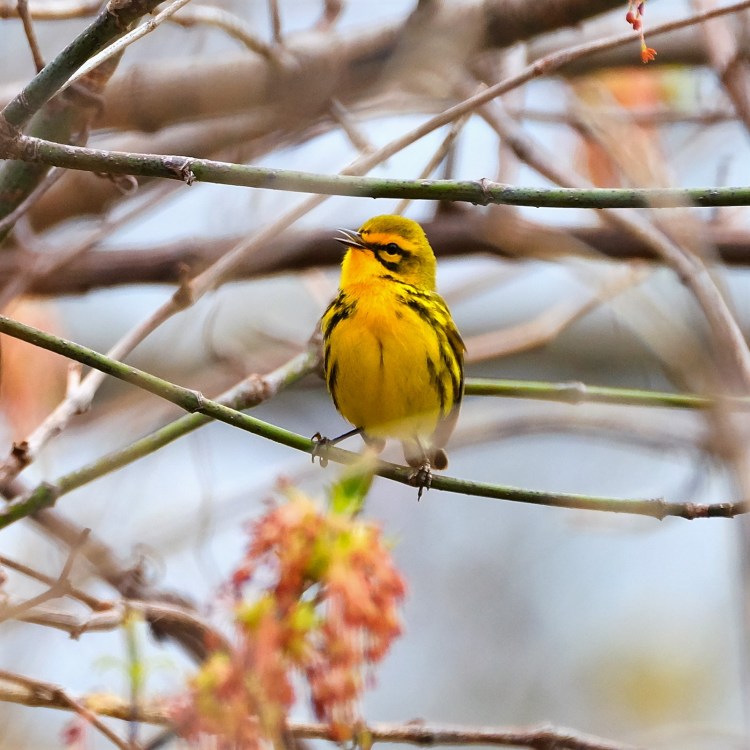
Here’s my best picture of the amazing prairie warbler that visited Estabrook Park for a few days back in May, 2022. He made me work hard for this picture and then seemed to get bored with the game and just started singing.
Here’s a violet-green swallow from Craters of the Moon National Monument and Preserve in Idaho, also in 2021. I had never heard of such a creature, and I could barely believe my eyes when I got a good look at it.
As I mentioned yesterday, I’m on the road again today, and to tide you over here’s a barred owl I saw in Glacier National Park back in 2021 on a hike up to Avalanche Lake, another great trip planned by Anne. It is my one and only barred owl and the only time, so far, that I saw an owl flying, watched where it landed, and could capture a picture of it where it perched. Truly a magical moment.




 Signs of Life in Estabrook Park
