Despite raining over the last two nights, the daytime weather continues to be beautiful out here. Yesterday afternoon, my sister, my niece, and I revisited the Farmington Canal Heritage Trail, and I was surprised to find this blue jay uncharacteristically perching out in the open and staying put as I took pictures.
Farther south, my niece spotted the melanistic squirrel again, and I was happy to have the chance to get a picture that better shows off its nice, black fur.
Then, as I was trying to line up a good shot through the sticks, it stretched out, reclined on the branch in front of it, and I swear mouthed to me, “Take a picture, why don’t you? It’ll last longer.” Cheeky little devil.
Near the south end, at the water feature in which my sister was hoping to spot wood ducks, instead we spotted dozens of painted turtles basking in the warm afternoon sun.
Then finally, Deb got her wish, although the poor wood duck could barely find an open bit of log to preen on.
This morning, we tried again, and this time at the Quinnipiac River Gorge Trail. There were a lot of birds singing in the trees there, including Baltimore orioles, warbling vireos, and black-and-white warblers, but the canopy is very high in the gorge, and the air was nice and warm, so the bugs were up high, too, and most of the birds followed them up there and were beyond the reach of my gear.
This little chipping sparrow, however, was hungrily munching on something it was finding on the ground, and so made a nice exception.
Finally, this house wren was more concerned with staking out his territory, a wren house, of course, and so stayed down at eye level, too.
It was grey and rainy this morning in Connecticut, so I wasn’t able to get any pictures to show you, even though my sister and I did go out and look. Instead, let me show you a couple more pictures from that fabulous photo shoot I had with the titmouse on Friday.
And now with the sound on.
The sun is finally out now, so here’s hoping I can get something new to show you by tomorrow.
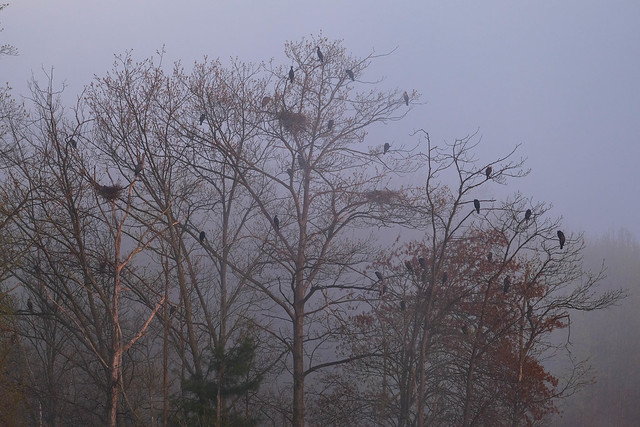
My sister, Deb, who rescued a wren from a glue trap a few years ago, suggested we visit the Broad Brook Reservoir on the east side of town this morning. It was another nice, clear day, so we got out nice and early, but failed to anticipate the fog coming off the water. Even with the fog, however, we could see that the trees on an island were full of cormorants and a few huge nests.
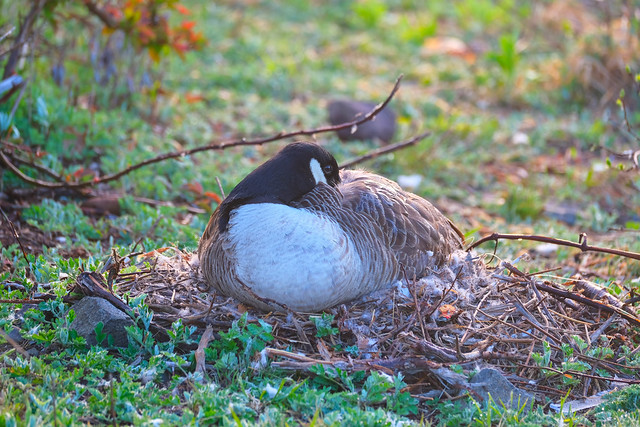
There is a cause way that splits the reservoir in about half, and we parked at one end and hiked to the middle. In the few feet between the guardrail and the water, this Canada goose managed to squeeze in her nest. Deb wondered how the goslings would fair so close to the road, but I bet she’ll have them swim to a nicer location just as soon as they’re all hatched.
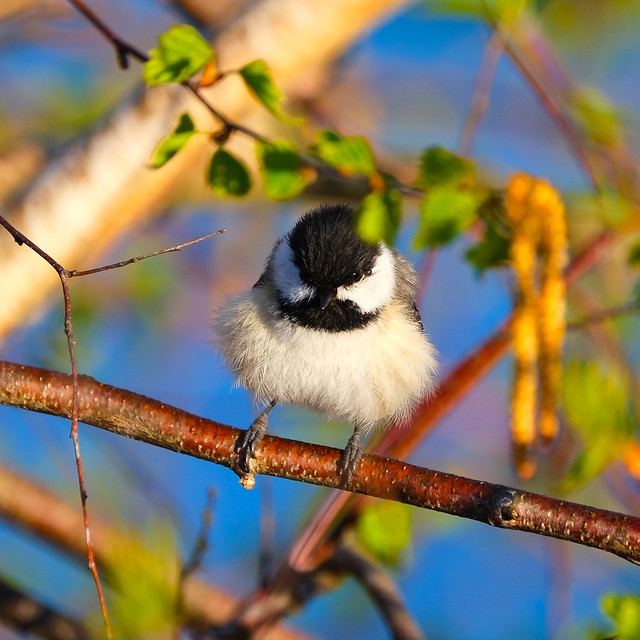
Eventually the sun came over the hills and started burning off the fog, at which point this chickadee took a moment in the sun to fluff up its feathers.
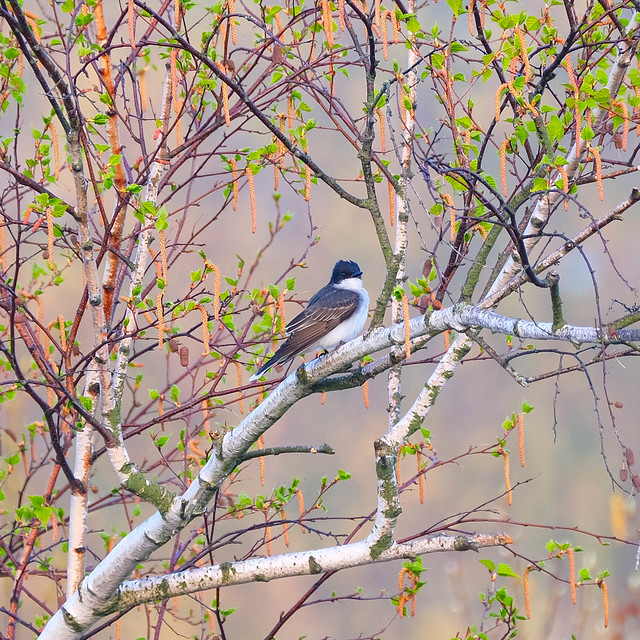
Then my first eastern kingbird of the season stopped in. It does not appear that anyone has spotted one in Estabrook yet this year.
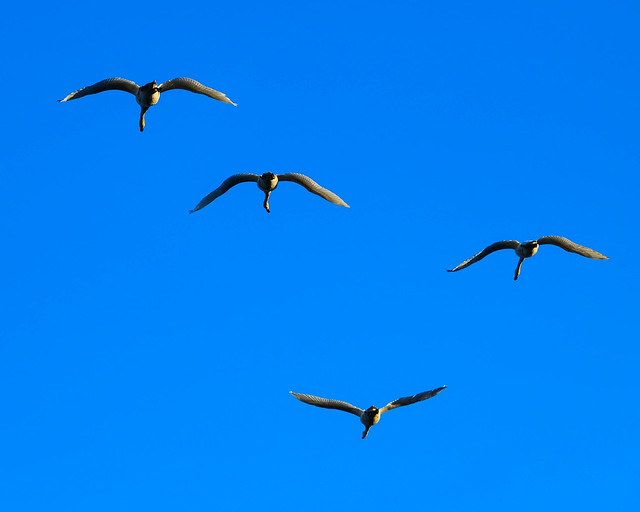
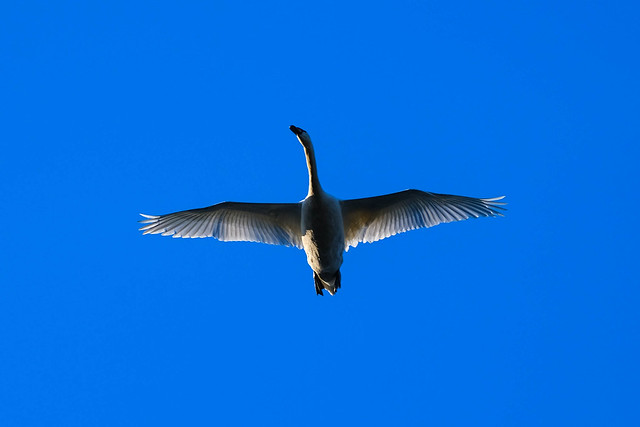
Deb says that she usually sees some swans on the water in the summer, but neither of us expected to see them fly back and forth over the cause way like cats that can’t decide if they want to be in or out.
I would not guess that such big birds take to the air on a whim.
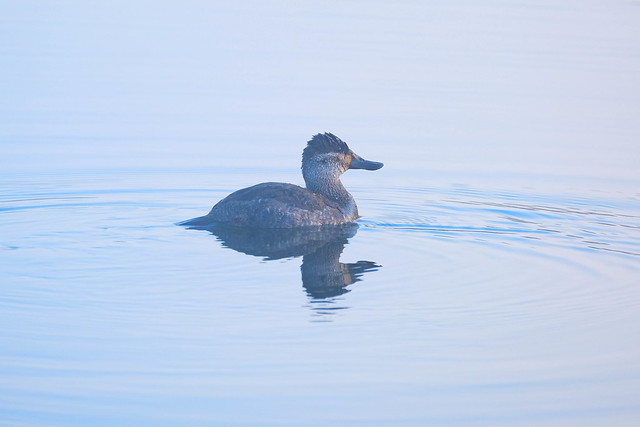
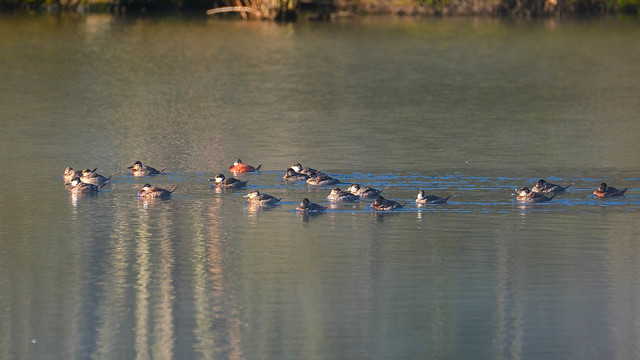
Once the fog was finally gone, we could see a whole raft of ruddy ducks out on the water.
Luckily for me, a couple were foraging on the bottom close to the cause way so I could get portraits when they came up for air. Here’s a non-breeding male in brown, …
I was pleasantly surprised to find my first spotted sandpiper as well. Still none at Estabrook yet, but soon enough.
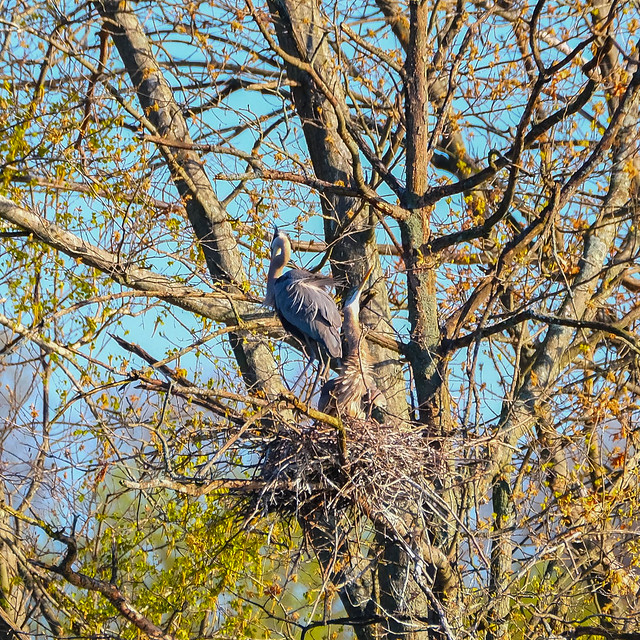
Finally, those nests on the island we could barely make out through the fog earlier, turn out to belong to great blue herons, and here’s a pair getting reacquainted after one returned from a fishing expedition. Sweet!
The streak of beautiful, if cold, weather in Connecticut continued this morning, so I was able to get out before sunrise, and this time I headed straight to the Farmington Canal Heritage Trail to see who else might be an early riser.
Next, as I checked the pond that lies along the trail, I found a quintet of ring-necked ducks. Outstanding!
Continuing south, in the spot I checked well yesterday in hopes of finding the mockingbird that is often there, look which mimetic I found instead. A pair of catbirds, one singing away and the other keeping quiet, looked to be setting up residence. “Welcome back, Cuties!”
Next, the sight I’ve been waiting for, a tufted titmouse ready and willing to pose for a portrait. Most of them seem to stick to the high canopy, at least when calling, but this little character was singing a different song and doing it in the sun at eye level. I couldn’t ask for a better setup.
Ta da!
Finally, as I neared the south end of my trip, there was even a pair of wood duck drakes.
Lastly, I’ve been seeing these guys on-and-off for years, but today was my day to get a picture of a melanistic form eastern gray squirrel. In the morning sun like that, the black isn’t as pronounced, but on a cloudy day, it would look jet black.
I arrived safely in Connecticut yesterday just before noon after a nicely uneventful couple of flights. I did have a little fun on the way, however, because my flights connected at Ronald Reagan Washington National Airport in Washington DC. I could see the Washington Monument, the Lincoln Memorial, and the Capitol Rotunda right out the window as I waited to board my connecting flight. I also walked past Senator Sanders between gates, and Senator Blumenthal was on my flight to CT. Best of all, I could see an osprey hunting over the Potomac River. Sweet!
It was a pretty, if cold, morning here in CT, and my sister joined me for a short walk right after sunrise. The only picture I got from that excursion is of this chipping sparrow, belting out his signature song. As soon as I moved for a better shot, he was having none of that and took off. Darn.
After my sister went to work and I had some breakfast, I tried again, and this time I got a nice portrait of a red-shouldered hawk, who was on the hunt beside the Farmington Canal Heritage Trail.
A bit farther north, this white-throated sparrow let me have a good look while he sang his song.
Even farther up the path, I got about my best picture yet of a Carolina wren. He was singing, too, but none of the action shots were as clear as this one.
As I approached the north end, this female brown-headed cowbird let me get surprisingly close. The ones in Estabrook tend to keep near the top of the trees.
Finally, what’s a trip out east without a glimpse of an eastern cottontail? Well, that’s not really saying much, of course, because we have plenty of these in Estabrook, too.
I’m off to Connecticut to see my folks for a week, so today is a travel day, and I’m taking the opportunity to show you the last of my Comoros pictures.
Here’s one last look at the stunning Malagasy sunbird.
Here’s a gecko that fades from green to blue.
Here’s a radiated tortoise (Astrochelys radiata), which is native to Madagascar, and was probably carried to Comoros to hang out at the hotel where we stayed.
This magnificent creature is probably the biggest spider I’ve ever seen, with a body about the size of the last digit of my thumb and a “wingspan” that nearly matched the size of my hand. My best guess is that it is a red-legged golden orb-weaver (Trichonephila inaurata).
There were plenty of other birds about, and I counted 50 different species, my most for the year so far, but none wanted their picture taken today. In fact, the only picture I managed to capture is of this American coot, and you can see how even it is hustling for cover. Oh well.
It was a beautiful morning in Estabrook Park, and it turns out that there was an Earth Day chore waiting for me at the pond. As I was at the north end looking for the recently arrived green heron, which I never did find, the geese on the west lawn near the south end of the pond started to make a little noise. It wasn’t a big ruckus, but more like the light chatter they make when someone walks their dog a bit closer than they like. The mallards and wood ducks on the water started acting up too, so I thought maybe there was a hawk in a tree overhead, and I walked over to investigate.
When I arrived, I found that neither guess was correct, and instead, a gosling had gotten one of its feet tangled in fishing line, which some angler had mistakenly left behind. Mom, Dad, and its seven siblings were all floating on the water, but it was starting to thrash a bit on shore just above the water line. I watched for a moment, to make sure I was really seeing what I thought I was seeing, and then decided to break the prime directive, again.
I reached down to grab the gosling, which caused its parents to go into a tizzy, and tried to free the foot, but the line was really wrapped around it. So, I held the gosling in my right hand and tried to gather up all the line with my left. There was probably twenty feet of it with sticks and aquatic plants tangled in it, but I got it all and stepped away from the water so I could kneel down and try to get it off.
The line was new-fangled dark green braided nylon, instead of old-timey clear mono-filament, so it was very hard to see, but the knot looked like a cow hitch, which I couldn’t get to loosen with one hand. I usually carry a pocket knife with me, for just this sort of situation, but in the discombobulation of packing up all my stuff to come home from Waterford yesterday, it somehow failed to make it onto my belt this morning, of all mornings.
Meanwhile, the gander was getting quite bold with his complaints about how long this was taking, and I had to fend him off with my left arm a few times, but he never actually bit me. I didn’t see anyone else around, so I walked up to the parkway and started waving down passing cars. I didn’t have immediate success, but about the sixth car did stop, and the good Samaritan in it even had a kit with a little pair of bandage scissors.
He handed them to me, but I had no luck cutting the line with my left hand, so I gave them back and held the line while he cut it. The gosling struggled all the while, so we just cut it close but didn’t even try to cut the line actually around its ankle. Instead, I have a hope that with no tension on it, the cow hitch will just come loose on its own.
The good Samaritan didn’t stick around, the parents were not calming down, and I wanted to get the gosling back ASAP, but I did pause for just one more moment to capture this image with my phone. Of course, the gosling wouldn’t look my way, but you can see Dad making ready to take another swat at my legs, and Mom in the far background.
I have already ordered a pair of those scissors to keep in a pocket on my camera harness so that I’ll always have them with me, and if you are an angler, please be careful not to leave any fishing tackle (line, hooks, lurers, etc.) behind. If you do clean up after yourself, please also consider picking up after your fellow anglers. Even if you are not an angler, please consider picking up any fishing tackle you find, because that stuff can be deadly to all kinds of wildlife. Example 1. Example 2.
Anyway, down on the river, I was surprise to see our lone common merganser drake again. Perhaps he has an ailment that is preventing him from flying north, but at least he seems to be eating well, and his feathers look marvelous.
Just on shore, I captured my first attempt at a house wren picture. I’ve been seeing them for about a week, and the little rascals are still quite shy.
The closest thing to a portrait I managed to capture today is this male eastern towhee giving his best hydration advice.
Anne and I took the grandson out to Waterford yesterday afternoon to spend the weekend with his great-grandmother. It was 32° out here at sunrise this morning, and there was frost on the grass, but the skies were clear, so out the door I went.
While the sky was still a bit dark, I got my first picture of a vesper sparrow (Pooecetes gramineus). I’ve been hearing their distinctive song out here for a couple of years, but haven’t been able to put a face to the voice until today. No one has reported seeing one in Estabrook Park yet, so I’m lucky to get the chance here.
There were plenty of birds, such as wood ducks, blue-winged teals, green-winged teals, and ring-necked ducks, on the little ephemeral ponds that haven’t dried up yet in the surrounding farm fields, but it is hard to sneak up on them across an open field, so I didn’t manage any pictures. Instead, here’s a sand-hill crane striding up a hill through the remains of last year’s corn stalks.
I found a pair of red-tailed hawks, with one on a nest, and the other nearby, but the big treat for me was finally getting an image, suitable only for proof-of-life, of a northern harrier (Circus hudsonius). I glimpsed one in flight over the river in Estabrook a while back, but I didn’t manage an image then. The big white patch at the top of the tail is the giveaway for me.
The most exciting sight for me, however, was my very first horned lark (Eremophila alpestris). Once again, I didn’t have much luck sneaking up on it across an open field, but I was happy to get close enough at least to see the yellow throat and little black horns.
Tree swallows were out, and here’s one taking a break for a moment.
Another one stopped by, too, and they exchanged some words, but I was unprepared for the action shot again. Sorry about the blur.
Lastly, great grandma has a pond in her back yard with some pine trees nearby so I could finally sneak up on this pair of hooded mergansers who had stopped in to sample the buffet.
Today was not the same as yesterday. It was sunny again, but it was colder, especially in the breeze, and there was a lot of activity going on between the Brew City Marathon and the Milwaukee River Cleanup. I don’t know which factor, if any, was the cause, but the critters were laying low today.
Nevertheless, the goslings on the pond gotta eat, so here they are bobbing around on the water pecking at anything and everything they see.
The green heron was still there, but hiding in the shade instead of the sun when I went by, and this female or immature male hooded merganser was not so shy.
As I searched the lawn for juncos, which I suspect have mostly flown north by now, I was happy to find a trio of field sparrows, with their characteristic little pink beaks.
The brown creepers have not yet all flown north, and here’s a smarty rustling up its breakfast while soaking up some sun and staying out of the breeze.
And the white-breasted nuthatches are settling down. Here’s a pair exchanging a morsel. I apologize for the blur, but I was not prepared for an action shot when I spotted this ceremony in progress.
Shortly afterward, this little cutie held nice and still for me.
Finally, as I made my way south along the river to keep off the marathon route, this chipmunk was surprisingly friendly and soon resumed its foraging not ten feet away from me.