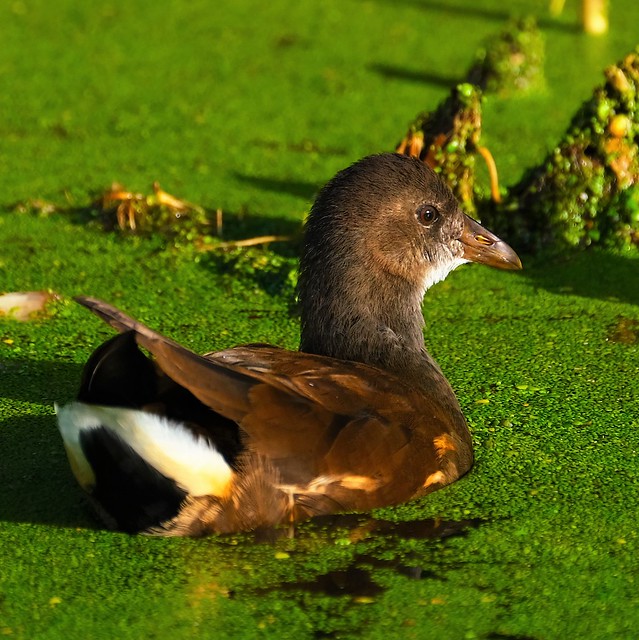
Not so fast…

It felt as if this morning set out specifically to show me that one data point does not make a trend. Thus, not even 24 hours after I announced that “the storks have flown south for the season“, look who I found posing pretty as a picture. While it may be true that some storks have indeed flown south already, this seems to be pretty conclusive evidence that not all have yet, right?

DSCF6571

Plus, there were a lot more geese around today, and as this formation approached from the horizon, I thought I was going to be able to show you a shot of a nice, big v-formation of geese actually heading south. Once they got overhead, however, I could see that these are not geese at all. Instead, they’re cormorants, on their way to catch fish in warmer waters. Ha! I doubt this picture even captured a third of the total.

DSCF6594

Another big surprise was that I got to see a kestrel hunting again.

DSCF6491

And this time, it drifted toward me, instead of away, when it repositioned itself.

DSCF6492

Then it suddenly dropped out of the sky like a rock, and I lost sight of it in the tall grass. I thank my lucky stars that I somehow managed to keep my camera pointed in the right direction, because when it reemerged, look what it had found! Ta da! Some hapless little rodent is on its way to becoming a very nutritious breakfast.

DSCF6498

Meanwhile, a great egret was hoping for similar luck along a nearby canal.

DSCF6600

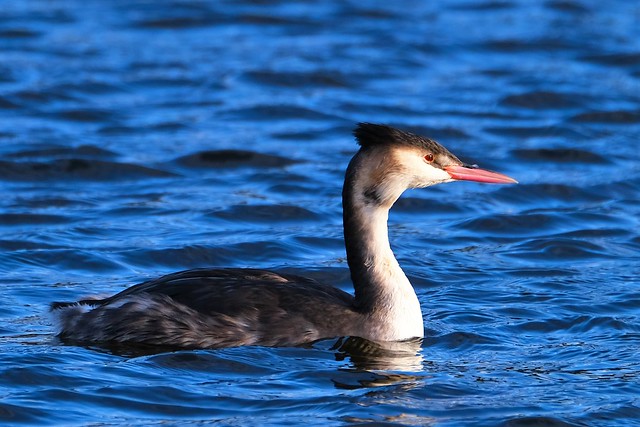
Finally, on my way back home, along the Delftse Schie, I spotted this great crested grebe chick, on the left, still in its zebra stripes, and still begging its parent, on the right, for something to eat. Hey, Kiddo, it’s October already, winter’s coming, and you’d better grow up fast!

DSCF6610

Dutch Autumn

Happy October, everybody! My assignment in Delft is officially half over, and I’m sorry about the recent radio silence, but I had some family events to which I wanted to give my full attention.

Anyway, the weather’s been pretty cool and wet around here for the past couple of weeks, and the forecast wasn’t great for today, so I wasn’t even sure I was going to go out this morning, but Anne gave me a nudge, so out I went. Well, I sure am glad I did, ’cause otherwise I would have missed this handsome little fella. He appears to be a Eurasian wigeon (Mareca penelope) male in eclipse plumage. Thanks, Honey!

DSCF6485

I’ve never seen one before, as far as I know, in any plumage, but I did record seeing it’s cousin, an American Widgeon, in Estabrook Park, back on November 1, 2021.

Speaking of ducks in Estabrook, I don’t see quite as many mallards here, and they often appear to be hybridized, but this couple appeared especially nice this morning when the sun poked through the clouds. Note how much thicker his white neck band is, compared to his North American cousins, and that she has a white neck band at all.

DSCF6452

Keeping with the duck theme, for a moment, here’s a pair of gadwalls sleeping the morning away.

DSCF6457

Going bigger, most of the geese have bugged out, and I only saw a few stragglers instead of the big flocks foraging in the fields that I’ve seen all summer. The swans, however, are still here, especially the cygnets, who might not have even fledged yet, and may still be sporting grey feathers.

DSCF6530

Also missing today, and probably gone until spring, are most of the shore birds, the curlews, godwits, redshanks, sandpipers, and lapwings. Instead, all I could find today was a little flock of black-headed gulls in their winter plumage.

DSCF6527

The storks are also gone, but the grey herons are still plentiful, and if they’re anything like the great blue herons they resemble, I might get to see them all winter.

DSCF6479

Finally, I did see one butterfly this morning, a speckled wood trying to bask in a brief moment of sunshine.

DSCF6511

There’s more, but I’d better save some incase tomorrow is a washout.

More little ones…

I didn’t see the goslings this morning, but that could simply mean that they were down in a canal paddling around when I tried to look from across the field. You may be surprised to learn, however, that they are not even the only late-summer youngsters out on the polder. Here’s one of a clutch of pint-sized pheasants I also saw yesterday.

DSCF6274

And here’s their mom keeping an eye on me.

DSCF6270

I don’t know if it was just a coincidence, but there were also more buzzards in the air than I’ve seen before, and here are three.

DSCF6298
DSCF6307
DSCF6309

The biggest surprise of today, however, was this good-sized, mud-covered crawfish crossing the bike path. We’ve seen smaller ones in Estabrook, and I knew they have them here as well, but I didn’t know they got this big. This one was moving pretty quickly, too, as though it were on a mission, and I tried to slow it down enough for a picture. It refused to grab a stick I placed in its claws, so I mistakenly thought they were just for show. When I tried to tug on its tail a bit with my fingers, it really let me have it, and the pincer tips were quite sharp. I hope I won’t be making that mistake again!

DSCF6401

Finally, the sun eventually burned off all the morning fog and warmed things up enough for the butterflies to come out, so I stopped by the flower patch on my way home and found this red admiral tanking up on nectar.

DSCF6406

Late arrivals…

Earlier this week, I came across an article in the newspaper that featured a nice bird picture, and as I prepared to send it to Anne, I realized it was of a Eurasian blue tit (Cyanistes caeruleus), which I have not yet seen, and not of one if its cousins, the great tit (Parus major), which I’ve managed to photograph here. That got me to wondering if and when I might see a blue tit, and as luck would have it, I didn’t have to wait very long at all.

DSCF6342

This little beauty was even kind enough to pose out in the open against a nice blue sky, although it’s a shame the warm morning sun was blocked by clouds at the moment.

DSCF6333

It looks quite similar to the great tit, with the same yellow belly black eye stripe, and little beak, but its tail, wings, and cap are blue, and there’s a band of white between its eye stripe and its cap. Here’s a great tit from this morning for comparison.

DSCF6261

Another big surprise this morning was this very fresh-looking batch of five Egyptian goose goslings being carefully shepherded by their parents amongst the Canada geese. I’m no ornithologist, but mid-September seems kinda late in the season at 53° north latitude. I thought those coots back in August were pushing it. I wonder who is more surprised: the goose, the gander, or the goslings? The Canada geese are probably thinking “what the heck are these Egyptians up to now?” Perhaps this is just what happens with a species that is “native to Africa south of the Sahara and the Nile Valley.”
DSCF6352

The rest of the avian world appears just as stunned as I am. Here’s a slack-jawed grey heron.

DSCF6285

A mallard hen doing a double take.

DSCF6313

A young blackbird just staring wide-eyed.

DSCF6295

A European robin doing the same.

DSCF6293

This crow, however, looks more concerned than surprised. Maybe it’s already seen a thing or two.

DSCF6286

Anyway, the goslings were pretty far out into a big field, so I couldn’t get very close, but I’ll keep an eye out for them and let you know if there’s any news to report.

Differences and Similarities…

I’ve still got some pictures left over from the weekend, if you can believe it, so here they are.

This first one features a pair of mute swan cygnets, and I took it on Sunday after I was inspired to look up just how big they are by the spectacular Saturday fly-over. I read that gray turns out to be the “natural” cygnet color, and ones with the white color morph are known as “Polish swans”, they are “found only in populations with a history of domestication,” and “Polish swans “carry a copy of a gene responsible for leucism.”

They all turn white when they grow up, so I guess it’s a moot point anyway.

Mute swan (Cygnus olor) cygnets. "The cygnet on the right is of the "Polish swan" colour morph, and carries a gene responsible for leucism."

Here’s a handsome common wood pigeon (Columba palumbus), which I first showed you back in May. It is close cousins with the smaller rock pigeons that nest under the bridges over the Milwaukee River at either end of Estabrook Park. I see them here often enough and usually leave them alone, but this one just seemed to be begging for a photograph.

Common wood pigeon (Columba palumbus)

Here’s another ruddy darter dragonfly, which are pretty common lately, but this one perched on such a nice bright red stem that I thought it was worth another shot.

Ruddy darter (Sympetrum sanguineum)

On Sunday, the thistles I was wading through to photograph butterflies were also full of bees, as you can probably imagine, and I am happy to report that we all left each other alone. Once in a while, however, the expected buzzing would sound disturbingly near and incessant, and upon closer inspection, I witnessed this fascinating behavior, where one “bee” would hover over another.

Hoverflies hovering over each other

It turns out that these little pollinators are not even bees at all, but hover flies instead, evolved to mimic bees for the protection from predators such appearance affords. There are “about 6,000 species” of hover flies, and I’ve seen several in Estabrook, but it might take me awhile to pin down exactly which ones these are.

Hoverflies hovering over each other

Some mate in flight, and perhaps that’s what these mid-air traffic jams are all about.

Hoverflies hovering over each other

The hover fly below, however, stood out for a different reason. It was absolutely huge, and that helped me look it up pretty quickly. It’s a hornet mimic hoverfly (Volucella zonaria), and “can reach a length of 25 mm (0.98 inches)!” Further, they mimic “the European hornet (Vespa crabro), by its size, by its appearance and [by] its buzzing flight,” and thank goodness I haven’t yet met any of the real thing yet!

Hornet mimic hoverfly (Volucella zonaria)

Finally, there were also several bumblebees hard at work, and here’s one on a different variety of thistle.

Bumblebee on thistle

Saturday Surplus

Here are some pictures that didn’t fit into Saturday’s report.

Besides the Canada goose I showed you, the graylag geese are also abundant and a little more wary than the Canada geese. Here’s one keeping an eye on me while its compatriots continue to graze.

Graylag geese (Anser anser)

Here’s a white wagtail who was foraging in the pasture along with the lapwings.

White wagtail (Motacilla alba)

As I approached the huge field in which I later spotted the buzzard perched, I glimpsed this smaller bird hovering above and managed this one picture before it opted to hover farther away. Back in June, I thought I saw marsh harriers hovering, but now I suspect the bird I was able to photograph then was also a buzzard. As for our hoverer, now that I have a better image, and I’ve read more about hovering raptors, I’m pretty confident that this is a common kestrel (Falco tinnunculus) instead, and a close cousin to both the American kestrels and the peregrine falcons we see in Estabrook.

common kestrel (Falco tinnunculus)

Here’s another picture of that acrobatic great tit gleaning for seeds on this gone-by blossom.

great tit (Parus major)

Finally, the cormorants are still here, and this one was catching some sun beside the Schie river as I rode back to my apartment.

Great cormorant (Phalacrocorax carbo)

Butterflies Abundant!

The weather was still nice but noticeably hazy this morning. Plus, I got up later than usual, so I missed the sunrise, and I was struggling a bit to find anything photo-worthy. I did glimpse the Eurasian jay again, but it had no time for me today. I also spotted another stoat, but it too had other items on its morning agenda. Thus I was heading home already with just three pictures to show you when I came across a nice big patch of wild flowers, mostly thistle, and I figured I stop and take a look. Holy Moly! The place was hopping with butterflies. I’m sure it helped that the sun was nice and warm by then and the winds were almost perfectly calm, so just perfect for butterflies to be out and about.

First up, there was at least one and probably two peacocks, which we haven’t seen since the start of July.

European peacock butterfly (Aglais io)

Then there was a brand new butterfly for us, this tiny and stunning common blue (Polyommatus icarus), with a little piece missing.

European common blue (Polyommatus icarus)

I read that they’ve recently been seen in eastern Canada, and they like bird’s-foot trefoil, which is quite common in Estabrook, so we might be seeing them there soon enough, for better or worse.

Meanwhile, back at the wildflower patch in South Holland, there was also an intricate map, …

Map butterfly (Araschnia levana)

a small copper, …

Small copper butterfly (Lycaena phlaeas)

lots of small whites (as they are known here), which I see all the time but don’t bother to show you, …

Small white butterfly (Pieris rapae)

another speckled wood, sharing a blossom with one of the hundreds of bees in attendance, …

Speckled wood butterfly (Pararge aegeria)

a red admiral, …

Red admiral butterfly (Vanessa atalanta)

and this clouded yellow (Colias croceus), that made me chase it from one end of the flower patch to the other and back before it found just the right blossom from which to sip nectar.

Clouded yellow (Colias croceus)

It looks like the close cousin that it is to the clouded sulfurs sulphurs that are common in Estabrook.

Lastly, here is yet another butterfly newish to us, a large skipper (Ochlodes sylvanus). It is not so closely related to the skippers we see in Estabrook, however, and you have to climb all the way up to the skipper family (Hesperiidae) to make the connection.

So that’s nine species, three of which are new to us, the skipper, the yellow, and the blue. It was hard to tear myself away. I actually walked back to my bike by the path twice and got drawn back in by yet another new flash of color before I finally extricated myself and rode back to my apartment for some lunch.

A sunny September Saturday in South Holland

After a bit of a cold snap last weekend, the weather is back to near perfect here in South Holland, with temps in the 70s, clear skies, and a light breeze. Plus, the sun already doesn’t rise until almost 7am, so I even got to sleep in a bit this morning.

Once again, the birds on the water, which I mistook for mallards at first glance, turned out not to be mallards. This time, they were gadwalls, nearly a dozen of them, and here’s a drake and hen taking a break from breakfast together. We’ve seen both gadwall drakes and hens in Estabrook Park, but I haven’t seen them here before, and I don’t believe I’ve ever seen them together until now. Ta da!

Gadwall (Mareca strepera) drake and hen

This pretty lapwing was oddly tolerant this morning. They haven’t let me get this close since back in June.

Northern lapwing (Vanellus vanellus)

I could have sworn that I’ve already mentioned that there are Canada geese here, but I can’t find when I did, so today I finally have photographic evidence. It appears they have gotten here both on their own and with some help, but it was not clear into which category this one falls, and it would not say.

Canada goose (Branta canadensis)

Farther afield, here’s another buzzard, surveying the situation from eye level.

common buzzard (Buteo buteo)

As I was trying to get a presentable picture of the buzzard, I heard big whooshing noises, and I looked up to find that they were made by these huge mute swans cruising overhead at just a couple dozen feet. I read that “the mute swan is one of the heaviest flying birds. In several studies from Great Britain, males (known as cobs) were found to average from about 10.6 to 11.87 kg (23.4 to 26.2 lb), with a weight range of 9.2–14.3 kg (20–32 lb).”

mute swan (Cygnus olor)

Near the other end of the size spectrum, this great tit was busy gleaning seeds from an old blossom.

great tit (Parus major)

Finally, there are still butterflies around, and here’s another map, …

Map butterfly (Araschnia levana)

and here’s another speckled wood.

Speckled wood butterfly (Pararge aegeria)

Let’s see if the weather holds through tomorrow morning. That sure would be nice.

Birds & bunnies & butterflies, oh my!

I tried taking the route, which has been my regular route recently, in reverse order this morning, so counter-clockwise on a map. Thus, I hit the spot where we saw the robin late yesterday morning bright and early today, and our reward is a brand-new bird, for a change. This time, it’s a Eurasian jay (Garrulus glandarius).

DSCF5846

Here’s an even blurrier picture that shows a bit more of its face. Although it’s an “Old World jay,” and so not in the same genus as the blue jays in Estabrook Park, they are both in the Corvidae family, along with crows, magpies, and jackdaws.

DSCF5844

You may have noticed that the pictures above are blurrier than usual, and it turns out, unbeknownst to me at the time, that some blockhead had previously turned off the stabilization capability built into my lens. It’s not the longest lens by any means, but it’s long enough that taking a hand-held shot at maximum zoom produces less-than-optimal results, as you can clearly see above. And before we get into the whole blame game, let’s just say that the culprit has learned his lesson, and it shouldn’t happen again.

Anyway, while taking blurry pictures of the jay, I happened upon this little cutie on the path ahead.

DSCF5850

Luckily, I turned the image stabilization feature back on before I came across this stunning red admiral butterfly soaking up the morning sun.

DSCF5854

Closer to the ground, I came across the first frog completely out of water that I’ve seen so far, which finally gives me a decent shot at identification, and all indicators point to (Pelophylax kl. esculentus), the so-called “edible frog”, prized in parts of Northern Europe for its delectable legs.

DSCF5900

Another fascinating feature of this frog is that it is “the fertile hybrid of the pool frog (Pelophylax lessonae) and the marsh frog (Pelophylax ridibundus),” and thus “it reproduces by hybridogenesis (hemiclonally),” where “half of the genome is transmitted to the next generation clonally, unrecombined (intact); the other half sexually, recombined.” Will wonders never cease? Maybe that’s why their legs taste so good.

After the close-up with the frog, I took a glance out on the water behind me and saw what I thought were three mallards steaming along. For reasons I can’t explained, I took a closer look with my binoculars anyway, and I was stunned to see that only one of them was a mallard. The other two were sporting giant bills like this, which makes them northern shovelers, instead! I haven’t seen the likes of them since last September in Estabrook. I didn’t even know we had them here, but sure enough, they’re here, too.

DSCF5865

I saw another ruddy darter this morning, and I think this picture came out even better than yesterday’s.

DSCF5906

Finally, here’s a great tit showing off some serious acrobatic skilz.

DSCF5862

Late summer scenes…

It was nice and cool overnight with clear skies and calm winds, so most of the big fields were covered by thick blankets of fog this morning, and I couldn’t even see the water where I spotted the flock of spoonbills last weekend, so I had to make do, instead, with what I could find closer to the path.

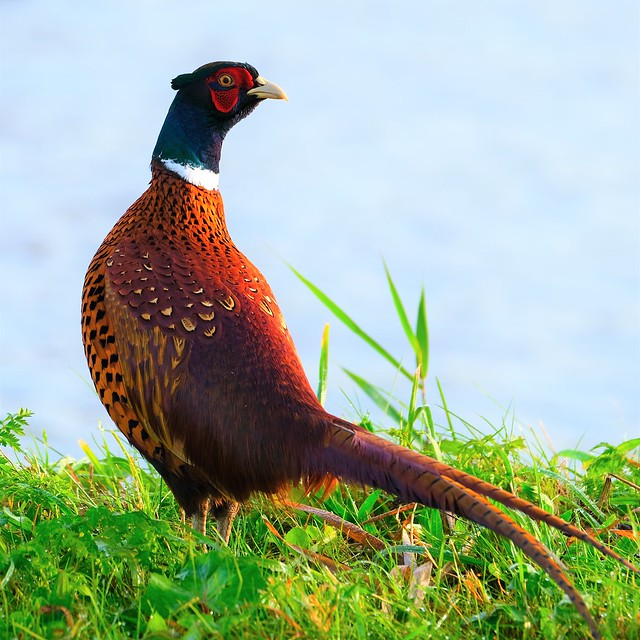
I saw at least four bouquets of pheasants, and this trio was definitely the boldest.

DSCF5741

The others, such as this hen, kept closer to the ground.

DSCF5731

This one looks like a young male starting to show red on the side of his face

DSCF5734

The morning sun soon warmed things up, however, so the bugs come out, and here’s another map butterfly, looking nice and fresh this time.

DSCF5754

It only opened its wings just a bit and for just a moment, so don’t blink.

DSCF5752

Here’s a new dragonfly for us, and it looks like a ruddy darter (Sympetrum sanguineum).

DSCF5747

Here’s a brand new butterfly for us, a diminutive and shiny small copper (Lycaena phlaeas).

DSCF5814

Like the map above, it was also shy but did offer a brief glimpse of its dorsal side.

DSCF5807

Finally, back to the birds, here’s another European robin granting us a rare audience.

DSCF5774

And that’s it, until tomorrow.