Several more firsts…

Alright. Let’s see if I can remember to include a title and press “publish” on the first try today. In any case, it was wonderfully dark, warm, and humid this morning with not much wind, so the bugs were thick and the little birds; the phoebes, kinglets, and warblers; were after them like crazy.

Here’s a yellow-rumped warbler by the river at the north end finally showing us exactly how they got that name.

As I was trying to get that warbler picture, I spooked a spotted sandpiper, our first of the season, who flew over to the island so that I could capture this fuzzy image. You can just make out it’s orange/yellow beak and eye stripe to distinguish it from the solitary sandpipers that haven’t arrive yet, as far as I know. Plus, it was doing that cool bobbing that spotted sandpipers do.

At the other end of that island, I spotted another pair of blue-winged teals, and here’s the dapper-looking drake. I mentioned it was dark out, right?

On the other island, the southern one, the great horned owl was less hidden than usual, perhaps to enjoy the nice warm air.

Back on the mainland, there must have been a northern flicker meet-and-greet because after I spotted this one, a male by the look of his mustache, I watched as at least 4 pairs took off across the river, two by two, from a big cottonwood tree while all flashing their distinctive white rumps.

At the pond, I saw my first turtle of the season, this shy red-eared slider.

Meanwhile, this little cutie was trying to get some shuteye.

On my way back south, I spotted this sparrow hopping in the grass and figured it was an American tree sparrow, which we’ve seen before, but the beak color didn’t look right, and that’s because it’s a field sparrow (Spizella pusilla) instead, which is an absolute first for me. Woo hoo!

Finally, I found another new spring flower up, these glories-of-the-snow (Chionodoxa forbesii) in front of the maintenance building. Yay!

Something new and something old…

Although this morning was gorgeous, I couldn’t get to Estabrook until almost lunchtime today. Happily, there were still all kinds of sights to see, and I’d like to lead you off with the newest arrival at the pond, Mrs. Red-winged Blackbird, here to see what the boys have been up to while she was away. Somebody had better have some good territory staked out.

Also at the pond, I was thrilled to see this brown creeper creeping up something other than grey tree bark for a change.

Here’s a creeper from yesterday, also by the pond so it could be the same individual, whom I caught mid-hop with its landing gear up.

At the river today, I couldn’t believe my eyes when I glanced at the far shore because these two looked at first like one huge bird. Nevertheless, finding two turkey vultures perched together like this is a first for me in Estabrook.

Here’s a nice mourning dove image I held over from yesterday morning.

After being absent yesterday morning, one of the black-crowned night-herons was back in its spot along the river.

Lastly, the crocuses are starting to bloom by the pond.

Oh, before I forget, when I got home from school today, Anne had another newspaper article for me. This one is about European starlings and describes a paper by assistant professor John MacNeill Miller and Lauren Fugate at Allegheny College, which questions the long-standing story that starlings were introduced to North America by Eugene Schieffelin in 1890 to complete the set of birds mentioned by William Shakespeare.

Here’s a link to the paper in Environmental Humanities, in case you’re really interested.

The warblers are here!

I hit “publish” on this yesterday, but found it in my “drafts” folder today, so I don’t know what happened. Sorry that you didn’t get to see it until now.

Sure, folks have reported seeing them for at least a week, and the waterthrush I showed you yesterday, which the experts have since confirmed is indeed a Louisiana waterthrush, is technically a warbler, but this morning I finally captured images I can show you of a bird with the word “warbler” right in its name. Yay!

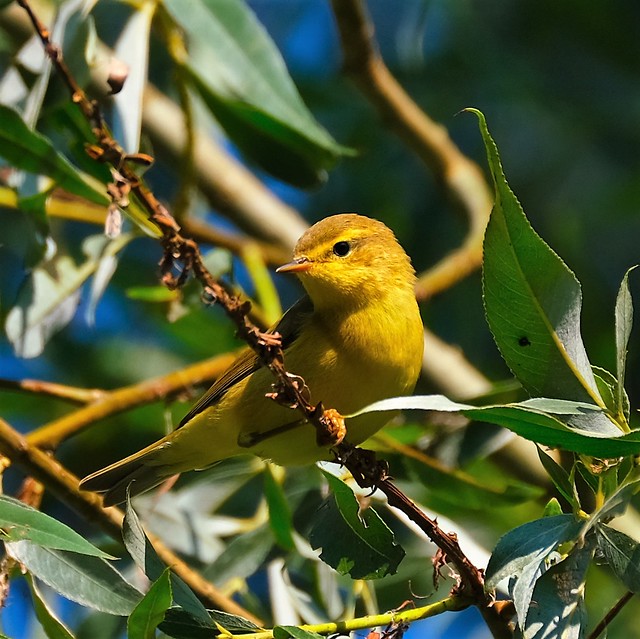
This is a yellow-rumped warbler by the pond and aptly named for the little patch of yellow on its back, just above the tail, that you can see here just under its wingtips.

I saw at least 5 different individuals throughout the park this morning, and here’s a nicer picture of one by the river. These are both males of the “myrtle” variety.

This one, with the subdued coloring is a female, I believe.

Another new bird for the season is this ruby-crowned kinglet, who was doing its very best to avoid showing us its ruby crown!

You can just make out one little ruby dot on the back of its head in this not-quite-as-nice image.

And, to round out the trifecta of new birds for the season, I finally spotted this trio of blue-winged teals on the river.

Also on the river, I saw both a male and a female belted kingfisher fishing at different points. Here’s the male, with his plain white belly, below the falls, …

And here’s the female, with her “chestnut belly band”, above the falls.

Plus, I caught both buffleheads up out of the water for the first time.

Meanwhile, up on the pond, there were a full dozen wood ducks, including two couples, …

one, as yet, unattached hen, and seven bachelors all vying for the last playoff berth. Here are six of the drakes with the one hen on the far right. It was quite a circus.

The solo, red-breasted merganser drake is still on the pond.

And the Canada goose is still incubating her clutch of eggs on the island.

I have even more pictures, if you can believe it, but I’d better stop here and save some for tomorrow.

Now that’s more like it!

Wow! What a morning! The sky was clear, the winds were calm, and there wasn’t as much frost coating the logs that I’ve been using to cross high water. They sure were treacherous yesterday.

The night-herons were in their usual spot and starting to attract some attention. I met a guy yesterday and two new guys this morning that I’ve never seen before, and they all mentioned the night-herons. The light was too low when I first went by, but a little beam of sunlight was shining on this red-bellied woodpecker, so I took her picture instead.

Below the woodpecker, this pair of wood ducks found some magic early morning light reflecting perfectly off the dried grass on the far riverbank.

Up at the pond, there were more wood ducks, mallards, our intrepid pair of geese, and this one red-breasted merganser drake.

As I was waiting for the merganser to drift into just the right spot, this red-winged blackbird foraged in the grass at my feet,

This cottontail hid in the bushes,

And this golden-crowned kinglet paused for half a second between hops from branch to branch.

On my way back to the river, I was surprised to find an eastern phoebe hunting from the lights strung over the beer garden.

Down by the falls, I bumped into Lisa, and we headed north to check on the owl(s). We eventually saw one, on our way back south, and just as hidden as usual lately, but the exciting find today was this waterthrush. At first I thought it was our first northern waterthrush of the season, and if you’ve been with us for a while, you may recall they were common for a week or so last fall. Upon closer inspection, however, I believe it is our first ever Louisiana waterthrush (Parkesia motacilla), but I’m waiting on the experts to weigh in.

Just a bit past the waterthrush, I spotted this red squirrel ripping bark from that branch it’s on, for a nest, I presume.

At the far north end, we saw plenty of geese, mallards, and a few more red-breasted mergansers and a few more wood ducks, but no buffleheads today. Instead, back on shore Lisa noticed this thrush hanging out with a pair of fox sparrows. I first thought it was a hermit thrush, as we saw Friday, but it was acting bolder and had a lot more red color on its back, so maybe it’s our first Swainson’s Thrush of the season. Another one for the experts, in any case.

On my way back south, as I was approaching the herons again, this European starling really wanted someone’s attention, if not mine.

And I finally found a junco. I guess, they’re not all gone yet.

At last, I made it back to the herons, and here’s one in the better light.

If this keeps up, I’m gonna need a bigger blog!

It’s gotta warm up someday, right?

I don’t think it got below freezing last night, but it was cold, clear, and calm enough for convective cooling to leave a coating of frost most everywhere. Happily, the mostly clear skies continued past sunrise for a couple of hours before the clouds rolled back in.

I didn’t see the blue heron today, but I found the pair of black-crowned night herons in the same tree as yesterday.

At the pond, beside the pair of geese, a pair of wood ducks, and a quartet of mallards, we had a red-breasted merganser drake trying his luck at snagging a goldfish.

At the river, I had the rare treat of catching a bufflehead, the drake this time, out of the water for a moment.

I almost didn’t notice this mallard hen making like a wood duck and taking a nice long break from the water.

There are still plenty of golden-crowned kinglets around, and here’s one down on the grass with a smidgeon of snow left over from last evening.

On my way back south, I was lucky enough to finally catch in range one of the belted kingfishers I keep hearing.

Meanwhile, closer to the water, an eastern phoebe was hunting smaller prey.

Finally, the night-herons were still in their perches as I went by again, so here’s one more glimpse, just in case they’ve moved on by tomorrow.

Lastly, I forgot to mention that a crew was delivering beer at the beer garden yesterday morning, so they ought to be opening soon. Also, the dark-eyed juncos and brown creepers were noticeably absent this morning. I doubt they are all gone yet, but perhaps they are starting to make their way north.

All signs that, despite the snow and frost, warmer weather can’t be too far away. Yay!

A good day for water birds…

It took a while for the rain to turn to snow this morning, so I didn’t get into Estabrook until 10am. Happily, must critters were still up at that late hour, and I got to see quite a few. Conditions continue to be suboptimal for photography, however, so let’s see what images I managed to scrounge up.

Right off the bat, near the very south end, I was thrilled to spot again our great blue heron, who’s been absent for a while since it first reappeared for the season back in March. I don’t know what it’s been up to in the meantime, nest building in some near-by rookery, we can hope, but welcome back anyway!

Farther north, I found our two new celebrities, the pair of visiting black-crowned night-herons, perched right where I left them yesterday.

I’m sure I’ll get tired of them eventually, but today was not that day.

As I approached the north end, I couldn’t believe my luck to finally get a clear shot of one of the elusive hermit thrushes that I knew had to be around somewhere.

At the north end, the quintet of red-breasted mergansers were still busy fishing along with one pair of buffleheads. Meanwhile, one pair of wood ducks was on the pond along with the nesting goose and her guardian gander.

On my way south, I spotted this little eastern phoebe surveying its soggy domain.

While a northern flicker, a female by the looks of her unmustachioed face, did the same from a high perch.

Finally, the black-crowned night herons were still in their spot on my second pass, and here’s the second of the two from across the river.

Tune in tomorrow to see if I finally spot one of the warblers that folks are beginning to report.

A short one…

I couldn’t make it to Estabrook this morning, while the skies were grey but dry, and had to go around lunch time when the clouds started leaking. Most of the critters were busy today, and had no time for pictures, but there were a couple notable exceptions.

Our two new favorite black-crowned night-herons were still gracing us with their magnificent presence, and I found them just a bit south of where they perched yesterday.

After I did my best to get pictures of both of them, one hopped down to the water’s edge to look for lunch.

The other bird I was able to capture today was this youngish looking bald eagle, maybe four years old with some like specks in its dark plumage and some dark specks on its white tail, soaring in lazy circles over the village of Shorewood, just east of the park. I don’t recall seeing this individual before.

And that’s the show for today, folks. The great horned owl was in its recent favorite spot again, but hidden even better than usual.

I see we’re due for snow showers tomorrow morning, so maybe that’ll make for some pretty pictures. We’ll see soon enough, right?

A morning of surprises…

It was still raining when we woke up, but soon enough the big green radar blob drifted out over the lake and left us with a pretty nice morning in Estabrook Park. As usual these days, there were plenty of birds making rackets, but hardly anybody had time for my camera.

This sparrow by the river was one exception.

At the time, I thought it was a fox sparrow, of which we’ve been seeing a lot lately, but when I got home and took a closer look at the pictures, I was thrilled to realize it is actually a swamp sparrow! I guess that would explain it standing in water up to its little round belly, eh? That’s the first one of those I’ve seen this season.

Another bright spot in my hike north was spotting this male eastern towhee by the pond, and this is the best picture he let me have today, but that’s another first for the season. Yay!

At the north end, I was happy to see a pair of red-breasted mergansers and a pair of buffleheads still around. I even spotted the quintet of mergansers who put on a show for us yesterday, for a total of 7, but I couldn’t get a picture worth showing today, and I was beginning to think that I really should have saved some pictures from yesterday.
Then, on my way back south, I was using the binoculars to try to get an accurate count of Canada geese on the southern island when I was stunned to spot this American coot just hanging out. What a pleasant surprise. We haven’t seen one since the first half of March.

There was one exciting moment when some big bird flew north over the river. At first I thought it was a young gull because of its grey color, but then I caught a glimpse of its profile, and it had a neck like a heron, but not the long legs I’m used to seeing on great blue herons. Then it even soared a bit, as I see raptors do, so I had no idea what it really could be.

Anyway, I continued south and took the stairs up the bluff by the falls to check for starlings or cowbirds on the lawn among the robins, and I can report that a crew was busy at work preparing the Beer Garden for their spring opening. As I walked along the edge of the bluff from the beer garden, I just happened to glance down to the river, and I could not believe my eyes. Our mystery bird was perched in a tree on the other side, and it turns out to be a black-crowned night-heron! Holy Moly!

It perfectly fits the description: a big grey bird, like a young gull, with a heron’s neck but not long legs like a great blue heron. Best of all, it was pretty comfortable with me hiding behind a tree on the far shore to take pictures, the sun came out a bit, and I even spotted a second one. Wow!

Long-time readers may recall that we had a juvenile black-crowned night-heron on the pond for a few days in August of 2020, but this is the first time I’ve ever seen an adult in Estabrook Park, or anywhere for that matter.

Why do I ever doubt that Estabrook Park will deliver the goods?

A bunch of little posers.

I didn’t get to Estabrook until nearly noon today, and I was happy to find that there were still plenty of critters up and about, but I didn’t get a picture until this handsome devil, a red-breasted merganser drake, came floating by at the southern island.

When I approached the northern island, however, things really started to warm up. Besides the geese, mallards, and wood ducks, there was still one pair of buffleheads from the big crowd yesterday, and four more red-breasted mergansers. With three drakes and just two hens, I guess I shouldn’t have been surprised when the drakes started putting on a show. Sadly, the hen seems to be nowhere near as impressed as I was.

Back on shore, I spotted another northern flicker, and his black mustache means he’s a he.

As I was trying to line up a shot, he started singing, so I switched to video so you can see and hear who makes the woods of Estabrook sound like a jungle this time of year.

Meanwhile, back at eye level, I was thrilled to discover that today must have been portrait day because all the little birds started posing, and first up is this little dark-eyed junco.

By the pond, a female cardinal, who has been starting to make herself scarce, was next.

Then this fox sparrow.

Followed by a much-smaller American tree sparrow.

And lastly, this slightly-ruffled looking white-throated sparrow must have gotten word late and came as fast as it could.

As if that string of little posers wasn’t crazy enough, the mammals also got in on the act, starting with this shy eastern cottontail.

This gray squirrel peeking out from its hidey-hole.

And even a chipmunk. It was just incredible.

The forecast for tomorrow morning is for showers and then partly cloudy skies, so we’ll see soon enough if I was supposed to have saved some of these pictures for then. Wish me luck!

A Spring Classic!

The classic spring weather continues, but at least it wasn’t precipitating this morning, so good enough for a visit to Estabrook.

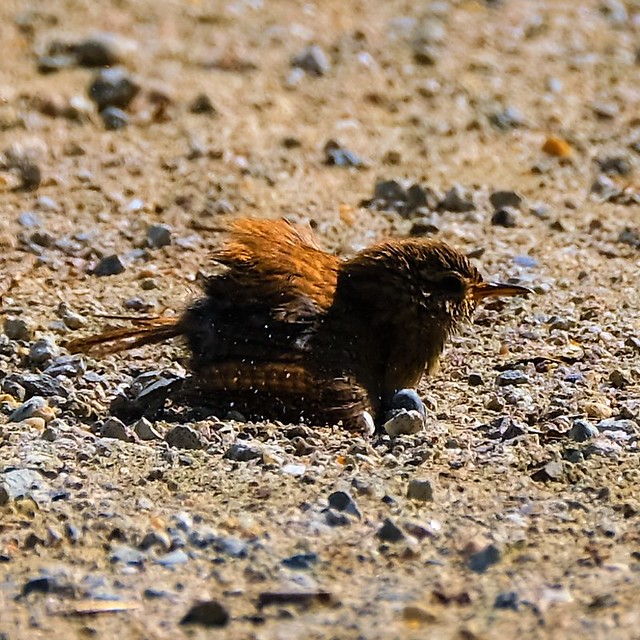
The winter wrens are as thick as ever, and this one had bigger fish to fry than staying out of my sight.

I don’t see the mallards in large groups on the river anymore. Instead, I see pairs, like this handsome couple, off by themselves.

There were plenty of wood ducks on the pond, and the sun even made a valiant effort to break through the clouds for a moment.

I bumped into Charlotte, “Wildlife Biologist and Professional Bird Nerd”, at the pond, and as we walked over to the river, we spotted both a peregrine falcon and a kestrel flying overhead. The falcon had a bulging neck and looked like a heron from the side, but Charlotte explained that it merely had a nice full crop from just scarfing down some breakfast, which I was fascinated to learn.

Over the path along the river, we spotted more tree-top wood ducks, and here’s the drake.

At the north end, I was stunned to find at least 14 buffleheads! There was just one hen, and all the rest were drakes. Here’s the best picture I could get of them together, and it shows just eight of them. Imagine nearly twice that many.

On our way back south, Charlotte spotted a woodpecker overhead, and when it flew to the next tree, she recognized that it was a yellow-bellied sapsucker. This picture is terrible, but you can see a bit of its name-sake yellow “belly”.
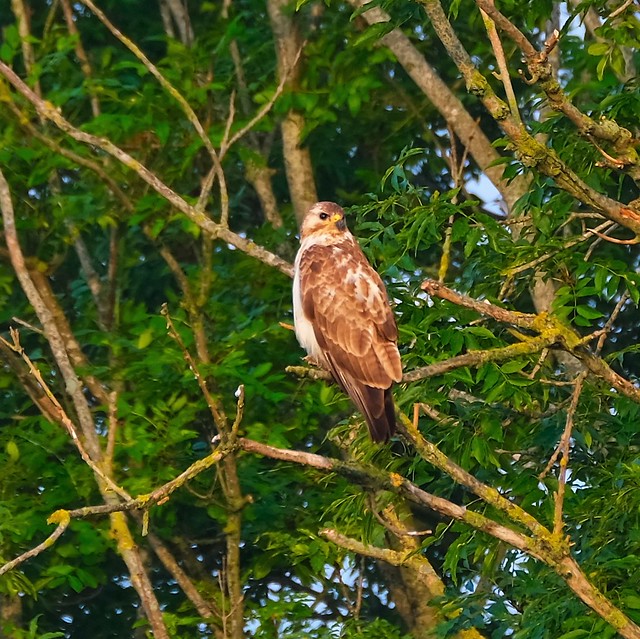
Just above the falls, here’s another herring gull with a fish.

Finally, as I was searching for a hairy woodpecker, to round out my woodpecker collection for this morning, I found my first spider of the season on one of the tipped-up picnic tables at the far south end.

Speaking of bugs, when I got home, I found that Anne had thoughtfully left a section of today’s New York Times open for me on top of my laptop. The article, “In Wisconsin: Stowing Mowers, Pleasing Bees“, is about how the “the No Mow May movement help[s] transform the traditional American lawn — a manicured carpet of grass — into something more ecologically beneficial.” In Appleton, WI “they found that No Mow May lawns had five times the number of bees and three times the bee species than did mown” lawns. If you have any say about when the grass gets cut where you live, perhaps you could give it a try and “do more by doing less.”