The weather hasn’t pranked me yet today, and it was a nice sunny morning in Estabrook Park. That let me get out nice and early, so I was able to spot this muskrat at the edge of the river, which we’ve seen plenty of times before.
But this is the first time I’ve managed to spot two of them together like this.
I’ve been seeing a kingfisher around lately, and even captured a picture by the river a few weeks ago, but this is my first picture of one over the pond for the year.
Finally, back at the river again, this is the very first horned grebe I’ve ever seen in Estabrook Park. I’ve seen one before at the South Shore Yacht Club, but this is a first for me in Estabrook.
Better yet, it caught a nice fish for breakfast. Ha!
The skies were grey again this morning, but at least it wasn’t raining. The most interesting sight today was this red-breasted merganser drake on the pond.
He even caught himself a goldfish for breakfast.
Since we’re all here, let me show you a bit more of the sights from Malawi. After staying one night at the house in Lilongwe, which featured the birds I showed you yesterday and the first day, we all traveled to the Nkotakhota Wildlife Reserve to stay at the Tongole Wilderness Lodge on the Bua River. On the one hand, it offered the possibility of seeing elephants and hippos, which would be super cool, but on the other hand, we couldn’t explore on our own, as we could at Dzalanyama Forest Reserve last October, because of the possibility of encountering elephants and hippos. I did the best I could.
Things did get off to a good start when I spotted this Arnot’s chat (Myrmecocichla arnotti) right at the entrance gate. It is a completely new bird for me.
I didn’t see anything else that first day, but when I got up in the morning, I could hear some loud bird(s) making a ruckus. I eventually found the source on the other side of the river. It was these five hamerkops (Scopus umbretta). Here’s a video of just one “talking”.
Later in the trip, I was finally able to get a nice closeup of one. Oddly enough, they are the only living species in their genus, and that genus is the only genus in the family Scopidae. You have to go all the way up to the order Pelecaniformes to find any of their relatives.
Despite the limitations on exploring, I did see more there than I want to cram into this post, so let me wrap up with a couple of the amazing butterflies I saw there.
Anne and I returned home from Africa safely late yesterday afternoon, and we did our best to get a good night’s sleep last night. The weather in Estabrook Park this morning wasn’t very cooperative, so the critters and I did the best we could.
There were several new arrivals, since I was there two weeks ago, and this first one is a golden-crowned kinglet, of which I saw at least eight.
Also newly arrived, but not quite as plentiful were the brown creepers.
Not so new, but just as fun to see was this muskrat foraging at the edge of the river.
Back to the new arrivals, I spotted just this one eastern phoebe. The big yellow blotch below it is the speed-bump warning sign across the soccer field. If I had more time, I would have taken a step or two to my right, but the phoebe was on a mission, and so this is the best I managed to get.
Finally, the fox and song sparrows are now everywhere, singing like crazy, and here’s one of the latter between verses.
While we’re here, this post isn’t very full, and I’ve got a good internet connection, let me show you a few more pictures from Malawi. These are also from the backyard in Lilongwe, from which I showed you the spotted flycatcher on Day 1.
This first one is also a brand-new bird for me, and it is a female or non-breeding village indigobird (Vidua chalybeata). I eventually saw breeding males later in the trip that I’ll show you another time.
I’m not sure if it was because we were in a different neighborhood of Lilongwe or a different season in the Malawi year, but I ended up seeing a total of five birds for the very first time, and this is the third one, a tawny-flanked prinia (Prinia subflava).
The fourth one was this immature wire-tailed swallow (Hirundo smithii). As with the indigobird above, I eventually did see mature adults later in the trip.
Lastly, I saw my very first canary in this back yard, and it was this yellow-fronted canary (Crithagra mozambica). I saw these throughout the trip, so I’ll be able to show you the yellow front of one soon enough.
That wraps up the new birds from the first location, and I expect I’ll be able to keep working through the rest of the sights from the trip along with the new arrivals in Estabrook.
By the time we reached the southern tip of the island, the tide was out, and several shore birds were foraging on the exposed bottom. Here’s a whimbrel, which we first saw last fall on Ilha de Mozambique, but I think this is a nicer picture.
There was also a new bird for me, this stilt-looking crab-plover (Dromas ardeola), which is “related to the waders, but sufficiently distinctive to merit its own familyDromadidae.” Ha!
Finally, at that same location the most common bird was the pied crow, which we’ve seen before, but this is the nicest pose they’ve ever let me see.
It was our last day here, so we just hung out at the hotel and watched the birds and bats. I finally got a real nice picture of that mysterious blue/purple sunbird, and I now believe I have it identified correctly as a Malagasy sunbird (Cinnyris notatus). My best guess for the confusion is that the sunlight has never been right to see the green, just as the heads of mallard drakes usually look green and only sometimes look blue, when the feathers catch the sun just right.
The mongoose was out again this afternoon, perhaps to wish us safe travels.
I’ve been seeing bronze mannikins here on the island now and then, but this afternoon this one let me have my best portrait yet.
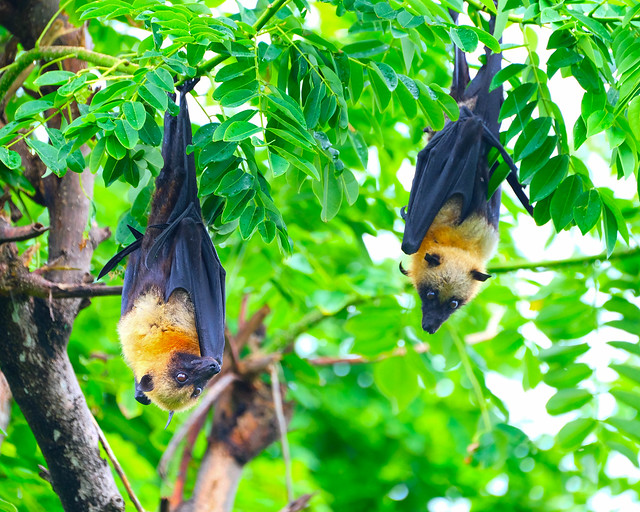
As the afternoon wore on, the bats started returning from their day in the forest searching for fruit, and here’s a pair.
Anne and I noticed that as they arrived and started to settle in for the night, some would appear to skim the surface of the Indian Ocean. Sure enough, the fine folks at Nature Seychelles Conservation report that “close observations show that the bats dip their chests in the water as they fly over and then lick the water off when they roost,” and that “many Pteropus species are found in coastal areas and islands and have been seen drinking salt water” probably to “to supplement certain minerals lacking in their diet.”
I got out nice and early this morning and had the hotel grounds and its critters mostly to myself for a while, and my first sighting was a pair of common mynas, which I only saw for the first time just yesterday. This one let me get a nice detailed look at it, and then I turned to continue my search, but I soon heard the two excitedly discussion something.
When I turned back to see what they might be all excited about, I could not believe my eyes as this stunning creature emerged from a hole in the ground. I’ve never seen such a thing before, so I looked it up to find that it is a small Indian mongoose (Urva auropunctata). Will wonders ever cease?
Later, I even spotted two of them scurrying over the rocks by the water. What an absolute treat!
After breakfast, Anne and I went on a little tour along the southern edge of the island, and an early stop was at a mangrove swamp where we all saw a couple of great egrets, which are always beautiful, but my favorite sight was this young-looking striated heron (Butorides striata) creeping through the canopy. Some of you might be thinking, “doesn’t that look awfully similar to the green herons we see in Estabrook Park, and you are correct because I read that “this bird was long considered to be conspecific with the closely related North American species, the green heron, which is now usually separated as Butorides virescens.”
I see my posts have become discombobulated and out of order, but let’s press on. Comoros continues to amaze, and after dinner this evening, Anne and I walked down to the water to sit and watch the fruit bats come home to roost for the night. What a sight!
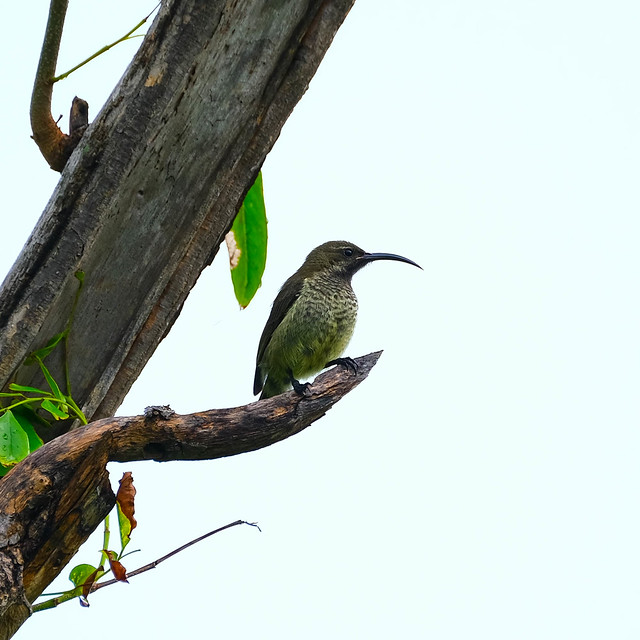
Anyway, new birds for today include this incredible sunbird, who might be a purple sunbird (Cinnyris asiaticus), but we are a bit out of their range, so I’m not sure yet.
Next, we have this bee-eater, my first one ever, and which may be a Madagascar bee-eater (Merops superciliosus). There were a few of them perched high in trees and making sorties to collect insects from the air.
This shy bird, in the same tree as the bee-eater above, but hiding under the canopy, is a bulbul, and I’m hoping that it is a Grande Comore bulbul (Hypsipetes parvirostris), because that would be my first endemic bird. The folks at ebird, however, say that they are “endemic to the middle and high elevations of the mountains of Grand Comoro,” and I spotted it at about sea level, so it is probably a Malagasy bulbul (Hypsipetes madagascariensis) instead. Oh well. Still crazy cool, right?
But wait! There’s more. Here’s my very first myna, a common myna (Acridotheres tristis). At one point, Anne and I saw at least a dozen of them foraging together in the grass.
Finally, I’ve gotta wrap this up because it is getting late, but not all the astounding creatures here have wings, and this is just one example. As far as I can tell, this is a Alticus anjouanae, which is a species of combtooth blenny for which Wikipedia appears not to have a common name. They are fish, but there were dozens of them hopping around on the rocks just above the waterline, munching on algae, I believe, and actively working to prevent the waves from washing them off.
Tomorrow, Anne and I are branching out from the capital city, Moroni, to see some sights on the east side of the island. Wish us luck!
I’ve got some time at the airport in Lilongwe with good connectivity and power, so let me show you a little more from Malawi in case conditions are not so good when we arrive in Comoros.
For a break from all the birds, here’s a vervet monkey from my visit to the Lilongwe Wildlife Centre yesterday. It was one of a large troupe monkeying around along the Namanthanga River.
Anne and I arrived in the tiny island nation of Comoros in the Indian Ocean this afternoon, and things got off to an interesting start. The jet parked right in front of the shiny new terminal building, we exited out onto the tarmac, we were instructed to hike instead to the old terminal building a few hundred yards to the south, and then skies opened up. Anne and I did our best to hustle with our luggage, but we were both pretty soaked as we went through passport control and immigration. At least I kept my camera bag dry. Ha!
But the show must go on, and so we took a taxi to the hotel Anne picked out for us, we checked in, we stepped out the back to check out the ocean view, and I saw the weirdest looking bird flap lazily by. The body looked at least as big as a Cooper’s hawk and almost as big as a red-tailed hawk. It was the most incongruous sight.
I said to Anne, “that looks like a giant bat!”
Sure enough, we didn’t have to wait long before we saw a couple perch in a nearby tree so we could get a better look.
As it got closer to sunset, they became more and more plentiful, and we estimated that there were as many as a couple dozen flying or perching over the grounds around the hotel. I read that they can weigh “approximately 600g, and can have a wingspan of up to 1.1m long.”
Finally, to wrap up on a more traditional note, Anne also spotted this stunner, a red fody (Foudia madagascariensis), just hanging out on a palm frond about 20 feet away. The light was getting pretty low by then, so the image is real grainy and the red runs together, but I think you get the idea. Comoros is amazing!
Sorry about skipping another day, but there was a lot going on yesterday, and I never had a good time with both connectivity and power. I did see more great birds, however, and I’ll be able to show them to you eventually. Today, Anne and I are flying to Comoros for the next phase of our trip, and here’s a darling black-and-white mannikin (Spermestes bicolor) to keep you company until I can post again. We saw bronze mannikins when we were here last October, but this is my first black-and-white.
For comparison, here’s another bronze from the same location.






 Signs of Life in Estabrook Park