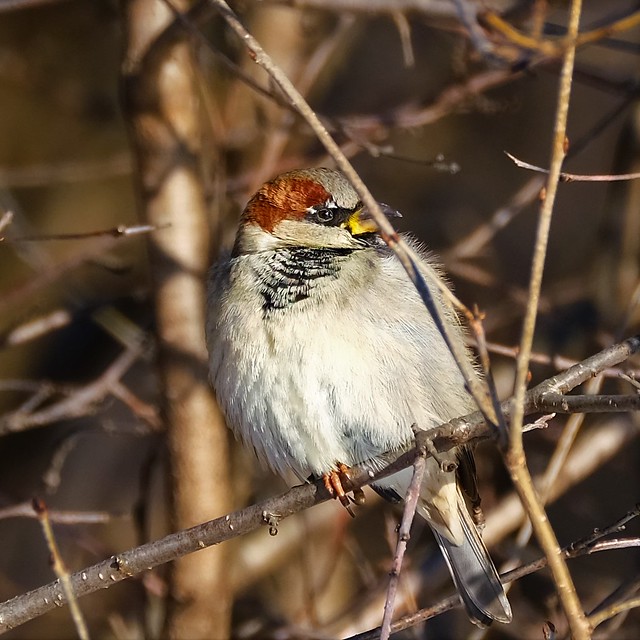
A Satisfactory South Holland Saturday

Well, I’ve been here for over a month, and I now have a local bank account into which I got paid and from which I paid my rent for July, so it looks like they’re going to let me stay a while. That’s cool ’cause now that I’ve had a taste, I’d like to see how this whole experiment turns out.

We had a beautiful morning here today, and my first stop was at the stork nest, where the chicks look healthy and appear even to be showing a little sibling rivalry.

DSCF4328
DSCF4330
DSCF4341

There were new butterflies out today, and here’s a beautifully earth-toned, female “meadow brown” (Maniola jurtina) feeding on a thistle blossom on the berm between the bike path and the canal.

DSCF4444

I also spotted another new bird for us, this shy Eurasian wren (Troglodytes troglodytes), who look just like the wrens we see in Estabrook Park. I am stunned to read that it is “the only member of the wren family Troglodytidae found in Eurasia and Africa (Maghreb).” Heck, we have at least three different species in Estabrook: the house, the winter, and the marsh.

DSCF4298

The goldfinches were out again, and this handsome devil struck a pose on the edge of an honest-to-goodness thatched roof.

DSCF4337

I finally found a male blackbird willing to sit for a portrait to go with the image of a female I showed you from my first day here.

DSCF4345

And I finally found a common moorhen with her chick.

DSCF4472

There’s more, but I’m gonna try to spread them out over a few days. Wish me luck and watch this space.

Fun with Names!

It did rain last night, as forecast, but the skies were mostly clear by morning, so out I went again. This time a female tufted duck was the first to greet me with a photo-op. I do see them around, from time to time, but I haven’t taken a picture of one since staying by the Kralingse Plas back in May.

I checked in on the storks again and found one parent and two chicks at home. You can see one chick peeking over the rim of the nest to help mom or dad keep eyes on me.

The stork nest is in the back yard of a house in a row of nice houses, and I often find little birds in the front yards. Here’s another white wagtail on someone’s garden path.

Here finally is a new bird for us, and I’m pretty sure it’s a song thrush (Turdus philomelos), although it might be a mistle thrush. I don’t recall seeing one before, but I spotted three different ones today. Oddly, it is in the same genus, Turdus, as the American robin, but the thrushes we see in Estabrook, the hermit thrushes and Swainson’s thrushes are not. Instead, they are in the genus Catharus. And, yes, this will all be on the final exam.

The front yards were busy this morning, and here’s another new bird for us, a dunnock (Prunella modularis) aka hedge accentor, hedge sparrow or hedge warbler. Ebird describes it as a “rather drab but distinctive little bird: note slender, thrush-like bill (not stout, like superficially similar sparrows).”

There was no sign of human activity this morning in any of the houses or yards in that row, but I didn’t want to hang out with binoculars and a long lens for long enough to cause some, so I tore myself away and continued on to the open water, which was still teaming with bar-tailed godwits. Here’s the one with the best pose this morning.

Across the bike path from the open water, a bunch of little birds was foraging in a long hedge of trees, which look like they might be mulberries, and this was the best picture I could get. I believe it is either a marsh tit (Parus palustris) or willow tit (Parus montanus) a great tit (Parus major), but the picture is not good enough to distinguish between the two. Next time. In any case, it’s in the same family, Paridae, as the black-capped chickadees in Estabrook.

I didn’t see any new waders today, and I had to go back by the row of houses anyway, so I stopped to see if there was anyone new around, and that’s when I saw this spotted flycatcher (Muscicapa striata) flying sorties from and returning to the same spot on a branch, just like the flycatchers and phoebes in Estabrook Park. It’s an “Old World flycatcher“, however, so isn’t even in the same family, despite the “superficial” resemblance.

Then I finally struck gold in the form of this colorful European goldfinch (Carduelis carduelis). I’d been catching glimpses of that bright yellow wing for a while, but this is the first time I got a good look at one, let alone getting anything on “film”.

It rivals the chaffinch, doesn’t it? The guy who came up with “goldfinch”, however, must have felt like an idiot after he got a load of the American goldfinch. He should have gone with Ewijk finch, since the village of Ewijk uses the same, white-orange-yellow-and-black, color scheme in their flag.

As I continued to make my way back to Delft, I spotted another bird of prey in the distance, and its large size, brown and white feathers, dark eyes, yellow and dark beak leads me to believe it is a common buzzard (Buteo buteo).

In more crazy naming confusion, as the Pedia of Wik explains, members of the genus Buteo, are called “buzzards” in the Old World and “hawks” in the New World. Meanwhile the New World turkey vulture (Cathartes aura) is also known in some North American regions as the turkey buzzard (or just buzzard). Sheesh!

After the buzzard, I figured I was done for the morning, and I put my camera back in my backpack, but it didn’t take long before I had to take it back out again for another Swedish blue domestic hen with a fresh batch of nine (9!) ducklings.

Meanwhile, right behind me, on the other side of the bike path, a spoonbill was busy foraging a lot closer to me than the previous one did, so here you go. Go ahead and count those feathers.

DSCF4291
DSCF4283

WordPress wouldn’t let me upload these last two images because it claims I’ve used up the full 13GB of storage that comes with my subscription, so I’m trying something new. I’ve uploaded the images to my flickr account instead and just gave WordPress the url for each of them. They look fine now, as I edit this post, and I’ll be curious to hear if you can tell the difference.

Weekend Waders

The clouds were pretty low and grey this morning but at least they weren’t leaking, so I rode out to the countryside to see what I could see, and I was soon greeted by this young great spotted woodpecker (Dendrocopos major) rustling up some breakfast in a birch tree that has seen better days.

With the red patch on the top of its head, instead of on the back of its head, it almost tricked me into thinking it was a lesser spotted woodpecker instead, but then I read that lessers don’t also have a red patch under their tail. Gatcha, big guy!

The similarity between the two black-and-white woodpeckers here reminds me of the hairy and downy woodpeckers in Estabrook Park. Oddly, it is the downy and lesser that are in the same genus, Dryobates, while the hairy and greater are each in separate genera, Leuconotopicus and Dendrocopos, respectively. Curious.

Anyway, moving on, I spotted one of the white storks, before I even reached their nest, with what looks like a beak full of dead grass.

And I guess it really needed that because off it went.

I didn’t get to see what happened to the clump of grass, but at the nest today you can really see how much smaller the chicks are than the adults, half-sized or less, even though they already have adult-looking white and black plumage.

Meanwhile, in the canal right behind me, this pool frog (Pelophylax lessonae), based on the light stripe down its back, stopped singing when I approached, but did let me see what it looks like, for the first time.

Check out the reflection in its pupil of me standing on the edge of the canal. Ha! My first Dutch self-portrait.

In another canal, I spotted a new duck, which appears to be a “Swedish Blue” domestic, and who perhaps is on maternity leave from some nearby barnyard…

’cause she had some ducklings in tow. I wonder if they know.

Out on the open water, a whole flock of godwits was busy foraging, I counted at least 50 birds, and I’m going with bar-tailed (Limosa lapponica) again.

Closer to shore, where the water is a bit shallower, a smaller group of common redshanks (Tringa totanus) was up to the same thing.

Even closer to shore, a pair of green sandpipers (Tringa ochropus) was helping to ensure that every niche was taken.

But that’s not all. There was even a solitary black-winged stilt (Himantopus himantopus) in the mix, my fourth wader of the morning!

To round up our wader count to five, here’s one more grey heron behind some tall grass on the edge of a canal.

Finally, on my ride back to Delft, I captured some images, at last, of an elegant common tern (Sterna hirundo) as it hovered briefly over a canal to fish.

I see that the forecast is for rain all night, but back to partly cloudy by sunrise, so maybe I’ll have another chance to get some pictures this weekend. Wish me luck.

Back in action after a brief Dutch Delay

Sorry about the pause, but I’ve moved into a new place again, I hope for the last time on this trip, and I don’t have to commute across the open fields between Rotterdam and Delft any more. Instead, I’ve now gotta decide to ride out there on purpose, ideally before work, and this was the morning that I finally got around to it.

Before we get to today’s pictures, however, I did manage a couple from a long bike ride out to Maasvlaktestrand on the coast this past Saturday with an old buddy. Here’s my best shot yet of a barnacle goose (Branta leucopsis), named after the barnacle from which there were believed to have come, if you can believe it. I’ve glimpsed one or two around here before but hadn’t been close enough for a presentable image until we came across a bunch on the berm between the bike path and a canal on the way back inland. I am astounded to read that they bread on the east shores of the Barents Sea and only winter here, unless they’ve gone feral. Cool.

The only other image I managed on that entire 90-km ride is this little holly blue butterfly (Celastrina argiolus) on a bush in downtown Rotterdam. I read that “in Europe, the first generation feeds mainly on the holly species Ilex aquifolium,” commonly known as common holly, English holly, European holly, or occasionally Christmas holly, hence the name I suppose, and it “is the national butterfly of Finland.

Meanwhile, it turns out that there are two stork chicks in the nest I finally spotted last weekend, both with black beaks, and they are growing up fast.

So fast, in fact, that here’s Mom or Dad, with a bright red beak and legs “from carotenoids in the[ir] diet,” getting some “me time” on a nearby chimney.

Back down on the water, there were a bunch of common cormorants, I counted six together at one point, all fishing in a canal together, and here are two of them. Their beaks are a bit bleached out in the image by the bright morning light.

Just above the cormorants, it appears that a pair of white-bellied barn swallow chicks have fledged, but were still lolling around expecting to be fed.

Lastly, the great crested grebe chicks continue to hatch, and here are a pair getting a ride on Mom or Dad’s back.

Sunset isn’t until after 10pm around here these days, and sunrise is before 5:30am, which doesn’t leave much time for my beauty rest, so we’ll just have to wait and see how often I make it out to the country side. The weather looks good for tomorrow, so wish me luck.

Delightful Dutch Weekend Overflow.

You may have noticed that I’ve been struggling a bit with little birds here. I think I’ve only shown you four so far, the chiffchaff, the sedge warbler, the reed bunting, and yesterday’s chaffinch.

The first excuse that pops into my head is that they are less flashy than the ones back home. Think of northern cardinals, Baltimore orioles, or almost any New World warbler. But then I spot a brightly colored one like the chaffinch yesterday, and I must admit that I just don’t know where to look yet, and it doesn’t help that all the trees are already leafed out.

In any case, this striking, little white wagtail (Motacilla alba) seems to have taken pity on me and posed right on the pavement where even I couldn’t miss it. Plus, it dawdled enough for me to get a pretty clean, if utilitarian, shot. Thanks, little buddy.

I spotted another massive stork nest, which I must have ridden past a dozen times before without noticing , and this one has not only an adult white stork (Ciconia ciconia) in it but also a little chick just peeking over the rim to see who’s staring at them now. Insert here your best joke about who brings stork babies.

Here’s one more view of a reed bunting.

And I finally caught one of the rose-ringed parakeet (Psittacula krameri), a controversial invasive species, that I’ve been glimpsing and hearing since the first day.

Here’s a third butterfly, from that same patch of thistles, and it looks to be a small skipper (Thymelicus sylvestris) or an Essex skipper (Thymelicus lineola), but I’m leaning towards “small skipper” because “the tips of the antenna are orange (best-viewed-head-on) and the black edge of the wings is sharply marked.” Either way, it holds its wings just like the many skippers in Estabrook, but you can’t see that very well in this picture.

Lastly, I was so excited to get one dragonfly photo yesterday, that I couldn’t believe my luck when this couple paused for a picture in the midst of their complex and precisely choreographed mating process. Yes, those really are two dragonflies, and no, they are not fighting.

Well, that’s the weekend roundup, and we’ll just have to see if I manage to get out during the week. Keep your fingers crossed.

Another Dutch Day of Sunshine

It was another beautiful morning in South Holland, so I hopped on my bike and headed into the countryside again. My first new find is this striking common chaffinch (Fringilla coelebs) finally posing perfectly after it made me chase it from perch to perch for a while. I read that chaffinch is “literally “chaff-finch,” so called for its habit of eating waste grain among the chaff on farms in winter.”

Here’s one more grey heron picture from yesterday when the sun was nice and low to give it that golden glow.

Also, from yesterday, here’s a common reed warbler (Acrocephalus scirpaceus) singing away, who looks just like the sedge warbler we’ve already seen, but without the eye stripe.

Here’s my first raptor. It’s not a great picture, but the brown on brown coloration makes me lean towards Eurasian marsh-harrier (Circus aeruginosus), which I have also seen hovering over the fields once in a while.

On that patch of thistle blossoms yesterday, there was also a single, slightly-roughed-up, painted lady butterfly (Vanessa cardui), “the most widespread of all butterfly species.” We’ve even seen them in Estabrook Park, and more than once!

I didn’t see any new butterflies this morning, but I did finally find a dragonfly taking a breather, and the blueish tail plus one black “spot” on each wing makes me think it might be the aptly-named black-tailed skimmer (Orthetrum cancellatum). Right?

I’d better stop there, for now, so that I have something to show you tomorrow, just in case this weather doesn’t hold.

More Dutch Details…

The planets aligned, and it was a nice sunny morning, for a change, and I had nothing else I had to do since the building in which I work is locked for the whole weekend, by policy, and I hear people need special permission to gain access. I could go to the library instead, but why risk it, right?

I’ve moved from Rotterdam to an Airbnb in Delft for the week, so my commute is now super short, but the best wildlife I’ve seen here so far has been in the fields between the two cities, so I headed out there when the sun rose.

I was very happy to spot a new bird, the common moorhen (Gallinula chloropus) aka waterhen or swamp chicken. They’re in the same family, Rallidae, the rails, as the Eurasian coots we’ve already seen. I read rail is the anglicized respelling of the French râle, from Old French rasle, from the Vulgar Latin rascula, from Latin rādere (“to scrape”), which is supposed to describe the sound they make. How’s that for a long walk?

I was surprised to spot more than one, since I haven’t seen one until now, and this one even had a chick with it, but the chick stayed further back into the reeds and so evaded my camera.

A godwit came out of the tall grass for a change, and this one appears to be a bar-tailed godwit (Limosa lapponica), based on the lack of orange in its beak, but in non-breeding plumage.

It turns out there are a lot of them if you can get to the right spot. The image below is a bit of a zoom-in, and the whole flock was easily twice this size.

There were also lapwings about, and this time, one also had a chick in tow.

Here’s a better image of the parent. That bit of iridescent green on its wing seems pretty consistent.

And finally, here’s a nice splash of color, a small tortoiseshell butterfly (Aglais urticae) feeding on the nectar of a batch of thistles growing beside the bike path. I read that they lay their eggs “on the common nettle, on which the larvae feed,” and I’ve got no complaint with that!

The only species in the genus Aglais that is found in North America is the fire-rim tortoiseshell or Milbert’s tortoiseshell (Aglais milberti) that I had the good fortune to spot in Yellowstone Park last summer. What are the odds?!?

Well, I’ve got some more pictures, but I’d better pace myself because who knows when I’ll get back out again to take more.

Another new bird and some new sights.

It’s a rainy Sunday afternoon in South Holland, and I’m in the library at TU Delft for the wifi and the comfortable working conditions. Despite the gloomy weather, I saw some fun scenes on my bike ride up from Rotterdam.

I was just riding a long and saw a big white bird land in the distance. I thought maybe it was an egret or even a stork, but when I finally spotted it down in a little canal between two fields, it turns out to be a Eurasian spoonbill (Platalea leucorodia)! Holy Living Eating Utensil, Batman! It was about 200 yards away, so really at the limit of my gear, but these images are at least good enough for a positive ID.

In the last image above, you can just make out the little morsel, at the left end of the stream of water droplets, it is tossing into its throat. I read that their “diet consists of aquatic insectsmollusksnewtscrustaceans, worms, leeches, frogs, tadpoles and small fish up to 10–15 cm (3.9–5.9 in) long.”

As I was intently focused on the bird, look who was horsing around in the background, a whole down of hares. Here’s four of them.

And here’s one taking a look to see who might be watching their cavorting.

Around the next corner and a bit further along, the path runs beside a larger canal, and as I rode by, I caught a glimpse of a sleeping great crested grebe. Even though I’ve gotten some pretty good images so far, I never know if I might be able to get a better one, and there is one in particular I’ve been hoping for. Well, today was my lucky day because here it is, a grebe chick on its mom’s back.

I was afraid that they’ve all gotten too big to snuggle with Mom, and this one isn’t tiny, but it’s clearly not too big yet, either.

Lastly, we’ve seen a lot of grey herons lately, and some of you may be thinking that you’ve seen enough or even too much, but this one let me get this nice portrait, so I just couldn’t resist.

Tomorrow is yet another holiday here in the Netherlands. This one is Whit Monday, the Monday after Whitsunday, also known as Pentecost, which marks the end of the Easter cycle that began with Ash Wednesday and the start of Lent. It’s supposed to rain all day tomorrow, so who knows when I’ll get to take pictures again, but I’ll be sure to post them when I do.

Time to get caught up…

It’s a rainy Saturday morning in Rotterdam, and I’m taking a break from bicycle riding to recover a bit from the recent big uptick in my daily mileage, so no new pictures today. Instead, here are some new sights from my ride back to Rotterdam from Delft yesterday evening.

First, I came across this pheasant hen at the edge of the bike path on the outskirts of Delft. She had a few chicks with her, but they hid much more effectively in the tall grass, so I have no chick-pix for you. Sorry. I was on a different route than I take in the morning, so I’m not sure that she knows the cock we saw Thursday, but maybe she does.

Then, as I approached the outskirts of Rotterdam, I caught a glimpse in the distance of this magnificent nest with a white stork (Ciconia ciconia) in it.

Okay. Now for some of the little birds that have been forming sort of a backlog, and the first I can identify is this reed bunting (Emberiza schoeniclus) perching on a reed just as you might expect a bird with that name would do. It is an “Old World bunting” and so not very closely related to “North American buntings“, to which the indigo buntings we see in Estabrook Park belong. In fact, the North American birds once grouped in the same family as Old World buntings are commonly known as sparrows. Way to keep it confusing, guys.

Next is a sedge warbler (Acrocephalus schoenobaenus) who was perched just like the reed bunting and singing up a storm!

And, if you guessed it’s probably an “Old World warbler“, you are correct! It is not even in the same family as “New World warblers.” Sheesh! I hope this stuff isn’t on the final exam!

Okay. Last one. I believe this is a common gull or sea mew (Larus canus) that was perched on the same roof ridge as the much-more-easily-identified black-headed gull from earlier in the week.

Well, that’s the roundup for now. I’ve gotta go to Delft tomorrow anyway, so maybe I’ll get out to the countryside early again and see what’s new to see. I’ll keep you posted.

Dutch countryside action scenes!

I’m starting to get quite a backlog of little birds that I still need to identify, but in the meantime, it was a beautiful morning to ride across the Dutch countryside, and I caught some interesting scenes of birds we’ve already seen.

First, I finally found a mute swan with cygnets, and these ones sure don’t look like “ugly ducklings.”

Here’s a grey heron with a crayfish it just snagged out of a little canal.

And here’s another grey heron that just snagged a duckling.

Just as I was thinking to myself “hmmm. I haven’t seen any wild mammals yet,” a pair of hares reminded me that I have been seeing some European hares (Lepus europaeus), and here’s one of them. They look a little lankier than the eastern cottontails we’ve seen in Estabrook.

Finally, here are a pair of white-bellied barn swallows pausing for a second after foraging over a canal and before swooping up under a little bridge to feed there chicks. By comparison, the ones I’ve seen nesting under the Port Washington Road bridge and foraging over the Milwaukee River in Estabrook Park have a distinctly “off-white” or “tawny” bellies.

You can just make out a beak full of bugs on the one below.

I read, in the usual spot, that “the barn swallow (Hirundo rustica) is the most widespread species of swallow in the world. In fact, it appears to have the largest natural distribution of any of the world’s passerine, ranging over 251 million square kilometres globally.”

Further, “in Anglophone Europe it is just called the swallow; in northern Europe it is the only common species called a “swallow” rather than a “martin“.”