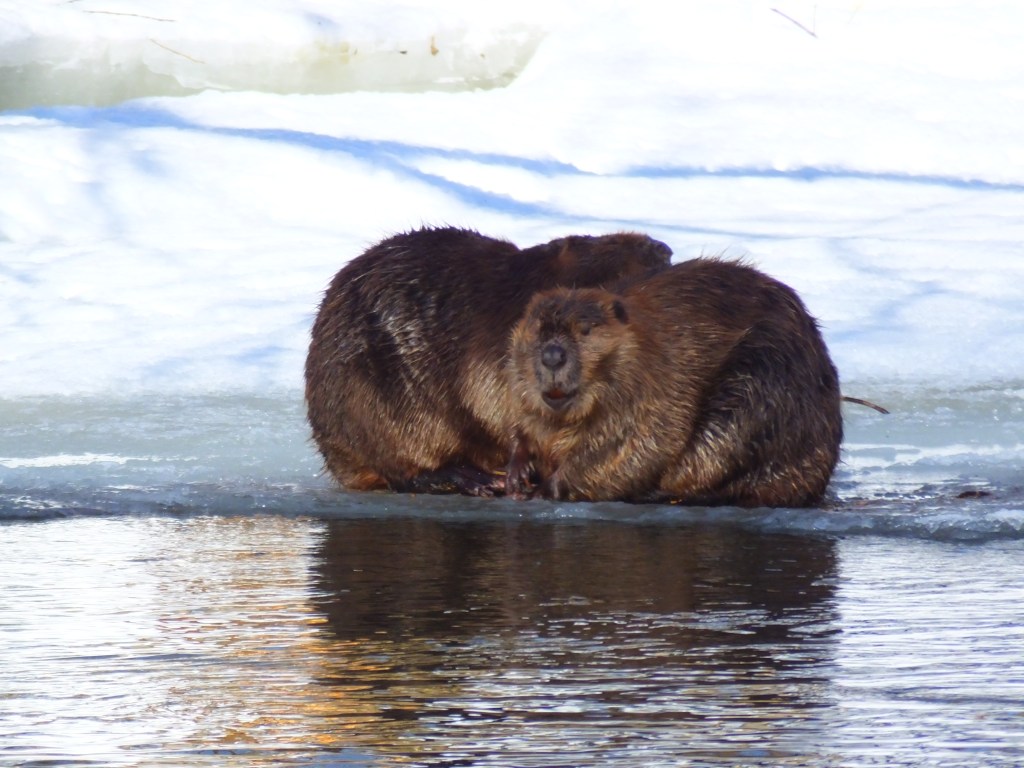
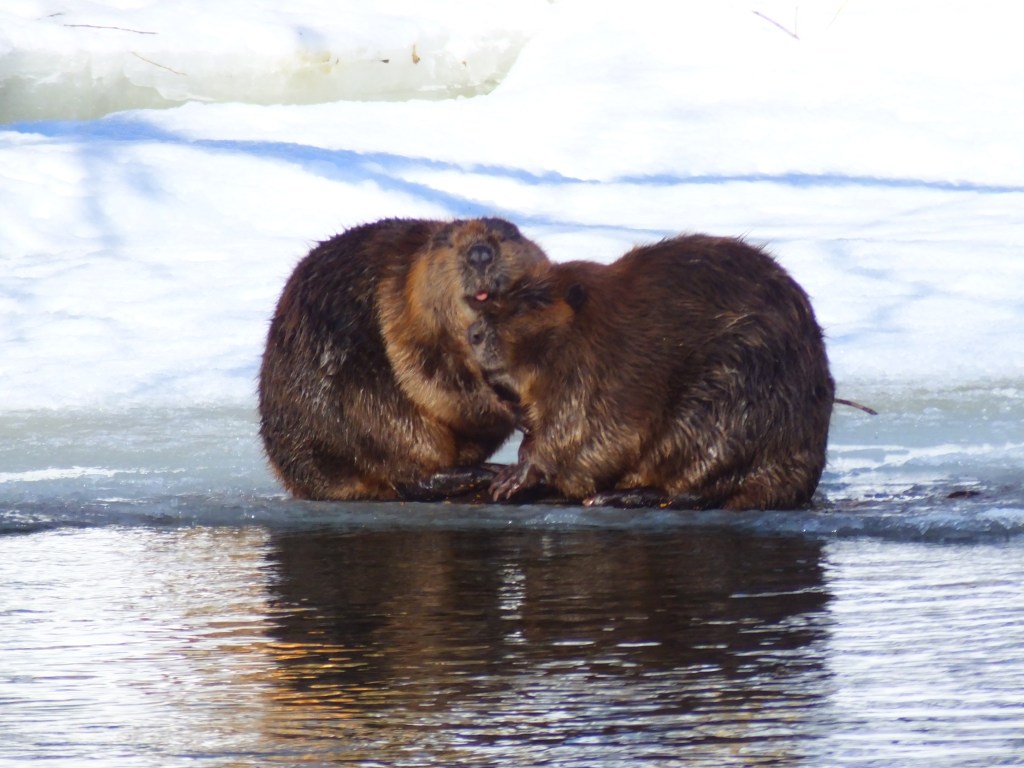
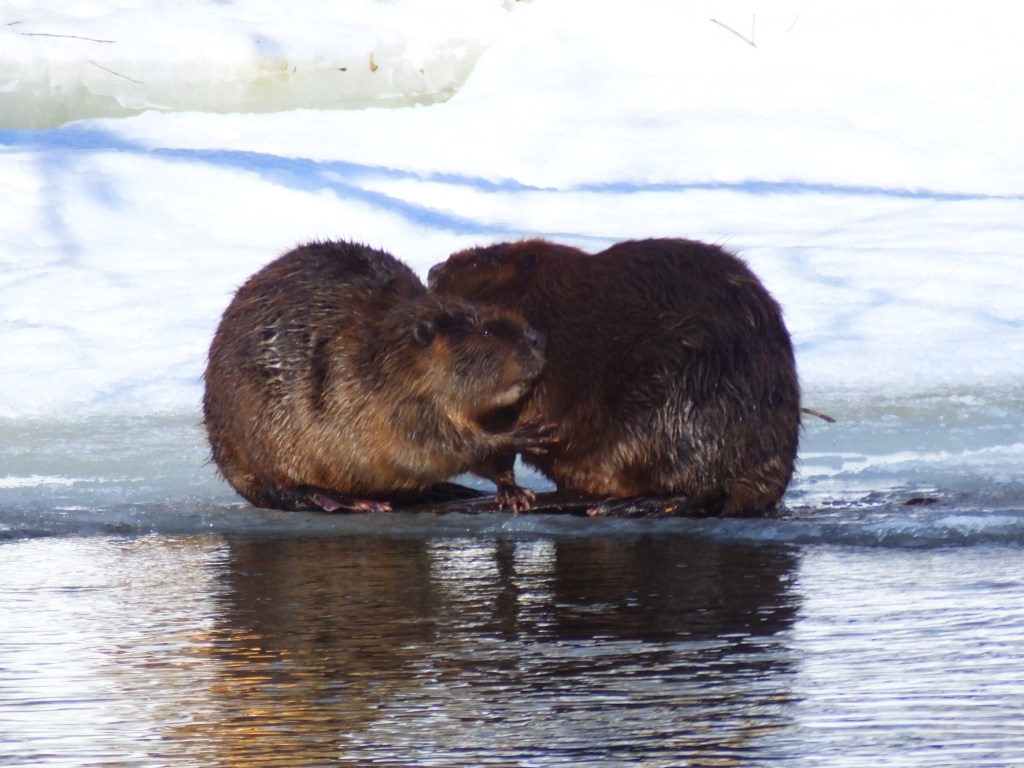
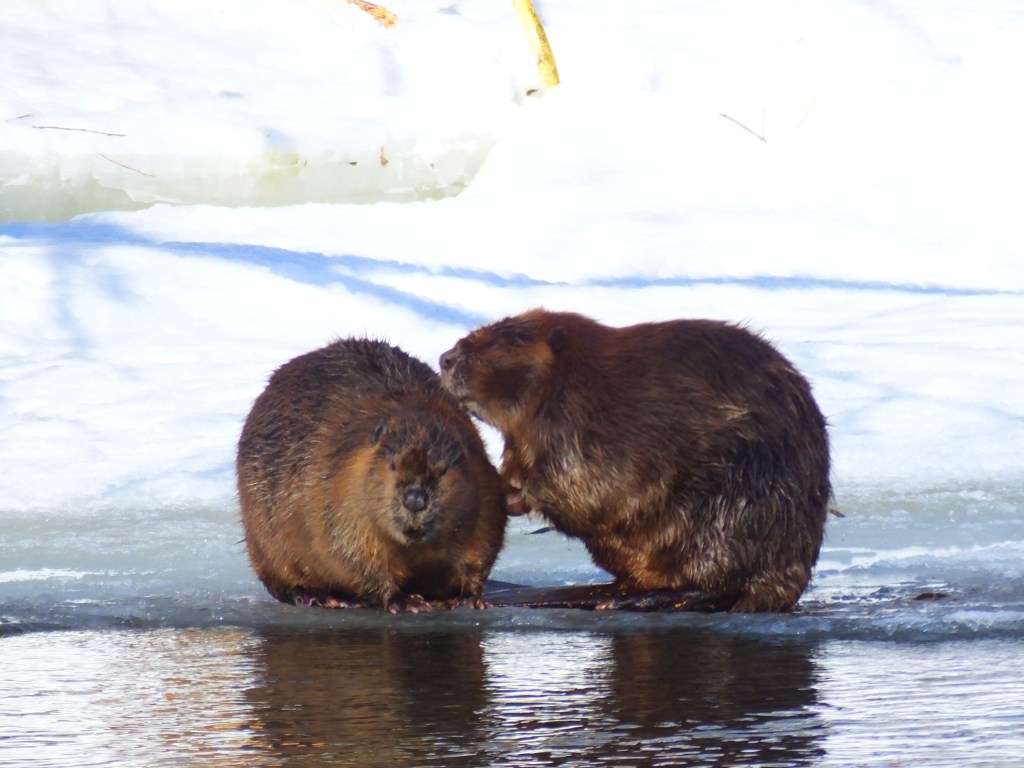
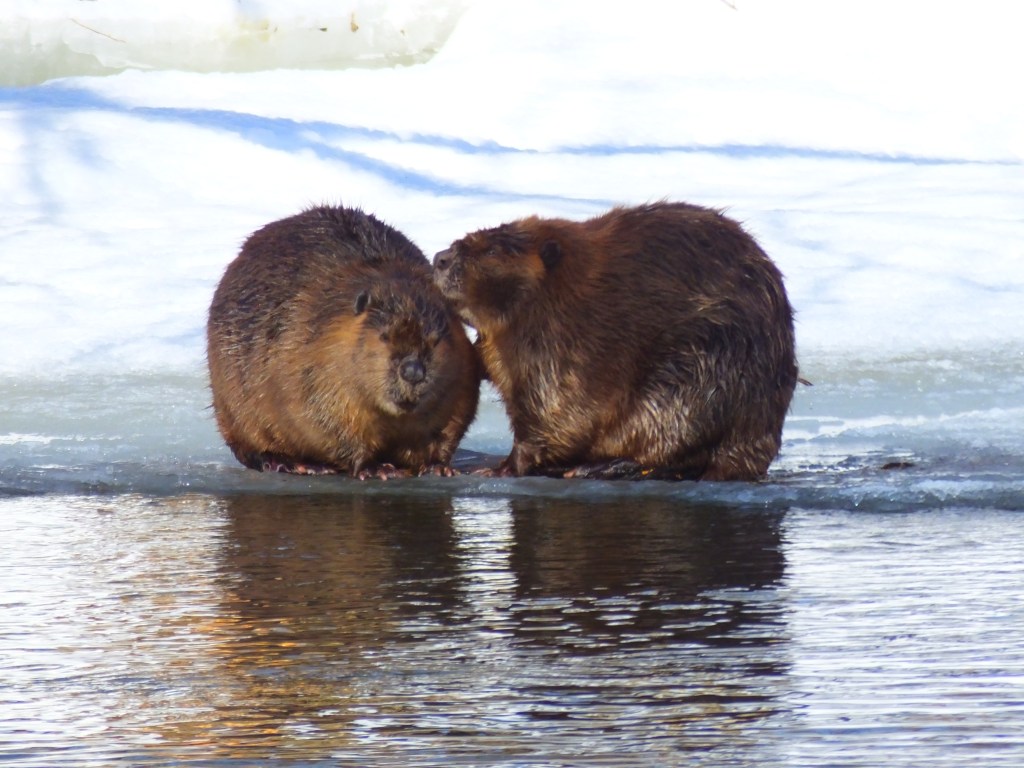
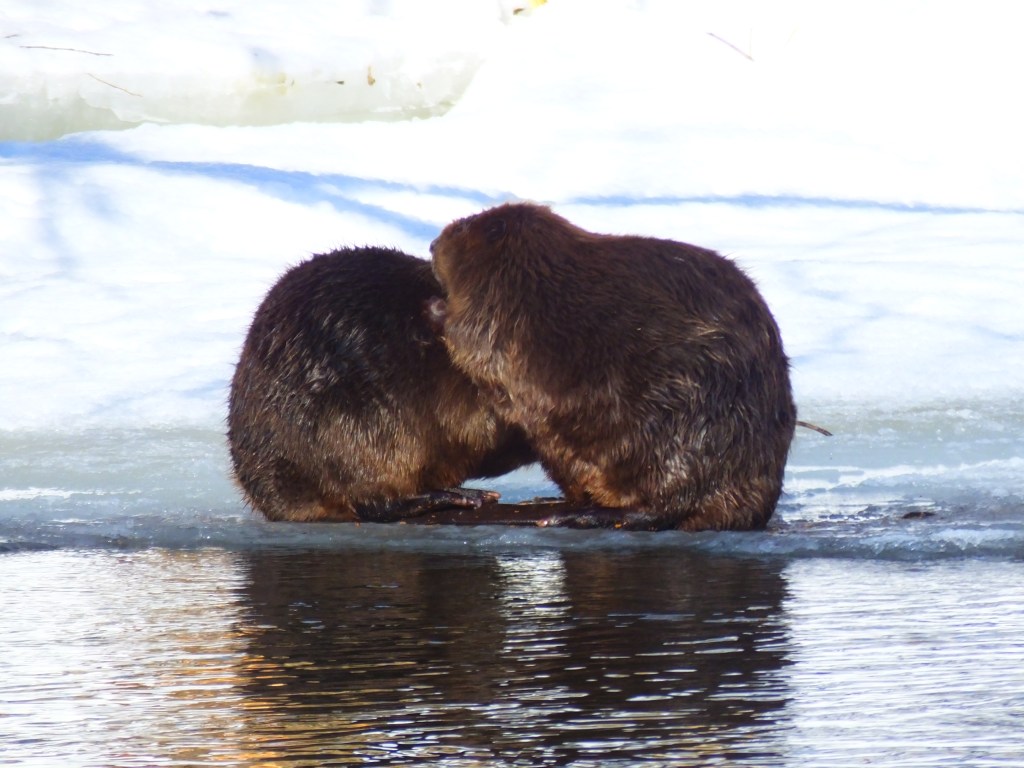
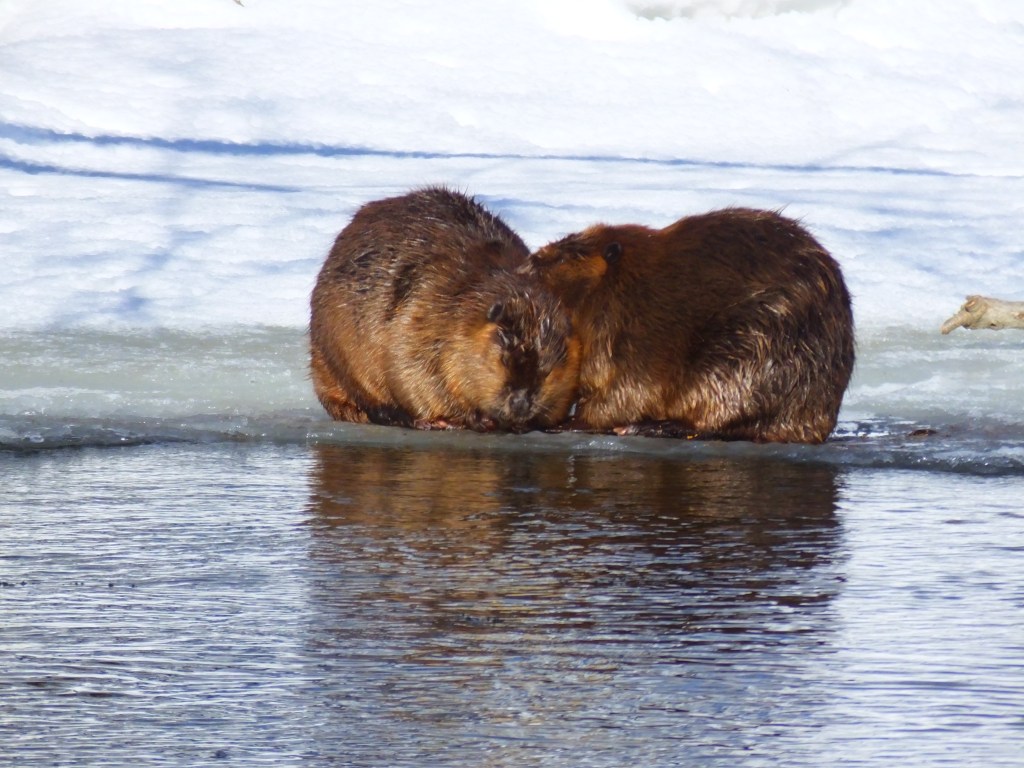
The one beaver we saw on Sunday must have reported back to the burrow that the deep freeze has indeed broken because today there were two of them, seeming to nuzzle and snooze together on the river ice in the bright morning sun.
Sorry for all the pictures. I can’t decide which is the cutest.
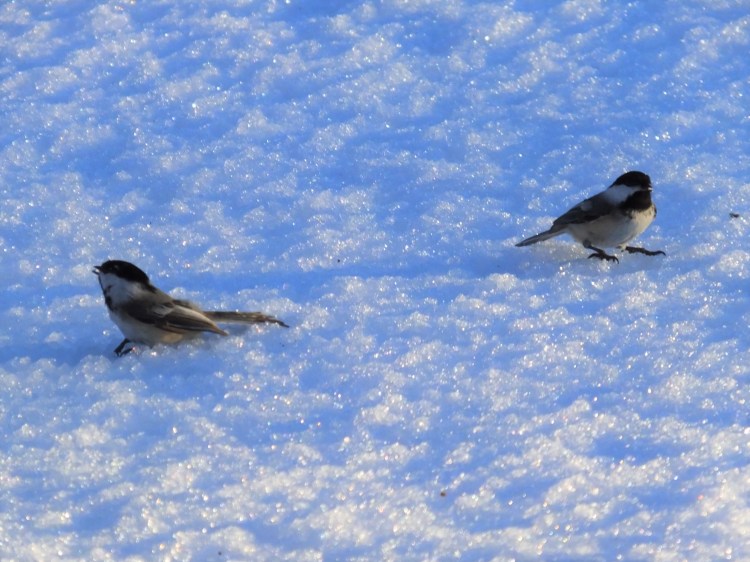
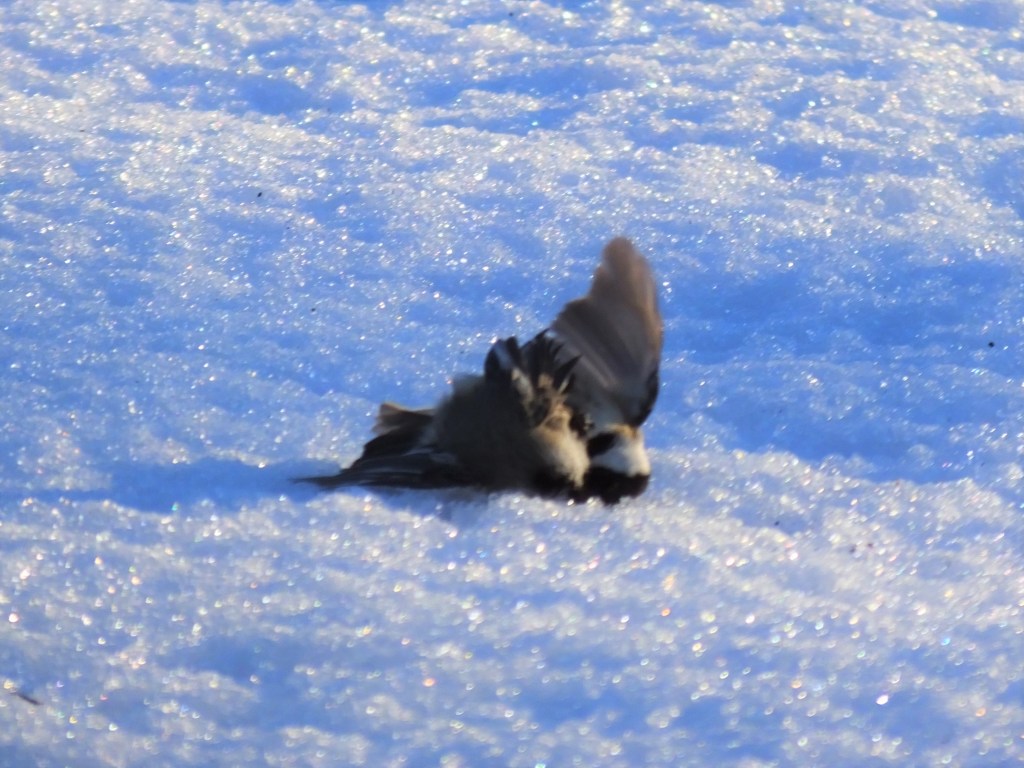
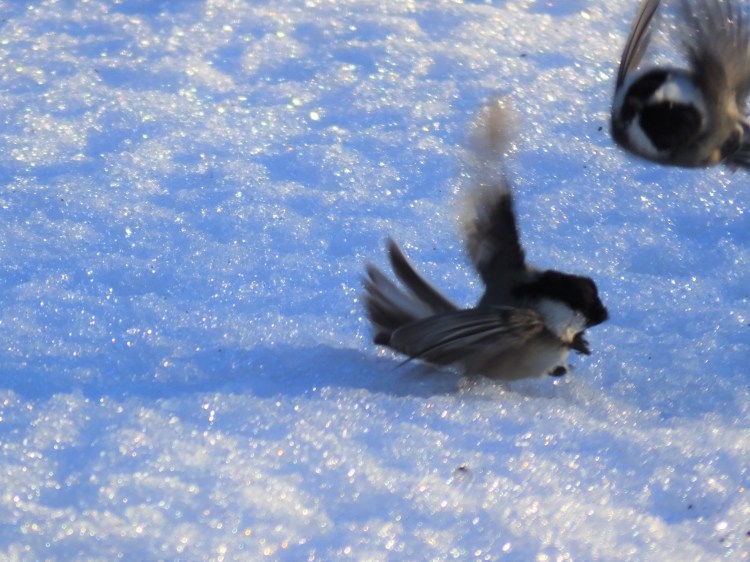
And the beaver are not the only ones who appear to have noticed a change in the weather. Here are a pair of chickadees who thought it was warm enough to wrestle in the snow!
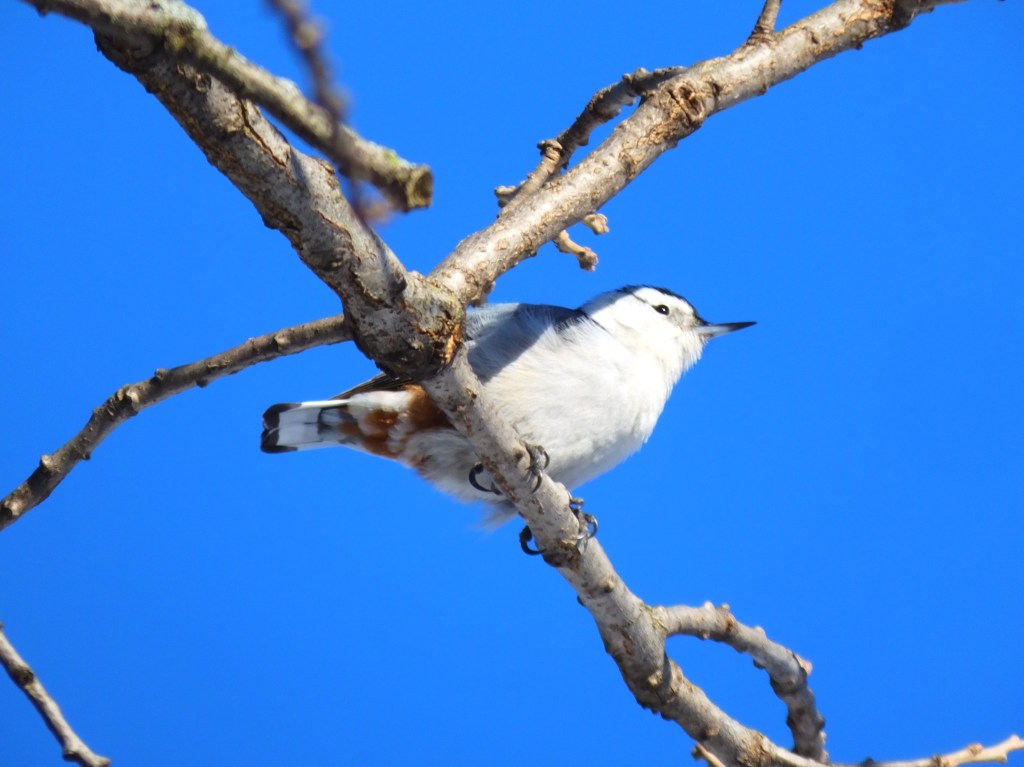
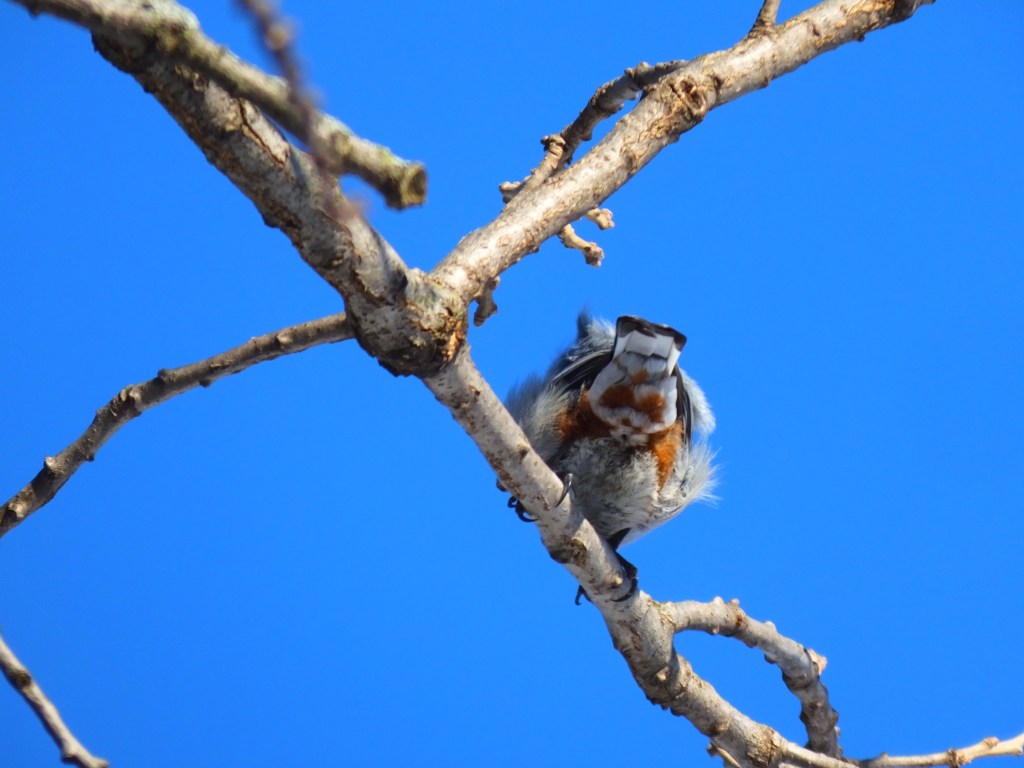
Here’s a pretty little nuthatch who was paying far more attention to its other three companions flitting around in the tree than to me.
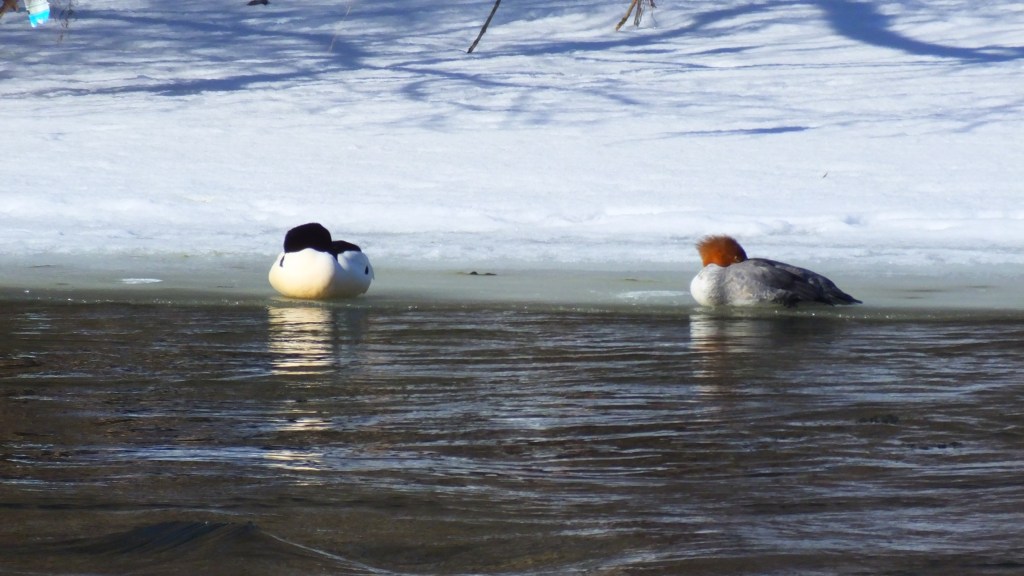
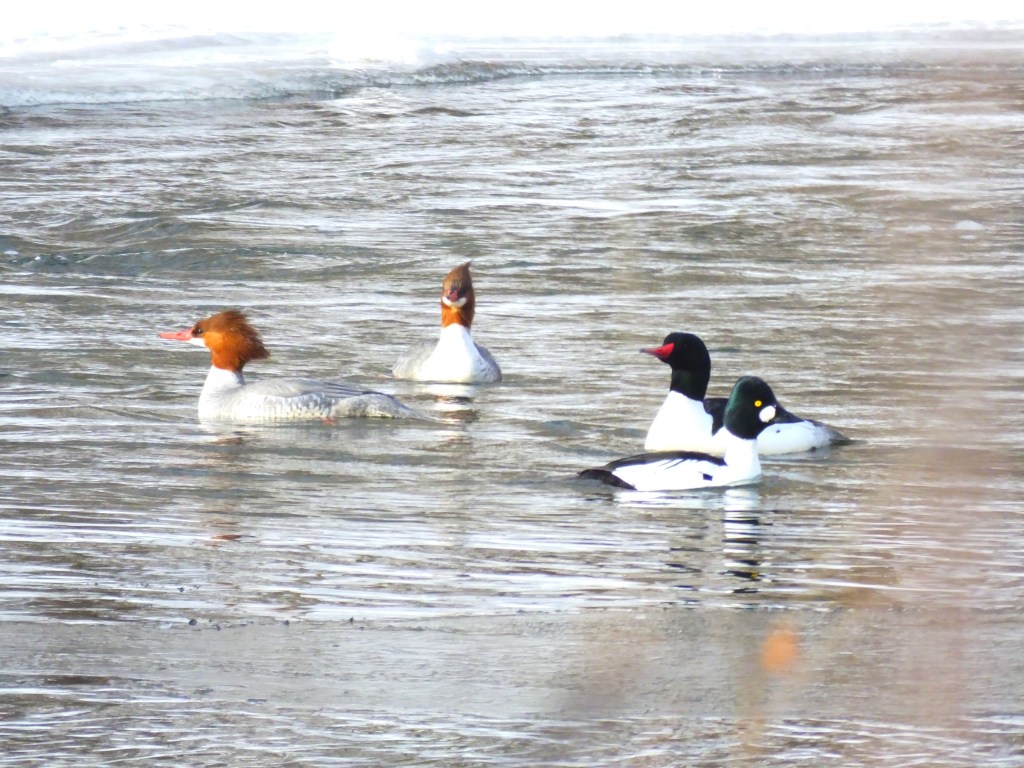
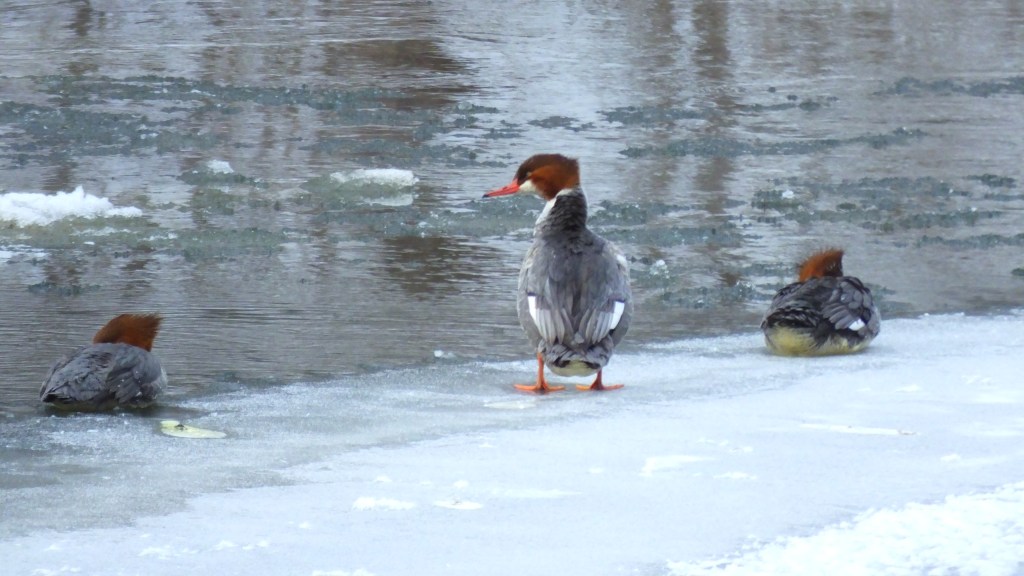
Here’s a pair of common mergansers also enjoying a snooze on the ice in the sun, although I did catch her keeping tabs on what I was doing across the river.
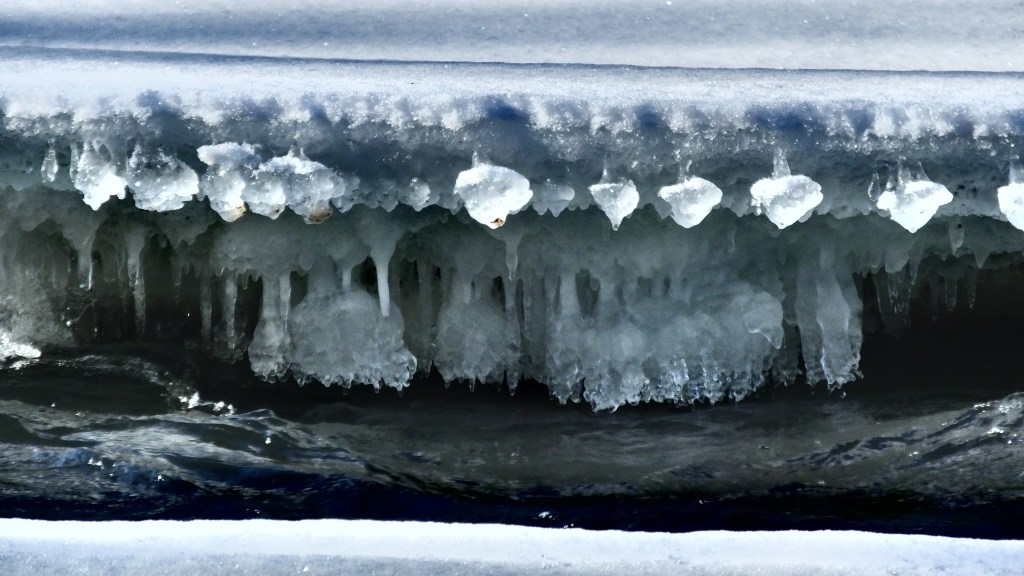
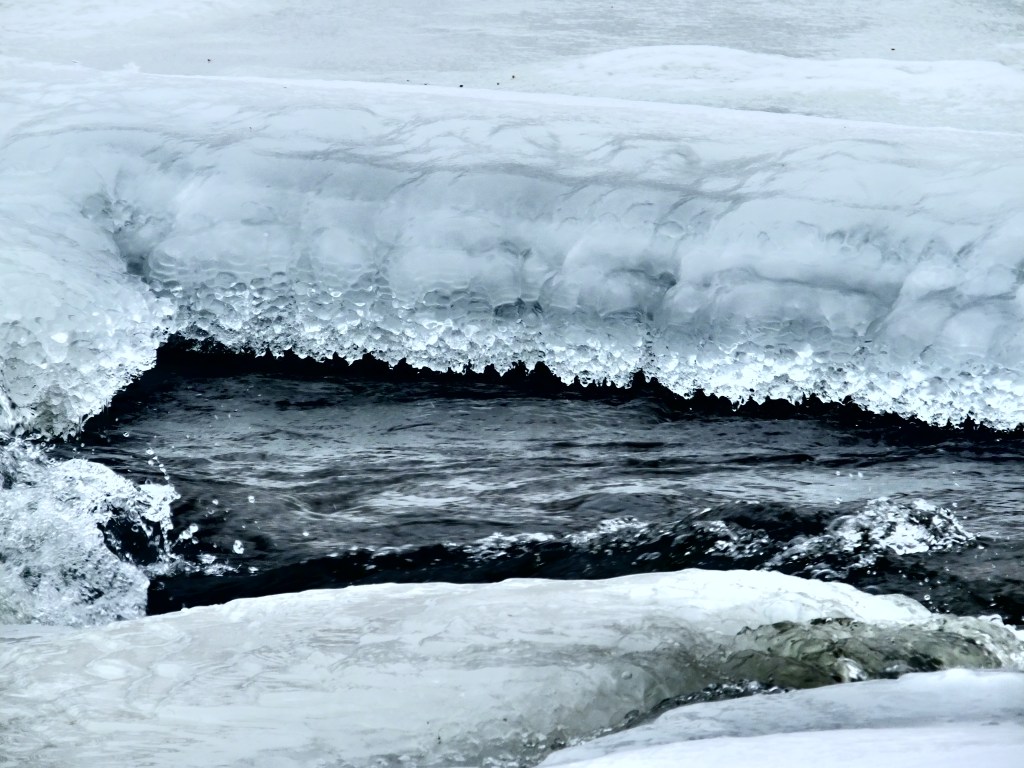
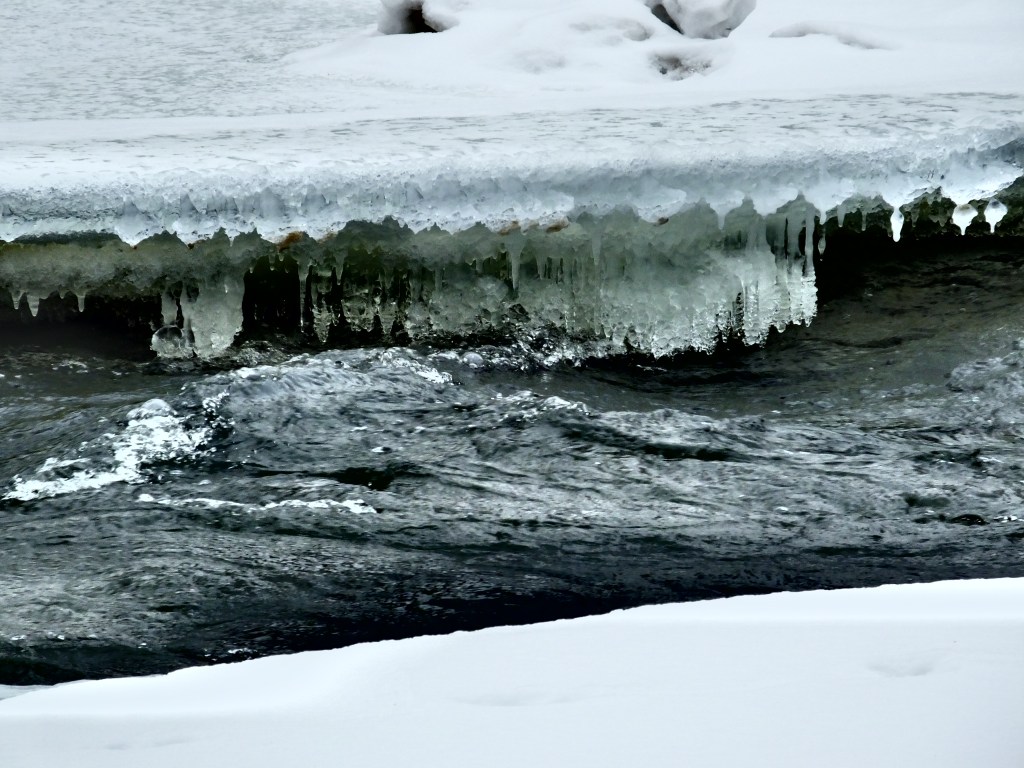
By popular demand, here’s your art-shot of some fancy river ice that can’t seem to decide whether it is freezing or thawing.
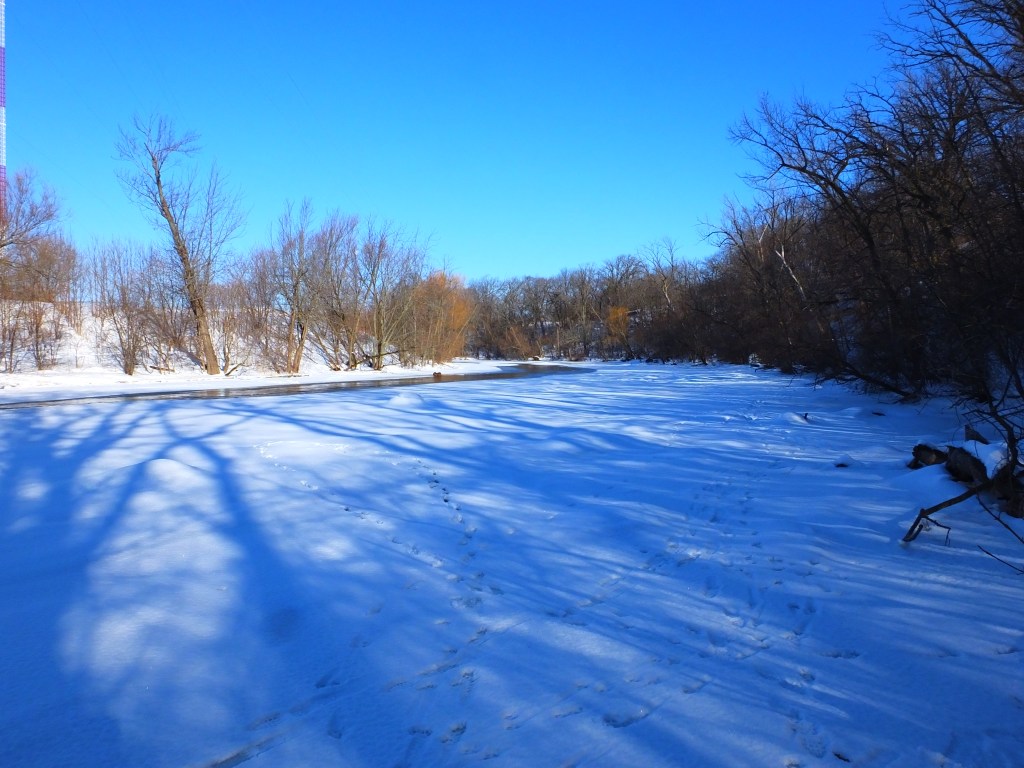
Finally, here a shot of the whole river “valley” with the two beaver just to the left of dead center. Still plenty of ice left, but I stayed off of it today, mostly.
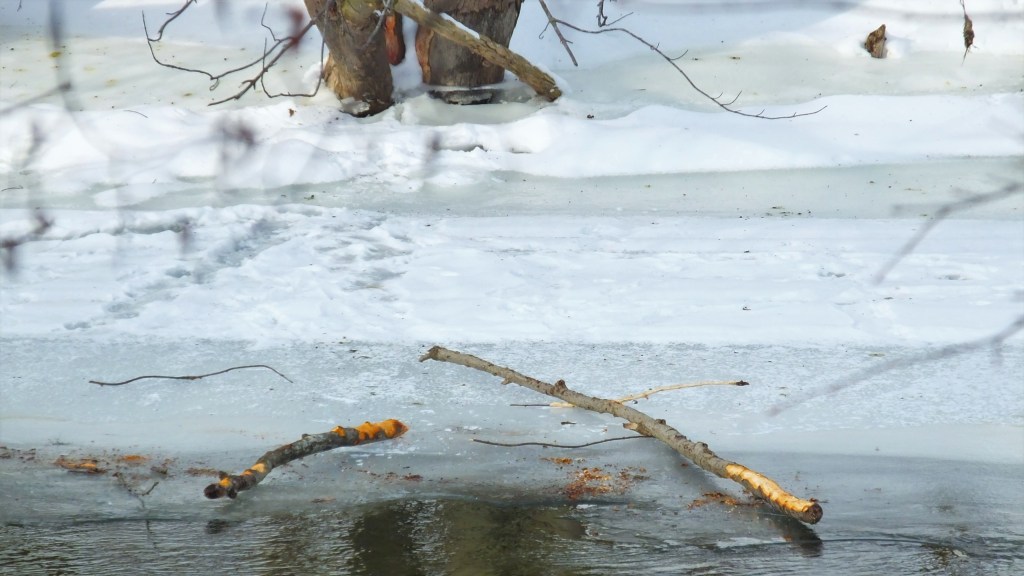
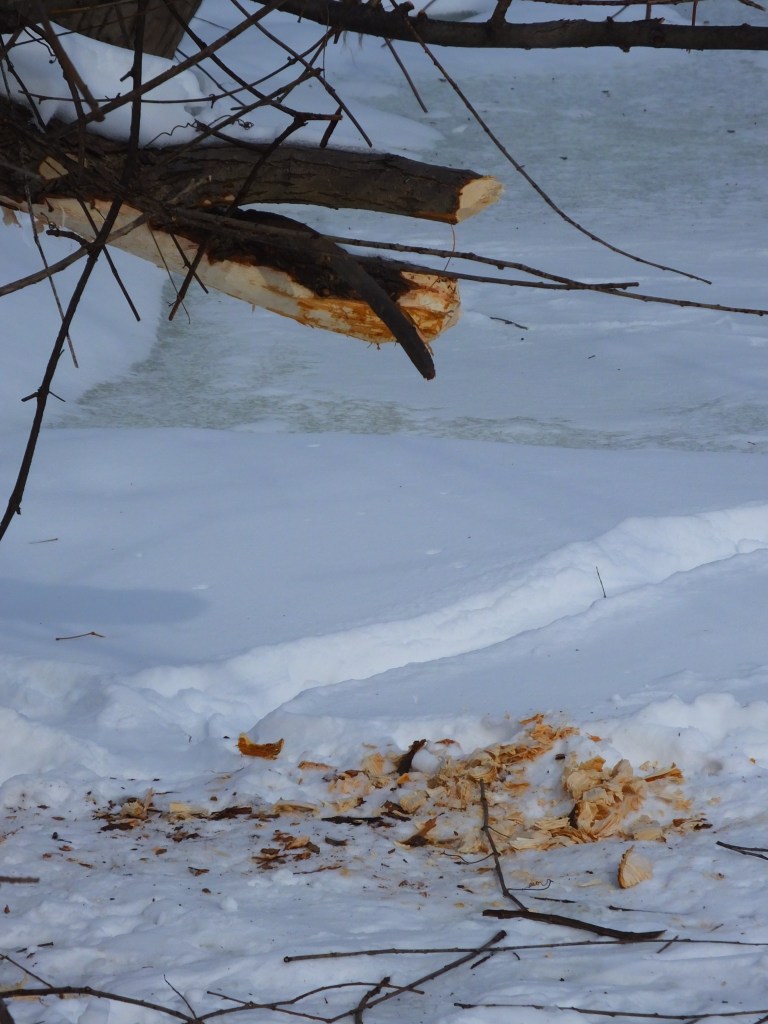
And they are hungry! As our long deep freeze finally eases up, the beaver, who we haven’t seen even a single wood chip from since December, finally ventured out last night, and they left freshly cut and debarked logs on the ice in at least four locations along the lower river. Since I walked on the ice for much of the river yesterday, I can confidently assert that these were not there then.
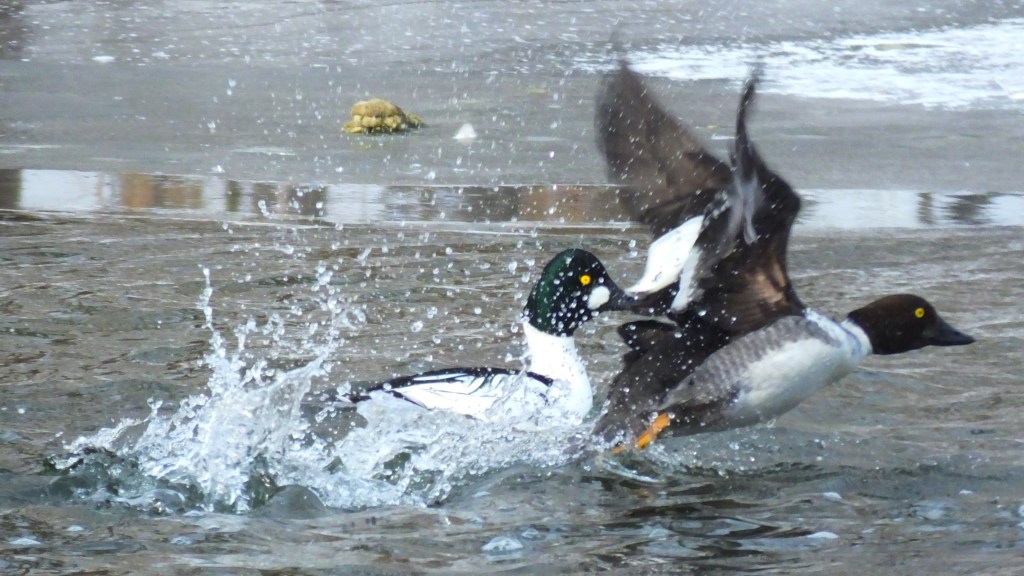
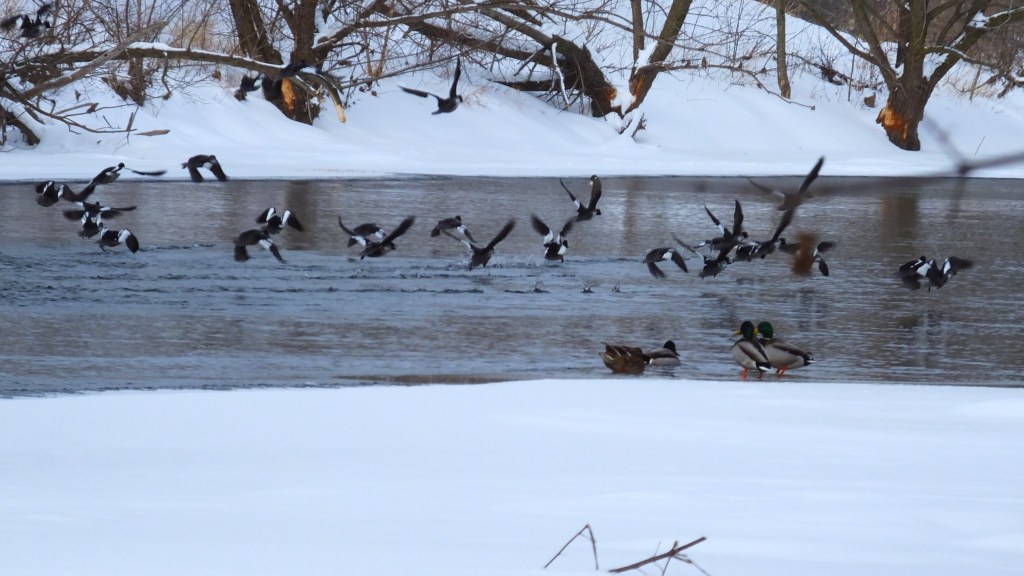
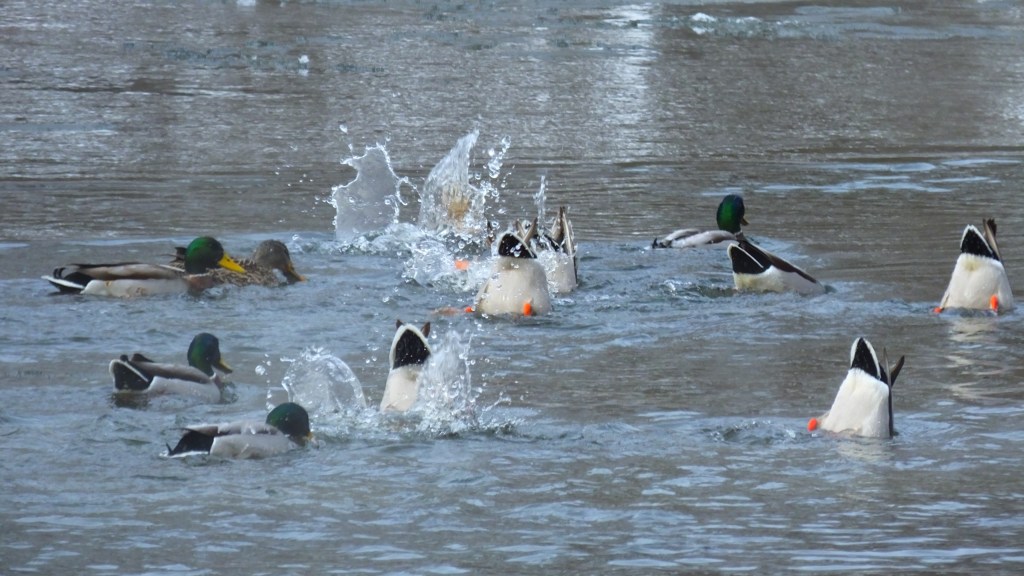
Check out the crazy ducks. For the first time, I’m not focusing on them, and they perform like rock stars!
Anyway, all the sites were on the other side of the river, and I wanted to get a closer look, to see if there were tracks, so I hiked across the ice, even after telling myself when I set out this morning I’d better stay off the ice today after how warm it was yesterday afternoon and last night. I got about 90% of the way across on the first attempt, and the ice started to feel a little punky, so I turned around and tried again further upstream where someone has helpfully strung a rope from side to side.
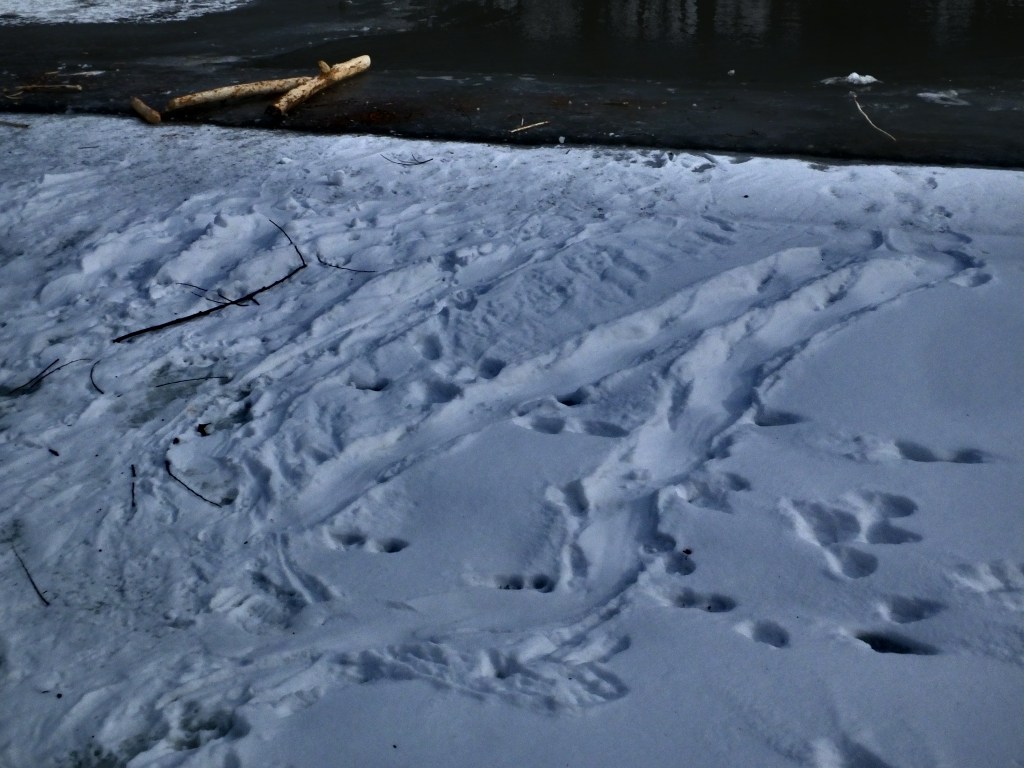
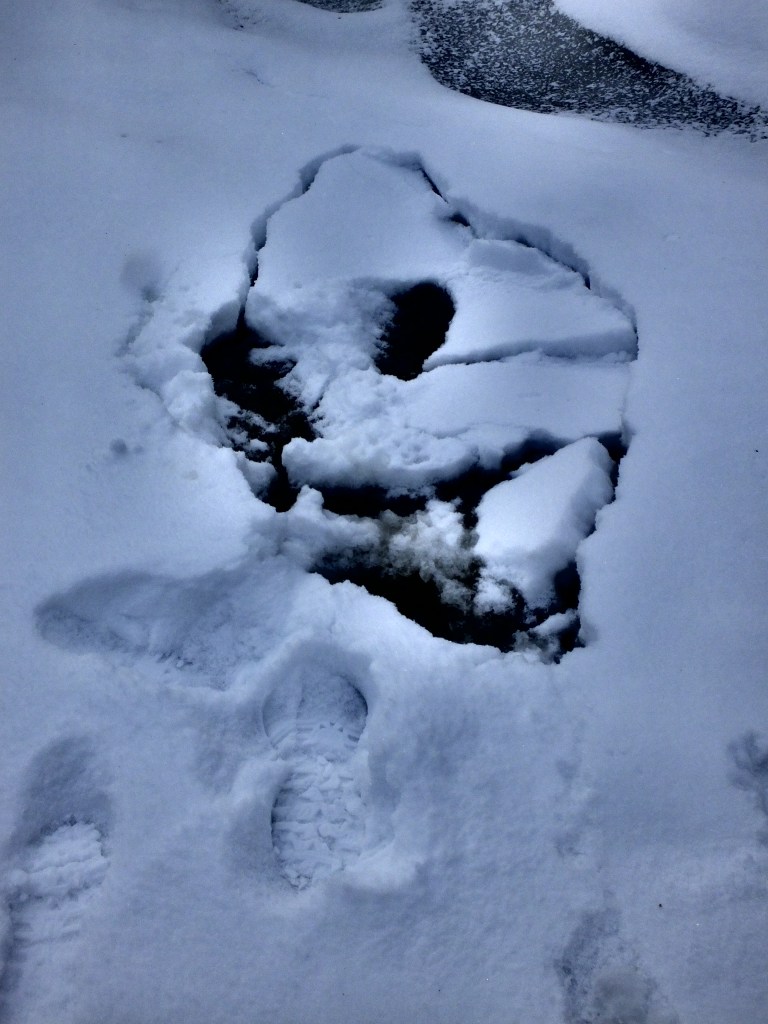
On the other side, I believe I can now confirmed who left that mystery track in the snow we saw yesterday. The lack of foot prints either beside or behind was what perplexed me. Now I’m confident that beaver cover their own tracks in the snow with that fancy tail they drag behind.
I also confirmed that the ice is indeed not safe. Ha! Sometimes science requires getting your feet wet, right? Luckily, that’s all it was, and the nice gaiters Carl got me worked surprisingly well to keep most of the water out. It pays to be quick, though.
Better yet, I spotted an actual beaver up on the ice a bit down stream, and I’ll spare you the details of how I managed to totally flub that shot.
Instead, since I was already on the other side for the first time in years, I decided to see what there was to see and hike up to Port Washington road to cross back over safely on the bridge. As I came back down the other side, it finally dawned on me that maybe the beaver I saw, who was hungry enough to come out to feed in broad daylight, might still be that hungry. Then I made a beeline back down to the lower river.
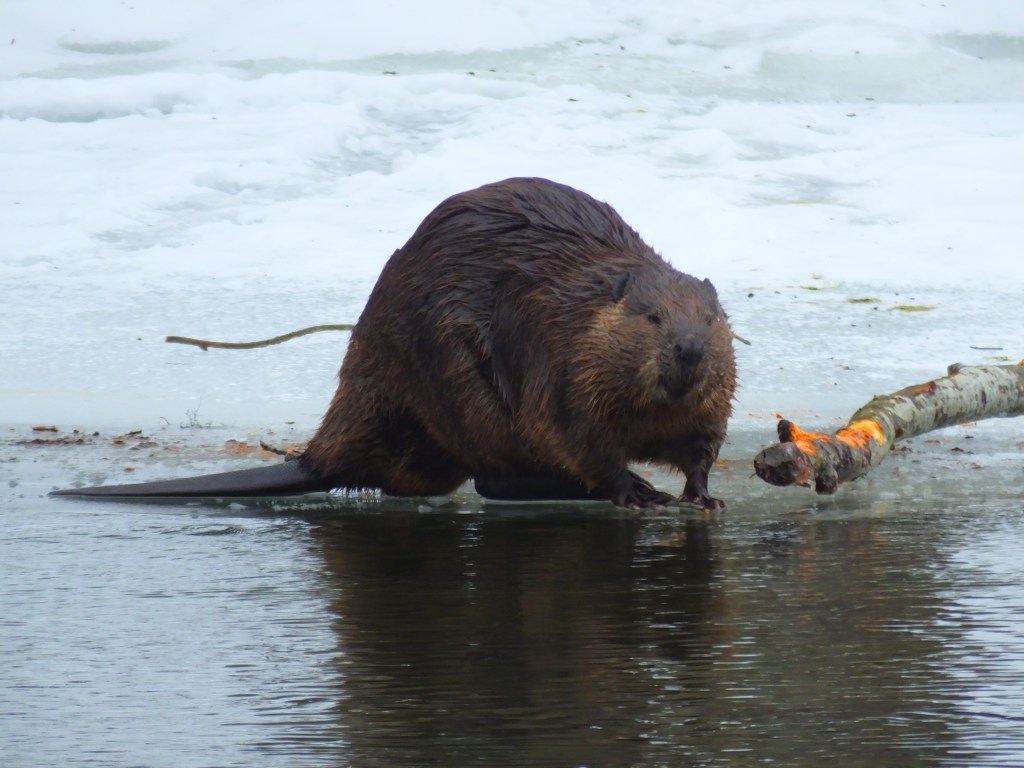
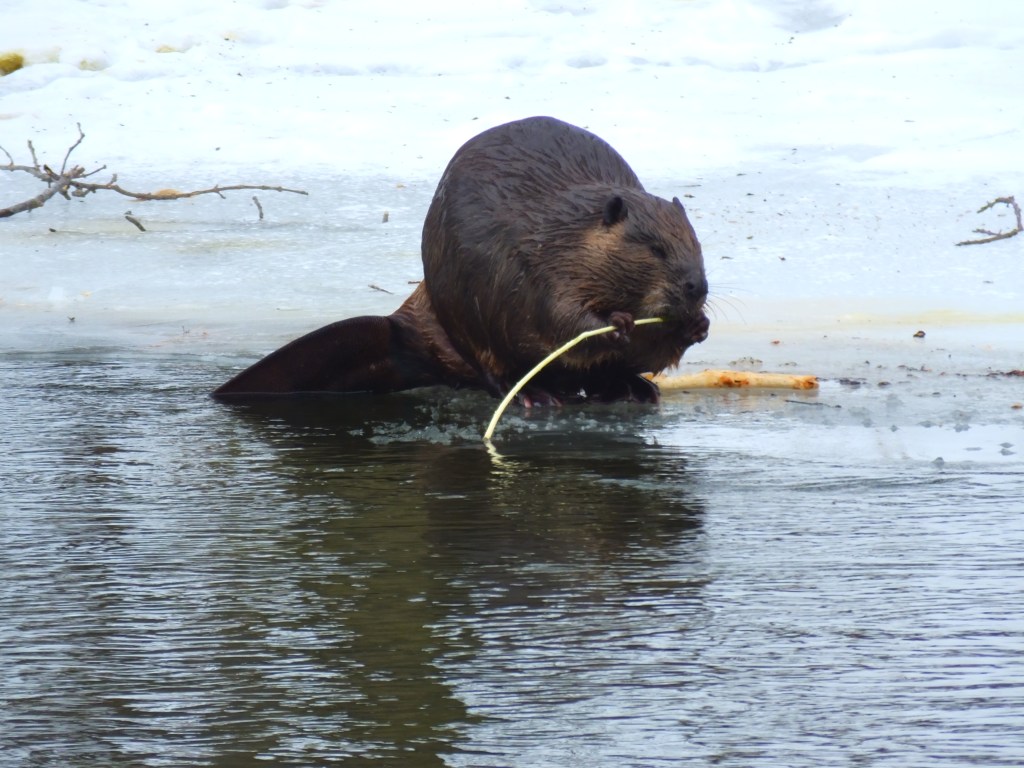
And sure enough, there it was back up on the ice on the west side. I needed all the zoom I have, and I tried every setting my camera had to capture a dark brown animal against bright white snow under a bright white sky. These will have to do for now.
I can only think of one time before that I’ve ever seen beaver live, and that was in the water last summer, so I had no idea how they behave on land. If you’ve ever seen a video of a sloth, that would give you some idea about how this one behaved, and I was grateful for all the time it allowed me.
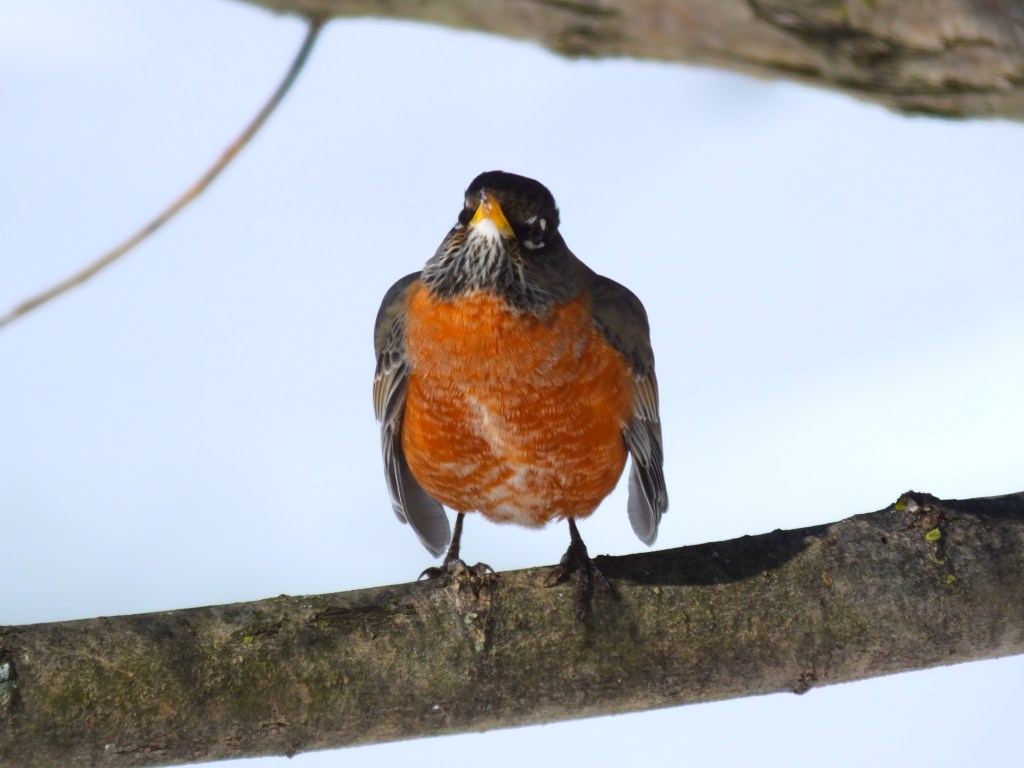
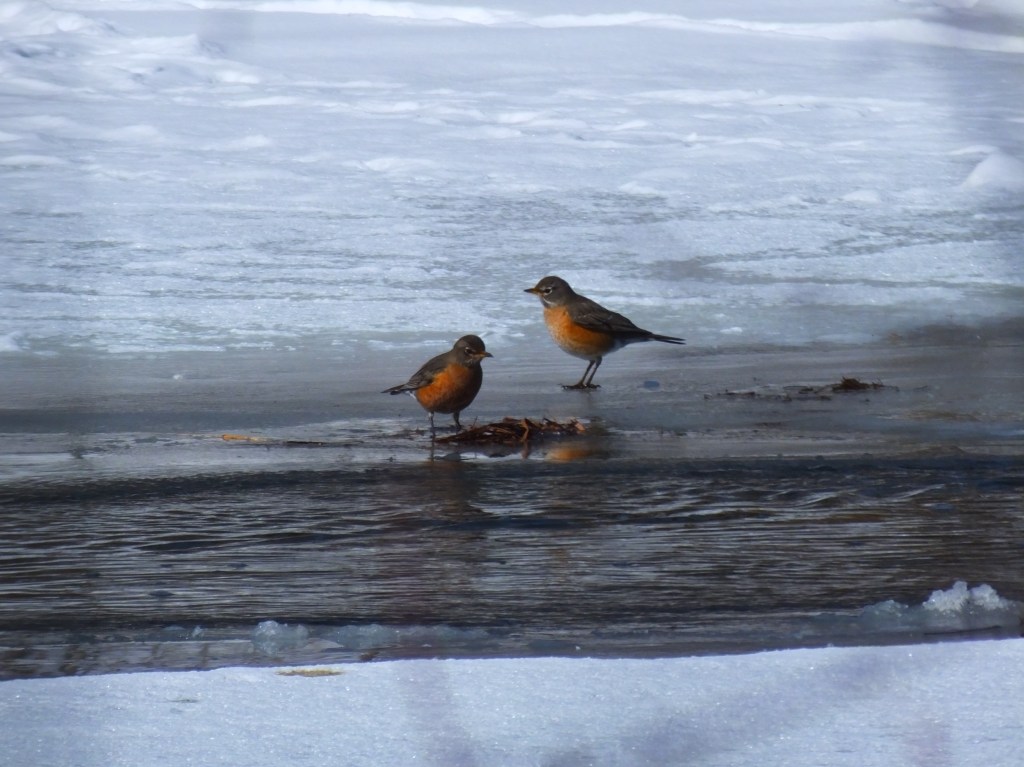
It turns out, you will probably not be stunned to learn, that beaver were not the only hungry ones out and about today. The seeps are finally thawed and flowing again, and this robin was right down into one looking for something good to eat.
It was a day so nice, I had to go out in it twice, and boy, what a difference 20 degrees makes! This morning, I wore two pairs of gloves, and this afternoon, I wore none.
With last night being probably our last deep freeze, I figured it was today or never to walk up river on the ice. What a treat that was.
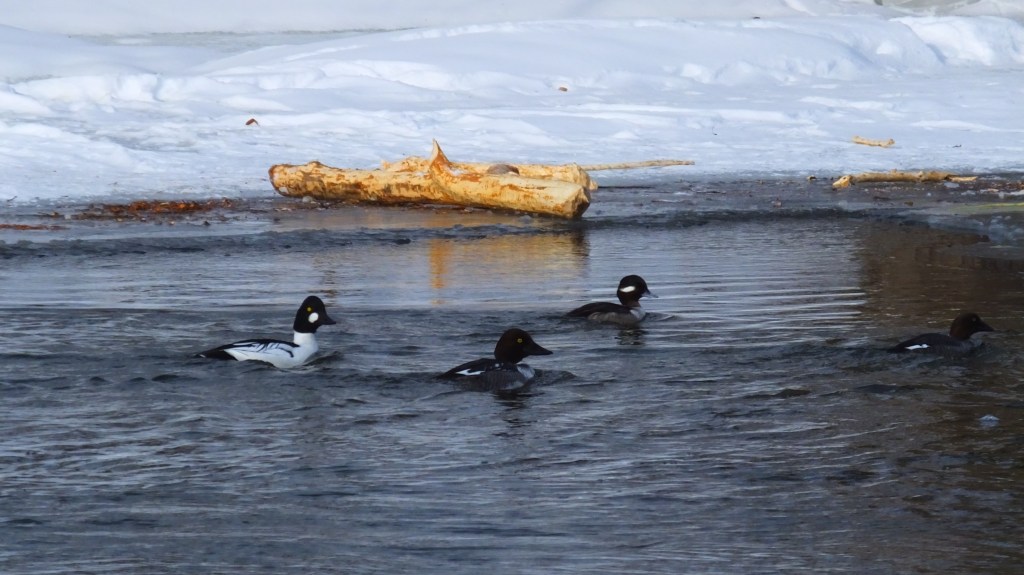
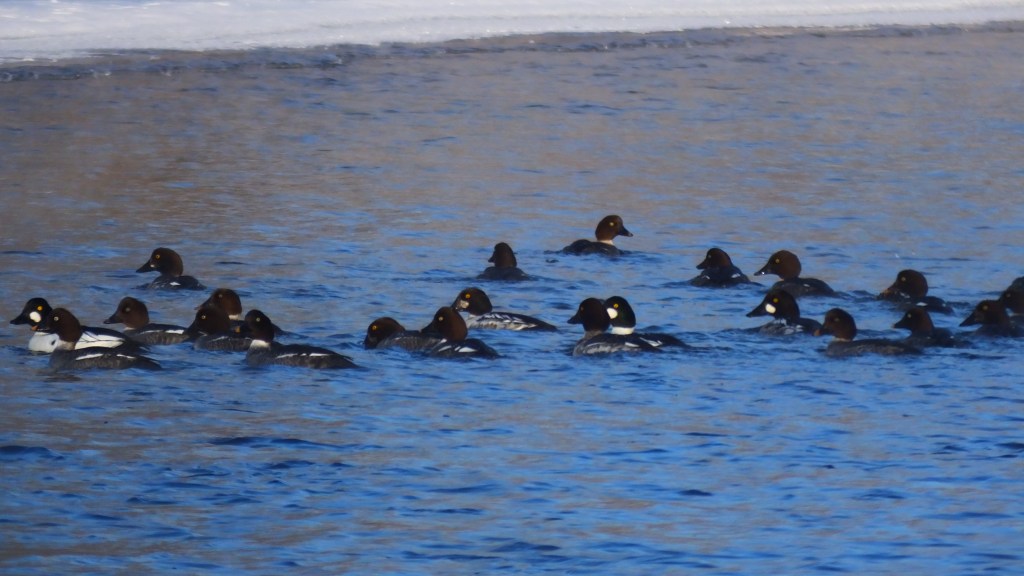
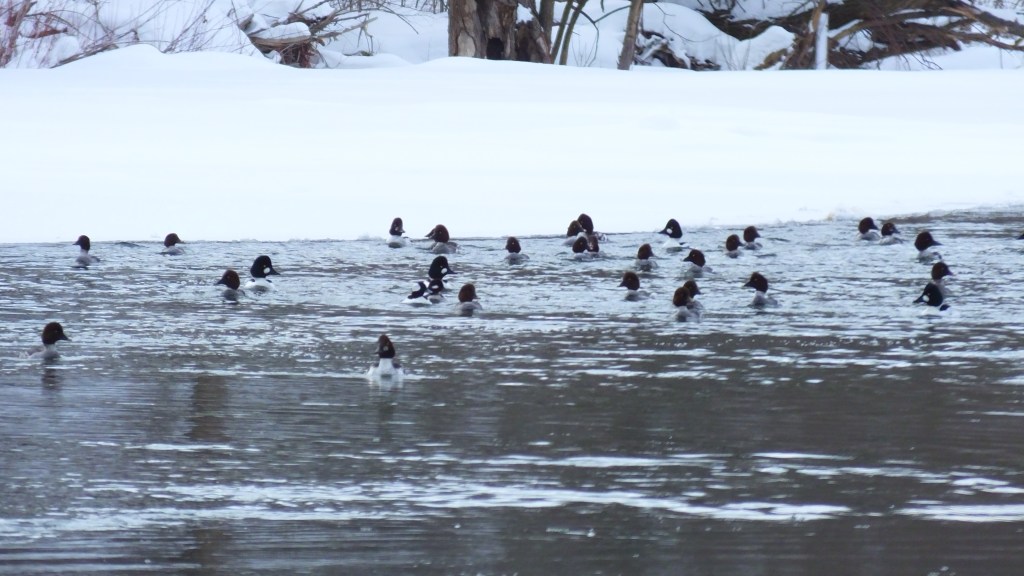
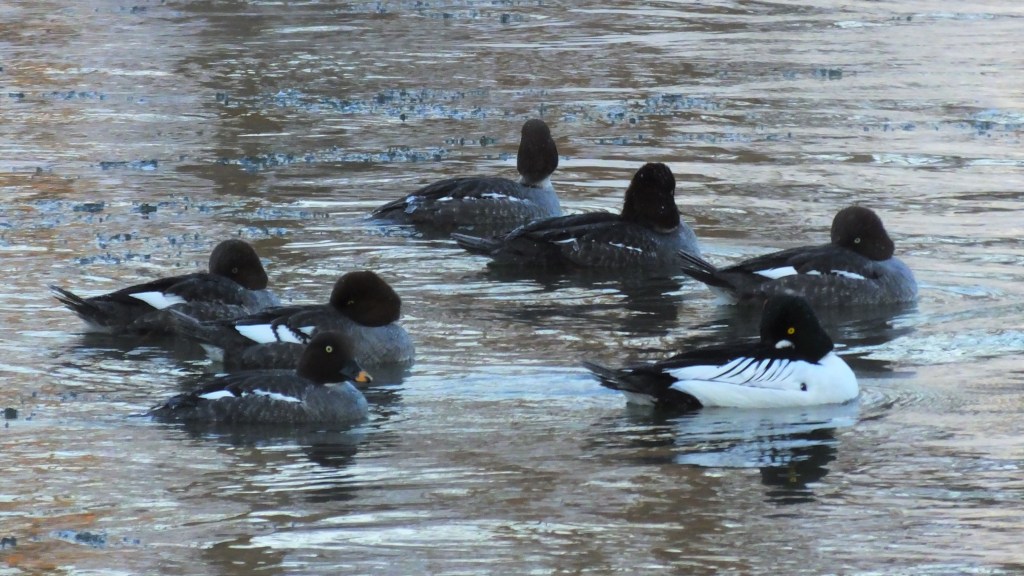
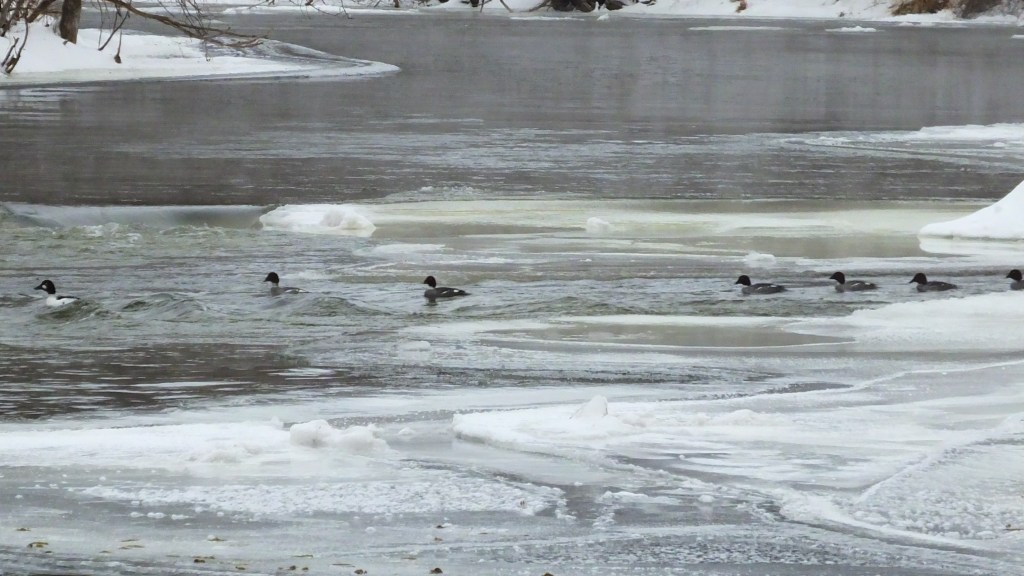
Not a whole lot to report critter-wise. A few mergansers, a few mallards, a slew of goldeneyes, and just one female bufflehead on the river. Here are a couple of a shots in which I attempt yet again to capture the size of the crowd. It is a sight to behold.
The usual song birds were about, and here are just a few of the robins who were out in force.
One curious sight on the river is this track in the snow. There were other no tracks near it.
In the woods, there were plenty of woodpeckers going about their business, and these two downies put on quite a show.
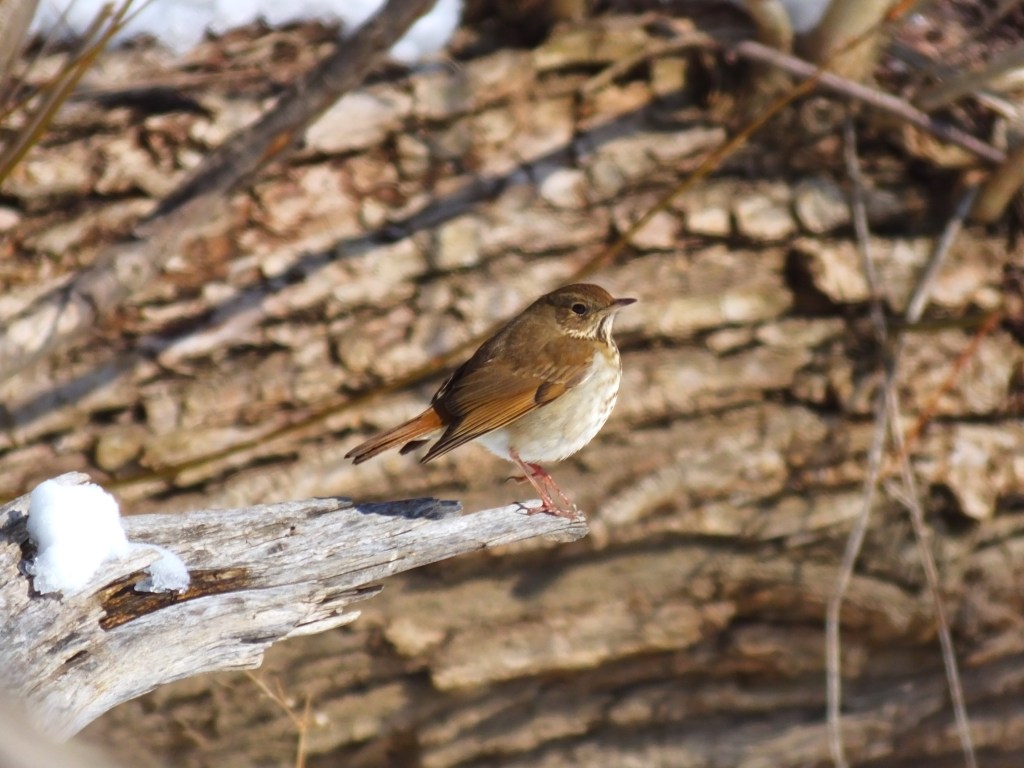
Our little buddy, the veery or hermit thrush was a bit south of where I usually find it, and perhaps it was think that I, standing on the river ice, was west of where it usually finds me.
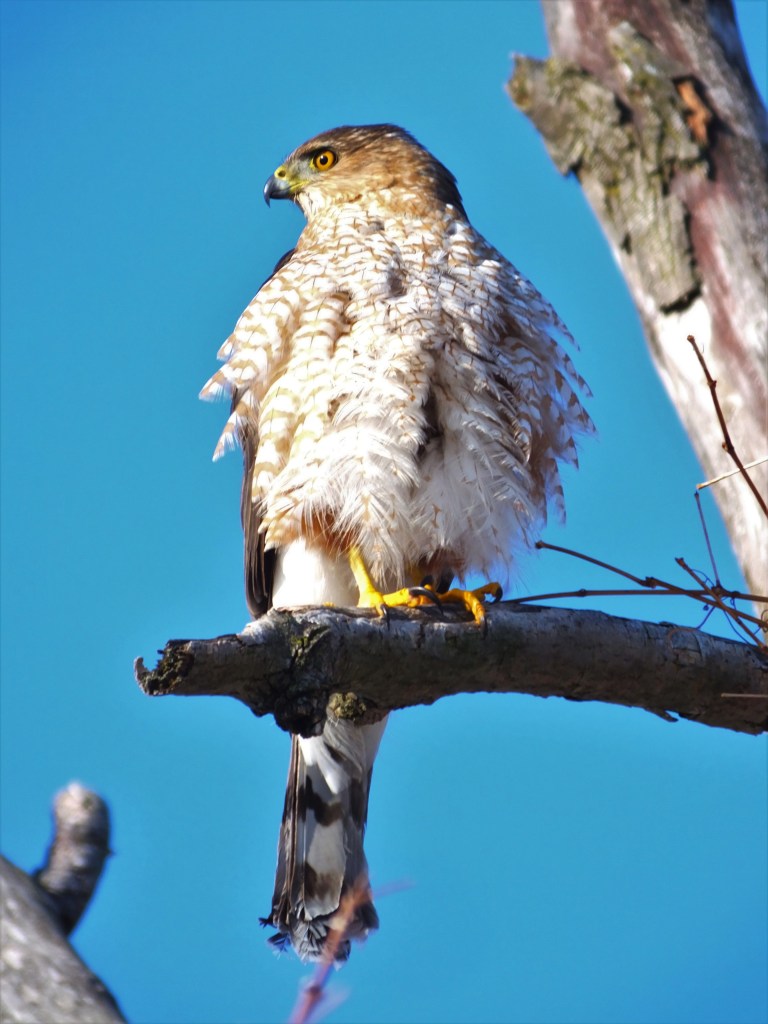
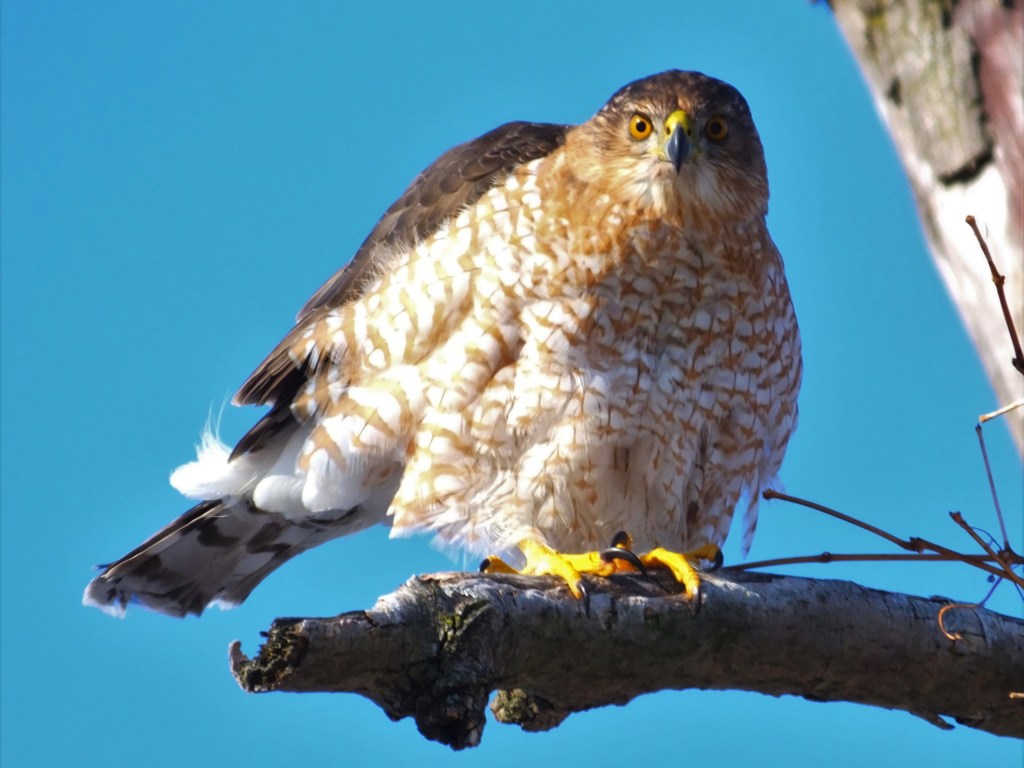
And, last, but by no means least, this magnificent creature, I think the Coopers hawk we’ve seen several times before, was waiting for me along side the Oak Leaf Trial. It even allowed me to walk past it, with my eyes averted of course, so that I could shoot with the morning sun at my back as it stretched a leg.
It’s been a quiet couple of days in the park, and do you know what that means, boys and girls? That means it’s arty picture day, where I try to supplement the meager content I have with pictures of super interesting snow and ice formations. Yay!
First up is this fascinating bit if snow that artfully curled up instead of simply sloughing off a tree trunk during the beautiful sunshine yesterday afternoon. Ooooh!
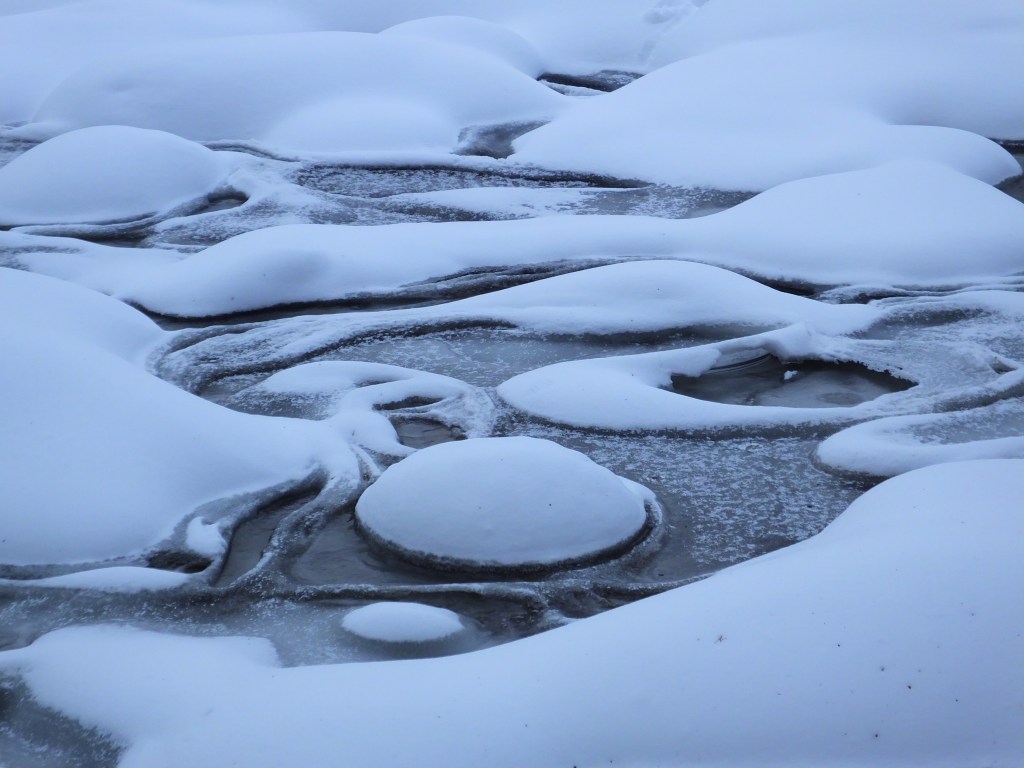
Here’s another one of some amazing bumps and whirls that have formed in the snow and ice on the river. Aaaah!
In hindsight, I should have used the camera setting I discovered for the first image on this one, but I’m showing them out of order, and I hadn’t stumbled across it in desperation yet.
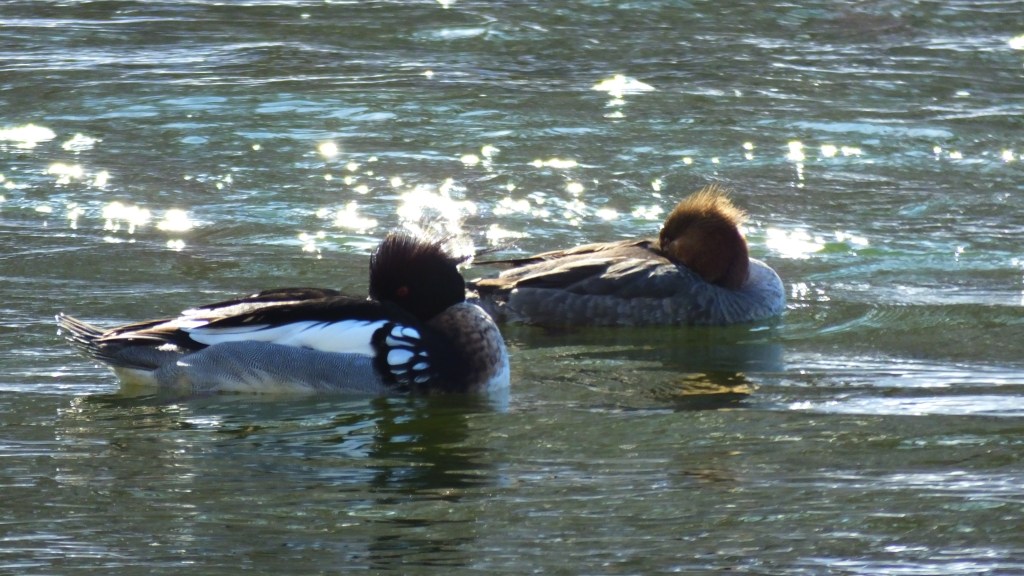
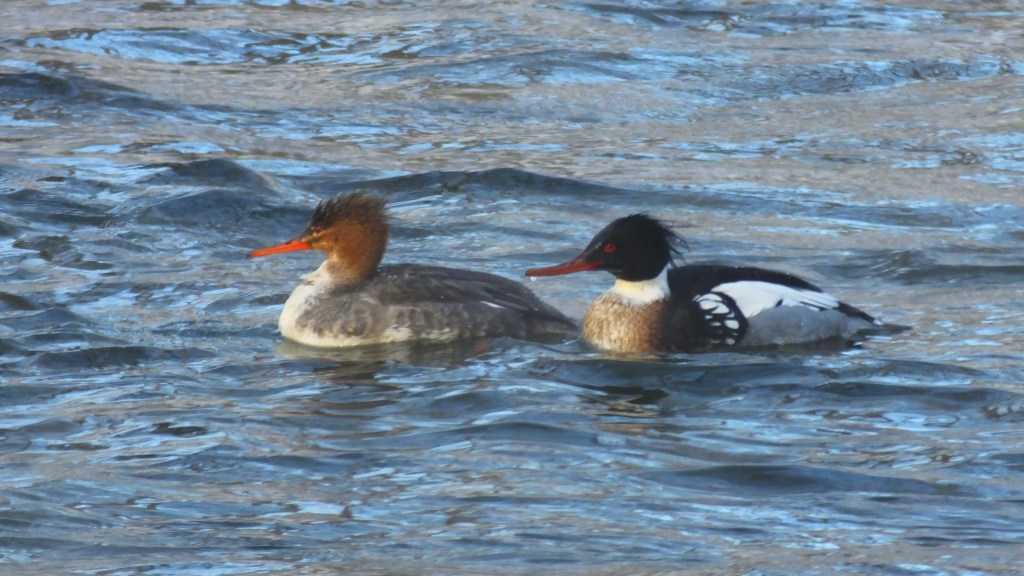
Happily, those are all the arty images worth sharing, so now we can get to the meager animal pictures. As you may recall, yesterday afternoon was still, sunny, and wonderfully warmer than recent days, and this pair of red-breasted mergansers seem to be just basking in it with a little mid-river nap.
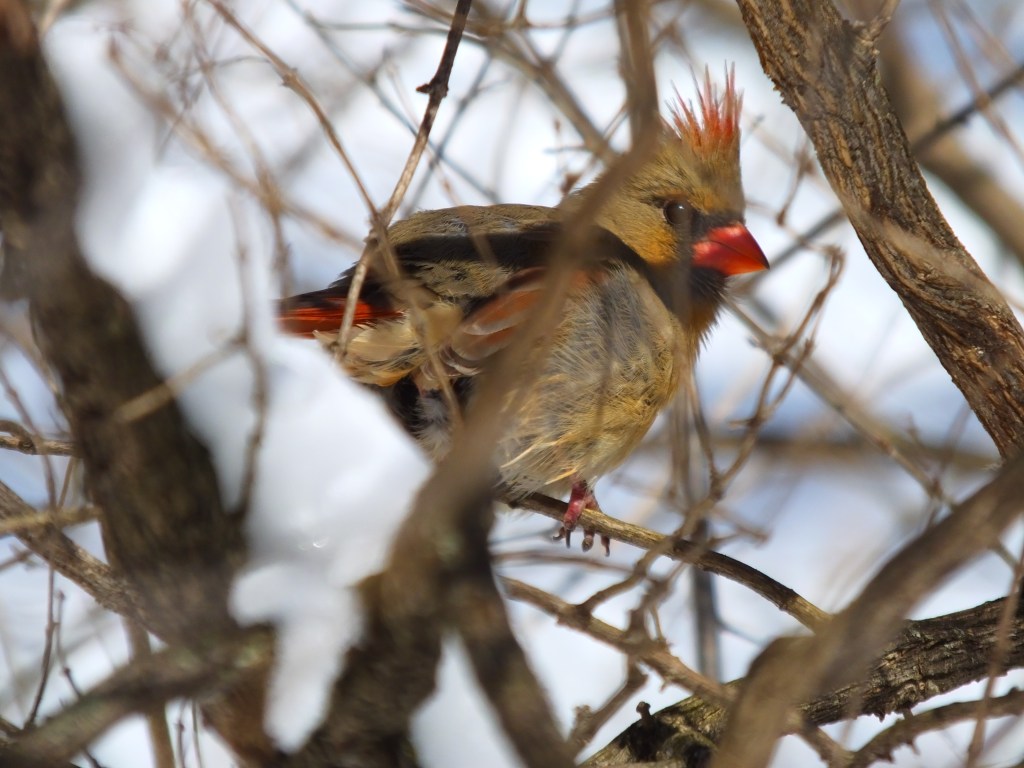
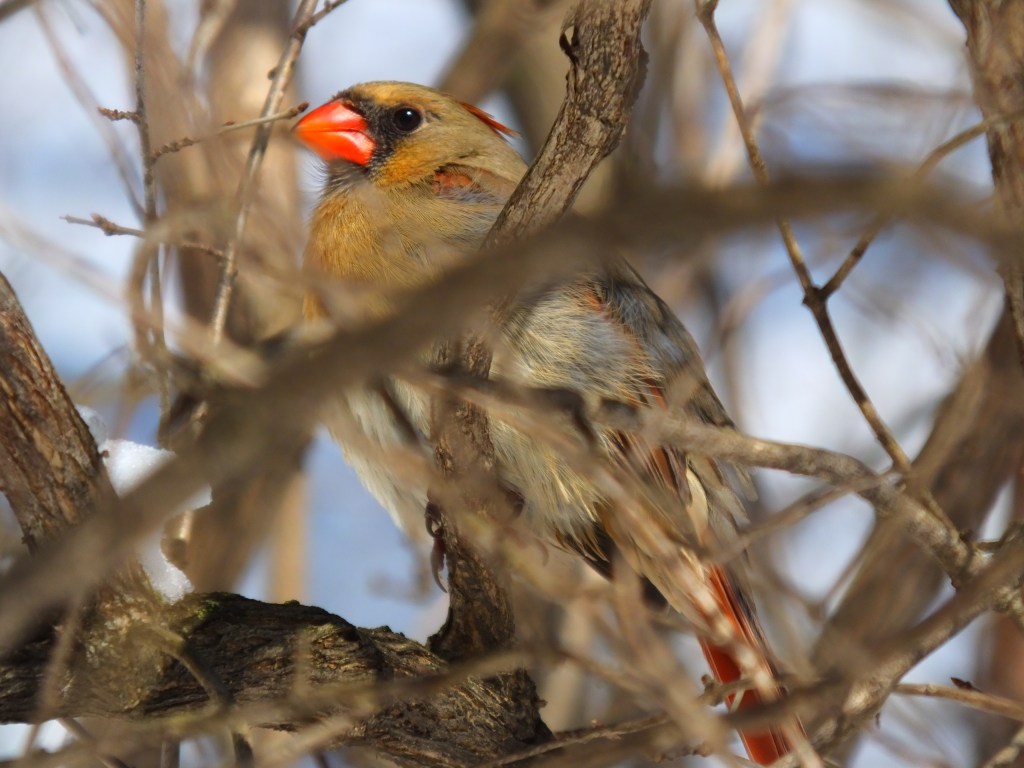
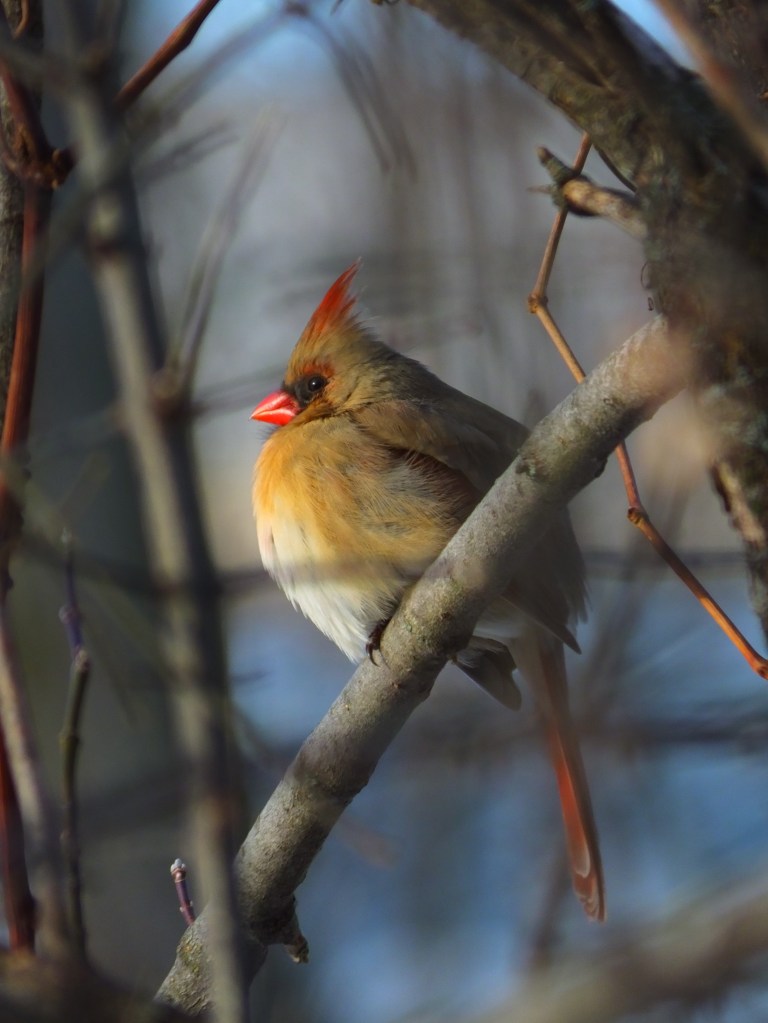
This female northern cardinal showed off just how versatile her head feathers are while hiding in the bushes. Yup, that’s the same bird.
The flock of goldeneyes seemingly continues to grow, and this time they were spooked by someone on the other side of the river, not me, so I could see it coming and try for a clearer shot of the mass scramble. I’d be surprised if there weren’t three dozen birds by now, but they are crazy tricky to count because they are continually diving to forage on the river bottom.
I am always surprised to rediscover how more comfortable single digits above zero are than single digits below zero. Add a smidgen of sun and a patch of blue sky or two and it was a very nice morning in the park. To mark the occasion, we had a visitor we haven’t seen in weeks and at least one new arrival.
First up, on the lower river, I spotted a pair of red-breasted mergansers for the first time in a while. The common mergansers were still their, but we’ve seen plenty of them lately.
Further north, the flock of goldeneyes continues to grow, and they continue to be as shy as ever. Here’s the best shot I could get through the bushes and the steam fog, then a shot of them taking notice of me as soon as I got clear of the bushes, and finally a shot of them taking off. Sorry kids!
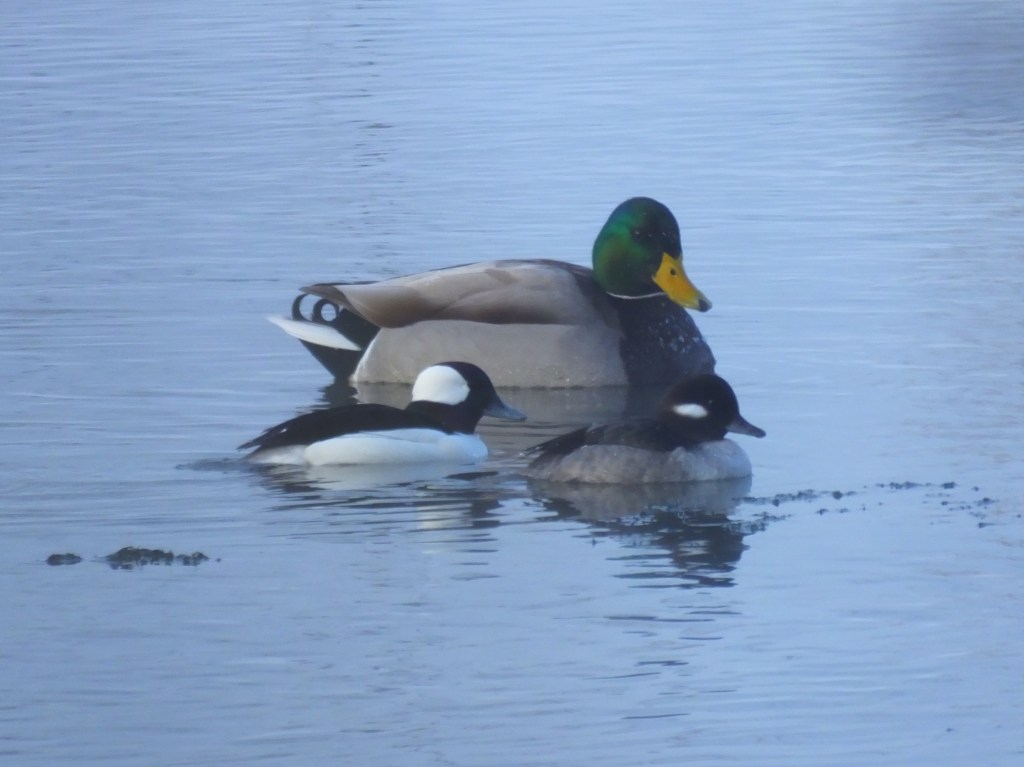
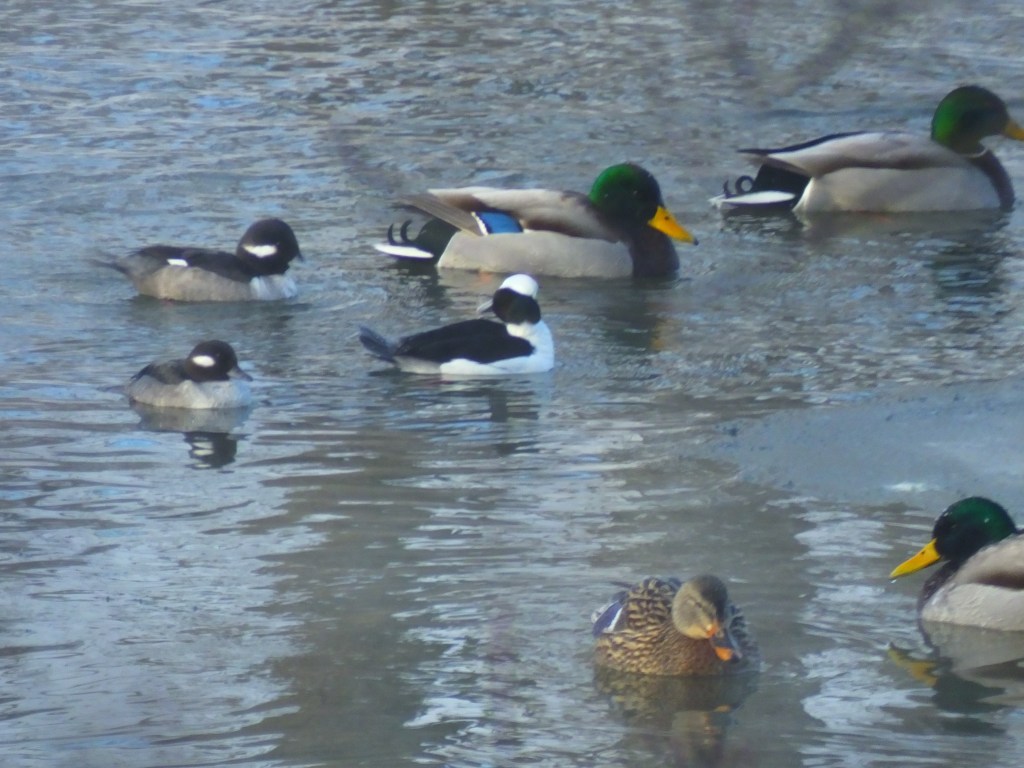
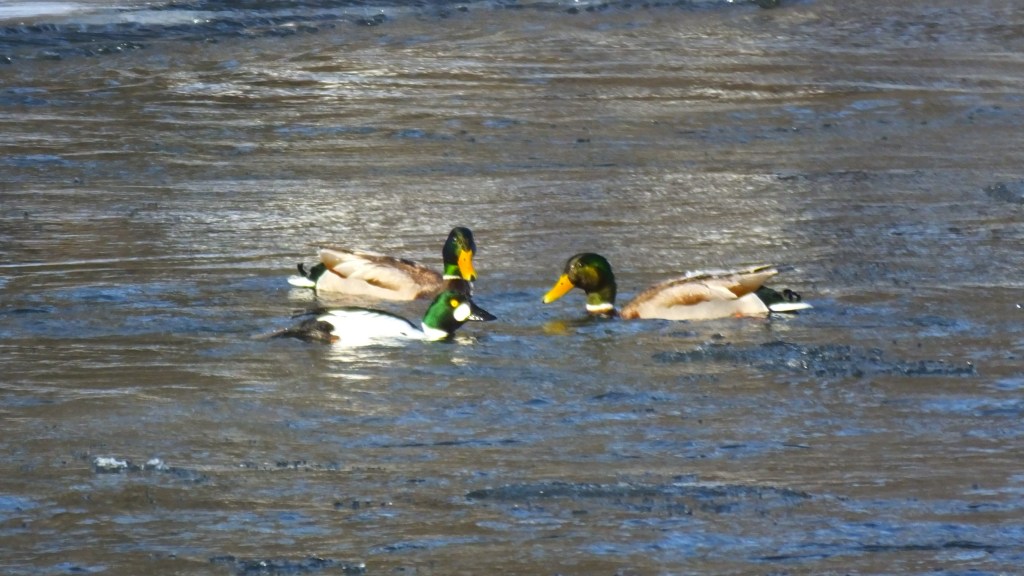
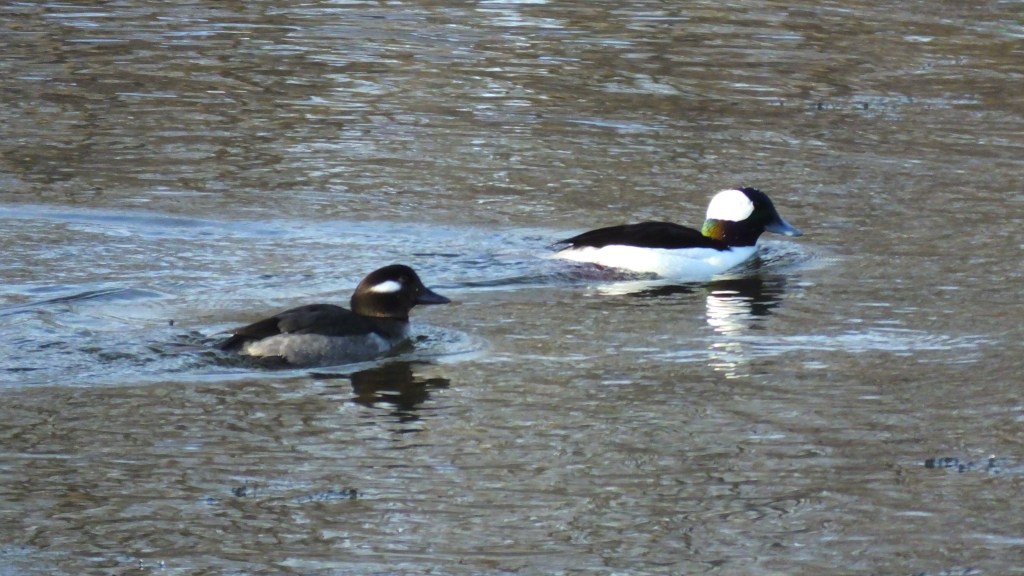
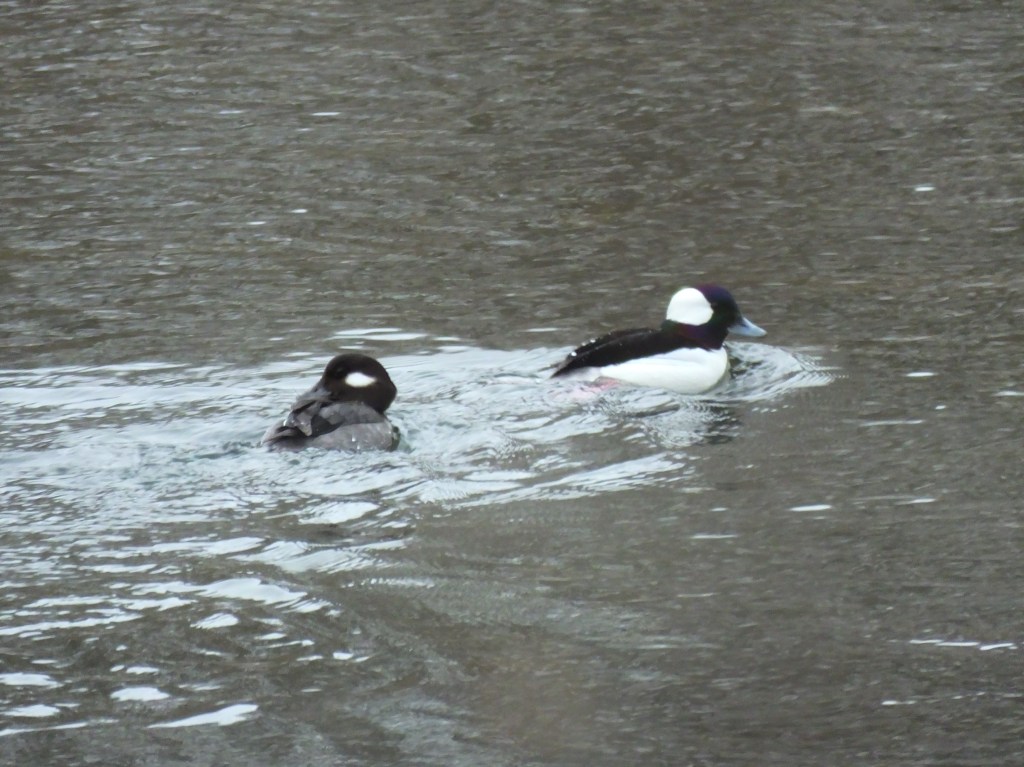
Just beyond that spectacle, where the ice begins to cover the entire river, a group of mallards have settled in with three little interlopers: a male and now two female buffleheads. I got one or two nice shots of him alone when the sun shone and the fog cleared, but we’ve seen plenty of those already. Whenever the three were together, though, they managed to do so only in the fog and shade. Sneaky little devils. Maybe we’ll get lucky and their numbers will start to swell like the goldeneyes.
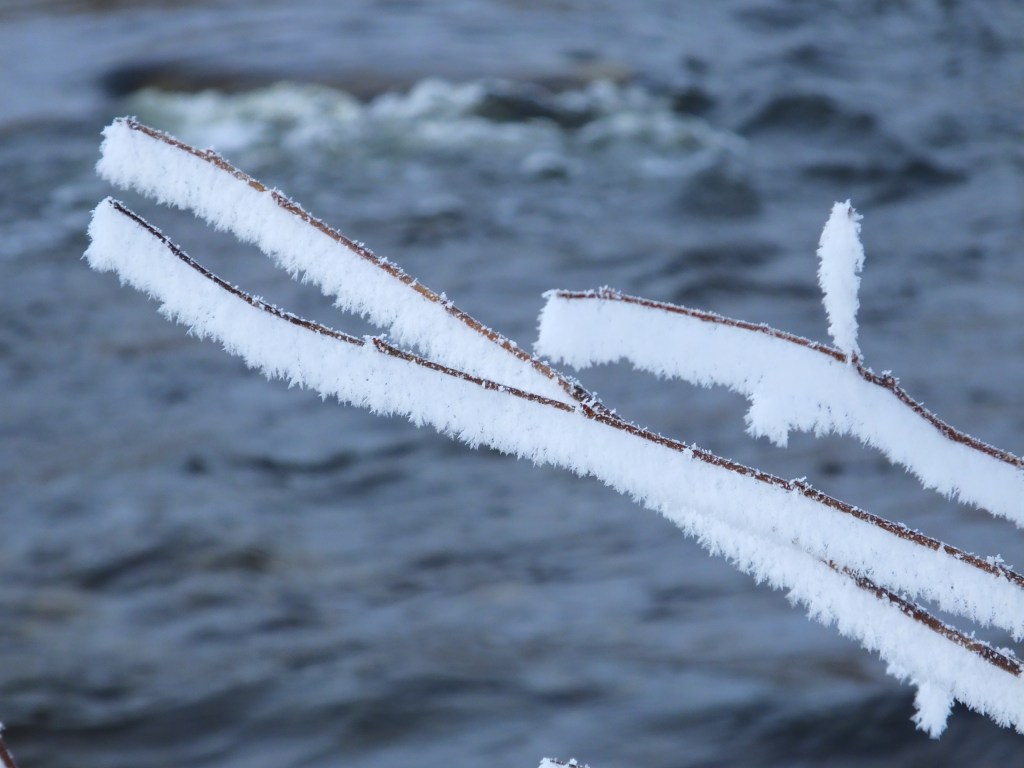
At the falls, the steam fog has formed some nice hoar ice on the branches over the river. The slightest breeze caused it to fall like snow.
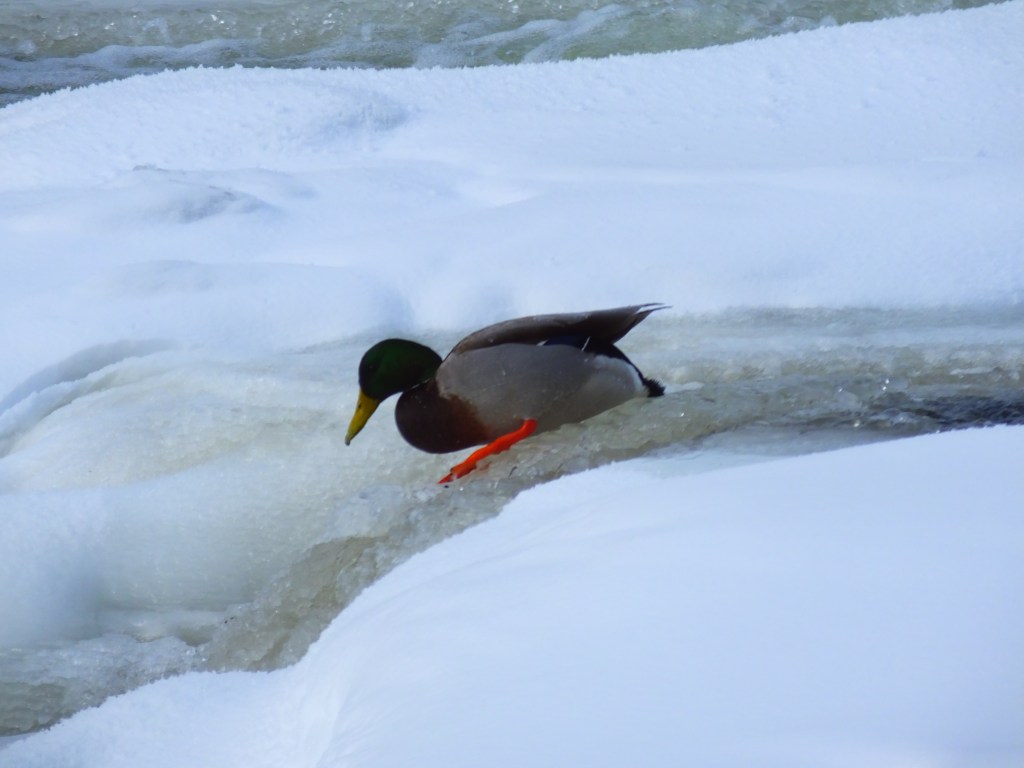
Finally, above the falls, there were just a pair of mallards and one male goldeneye. As I watched, the mallards decided to check out the buffet below the falls, and here’s the male climbing down the ice.
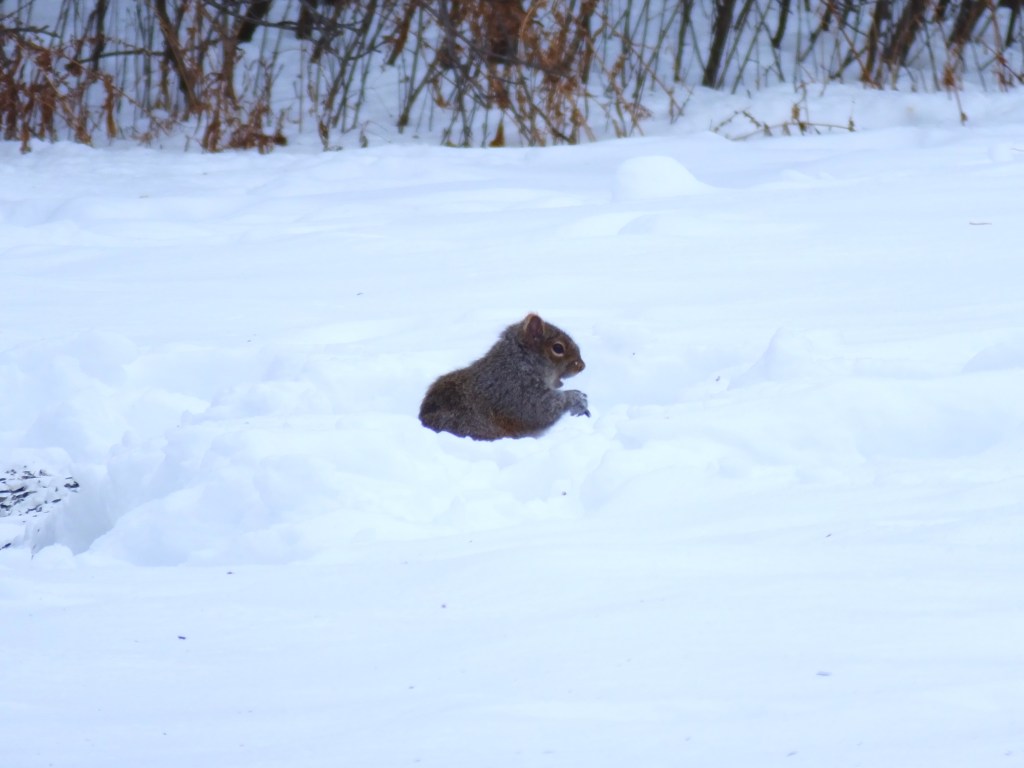
Plenty of woodpeckers, song birds, and even a couple of squirrels today, but no raptors, and nobody particularly photogenic, so we’ll have to wait until next time.
After getting skunked for the last few days, I’ve finally got something to show you, and given the nature of this project, perhaps I should clarify that by “skunked” I mean coming up empty, not being sprayed by a skunk, which I would definitely endure in exchange for a good picture, but that would be a different story. I saw no skunks in the park today.
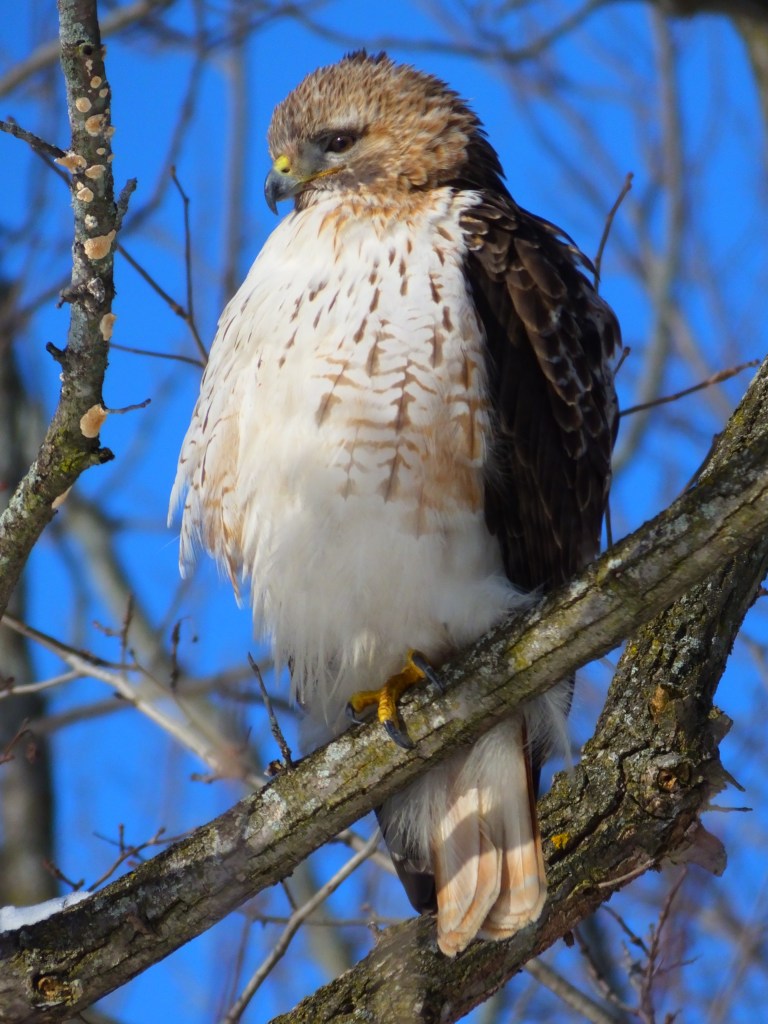
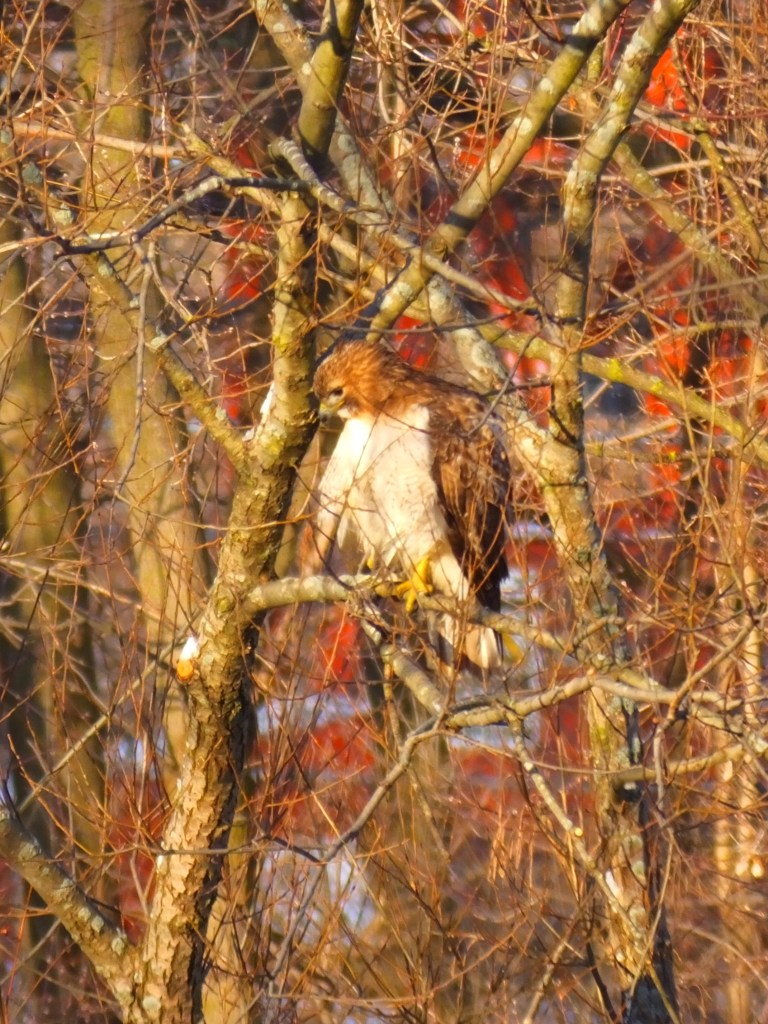
I spotted what I hoped might be a raptor from seemingly a mile away, and I had to check with binoculars to make sure it wasn’t just some snow on a tree. As I made my way towards it, at one point it made a try for a squirrel, but came up empty, and I was thrilled when it settle back down in the vicinity for me to continue my pursuit. In the end, I even crossed some of the frozen river, all the while trying to make it look like I wasn’t ever walking straight towards it, as my friend Drew suggested. I ended up about 20 feet away and right next to a tree to which I could hold my camera to eliminate jiggling. After I figured I must have gotten one good shot (out of 50+!) I continued north and was able to confirm from behind that it is indeed a red-tailed hawk, not some cheap knock-off, and it might even be the one we saw back in January feasting on a different squirrel.
Anyway, the river continues to freeze over, but a slew of intrepid goldeneyes, common mergansers, and even some mallards are sticking around in the few remaining wet spots. There was not a single water fowl on the upper river today, however, and that was long after the one bald eagle I saw had already flown past.
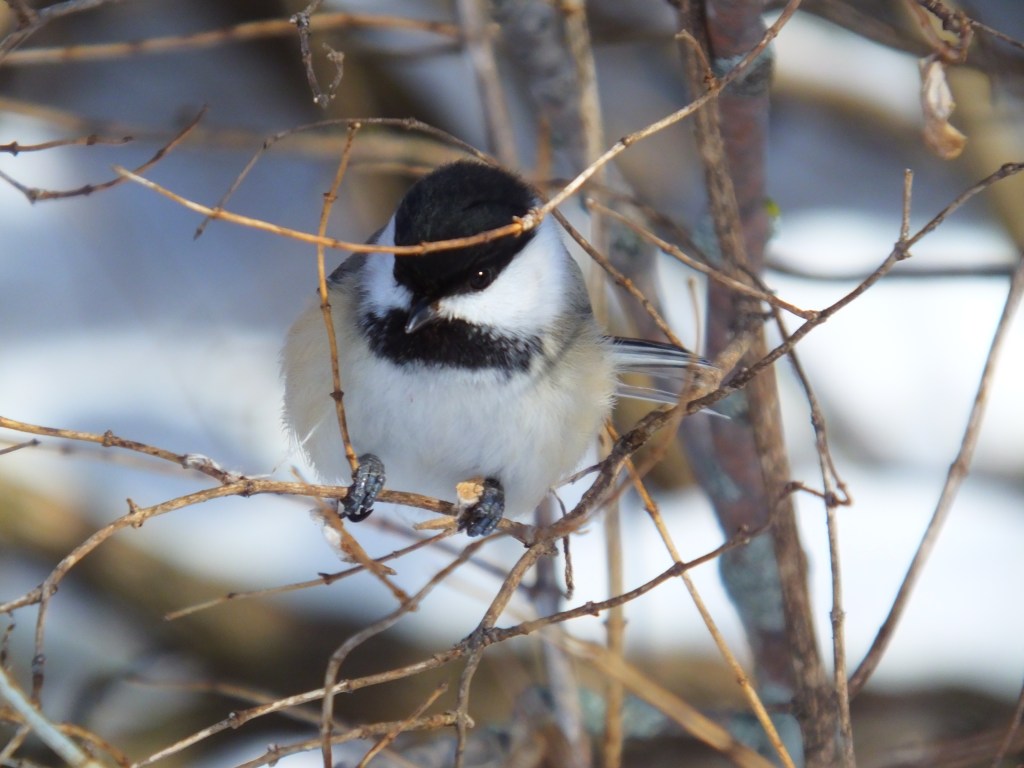
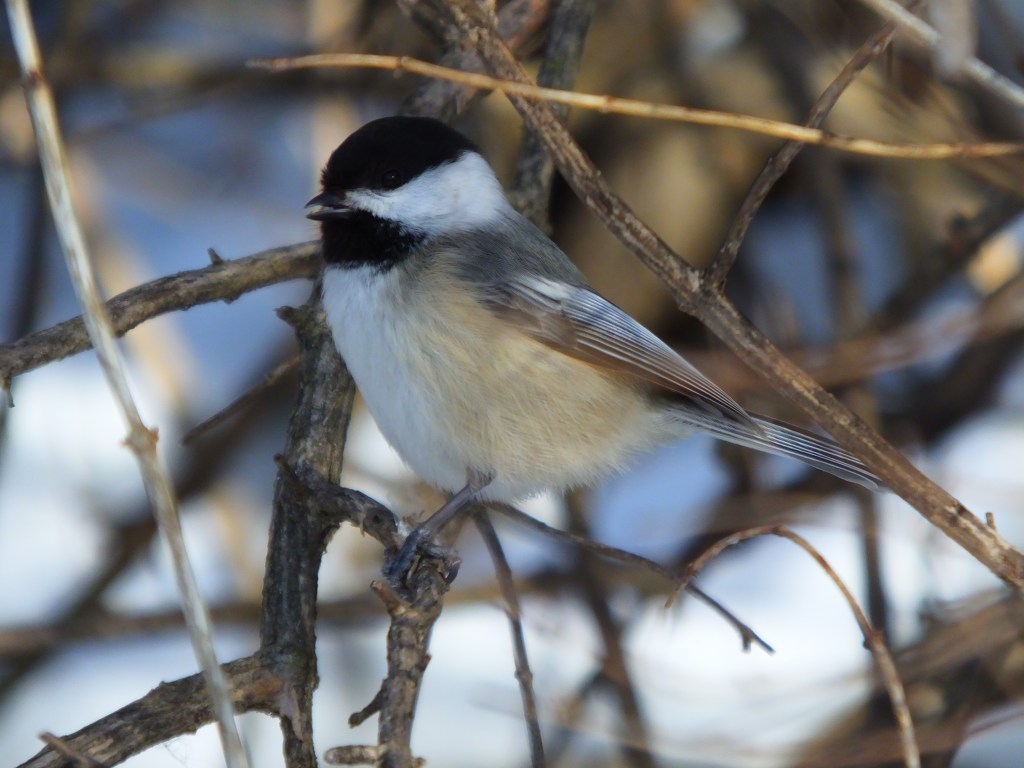
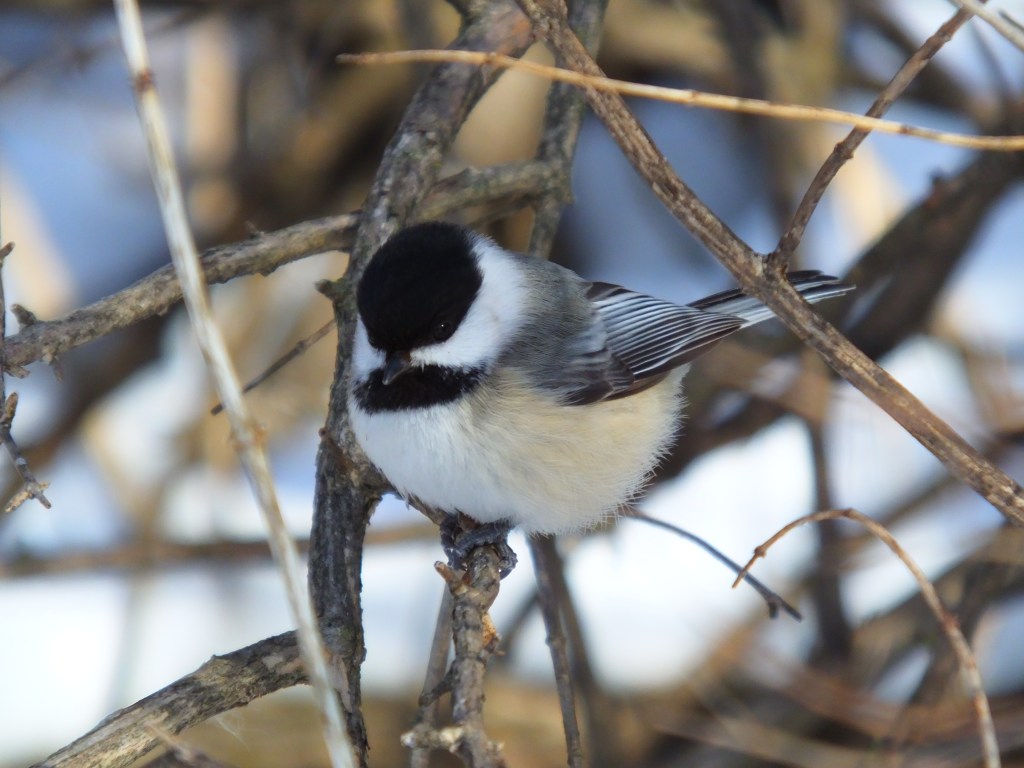
Instead, a certain chickadee almost seemed unwilling to admit it had made a mistake by landing on a branch too closed to me. As I carefully took out my camera, it pretended not to notice that I was only 6 feet away and quite casually went about its business. Sweet.
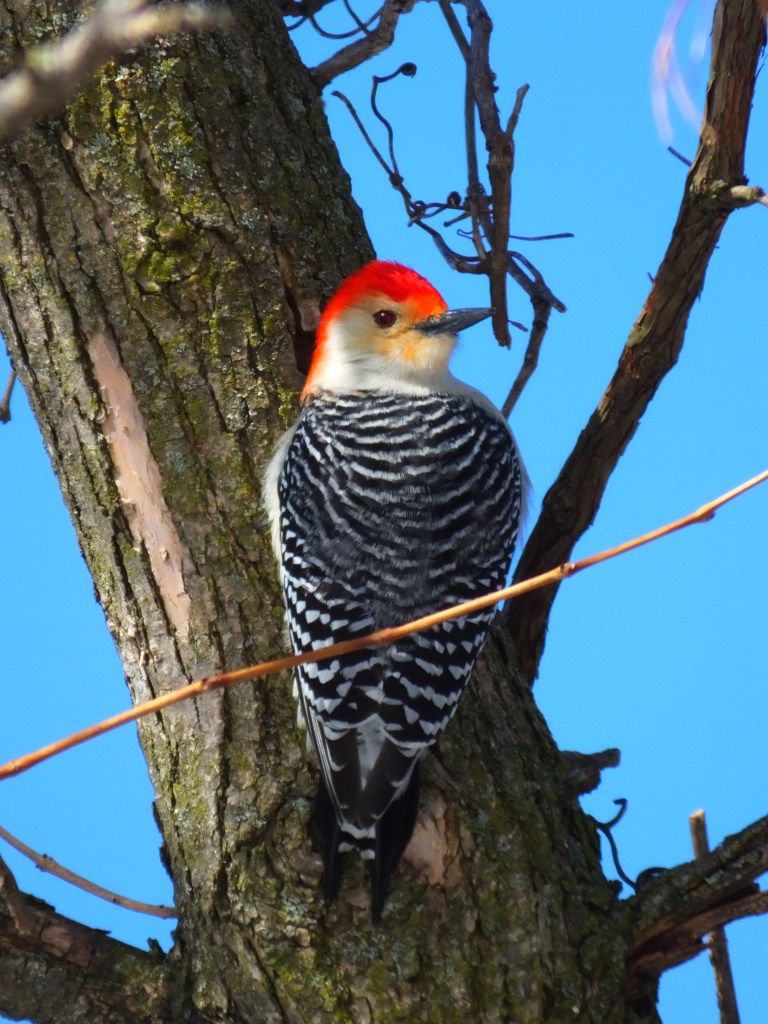
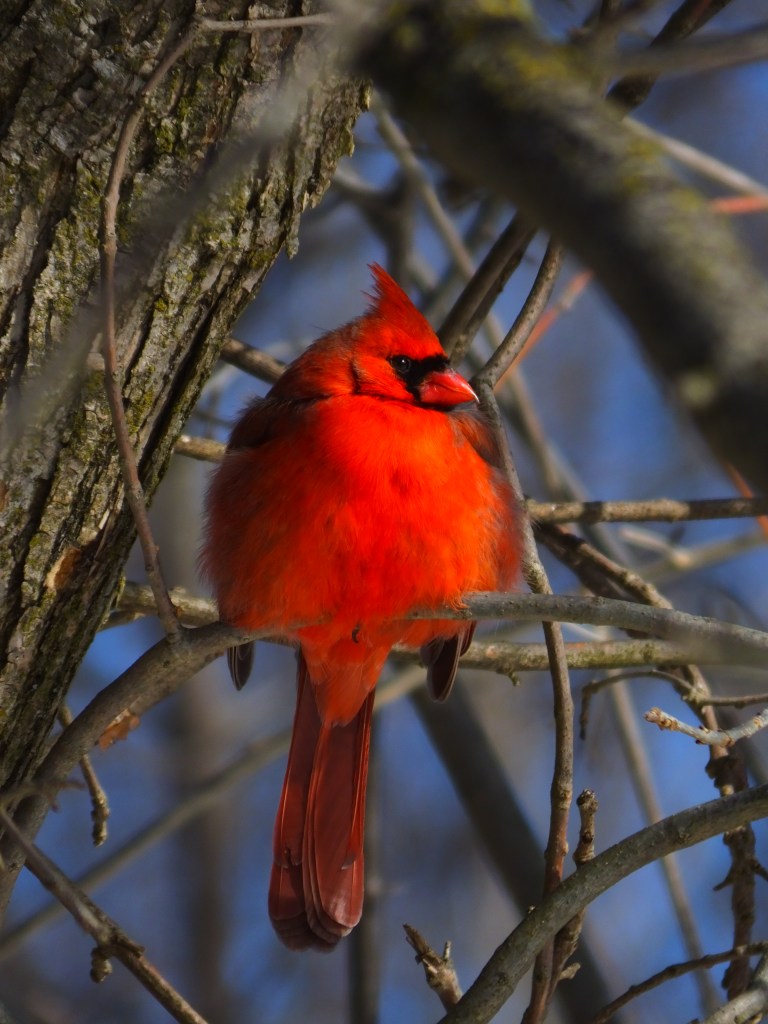
After glimpsing an eagle and photographing a hawk, I had a hope that I might get lucky at the pond, and I did, but not in the way I expected. Instead, these two colorful characters provided these close-ups that almost looked staged, right?
Male red-bellied woodpecker
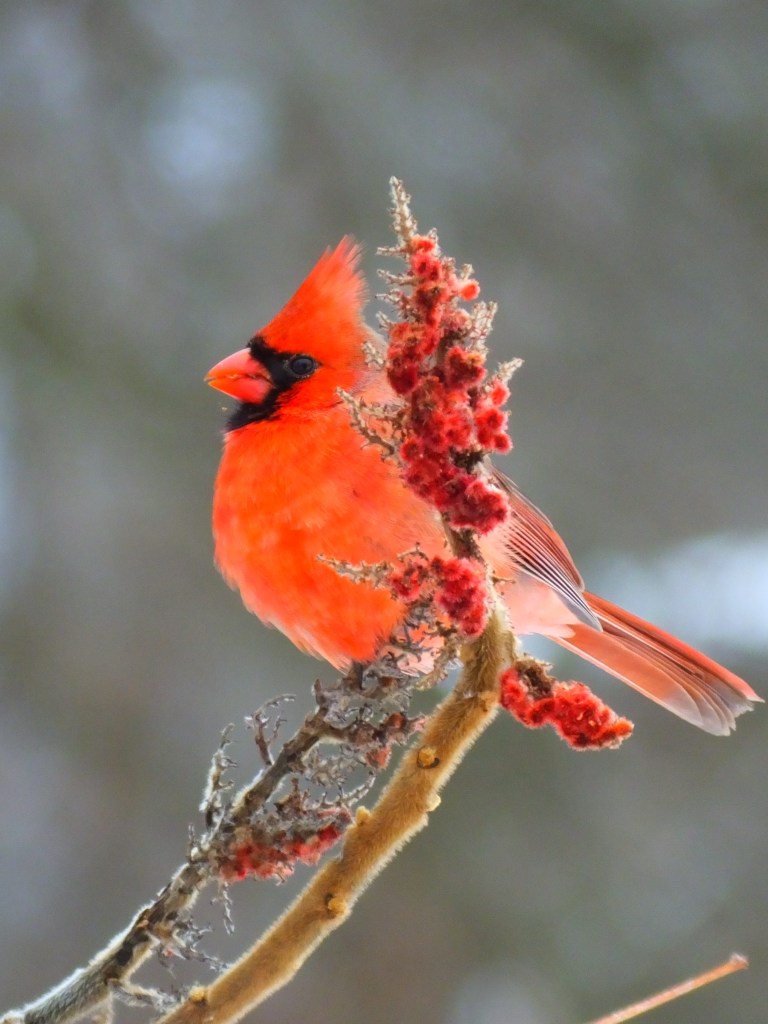
Male northern cardinal
And these little cuties could not seem to be less concerned about me. I half expected either one of them to check my head next. I’ve thought there must be bugs in there for years now.
The amazing streak of cold weather continues, and I didn’t see a single mammal this morning, but for the birds who are prepared for it, not only does it not seem to slow them down, they’re actually starting to get frisky!
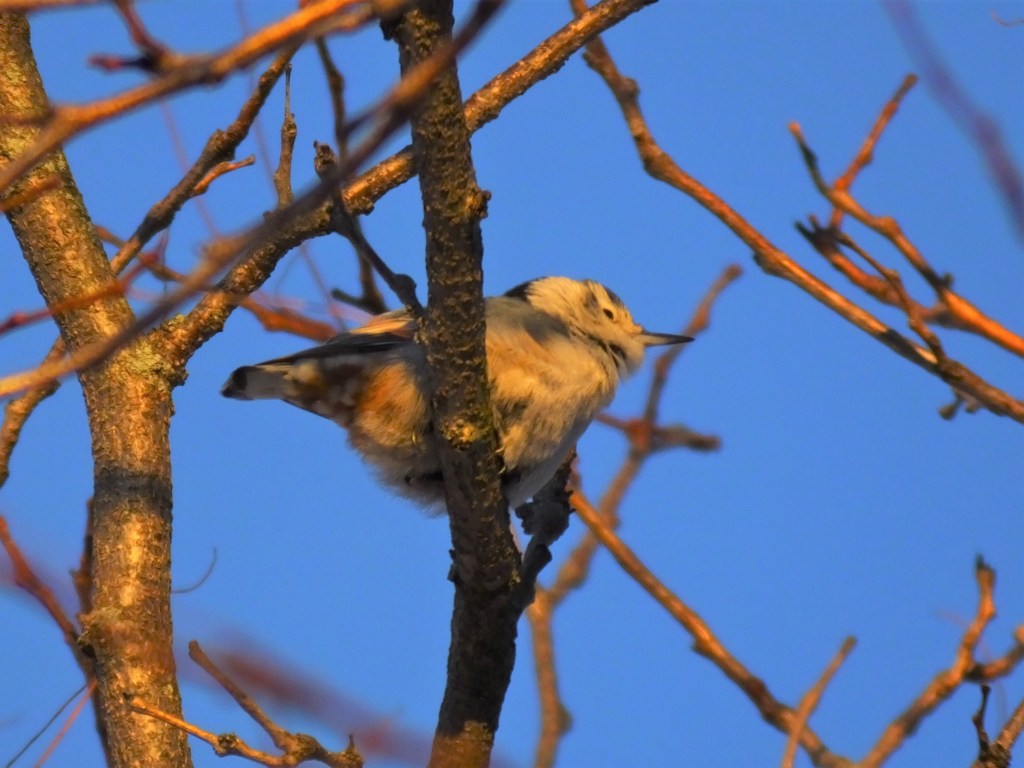
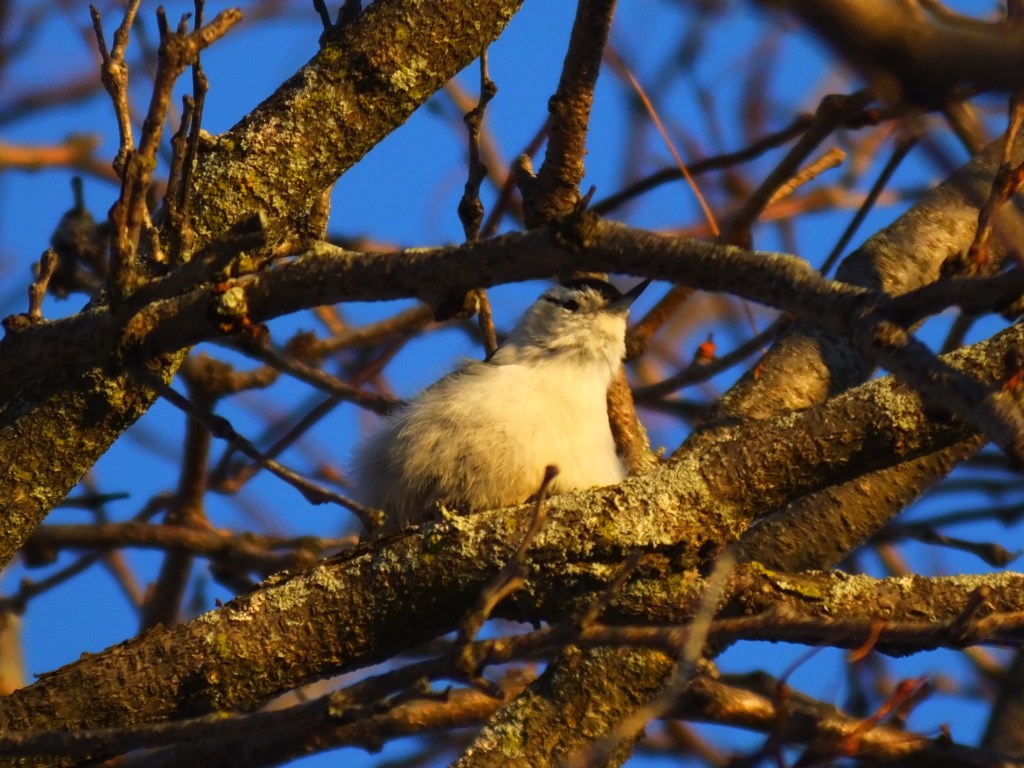
I had barely gotten into the park when this pair of nuthatches caught my ear. Well, his song caught my ear, but when I looked up, I spotted her first. I read that you can distinguish him from her by her greyer cap compared to his blacker cap. Plus, he was doing all the singing, and she was just soaking it in along with the bright morning sun.
female
male
Within the same earshot, this male northern cardinal was staking out his territory.
On the lower river, there wasn’t much new. The goldeneye flotilla was in the same spot as yesterday, but not quite as big, and some of them appeared to be trying to take a nap, although you can see that the male was keep his goldeneye on me.
Above the falls, there were a few mallards, one male goldeneye, and the pair of buffleheads, but no eagles today. The one fascinating event I got to witness was the goldeneye, who had been diving with the buffleheads, suddenly making a beeline for the mallards, and the half-pint male bufflehead popping to the surface right behind him and in hot pursuit! I guess, as they say with dogs, it’s the size of the fight in the bird as much or more than the size of the bird in the fight.
Here’s the male goldeneye a moment later explaining to a couple of male mallards that he actually wanted to swim over towards them ’cause that other spot is pretty much grazed out now.
Here’s the male bufflehead escorting his date the heck out of that dump!
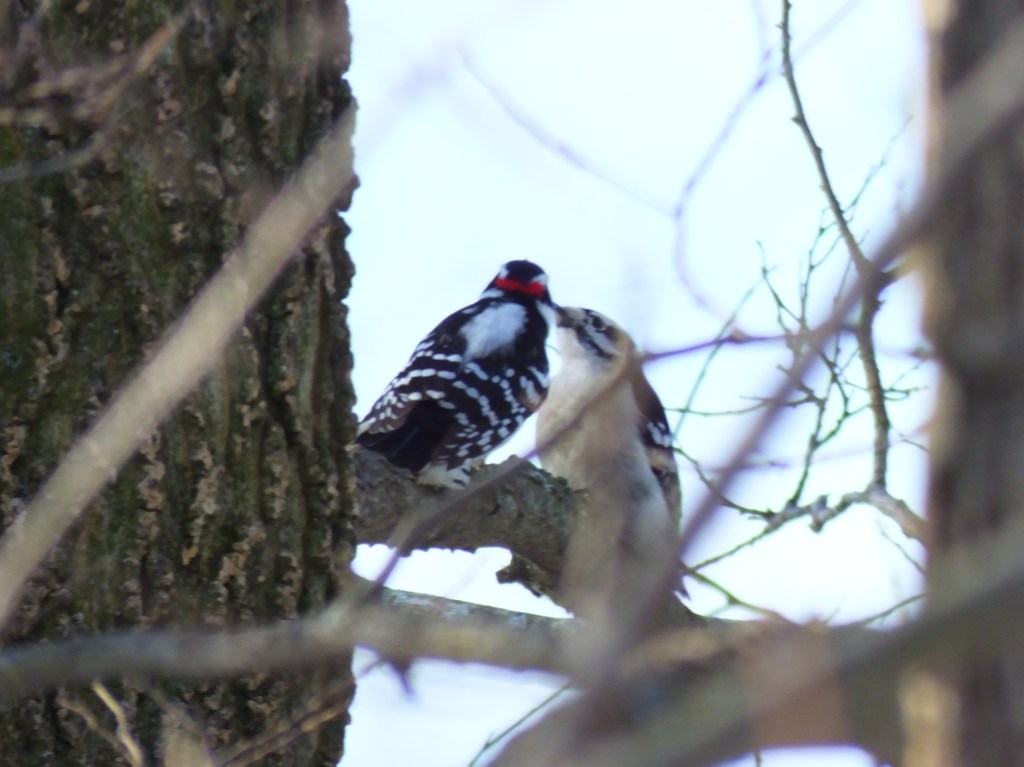
There was nothing new at the pond this morning, but there was a lot of activity in the trees lining the Oak Leaf Trail. Here are a pair of either downy or hairy woodpeckers checking each other out, bill to bill, but my one lousy shot doesn’t reveal the cues that would enable me to tell them apart. There was also some energetic movement before this scene, but you’ll just have to imagine that, or watch this nice video someone else posted on youtube.
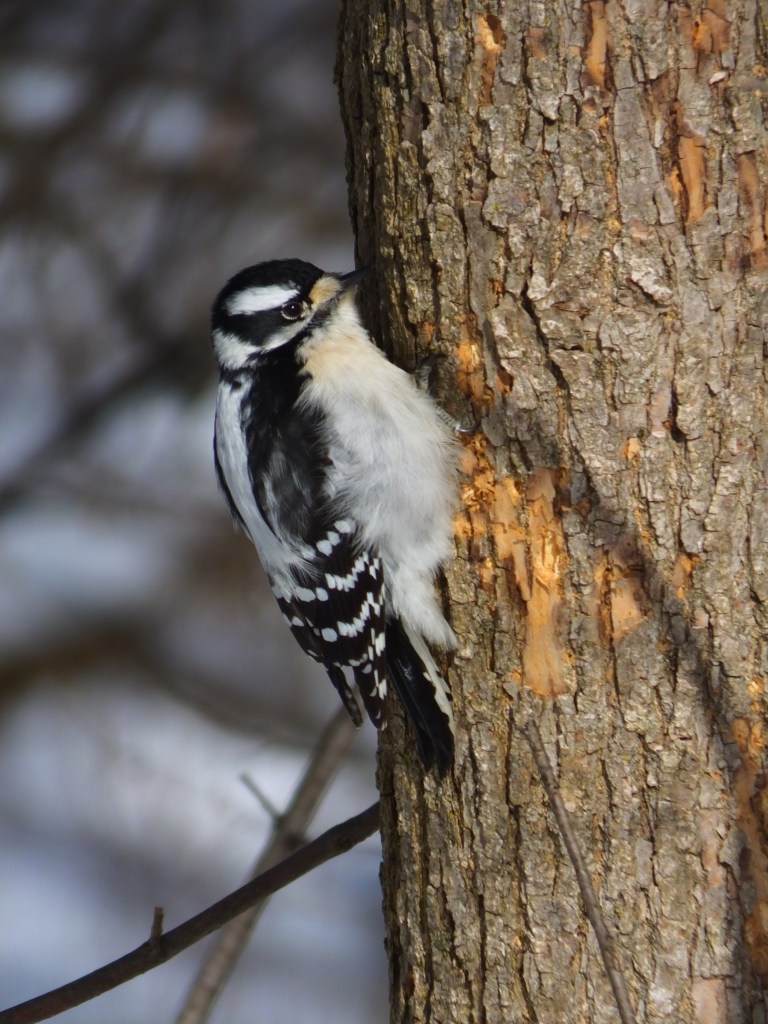
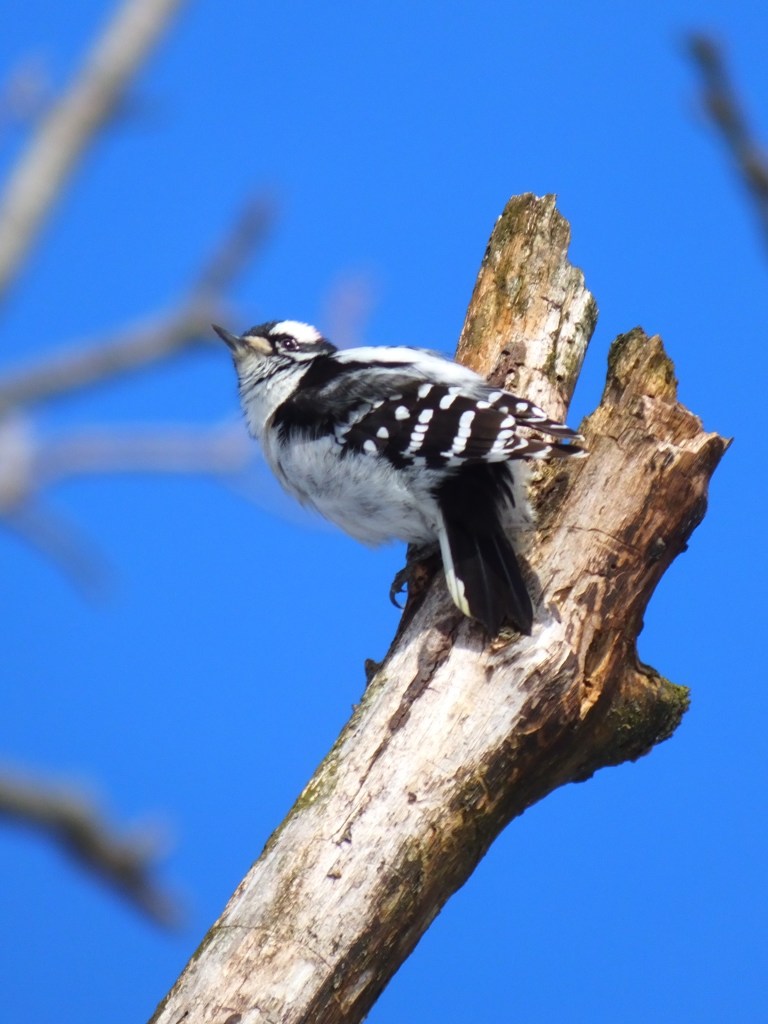
Anyway, this male downy was kind enough to sit for a proper portrait.
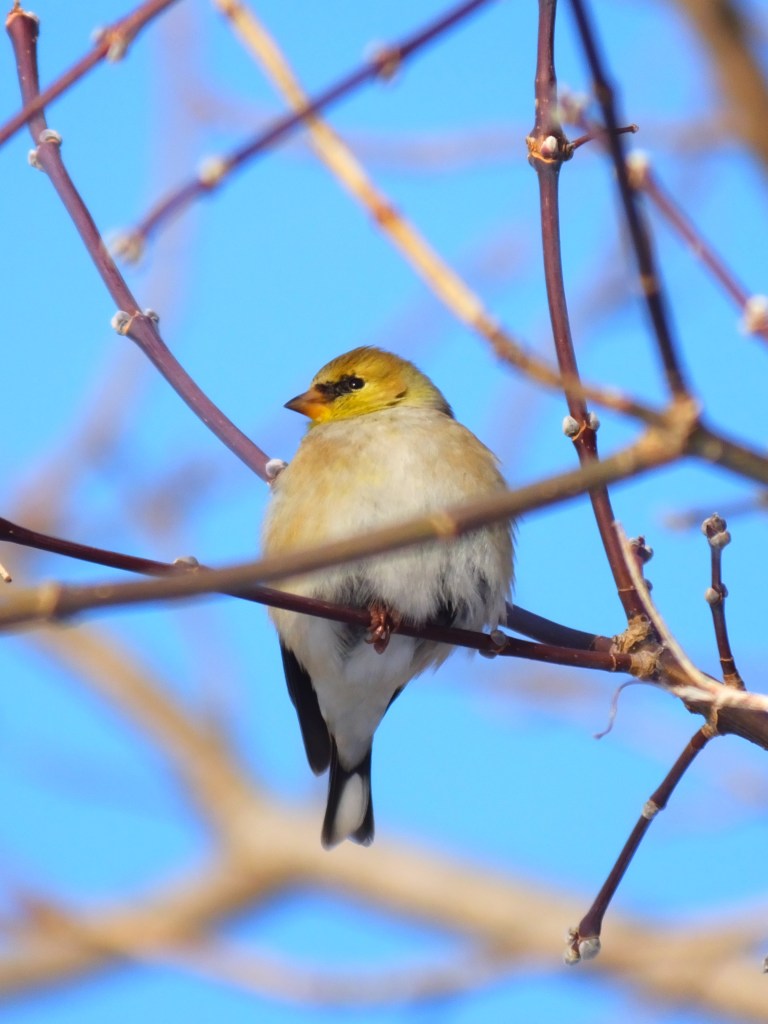
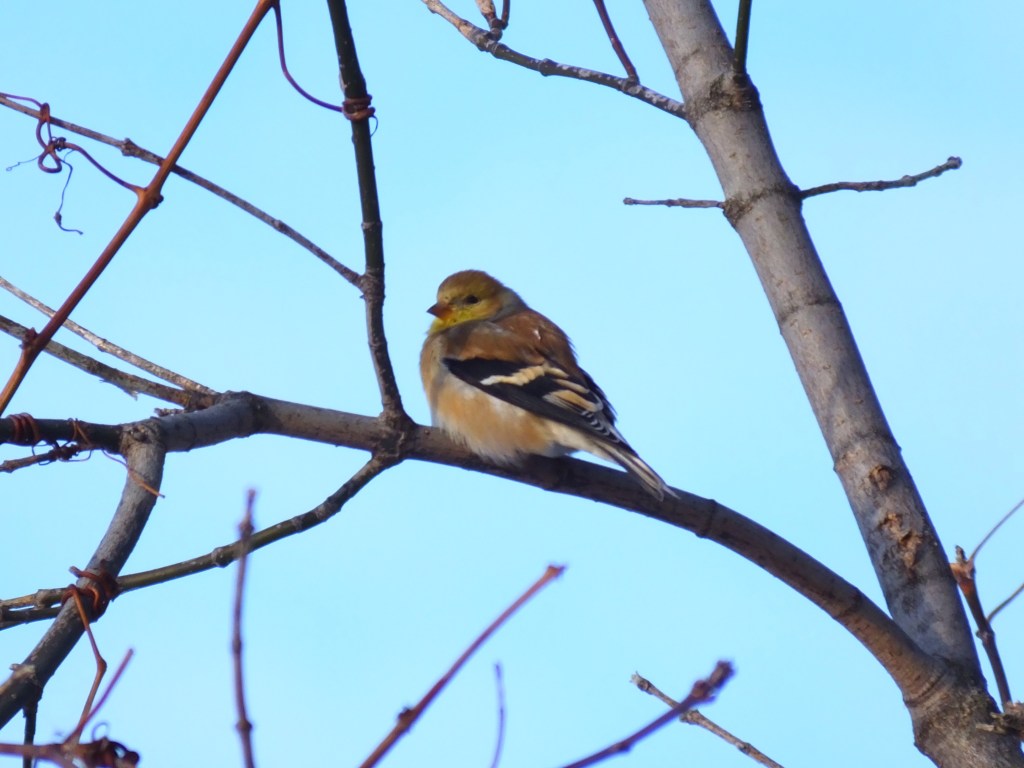
Finally, this goldfinch wasn’t doing anything new or interesting, but just looked too nice against the nice blue sky to pass up.
Today seemed a bit like an odd and dark repeat of yesterday. The temps were about the same, but the sky was blanketed by heavy grey clouds, and that seemed to throw everything off.
I only spotted a few female common mergansers on the lower river, and was doing my best to spot more, when there was a big commotion in a tree not 20 feet up the trail from me. It looked like a big hawk, of undetermined kind, had crashed into a tree, and then a smaller bird, maybe a robin, fled across the river from the crash site like a bat out of hell. I froze in hopes that the hawk would take a moment to collect itself, and I would have a chance to take a picture, but no luck. It quickly took off, too, and I was left with only the memories.
Further north, I was approaching the spot where the goldeneye’s have been hanging out, and I quietly approached the water to reconnoiter the situation from afar, when the single male, who must not have spotted me yet, led his flock downriver right towards me.
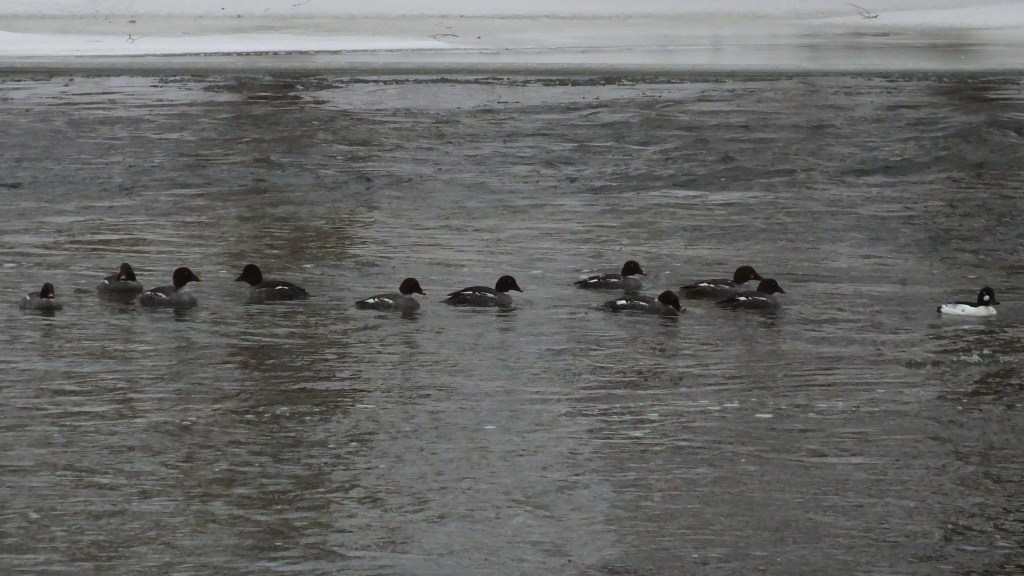
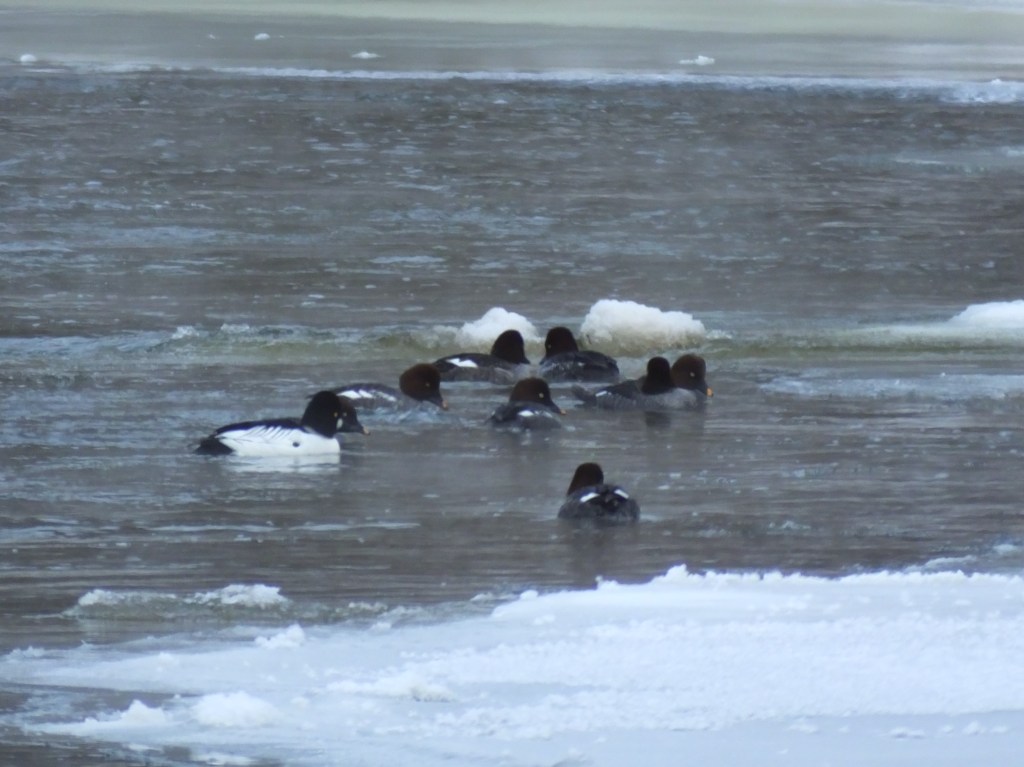
I froze again, because these birds have been especially shy all winter, and they drifted to a stop right opposite me, and now I can see that the little stud is escorting 10 females. Ha!
Anyway, I waited and waited for him to do that call thing with his head and neck again, but he refrained, and I eventually had to give up and move on. It’s too cold out to stand still for too long.
As I approached the falls, I again stopped to scope out the scene before I disturbed it, and the few mallards on the water just above the falls all took flight, just like yesterday, and sure enough, a young bald eagle, not yet in mature colors, drifted into view high overhead. This time, sadly, it and at least one companion stayed far to the north, so I couldn’t get a good look at them, let alone a picture, but it’s just as well. With the dark grey skies behind them, they’d only come out as silhouettes anyway. I did glimpse two of them performing some exciting-looking aerial acrobatics, but it is really hard to tell if it was courtship or rivalry.
After all that excitement, I finally proceeded north and as happily surprised to find the bufflehead pair, whom we haven’t seen in days, back on the water, and just as shy as ever.
By the time I walked up to the north end and back, a few mallards had already returned to the river and were busily back at work accumulating the calories they need to melt the ice off their bills.
Finally, I swung by the pond again, but didn’t see a raptor there at all today. I did spot a squirrel, and hoped it was our little red friend, especially after the visit from the Cooper’s hawk yesterday, but, from the comfort of my dining room table, today’s visitor looks decidedly grey.
Lastly, the skies, the water, the eagles, the ducks, and the squirrels may all be shades of grey today, but the male northern cardinals are still rocking their brightest red. Yee haw!
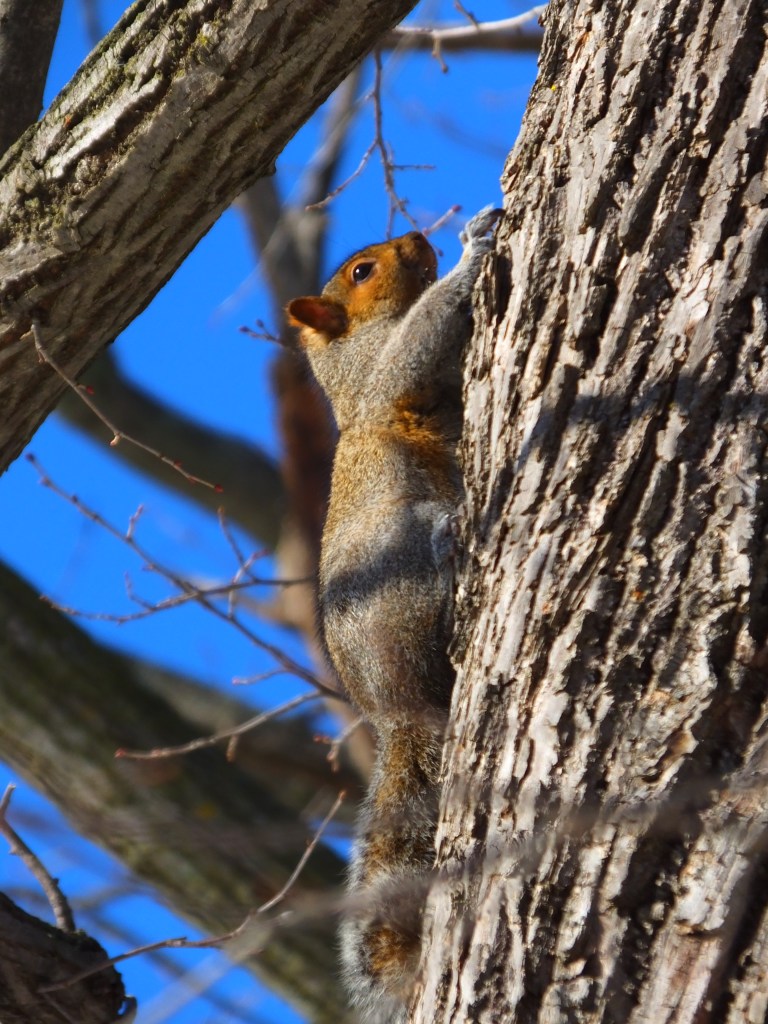
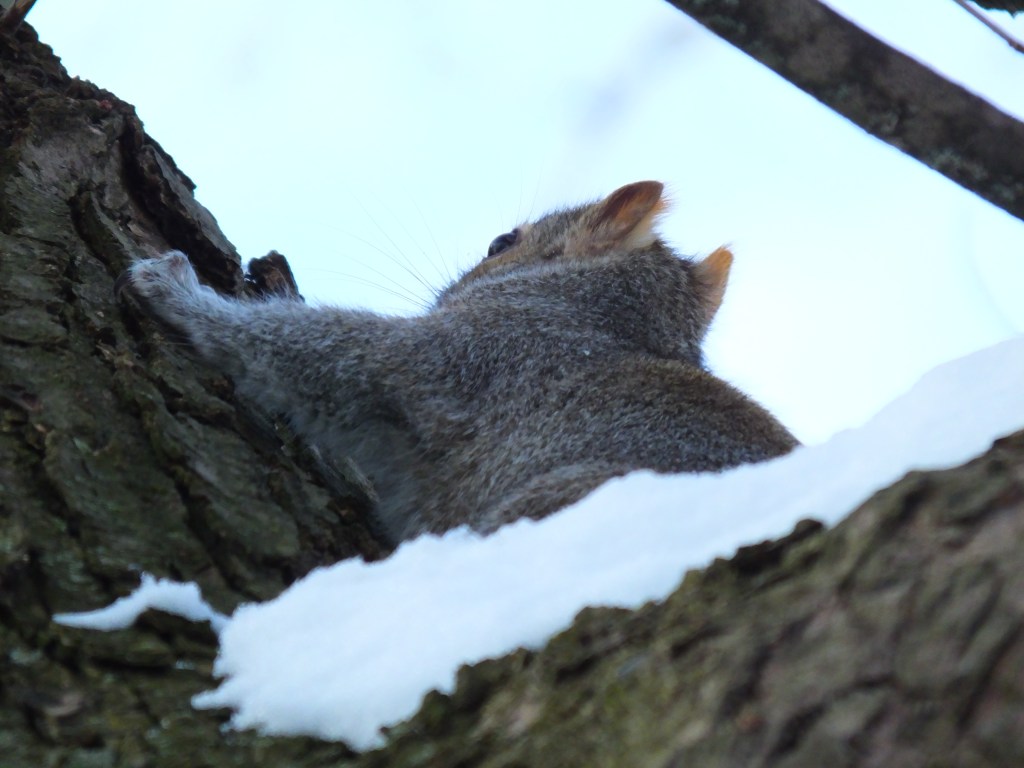
Just north of there, I also startled a grey squirrel, who darted up this tree a bit, and then froze, while perhaps thinking as loud as it could at me, “I am not the squirrel you are looking for.”
Near the end of the open water on the lower river, the growing group of goldeneyes were right where we’ve been seeing them lately. The male called again, and this time I did catch him with his head completely up against his back. Maybe next time, I’ll focus first.
And this time, it was accompanied by this female cardinal, who seemed to be enjoying both the nice morning sun and the smooth jazz stylings of this male cardinal who was serenading her from the tree behind me. They would make a dashing pair, eh?
As I approached the falls, I paused to survey the scene from afar, and a flock of mallards buzzed the group still in the water, who immediately scrambled to follow them. A few seconds later, I was treated to a new spectacle that had just caused the previous one.
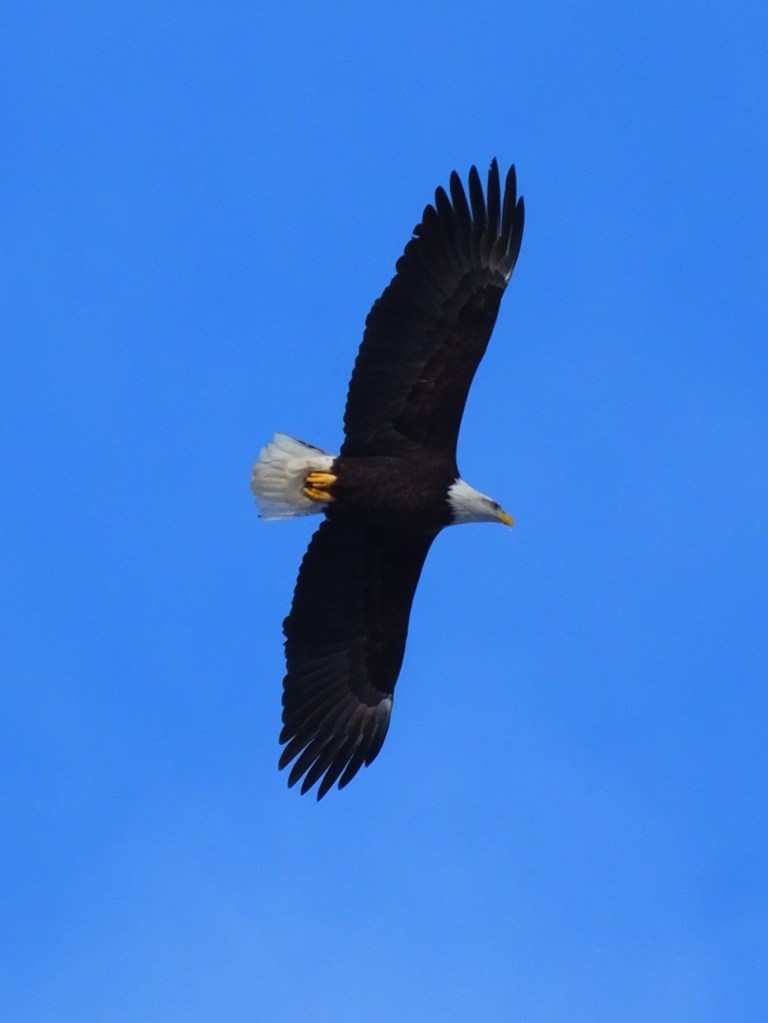
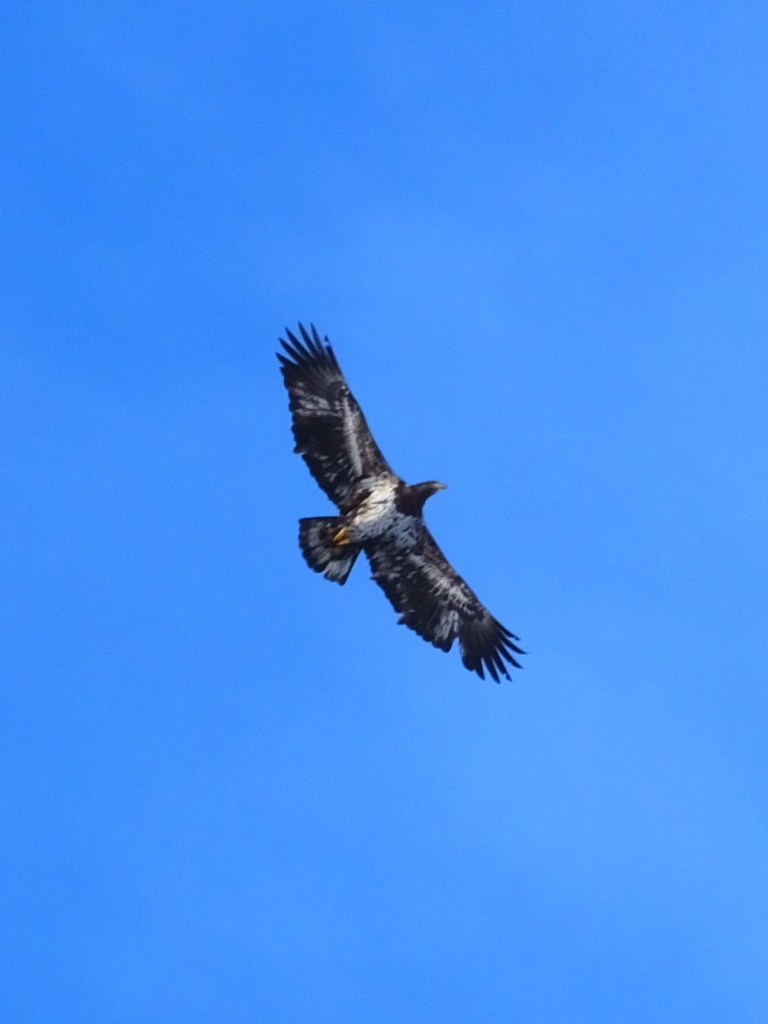
Not one, not two, but three, yes three bald eagles soared over the falls! Two were mature adults in white heads and tails, which we’ve seen before, and the third was a juvenile, perhaps in its second year, based on the whitish belly and dark head. They all circled a few times before confirming that there was not a bird left on the water and then headed south.
After that, with my heart all atwitter, I continued north along the river before it occurred to me that if I could spot a Cooper’s hawk, perhaps at the pond where we’ve seen them several times before, I’d have my first raptor hat-trick. So I made a bee-line to the east.
As soon as I arrived, I could tell by the sound of all the chatter, that there was no hawk around. Well, I’m at the pond anyway, where I’ve seen some nice things, so I settle in to take a look. Not more than a minute later, a hawk glides right in and perches on a branch in a tree at the northeast corner. The pond ice is nice and firm these days, so I head directly there, and it must have been hungry, or I’m getting a little better at this, because it let me get nice and close before I turned around and left it to hunt in peace. Ta da!
At that point, I was almost exhausted from all the excitement, so I opted to walk straight home along the Oak Leaf trail. Well, there are plenty of birds there, too, and what’s the point of such a beautiful blue sky if we don’t spot a woodpecker against it. Right? By the looks of the marks on her white tail feathers, I’m gonna say she’s a downy.
It wasn’t as cold as yesterday so my eyelashes didn’t freeze this morning, but sustained temps near 0°F and about a foot of snow on the ground is about as good as we get it here in southeastern Wisconsin, and the hardy critters seem to be coping just fine.
The group of goldeneyes upstream has grown to eight females and one male, but they are just as shy as ever, so I can only get this group shot from far away, and the steam fog is still present.
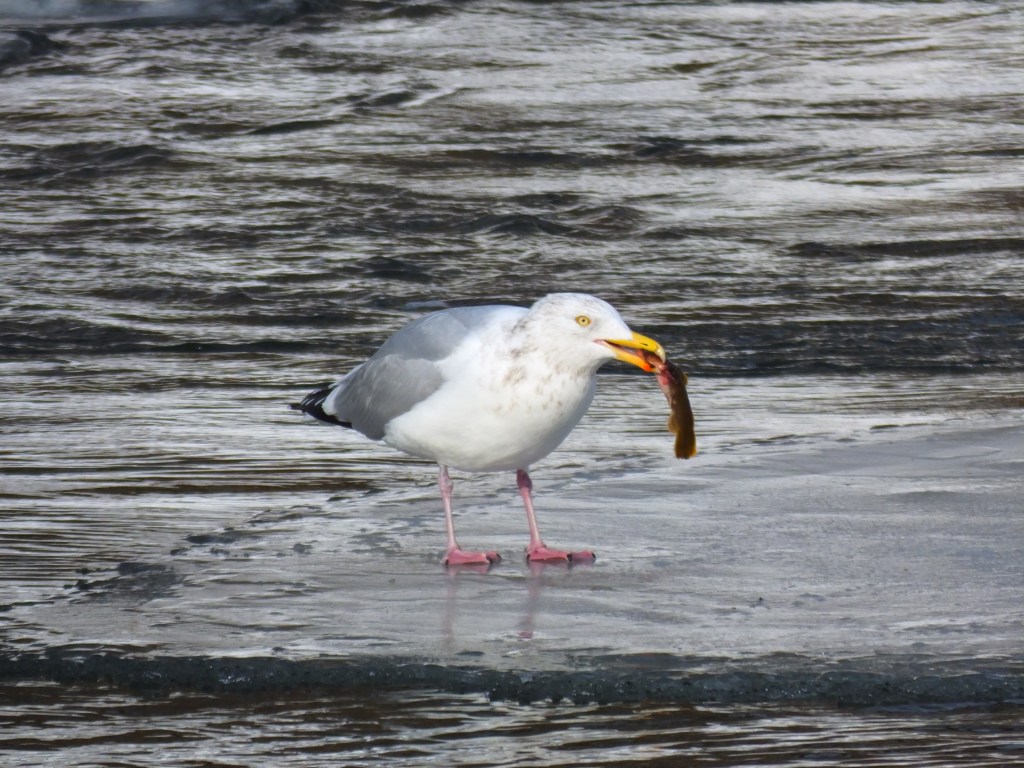
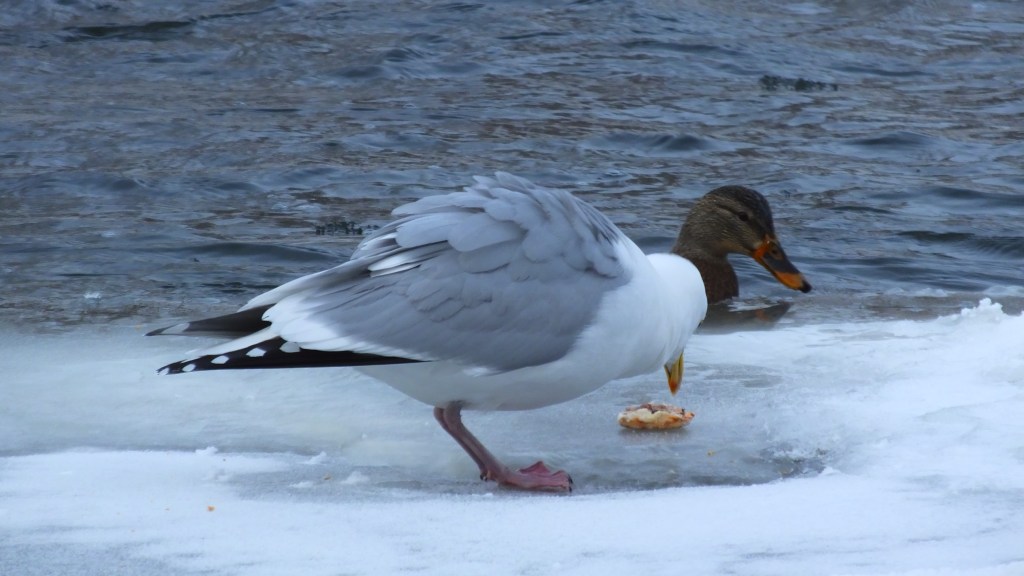
Also on the lower river, a herring gull was working on a morsel it had found while a female mallard looks on.
Above the falls, I could only see mallards today, and this bunch had found a spot to graze that was perhaps a little deeper than usual, but not deep enough to dive for. Thus, they had to generate quite a bit more splash with their feet than usual to reach the good stuff.
Meanwhile, on the far shore, a crow stopped by to take a sip of the only liquid water to be found in the park.
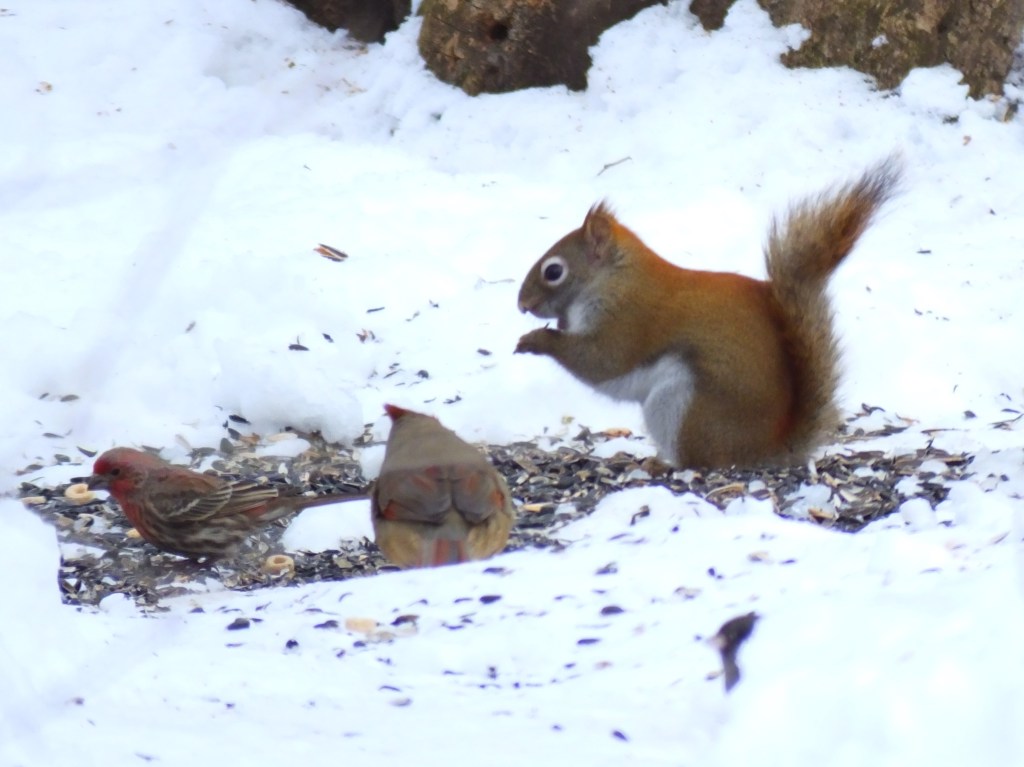
By the pond, someone has scattered birdseed on the snow, and it attracted this trio this morning: a red squirrel, a female cardinal, and some kind of sparrow.
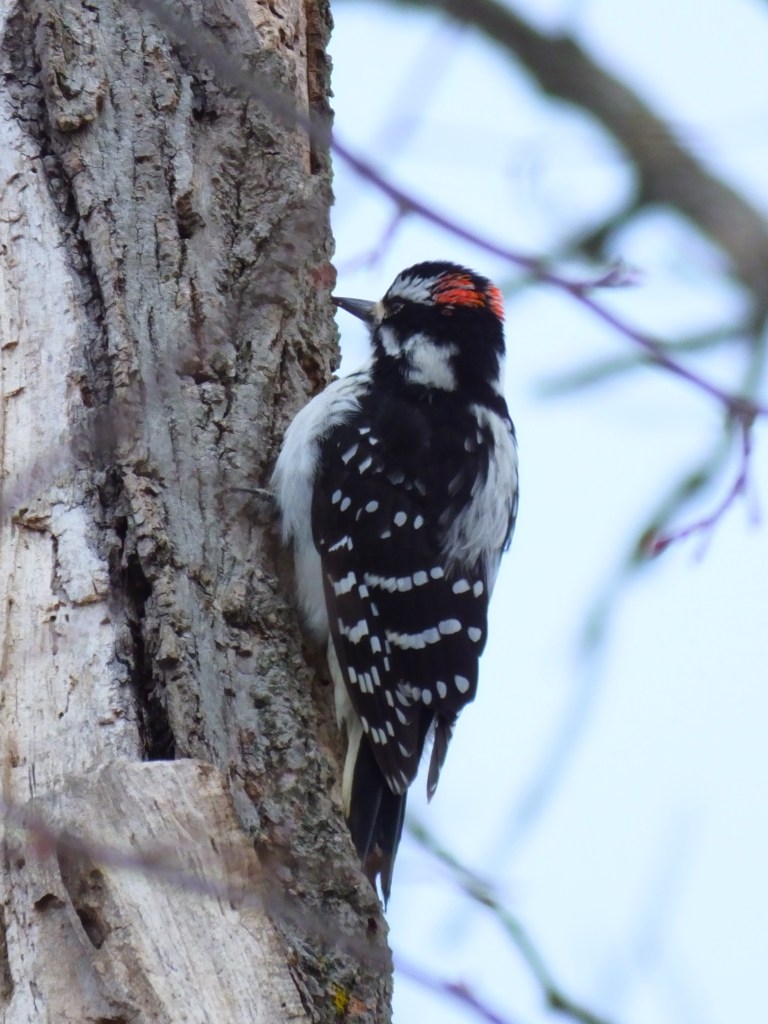
The woodpeckers were hard at work throughout the park, including this hairy male.
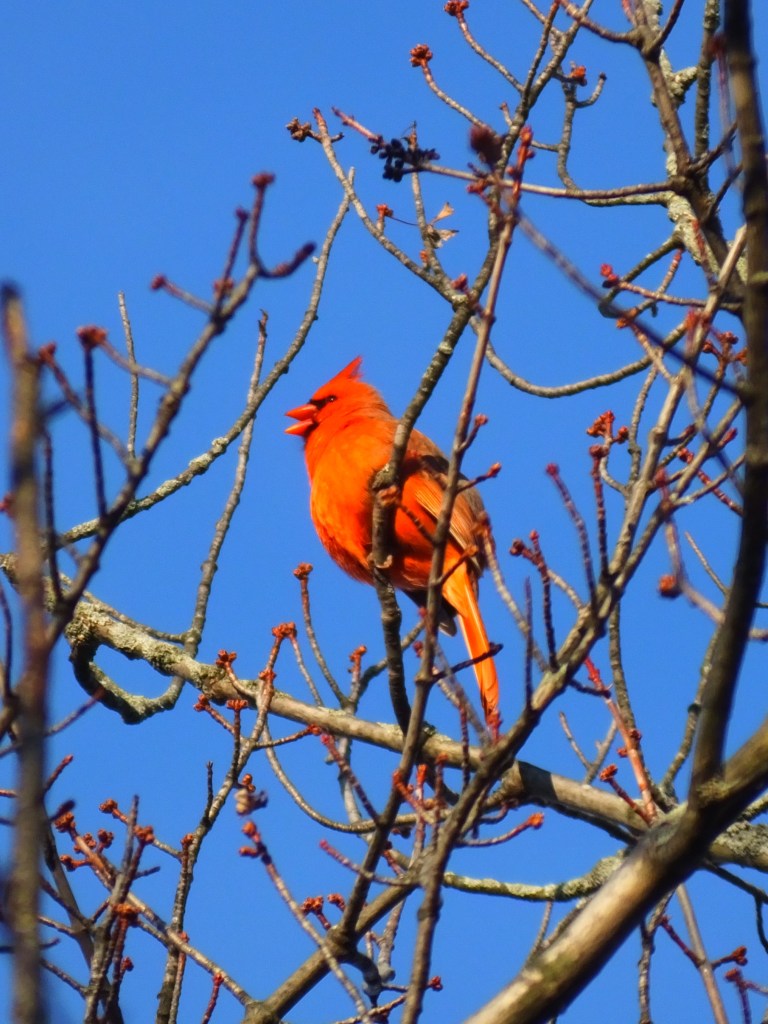
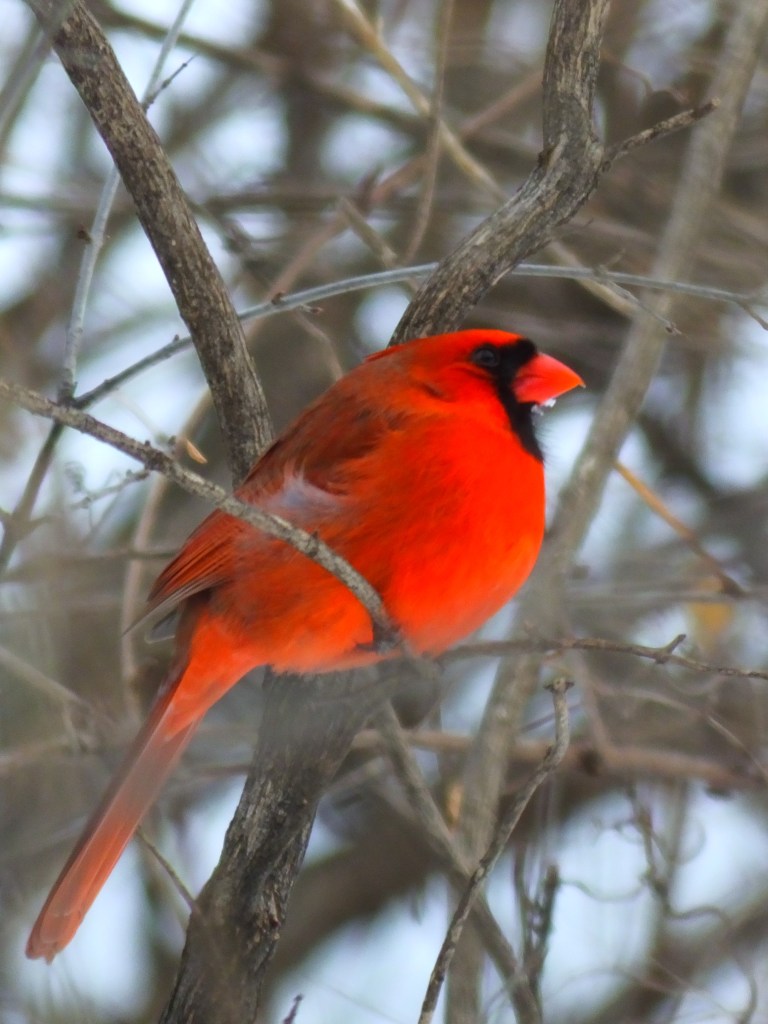
Finally, despite the current conditions, some of the male cardinals have already started to stake out their territory in song. This was not one of them, at the time, but he made a much nicer picture.


















 Signs of Life in Estabrook Park