Three kingdoms

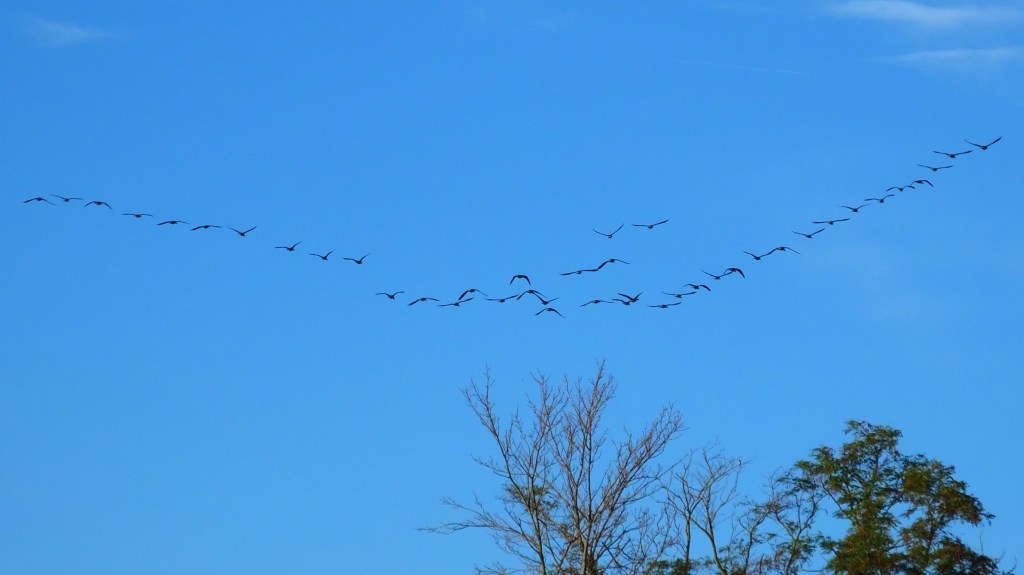
There were Canada geese on the pond this morning, which we haven’t seen in weeks, but I’ll spare you one more goose picture, and let’s start with some of the other familiar faces.

From the animal kingdom, the mallard family with the one yellow duckling continues to hang out in the oxbow pond beside the river, and all appear to be healthy (top/left). Meanwhile, the baby catfish (kittenfish as my old buddy Mark Purdy recently quipped) can still be found, wiggling vigorously, both in the pond and in the stream on the way to the river (bottom/right).

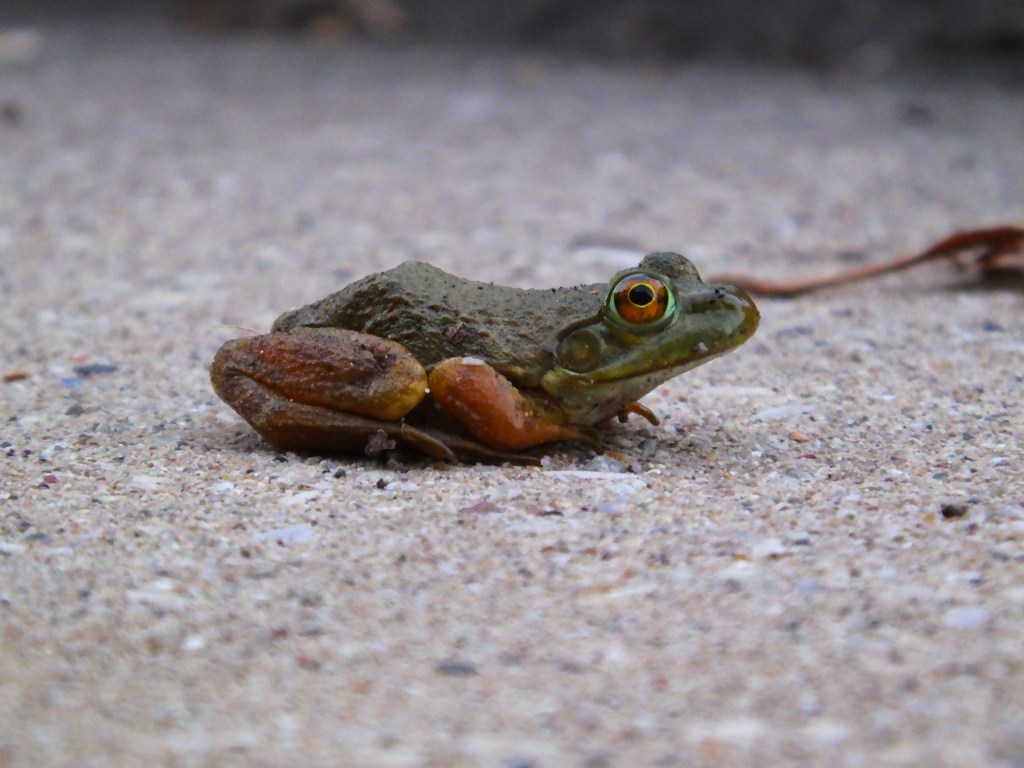
Yesterday afternoon I spotted on the river what might be the biggest bullfrog I’ve ever seen (top/left). I read they can grow to weigh a pound or more, and I’d be stunned if this one hasn’t already done that. Jabba the Hutt would be proud. For comparison, the little guy beside him (bottom/right) was perched on a leaf in the pond.

Okay, okay, on to the new arrivals, and we’ve been waiting over a week for the first one (top/left), a cicada, ever since we first heard his song! Well, actually, that’s just the empty exuviae, what the ancient Latins called “the remains of an exoskeleton and related structures that are left after” molting. Maybe someday I’ll find one still inside its skin, eh?

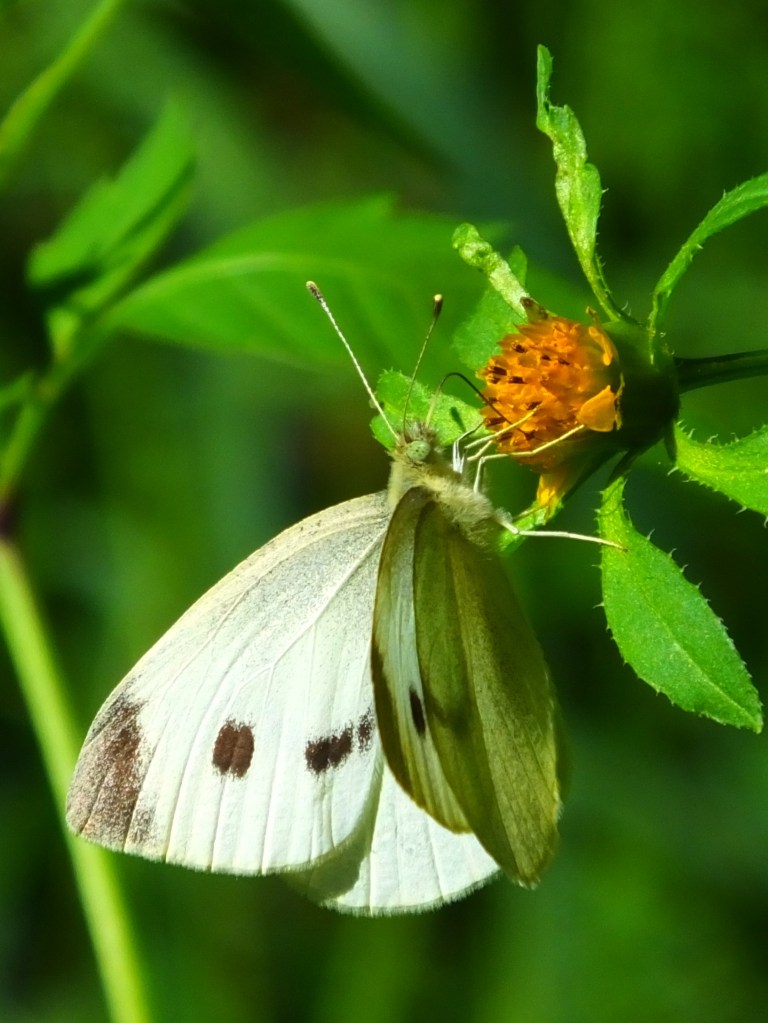
Next (bottom/right) is a striking Leconte’s haploa moth (Haploa lecontei) that really preferred hanging out on the bottom side of leaves, but indulged us just long enough for this mediocre shot. Why couldn’t it be nice and sit still like the cicada?

Also a little flighty, I believe we have a ruby meadowhawk dragonfly (Sympetrum rubicundulum) (top/left) striking a pose, and some handsome damselfly (bottom/right), probably a dancer, based on the shape of its wings and the way it’s holding them, but I can’t for the life of me find an image online of one with such a luxurious bronze color. Maybe that’s just an artifact of the bright sun and my camera.

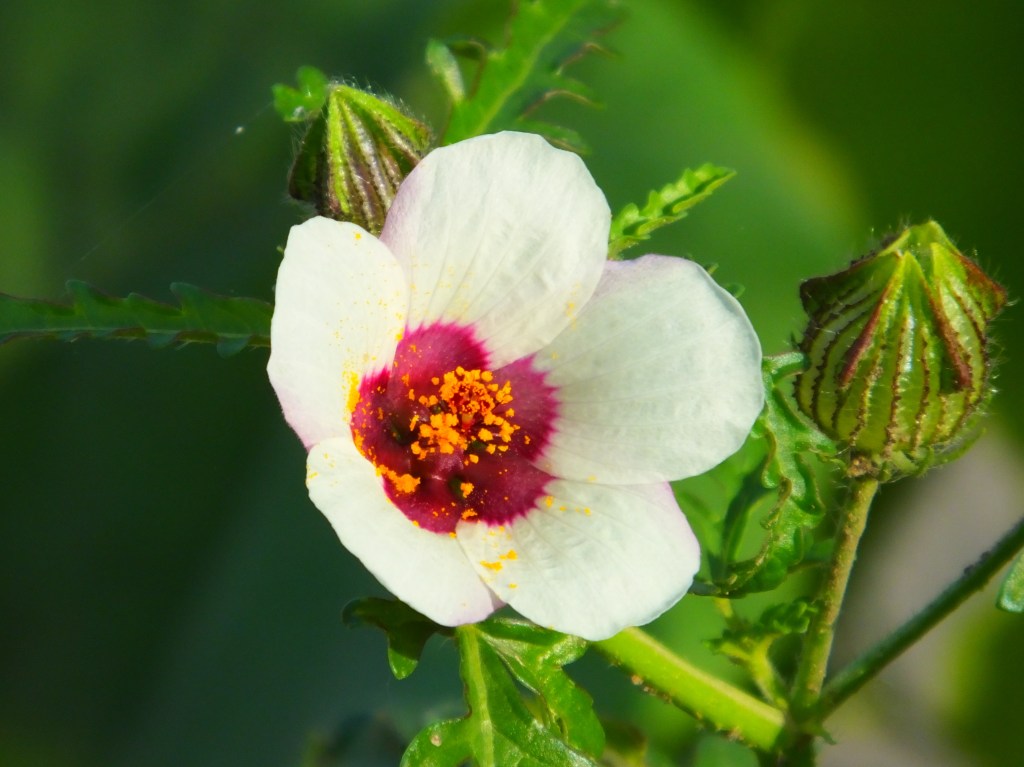
In the plant kingdom, goldenrod is beginning to open (top/left), and I read that “if you see a goldenrod blooming in July,” it’s early goldenrod (Solidago juncea)Motherwort or lion’s tail (Leonurus cardiaca) has been blossoming for a week or so (bottom/left), and herbalists once thought it “useful for removing melancholy vapors from the heart, improving cheerfulness, and settling the wombs of mothers,” not to mention “protect[ing] against evil spirits.”

Finally, in the fungi kingdom, this amazing-looking mushroom might be a young “white-pored version” of chicken of the woods (Laetiporus sulphureus), but don’t trust me with your life on that. You’re better off with the Motherwort.

Auf wiedersehen!

A river grab bag

With the Farmers Market, Beer Garden, and beautiful weather added to the usual Sunday crowd, I tried the find the quietest spots I could, which tend to be along the river, and this is the oddball cast of characters I found there.

First up is a young blue jay (Cyanocitta cristata), old enough to fly, but still pleading to be fed, with incessant diminutive calls and little wing flutters. Really, that’s the cutest age, right? At least he was too busy to elude my camera as well as his elders have managed to do all summer.

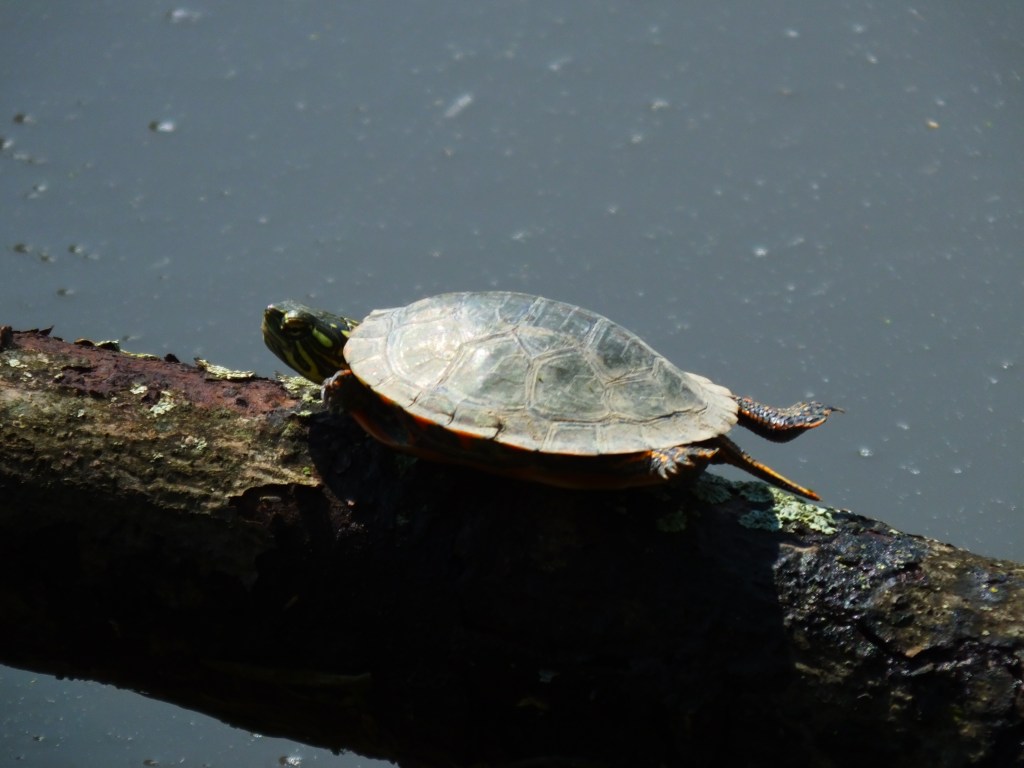
Next up are a couple of surprises for me in the river, a painted turtle (Chrysemys picta) northern map turtle (Graptemys geographica), which I originally and mistakenly thought was a painted turtle, sporting a fine algae patina, plus a tadpole, probably an American bullfrog (Lithobates catesbeianus) judging by its size, who’s already grown hind legs. We’ve seen both in the pond, of course, but I wouldn’t have expected to find either one in the river. Live and learn, we hope.

This next pair take us back a bit, to the Middle Devonian age, about 385,000,000 years ago. They are brachiopod fossils imbedded in the argillaceous dolostone of the Milwaukee Formation, laid down when the future midwest was under a shallow sea. I had to step off the path to let a group pass, and as I waited, these were just staring me in the face, as patient as can be. Yup, we’ve even got fossils in Estabrook Park.

A little less patient were these two, an eastern tiger swallowtail (Papilio glaucus), who appears to have seen better days (insert joke here about someone swallowing its tail), and an unassuming little moth who appears to be a gray spring moth (Lomographa glomeraria).

Speaking of impatient, get a load of this bunch of damselflies all trying to mate on the same little scrap of grass floating on the river, and based on their color and location, I’m gonna go with river bluet (Enallagma anna). On the other hand, the BugLady asserts that this behavior, an “oviposition aggregation”, suggests powdered dancers (Argia moesta).

Lastly, we’ve got this little cutie, and based on the pictures, my guess is (common) pill-bug (Armadillidium vulgare), especially given “restricted to calcareous soils or coastal areas” after what we just learned about the Milwaukee Formation. I read that pill-bugs are crustaceans, not insects, they breathe through gills, and many other fascinating tidbits.

Further, there are trilobite fossils in the Milwaukee Formation, and pillbugs are among the closest living relatives. Heck, there are even pill-bug fossils for sale! The more I dig, the deeper it gets.

Anyway, that’s the weekend round up, and who knows what the new week will bring, eh?

Down to the river they went…

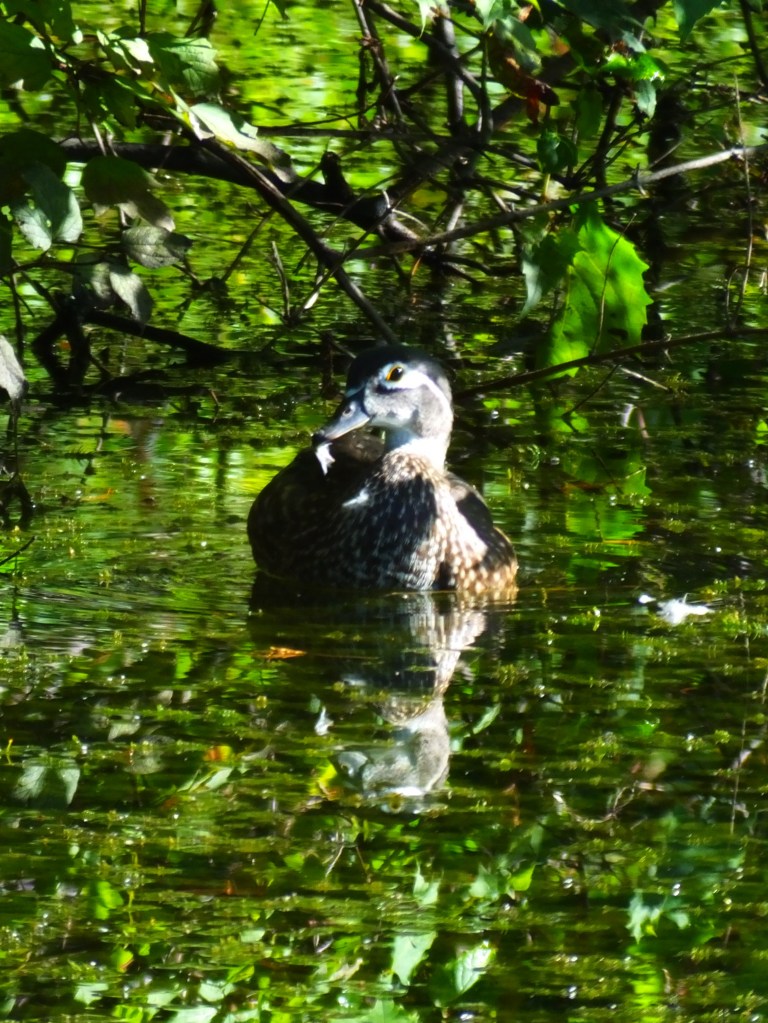
I found our Mrs. Wood Duck down on the river yesterday afternoon, instead of up on the pond where we just saw her last, and it appeared that she had some youngins with her, but they quickly got and stayed out of sight. I didn’t see them this morning, but I’ll keep my eyes peeled. Here she is demonstrating her ability to perch in trees, and I read that hers is the only North American duck species that have the long toes with claws necessary to do so. I’ve spotted them in trees by the pond before, but never managed to get a shot till now.

She’s not the only one to follow the Canada geese and the mallards to the river, either. Here’s a bunch of our baby catfish that probably ventured too close to the pond drain, and they seem to enjoy wiggling around in the stream just as much as they did in the pond.

They’re not even the only tiny fish in the stream, which is narrow enough in spots to step over without getting your feet wet. Here are a couple more diminutive creek dwellers, probably creek chub (Semotilus atromaculatus), in about just an inch or two of water. Man, even that little stream is full of life.

Also down by the river are more jewelweed, but in yellow instead of the orange we saw yesterday. This yellow jewelweed or pale jewelweed (Impatiens pallida) can grow right beside the closely-related orange jewelweed (Impatiens capensis) and has a slightly larger blossom. We’ll have to check and see which species is better at launching its seeds, eh?

Speaking of blossoms, here are two more that I’ve spotted recently. From left/top to right/bottom, we’ve got purple loosestrife (Lythrum salicaria), growing by the river, listed as “a restricted invasive species” by the DNR, and which I should probably pull up the next time I see it 🙁; and some variety of mint, based on the aroma from a crushed leaf, maybe horse mint (Mentha longifolia) growing right beside the falls.

Meanwhile, back by the pond, we’ve got either new dragonflies emerging, or dragonflies that I simply haven’t managed to capture until now. They are, from top/left to bottom/right a male and a female widow skimmer (Libellula luctuosa), which the BugLady describes as “exquisite” and her favorite “King Skimmers.”

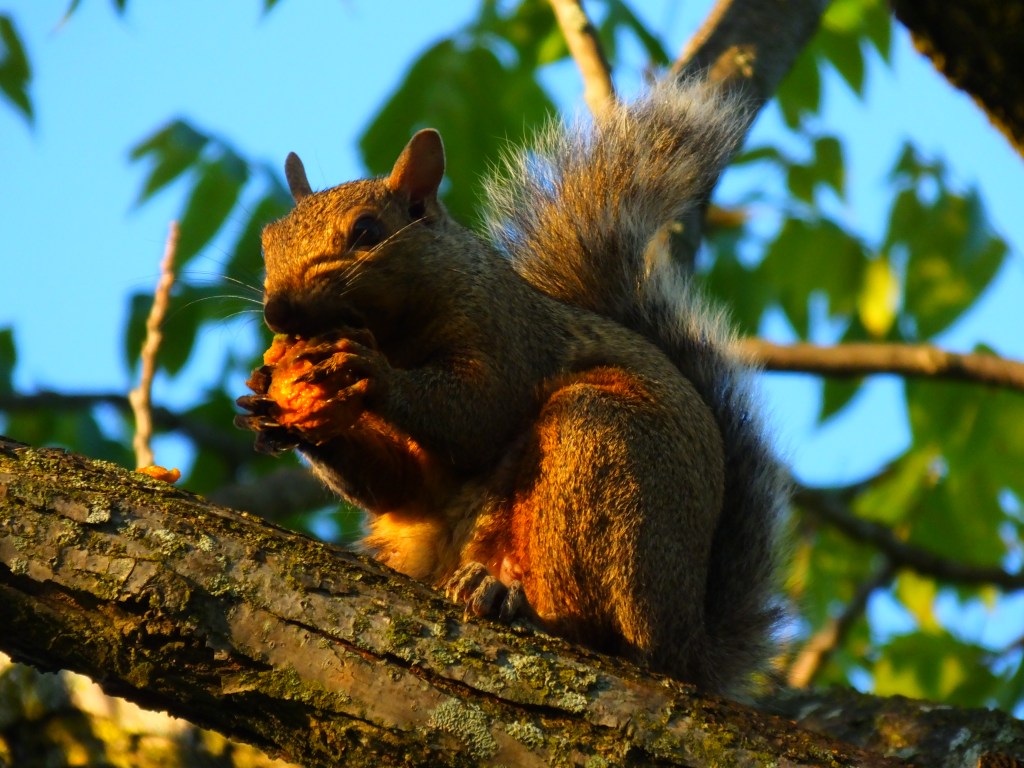
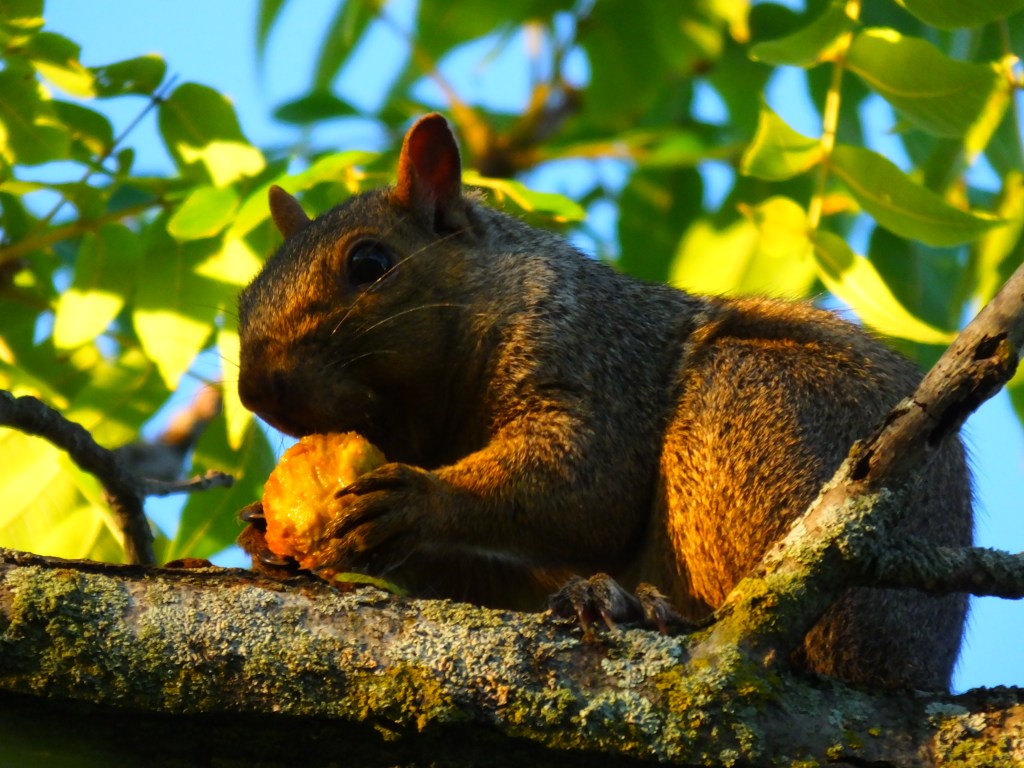
Lastly, after all the deer, rabbit, muskrat, chipmunk, and even red squirrel pictures lately, this little eastern gray squirrel (Sciurus carolinensis) must have been feeling left out, he was posing so well, so here’s his picture, too.

Well, that’s a wrap for today, and I’ll catch y’all on the flip side.

The three Bs: birds, bugs, and blossoms.

What? Which three Bs are you thinking of?

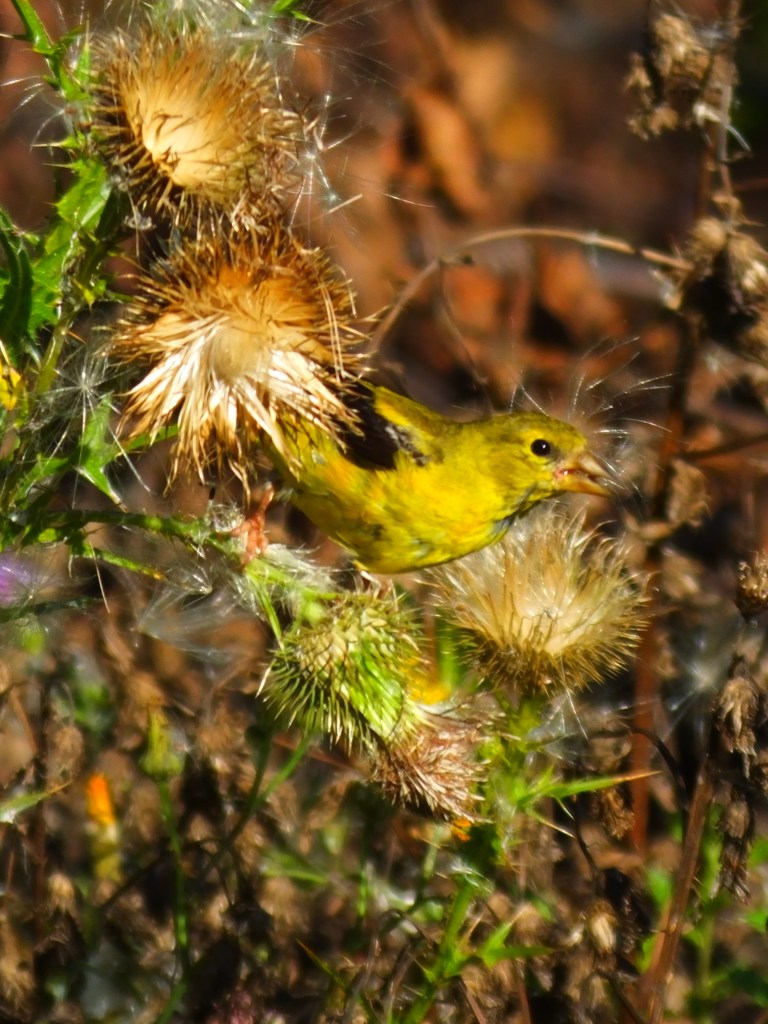
First the birds. Now that the thistles are going to seed, the goldfinches are starting to be all over them.

The young brown-headed cowbirds (Molothrus ater), whose eggs were laid in the nests of other species, appear to be now getting out on their own and somehow learning to socialize with other cowbirds. Below, from left/top to right/bottom, is one that clearly looks smaller and fresher than the others, one calling to her pal, and then the two of them gettin’ right to work rustlin’ up some breakfast.

The mallard ducklings keep on growing under their mom’s watchful eye along the river. You may recall we met this brood of five, one of which is inexplicably yellow, a couple of weeks ago.

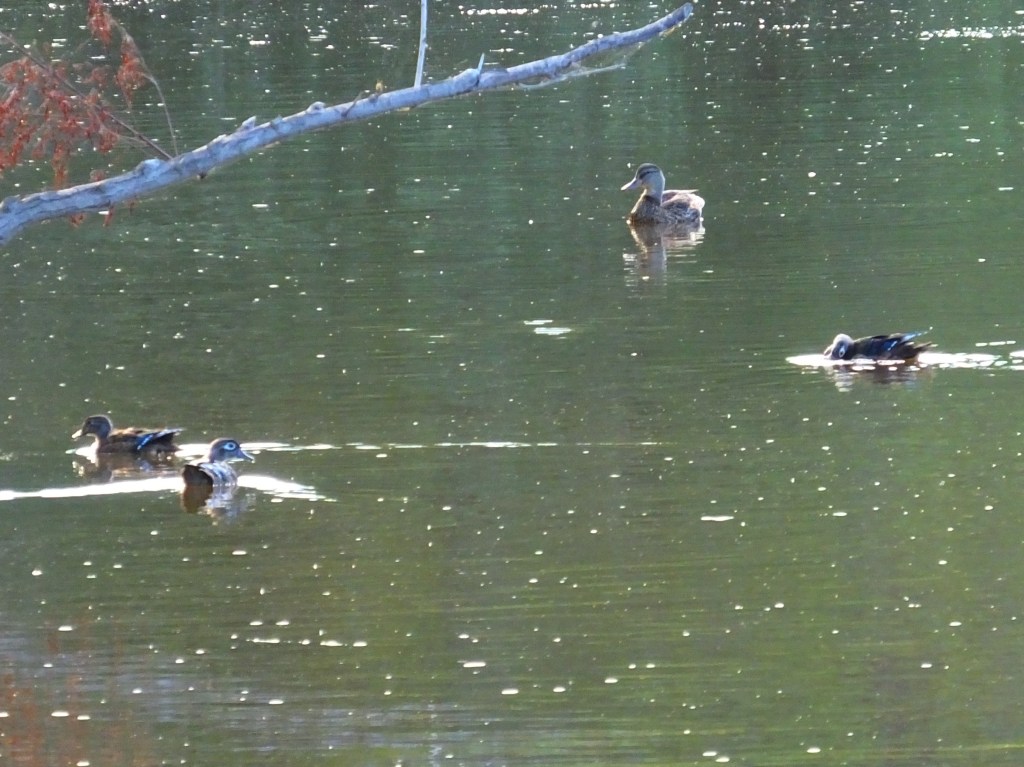
Finally, one female wood duck visited the pond again and took a lap around the island. I wonder what she’s looking for.

Onto the bugs, and first up is this master of disguise, maybe a “mid-instar with small wing pads” of the narrow-winged sand grasshopper (Melanoplus angustipennis), blending into the rough concrete at the kayak/canoe launch at the north end of the meadow.

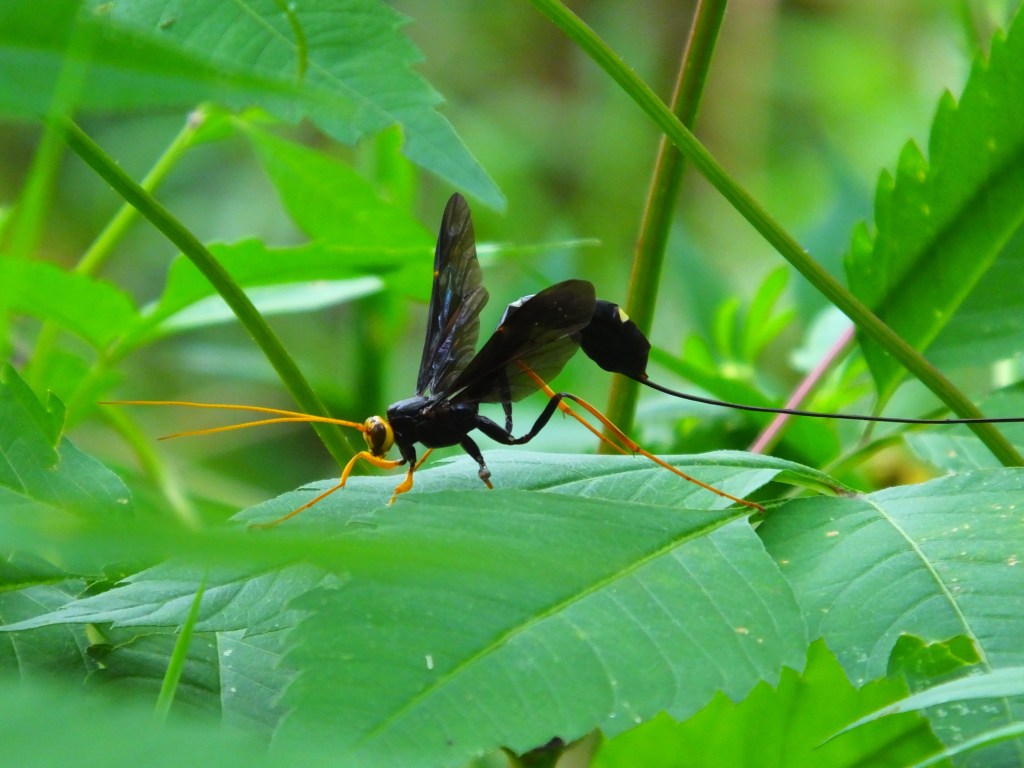
Next is this astounding giant ichneumon wasp (Megarhyssa atrata), who had sadly met her demise before I found her. I put a dime, which I found in the parking lot a little earlier, into the picture to give you some sense of scale. She is huge, but that’s not a stinger, it’s her ovipositor, which she uses to “lay eggs into the hard wood of tree trunks.” Fantastical, right?

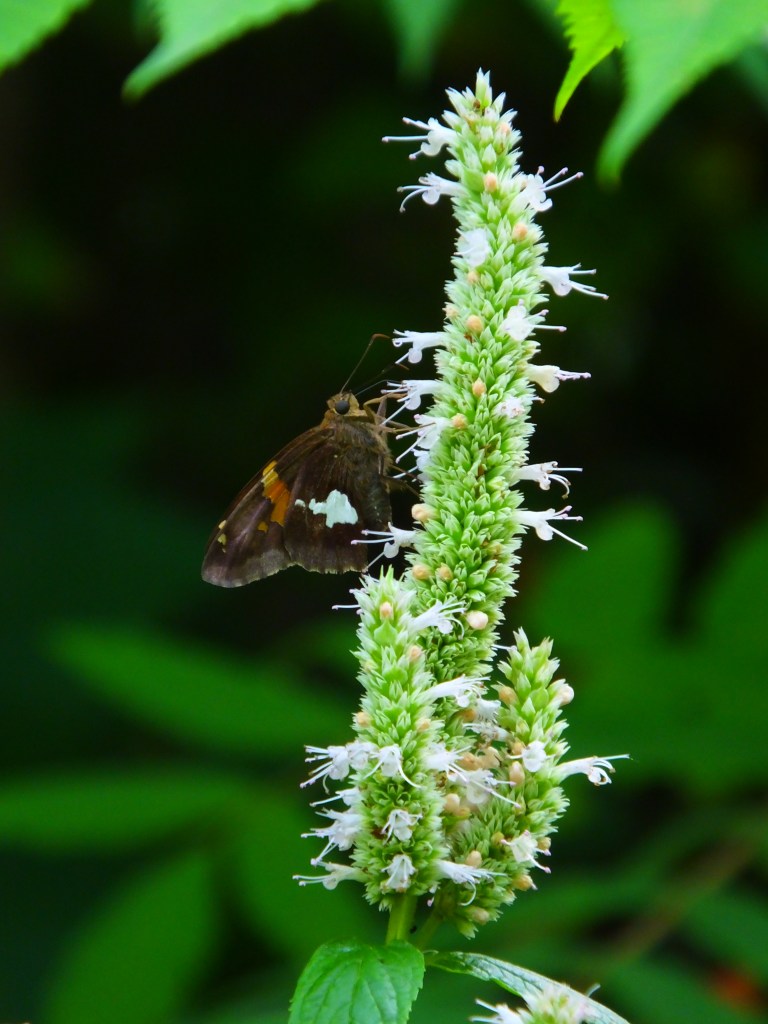
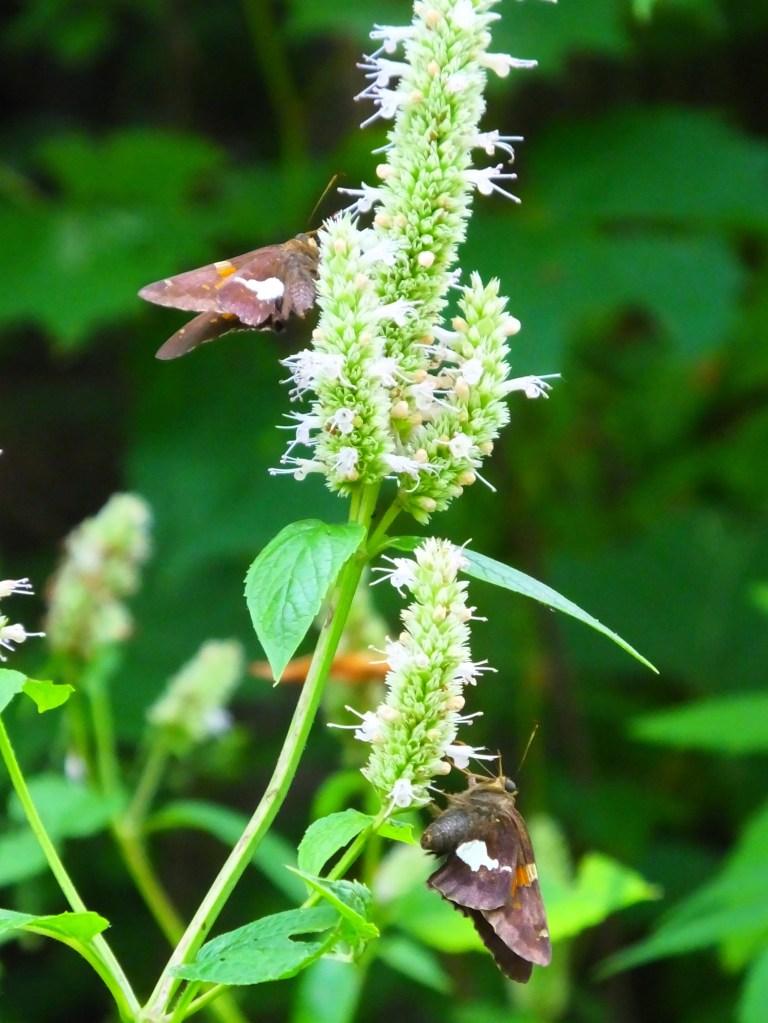
Finally, some new blossoms are beginning to open up. From left/top to right/bottom, we’ve got wild bergamot or bee balm (Monarda fistulosa) just off the path north of the beer garden. Only a little further up the path is some orange jewelweed, common jewelweed, spotted jewelweed, or touch-me-not (Impatiens capensis), which earns that last common name because “the seed pods have five valves which coil back rapidly to eject the seeds in a process called explosive dehiscence, [and] in mature seed pods, dehiscence can easily be triggered with a light touch.

Well, there you have it, boys and girls. Just another summer day in Estabrook Park brimming with amazing sights to see. Don’t forget that tomorrow is the Shorewood Farmers Market, and maybe I’ll see you there.

Must be my lucky day…

We had a nice line of thunderstorms roll through last evening, and precipitation lingered into this morning, so I got off to a latish start. At first, is seemed that everyone was still laying low. Even Ol’ Blue had to take a step back from his usual spot by the falls.

So I headed up to the meadow by the river to see if maybe I could get another chance with the sandpiper, but the river was so high, even the rocks he perched on yesterday were submerged, and he was nowhere to be seen.

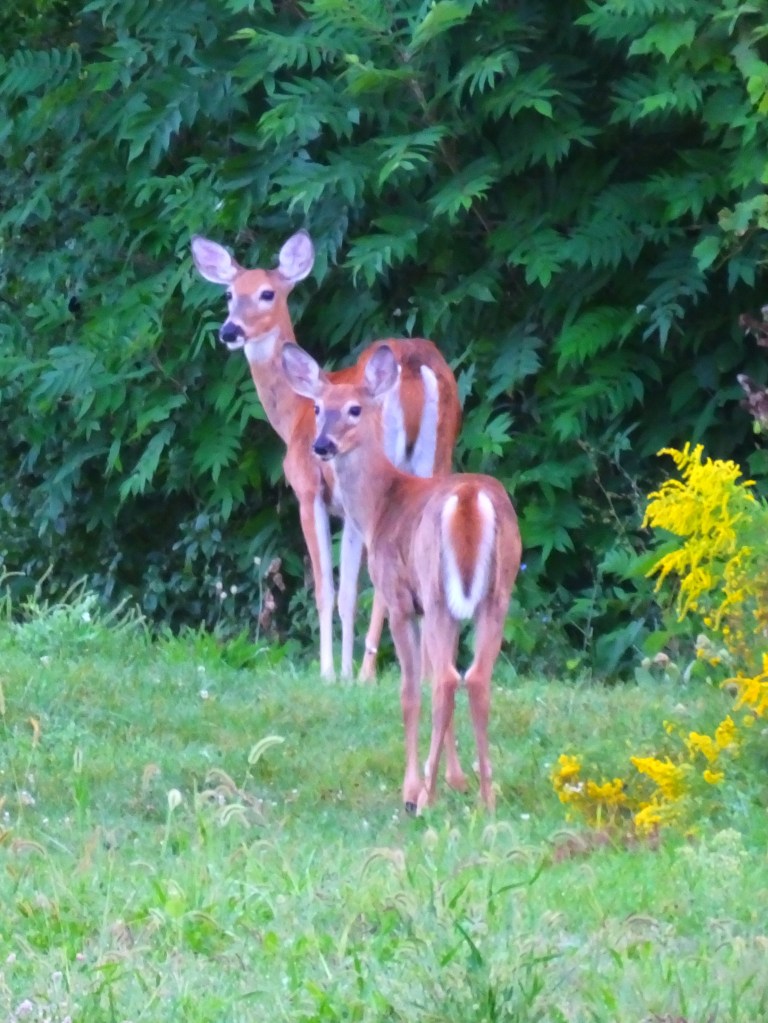
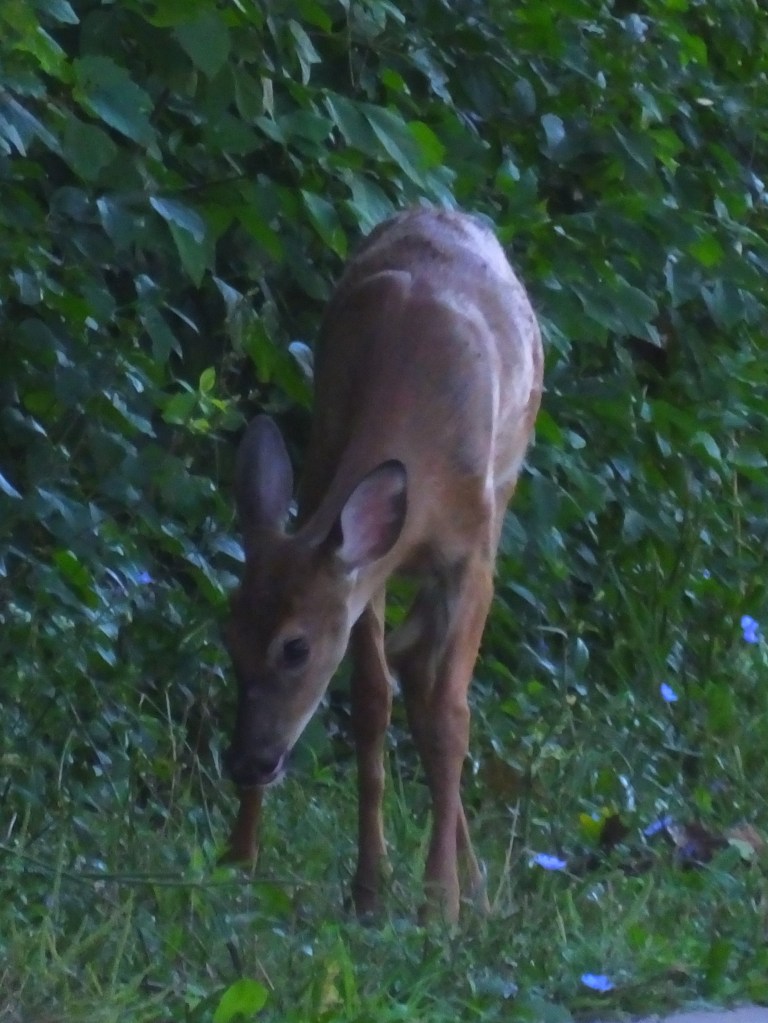
I had barely turned around to head home, perhaps feeling a little dejected, when this amazing creature came out of the woods to say “hi”, and I stood as still as I could.

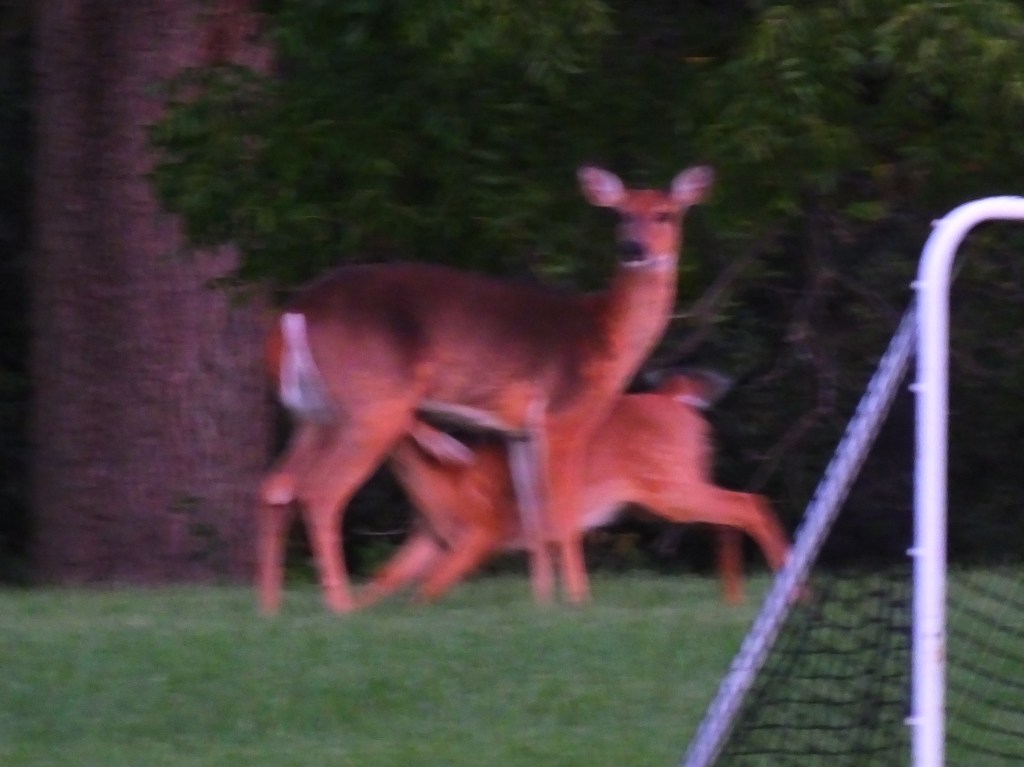
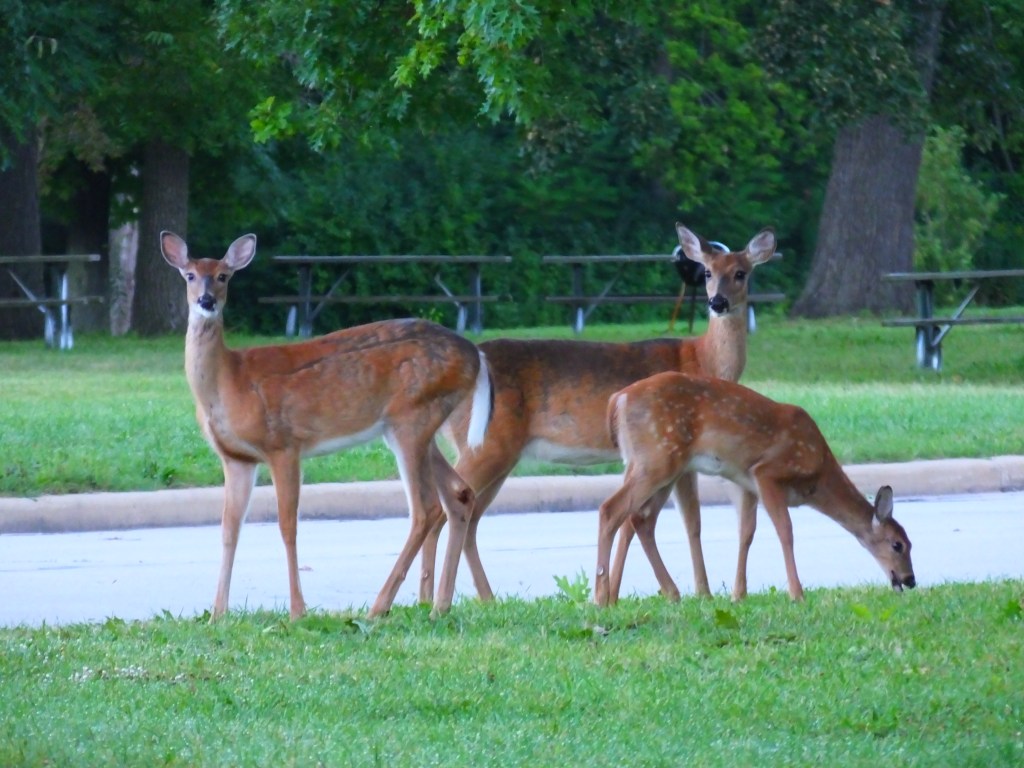
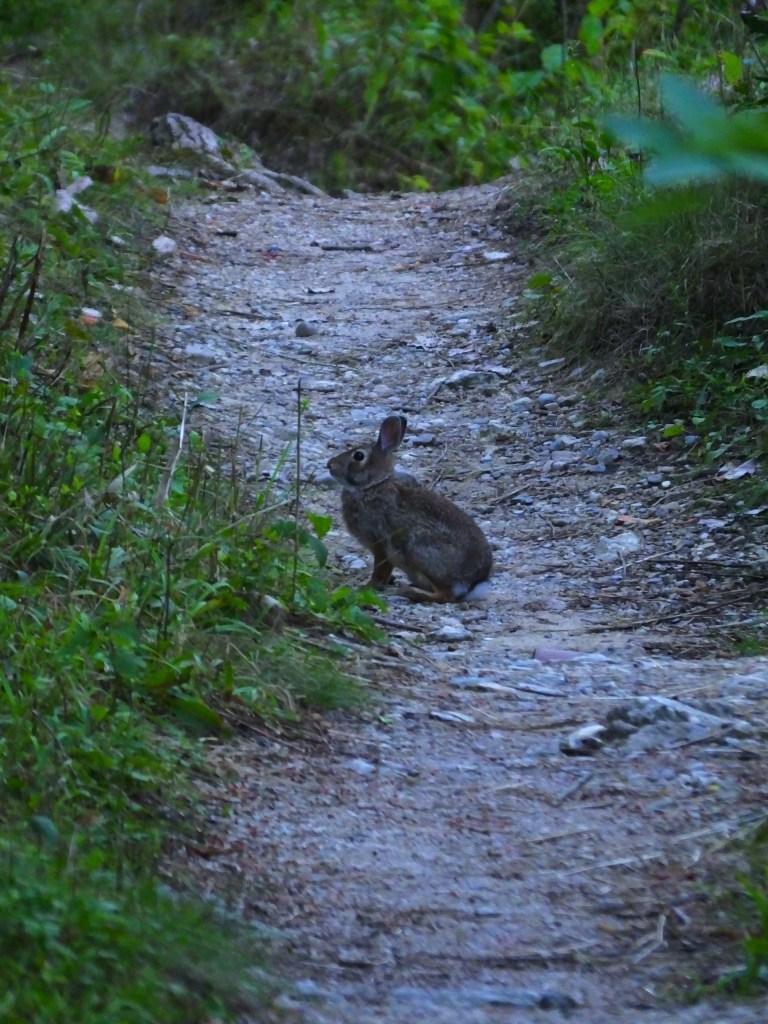
You can tell by the look on her face how threatening she found me this morning. At that instant, I was standing about 10 feet away. A few minutes and a couple dozen shots later, look who else decided it must be safe to come on out!

Here you can plainly see that he’s about as afraid of me as she is.

He probably worked on his tail for a full minute. Man, now I’m gonna hafta wear this t-shirt, unwashed, for the rest of the summer! Anne will be thrilled. I eventually walked away as slowly and evenly as I could, and they were still munching on their breakfast as I exited the south end of the meadow.

Soon after, while the iron was still hot I guess, I came across this handsome critter, who appears to be an orange ruby meadowhawk dragonfly (Sympetrum rubicundulum). The Bug Lady explains that some can be tricky to identify just from a photograph, so I don’t feel so bad.

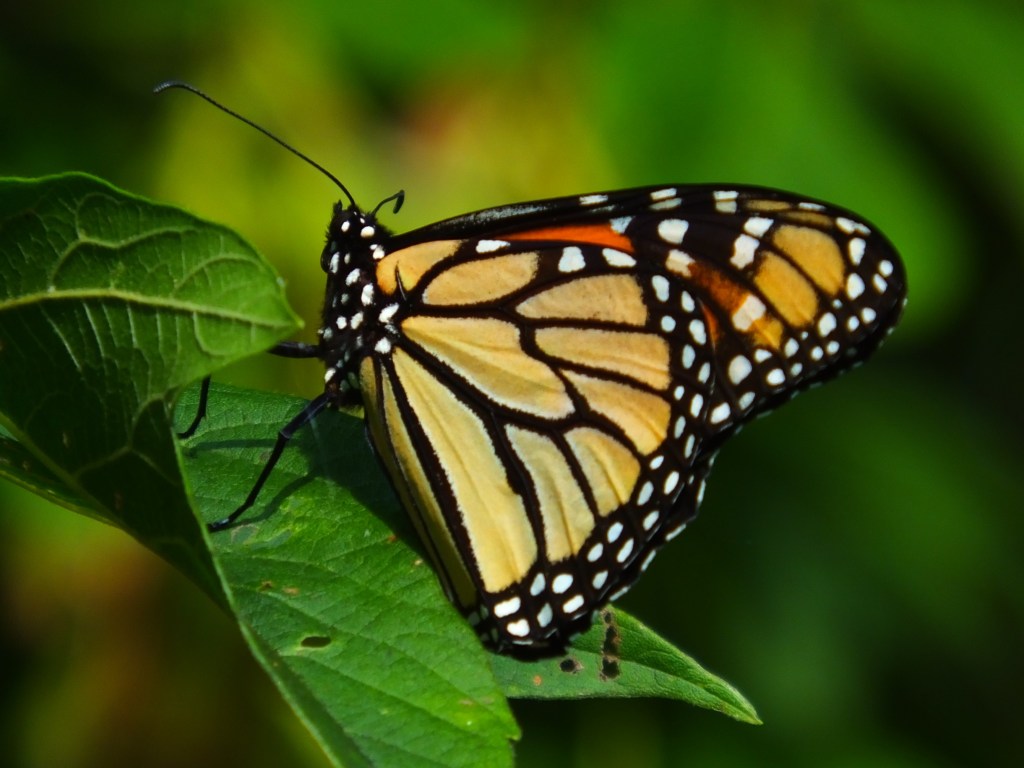
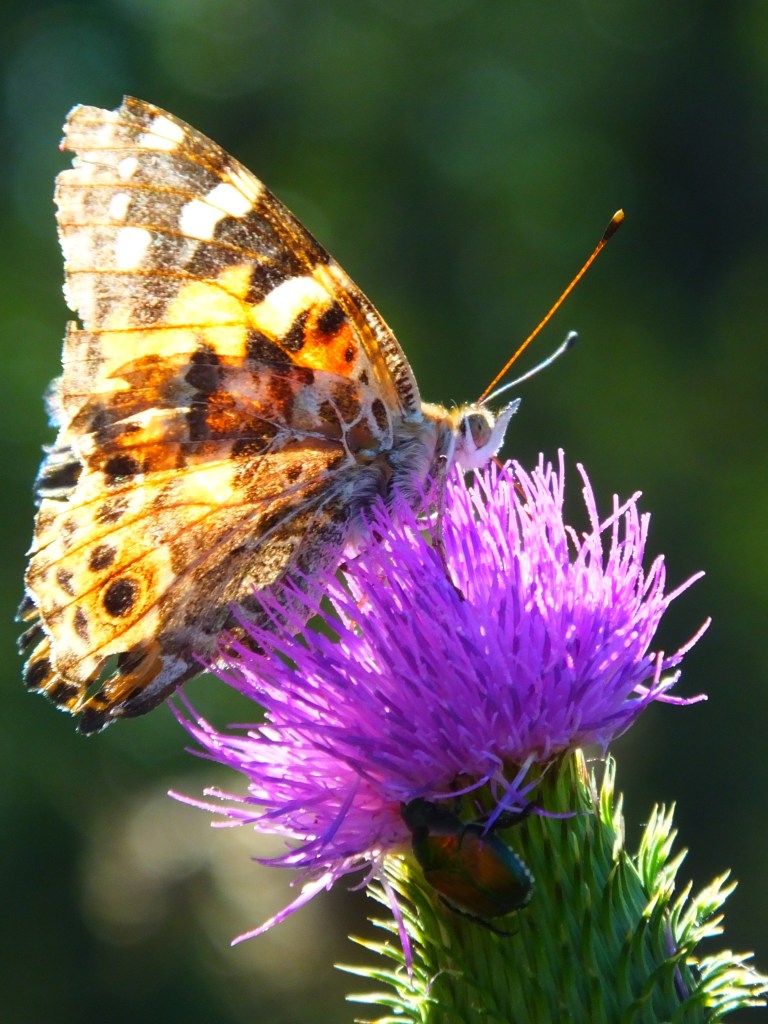
Lastly, I stopped by a patch of Canada thistle (Cirsium arvense), which is now blooming like crazy, to take even more pictures of monarch butterflies, when I spotted these two, who appear to be great black wasps (Sphex pensylvanicus). The Missouri Department of Conservation explains these are “a friend to gardeners: a single female great black wasp can capture 16 hoppers a day, helping control grasshoppers, which chew on crops and garden plants. This wasp also pollinates plants in the milkweed, carrot, and bean families.”

Yeah, there’s some new flowers out, too, but it looks like I’ll have to save those for a rainy day. Fino ad allora abbi cura di te.

A pretty good mix of old and new…

It appears we’ve got our first new bird in a while, a young spotted sandpiper (Actitis macularius). It’s across the river and not very big, so the picture isn’t the best, but it’s the little grey and white shape right in the middle of all the grey and white rocks. I first spotted it at the edge of the water on the little canoe/kayak launch at the north end of the wildflower meadow, but I couldn’t get a shot before it flew to the other side. Better luck next time, eh?

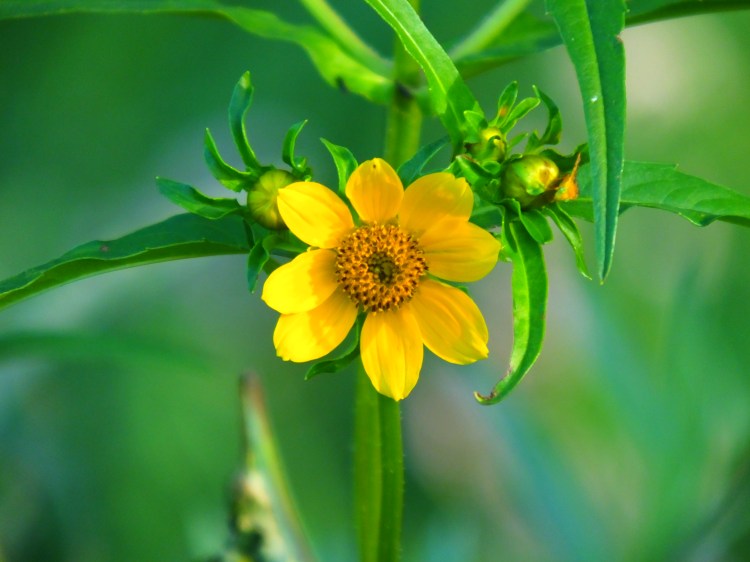
It also appears that we have yet even one more bright yellow flower in the park, and this one looks to be a yellow coneflower (Ratibida pinnata). I spotted this one and a few compatriots on the steep slope from the beer garden down to the river, where we have already seen lance-leaved tickseeds, black-eyed susans, and ox-eye sunflowers. How many more can there be, right?

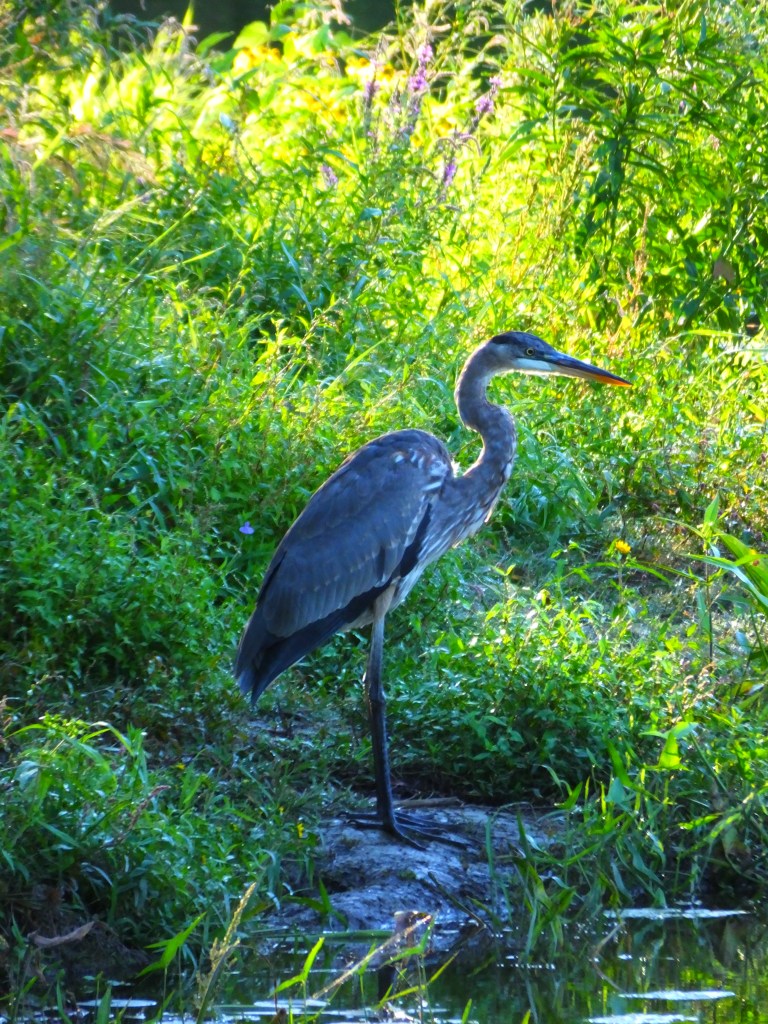
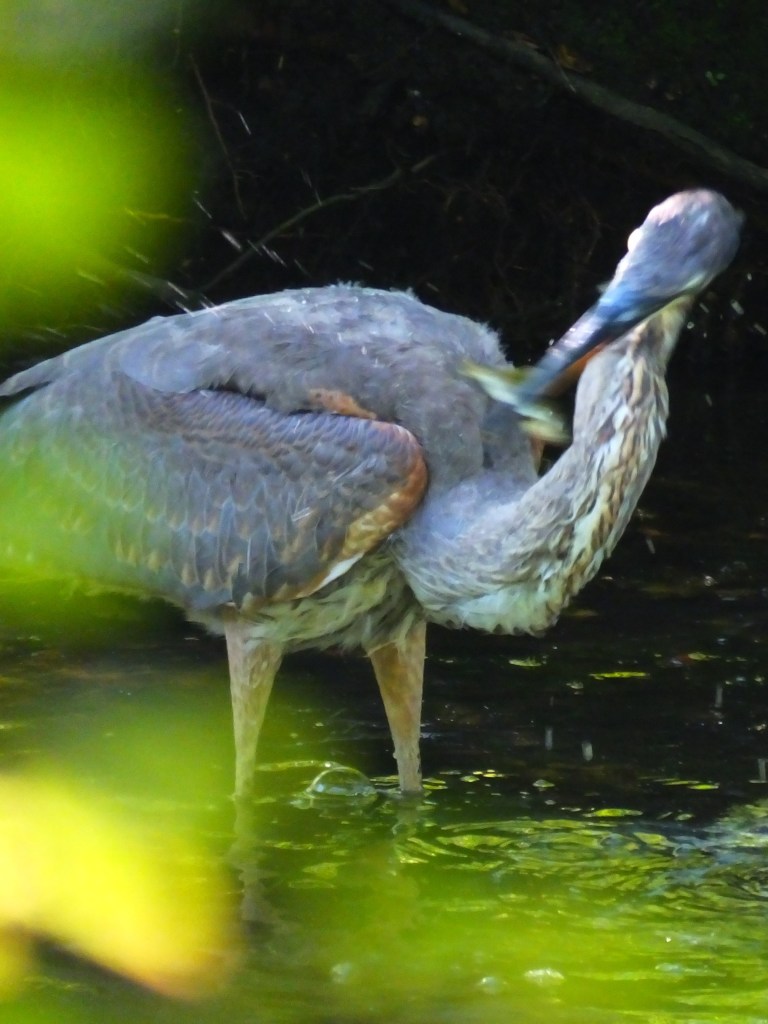
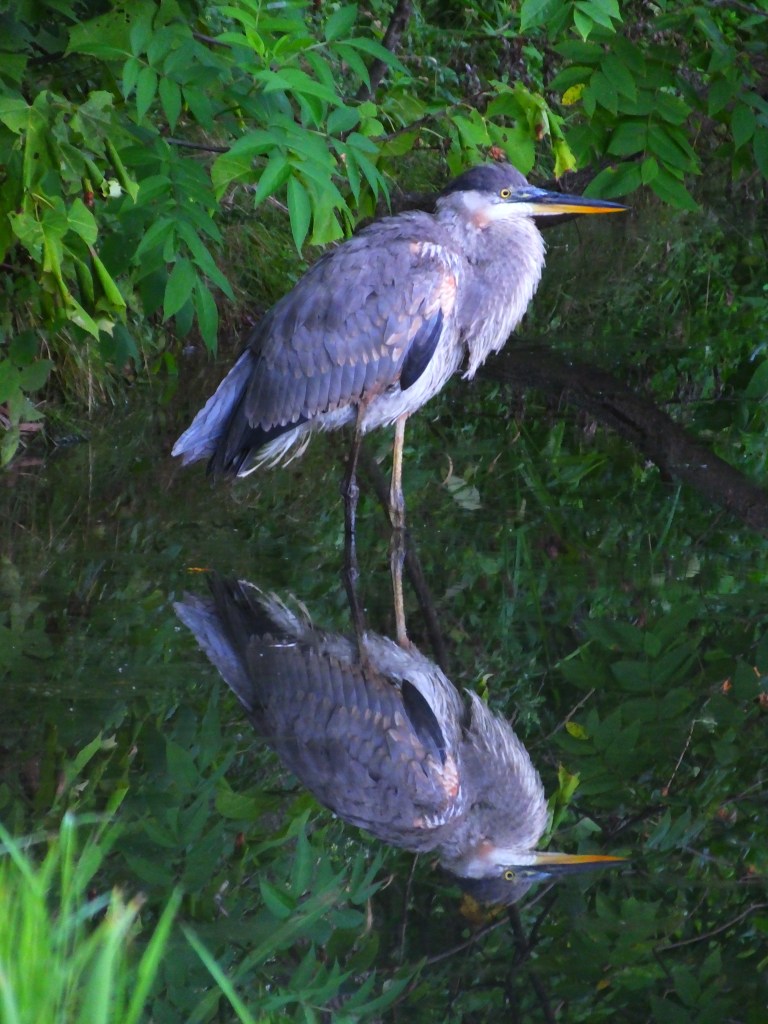
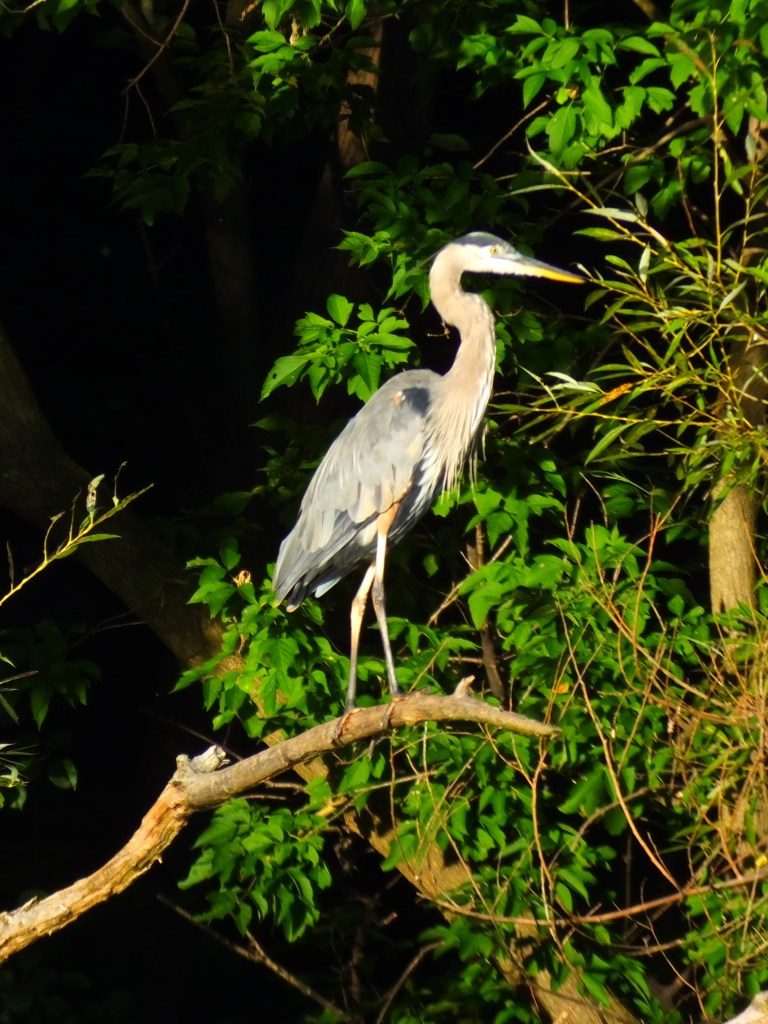
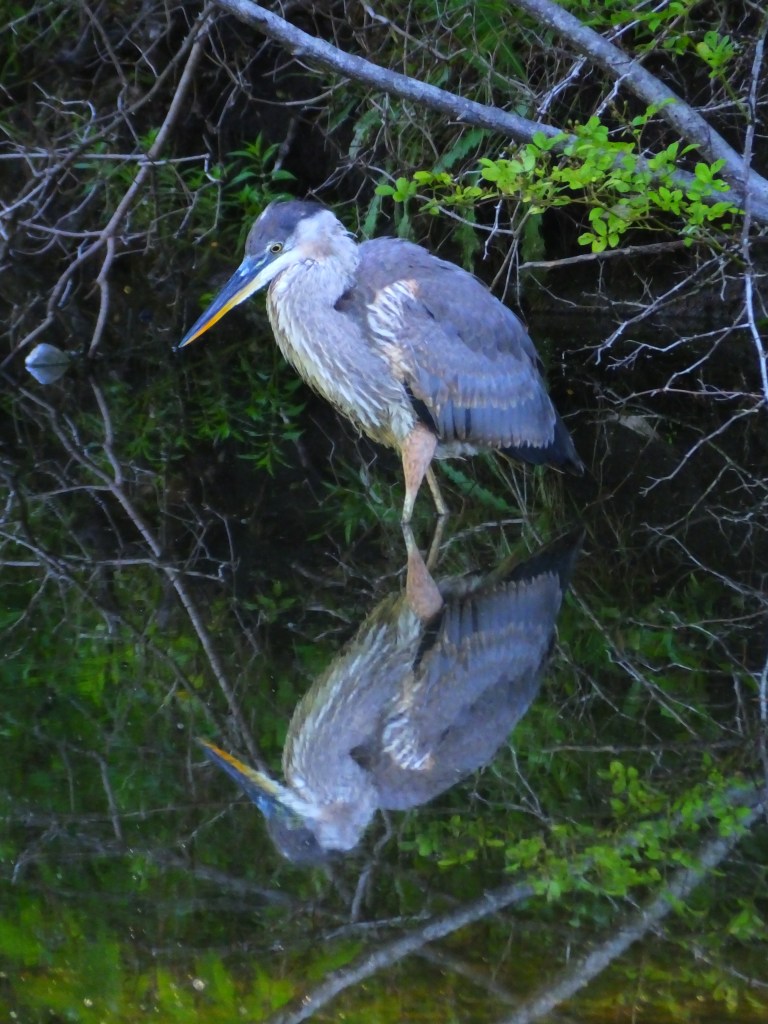
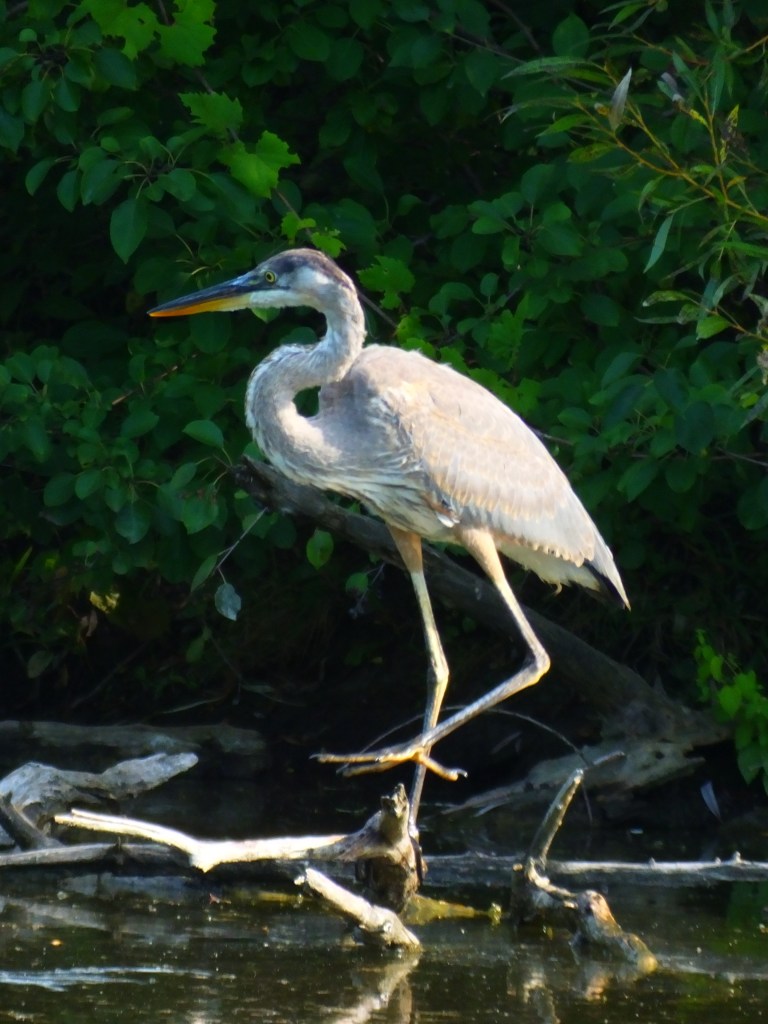
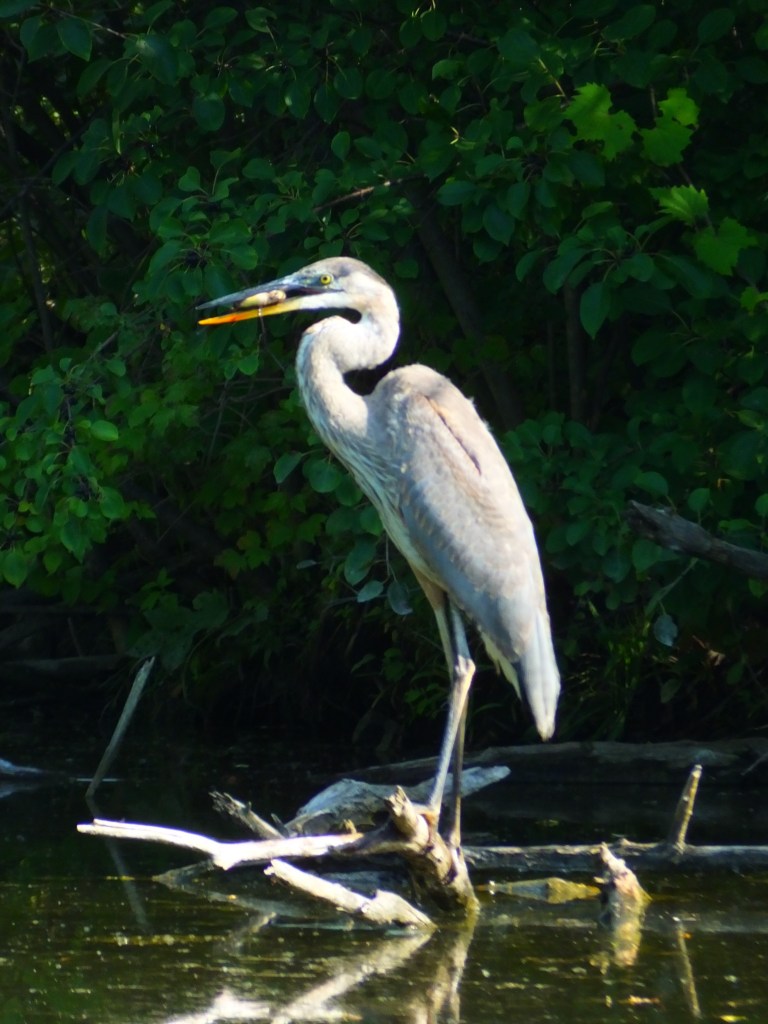
Meanwhile, the blue heron and at least one of the mallard families were going about their usual morning business along the river where we’ve seen them before. Since the salmon won’t be running for months, I wonder if the heron is finding something else going up or coming down the falls, or he just likes that spot for the morning sun.

I also spotted a male ebony jewelwing damselfly (Calopteryx maculata) in the woods along the river, and I hope he finds the female we spotted a couple of days ago so that they can get busy looking for “the soft stems of aquatic plants.“

Lastly, I’ve been trying to get a picture of a black saddlebags dragonfly (Tramea lacerata) for you for weeks, but they just never seem to sit still. As the Bug Lady says, “they fly and glide A LOT,” and she “takes a lot of ‘Hail Mary’ shots.” Anyway, as I was scrolling through the dozens of pictures I took of the schooling baby catfish, in the hopes that one might be presentable, you’ll never believe what I found. Not one, not even just two, but a male-female pair of saddlebags dragonflies riding two-up somewhere along the “complex, precisely choreographed process” of making more.

Miracles never cease, eh?

Oh, before I sign off, I should probably forward on the “Brew Hero” promotion from Milwaukee County Parks. Maybe you too can “win Brew Hero prizes from [their] program sponsors!”

More cats and caterpillars…

Right off the bat, let me present the reader photos of the week sent in by local naturalist John Giesa, which show the absolutely astounding caterpillar of the white-marked tussock moth (Orgyia leucostigma). The moth looks pretty cool, too, but we haven’t captured an image of one of those yet. In the meantime, tell me this doesn’t look like the fine work of some skilled but exasperated graphic artist whose boss said, “looks good, but what if you added some white bristles sticking out of the top, too?”

Speaking of fine graphic arts, check out the amazing detail in the wing and leg of this Carolina grasshopper (Dissosteira carolina), also known as a Carolina locust, black-winged grasshopper, or road-duster, which I spotted in the middle of the center parking lot.

Meanwhile, back in the pond, there are even more catfish this morning, probably channel catfish, and these are both much larger and much smaller than the ones we saw Monday. The adults were easily 8-10 inches long, and the young were less than 1/2 an inch. As before, I’ve posted on youtube a short video showing them swimming around that you can watch by clicking on this link.

There’s also yet another new yellow flower opening in the park, especially in the wildflower meadow at the north end, and this time it appears to be field sow-thistle (Sonchus arvensis). There are several sow-thistle species in the Sonchus genus, and all appear to have similar dandelion-like yellow flowers, but this one grows in Wisconsin and has leaves closest to what I saw in the park. Of course, the pollinators are all over them, and I’m not yet sure about the first one (top/left), but the second one (bottom/right) is our ol’ buddy, the bicolored striped-sweat bee (Agapostemon virescens), that we saw just yesterday on a chicory blossom.

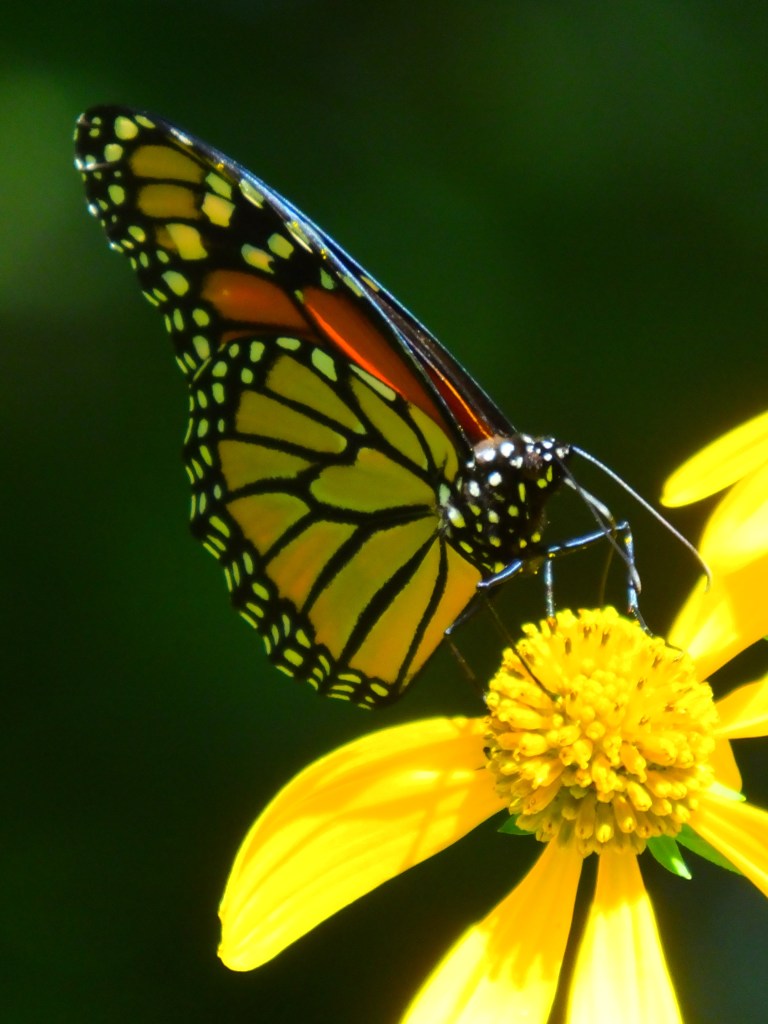
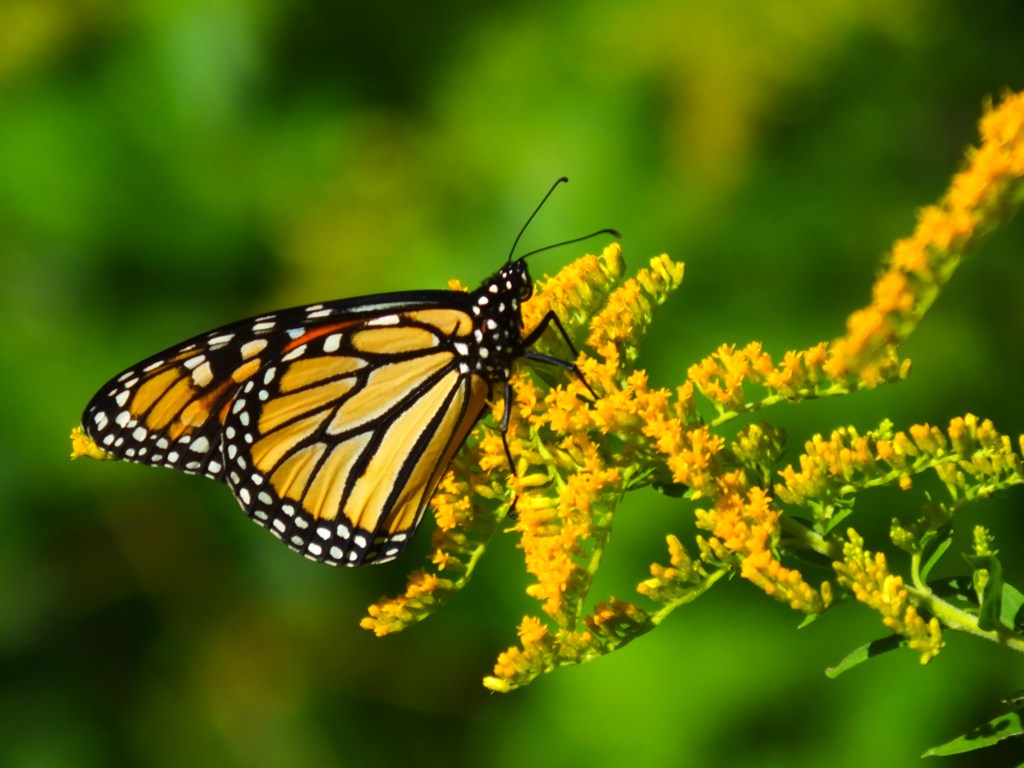
For our final picture today, here’s a combination I don’t think I’ve shown you before: a monarch butterfly taking a sip from a Canada thistle blossom. Sweet, eh?

Lastly, thanks for all the comments yesterday about reaching 100 episodes. This whole project is a labor of love, of course, but your feedback helps get me out there even when I don’t quite feel like it at first. Hasta mañana.

Episode 100!

To commemorate the 100th day in a row, that’s every single day since March 30th, that we’ve managed to find something pretty and/or interesting to look at in Estabrook Park, I am thrilled to show you that I finally managed to find an American red squirrel (Tamiasciurus hudsonicus) willing to sit still for a second. Our hero this morning was hunting for breakfast by the river when I interrupted it, and within 30 seconds, it went right back to work. Thanks, little guy.

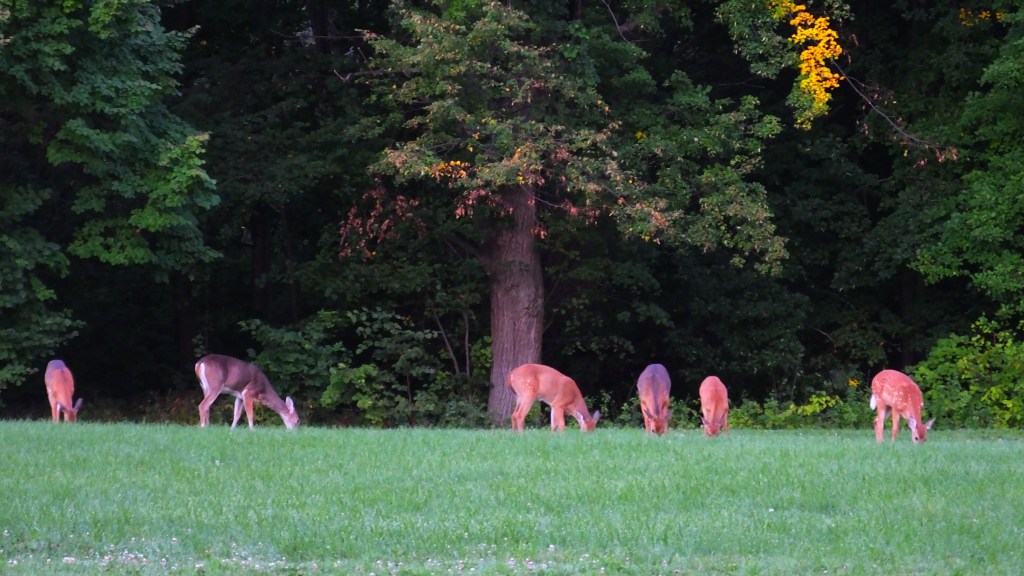
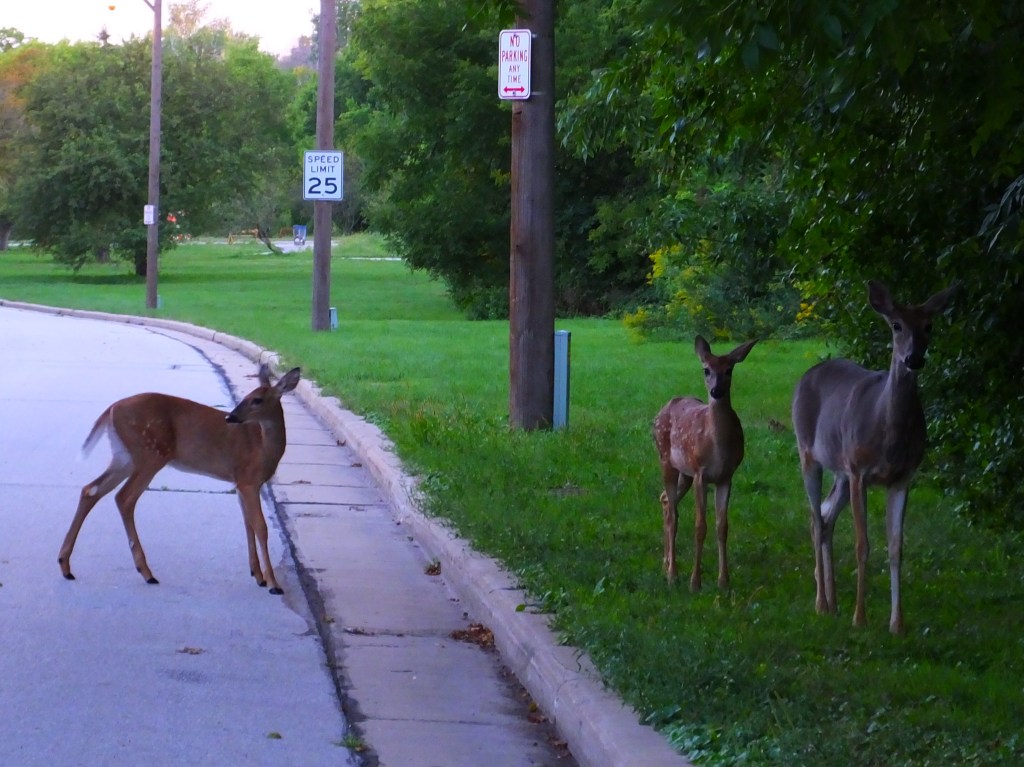
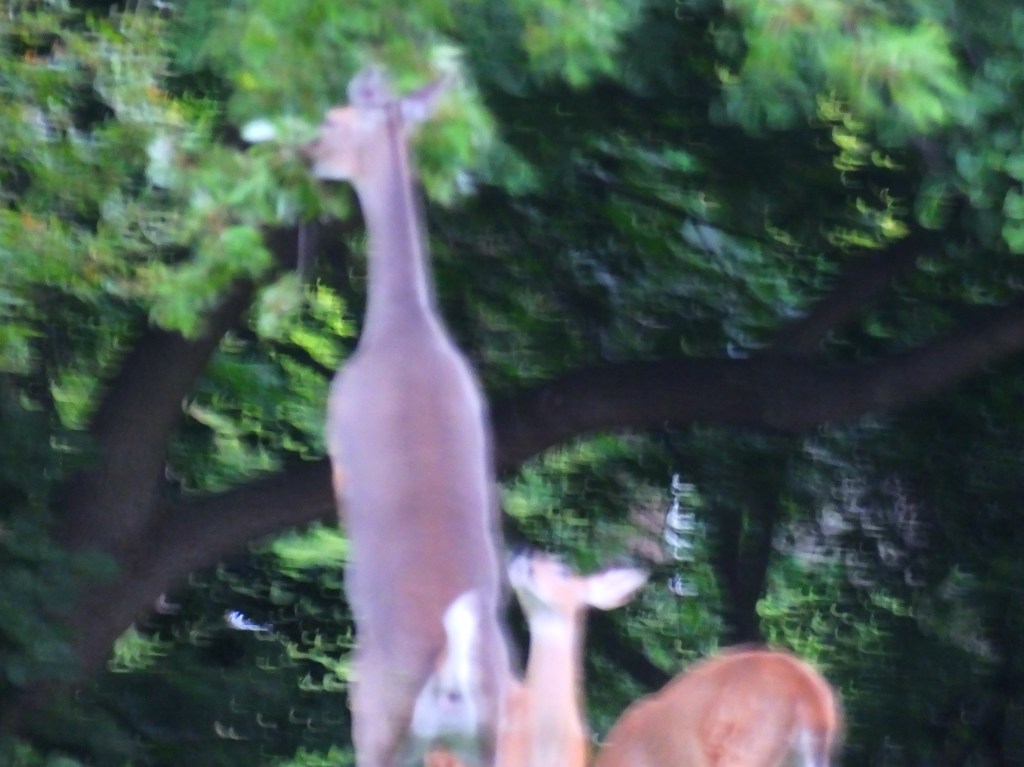
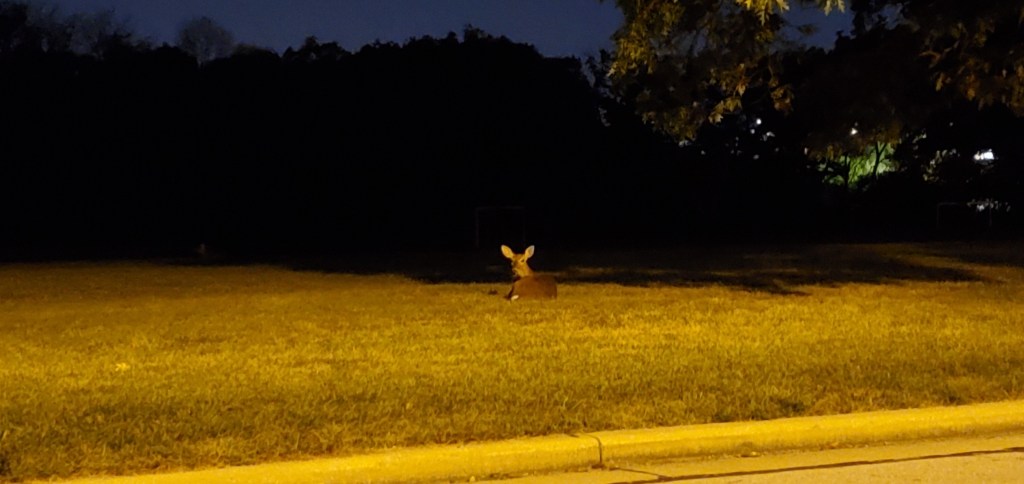
Also out this morning, perhaps to help us mark the occasion, are a couple of our old friends: one of the several deer that reside in the park was checking out the Benjamin Church House, and Ol’ Blue or his cousin Bill appeared to be waiting for the salmon to start running. He’s got a while to wait, though, because I read in the Smithsonian, of all places, that “in Milwaukee, the best months to see the salmon runs are September and October for Chinook salmon, and October and November for Coho salmon.” So, we’ve got that to look forward to, eh?

Perhaps not wanting to be left out of the festivities, our pal, the striking leopard slug (Limax maximus), glided by before the sun got too hot. Man, if you thought the mating habits of earthworms or damselflies were unusual, wait till you read about those of the hermaphrodite leopard slug, which “are considered unusual among slugs!” Oh, and don’t forget that they’re supposed to grow up to 8 inches long. Yowza!

Finally, our favorite sweat bee, the bicolored striped-sweat bee (Agapostemon virescens), the official bee of Toronto, was hard at work gleaning the pollen from this sublimely-hued common chicory (Cichorium intybus) blossom.

Well, I gotta keep it short and sweet, this morning, so do zavtra!

A Leviathan!

Sorry I’m late today, but I hope you find this worth the wait. The cicadas were already singing by 8am this morning, so you know its gonna be a hot one, and I was just walking past the pond when I caught a disturbance in the water out of the corner of my eye. Holy Moly, it’s a leviathan!
Okay, so technically, it’s probably a common snapping turtle (Chelydra serpentina), not the actual leviathan described in Job 41:1–34, but it is huge, easily over 2 feet long from tip to tail. We’ve seen him before, back at the end of May, but this morning is our best sighting so far.

And, as if that wasn’t amazing enough, wait till you get a load of these brand-new kids in the pond. That’s right, we’ve got a whole school of tiny catfish, probably channel catfish (Ictalurus punctatus), “North America‘s most numerous catfish species and the official fish of Kansas, Missouri, Iowa, Nebraska, and Tennessee!” Just look at those cute little whiskers.

I uploaded a video to youtube, which is a little bit mesmerizing and which you can watch at your leisure by clicking on this link. I think it would make a great slow TV channel, right?

Alright, who’s ready for some colors? I know I am. From left/top to right/bottom, we’ve got creeping bellflower (Campanula rapunculoides) blossoming in several locations across the park; common evening-primrose (Oenothera biennis), which I spotted along the Oak Leaf Trail and which only opens its huge (more than 2 inches across) blossoms in the evening; and maybe a pink/purple variety of yarrow, which we’ve already seen in its natural white.

Lastly, some more little creepy-crawlies, some of whom are also colorful. From left/top to right/bottom, we’ve got the tiniest monarch caterpillar I’ve ever seen, maybe about 1/4 of an inch long and a “second instar larva“, just getting started on a milkweed leaf; a tiny land snail; and a red milkweed beetle (Tetraopes tetrophthalmus), not to be confused with the Large milkweed bug (Oncopeltus fasciatus) we saw just a few days ago at Kohler-Andrae State Park, also on milkweed, and its “red and black coloring are [also] aposematic, advertising the beetles’ inedibility.”

Okay, I’d better stop here and get this out before you quit waiting for it, but before you go, just one last thing. Someone recently asked if it was okay to share a link to these reports, which was super polite, of course, and the answer is a resounding yes! If you think someone might get a kick out of the comings and goings I stumble across in Estabrook Park, by all means, send them a link. If you’re a subscriber, and get these as email messages, just forward one on. I get paid the same either way.

You know it’s gonna be a hot one…

when you hear the cicadas singing before 9am. Yup, it sure is hot out there, and the cicadas have begun to emerge from the ground, climb up into the trees, and announce their availability on the original dating app: known by many as mating call. I don’t have a picture for you yet, but I’ll be keeping my eyes open. There are supposed to be 9 cicada species in Wisconsin, and I don’t know which one we’re hearing now, but I read that “the one most frequently encountered is Tibicen canicularis, sometimes called the Dogday Harvestfly.

Cicadas are not the only critters emerging these days. Here’s another, a frog just out of the water still sporting a little bit of its tadpole tail. This one is sitting on a lily pad on the river, and I’m afraid I can’t tell you exactly what type it is because it appears that the distinguishing features, such as ridges down the back or around the ear haven’t formed yet.

Below are the remains of yet another emergence, and this time it appears to be the empty exoskeleton from the final molt of a mayfly.

Here’s a female ebony jewelwing damselfly (Calopteryx maculata), who we first saw back at the start of June, and this time she looks like she’s up to something, but I’m not sure what. She’s supposed to lay her eggs “in the soft stems of aquatic plants“, not on this leaf. Maybe this is just a “dry” run, eh?

Keeping with our theme, below is a newly emerged mushroom, and this time I’m gonna go with Fairy Ring Mushroom (Marasmius oreades), despite the fact that there were no other mushrooms visible in the lawn at the time. MushroomExpert.com explains “the ring created by Marasmius oreades is often indistinct, and can’t always serve as a way to identify the mushroom.”

One more. The ox-eye sunflower (Heliopsis helianthoides) has just opened for business, and I found a few on the steep slope from the river up to the beer garden, which is also now open for business.

Finally, check out the fun these krazy kids look to be having going over the Estabrook falls. Good for them, right?

That’s it for today. Stay cool out there and tune in tomorrow for more exciting revelations.