Something old, something new…

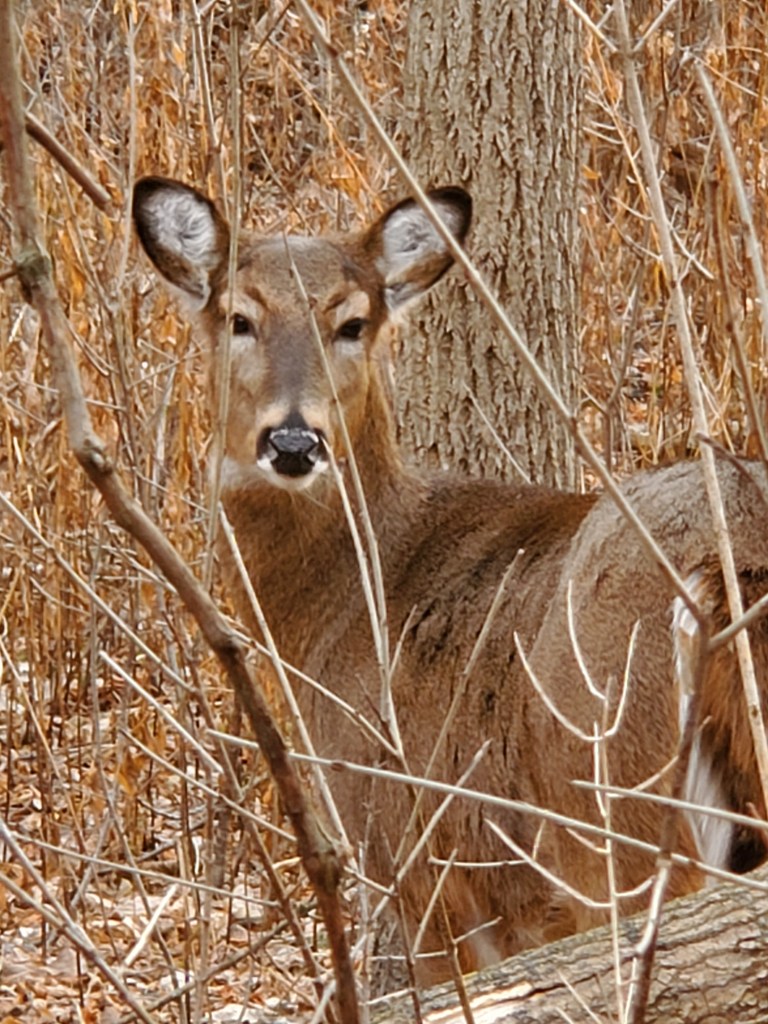
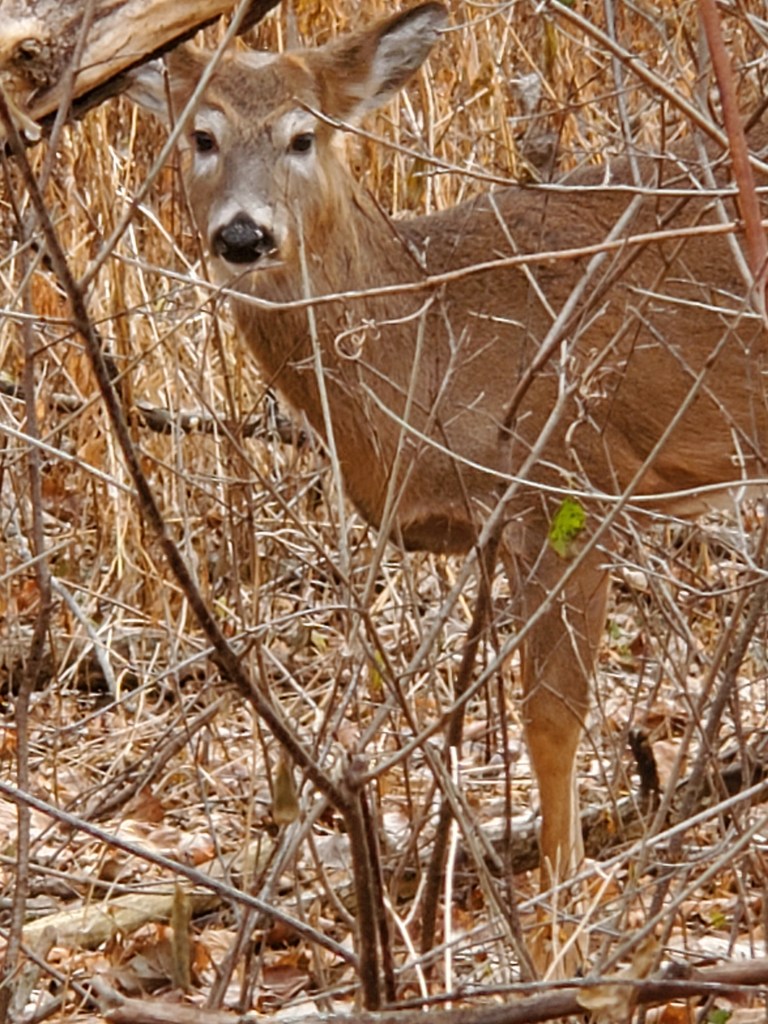
Well, here’s an oldie but goodie, I hope. Sure, we’ve seen plenty of deer before, and I can positively assert that I already have pictures of this one due to the long thin identifying mark down her left side, but still, it’s nice to see such a magnificent creature out enjoying the park right after all the commotion of the Farmers Market, isn’t it?

By the way, when we first met her, in the southern parking lot, back on June 11, she also didn’t know what to make of me, and came pretty close trying to determine what I was made of. If you go back and look, you’ll see I chose a picture then that didn’t feature the mark because it still looked a little fresh, and I’m sure glad to see that it seems to have healed up pretty well.

Now, onto the new stuff! Below, I’m pretty confident that we have St John’s wort aka perforate St John’s wort or common St John’s wort (Hypericum perforatum). Note how the petals appear asymmetrical, like little fan blades with tiny black dots along the edges.

The Pedia of Wik reports:

St. John’s wort has been used in alternative medicine as a likely effective aid in treating mild to moderate depression and related symptoms such as anxiety or insomnia. [However,] study results on the effectiveness of St. John’s wort for depression have been mixed. [And,] since St. John’s wort causes drug interactions, it might not be an appropriate choice for many people, particularly those who take other medications. [Moreover,] the plant is poisonous to livestock.

It continues “the common name “St John’s wort” may refer to any species of the genus Hypericum. Therefore, Hypericum perforatum is sometimes called “common St John’s wort” or “perforate St John’s wort” to differentiate it.

Finally, “St John’s wort is named as such because it commonly flowers, blossoms and is harvested at the time of the summer solstice in late June, around St John’s Feast Day on 24 June.

Lastly, we appear to have some fresh little Japanese Parasol or Pleated Inky Cap mushrooms (Parasola plicatilis), below. Sadly, urbanmushrooms.com reports that it is “too flimsy to eat”, which really sounds like more of a challenge than a prohibition, doesn’t it?

First-Nature.com is a little firmer with “generally regarded as inedible”, but not much, eh? They make you wonder if they’re not just saving some tasty little morsels for themselves, don’t they?

Well, that’s it for today, thanks for checking in, and see you all in July!

Plenty of flowers and critters about…

A lot of cool new things to cover on this beautiful summer morning, so let me get right to it. First up are a couple of reader photos of the week, “sent in” by Donna, a keen observer and long-time reader. By “sent in”, I mean she invited me to stop by and bring my camera. 😊

On the left is a tiny hummingbird nest high up in a honey locust tree in her front yard, and on the right is a little American red squirrel (Tamiasciurus hudsonicus)  under a bird feeder in her backyard. Sadly, I never spotted a bird on the nest, although I did see one shoot through the back yard. I’ve seen both critters in the park but have only managed a bad picture of a hummingbird so far, so I was glad to add these to our portfolio.

There are several new blossoms out, and let’s start with the pinks. On the left looks to be Japanese meadowsweet (Spiraea japonica), and on the left looks to be perennial peavine or everlasting pea (Lathyrus latifolius).

In white, we have yarrow (Achillea millefolium) on the left, and Queen Anne’s lace (Daucus carota) on the right. Doesn’t the Queen Anne’s lace just make it feel like high summer?

Plenty of new creepy-crawlies, too. On the left is the fabled inch-worm, which I can’t yet identify any more precisely, and on the right is a good sized (3-4 inch) and quite handsome slug who looks to be a great grey slug aka leopard slug (Limax maximus), which I read literally means “biggest slug”.

In keeping with that theme, we’ve got another American toad (Anaxyrus americanus) on the left, which we’ve seen before, but with much more green and yellow. Our hero this morning looked almost black at first, and so I checked with the Pedia of Wik to find “skin color can change depending on habitat colors, humidity, stress, and temperature. Color changes range from yellow to brown to black, from solid colors to speckled.” Who knew?

On the right, the ants are up to something! My best guess so far is a battle between colonies of pavement ants (Tetramorium caespitum), and I’m not making this up! If you don’t believe me, and I wouldn’t blame you, click on one of the links and read about it for yourself.

Well, there are plenty of more pictures; some new yellow blossoms, some new thistles, some new mushrooms; but I’m out of time, and I’d better keep them in reserve, as Anne suggests, for the morning when I come up with nothin’ new for ya.

Oh yeah, before I forget. The Shorewood Farmers Market seemed to go off without a hitch yesterday. There appeared to be over 30 vendors and plenty of visitors with masks. Best of all, the park looks no worse for the wear this morning. Yay, and kudos to the organizers!

Summer kicks into full bloom…

The wild chicory (Cichorium intybus L.) is finally opening, and some little pollinators are already all over it! I think these little guys or gals are all hoverflies of some tiny variety.

Another type of thistle has opened, unfortunately the invasive Canada thistle (Cirsium arvense) this time, but it is also popular with the pollinators. On the left is a large bee-fly (Bombylius major), a fly that mimics bees but neither bites or stings, and on the right is our ol’ buddy the bicolored striped-sweat bee (Agapostemon virescens), a real bee that can sting, but just a little, and who we first saw last week.

The field bindweed (Convolvulus arvensis), which has been out for a while, continues to attract attention. In this case, it appears to be a bright green Scudder’s Bush Katydid nymph (Scudderia).

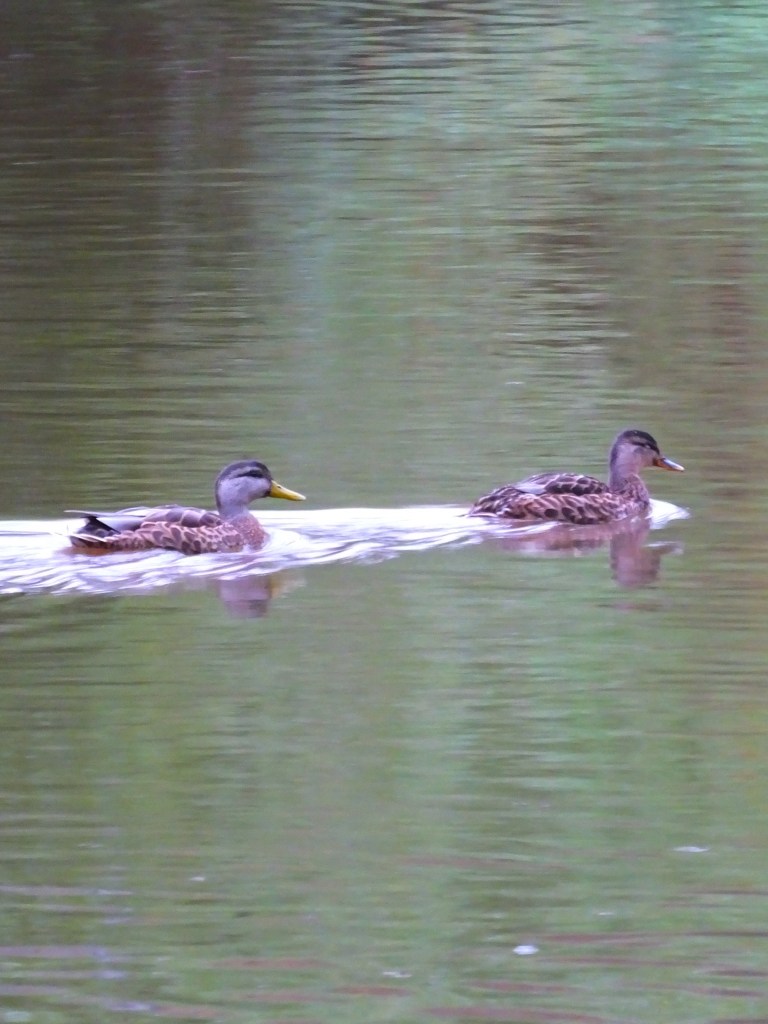
Sick of all these bugs and blossoms, are ya? If so, then I’ve got just the antidote. On the left, of course, is yet another family of mallards, this time with 6 ducklings! I can’t walk down to the river these days without coming upon a brood of mallard ducklings it seems.

On the right, is a chipmunk, who we’ve seen many times before, but when this guy heard that I took a picture of a little bunny sitting up on its haunches, he said “hold my beer! Wait till this joker sees me holding a morsel I’m in my own fuzzy little paws and nibbling on it! I’ll give him ‘cute’.”

Well, the Shorewood Farmers’ Market will be kicking off soon in its new location, the south end of our park, so maybe I’ll mosey over there to check it out. Let me leave you with one last bug on a blossom.

A smorgasbord

As promised yesterday, here are some of the new blossoms in the park. Left and right both appear to be pale purple coneflower or prairie coneflower (Echinacea pallida) growing by the connection to the Oakleaf trail just south of the middle parking lot. The middle looks like common milkweed (Asclepias syriaca) blossoms covered with ants and growing by the southeast corner of the same lot. That’s where I found the monarch caterpillars earlier, but there’s been no sign of them for a while.

On the left is a member of the bellflower genus (Campanula), maybe peach-leaved bellflower (Campanula persicifolia), based on the written description of the leaves, growing along the Oakleaf Trail, and on the right appears to be blossoms of common mullein aka flannel plant (Verbascum thapsus), which the plant is only able to produce in its second or third year.

Meanwhile, this little guy seems to be wondering “so what’s with all the flower pictures? What’s a little bunny gotta do to get your attention? Sit up on my haunches?”

Well, yeah, that’ll work. Or be cute as ducklings, which is amply demonstrated by yet another brood of mallards, this time upriver from the falls, so I’m pretty confident these four are not part of the five we’ve seen earlier in the week downriver. Man, when they are not napping, they don’t sit still for a second. No wonder mom is always exhausted. Oh, and good luck asking the interwebs why one is yellow.

Finally, for something completely different, check out these mushrooms growing on an old log right by where the ducklings were exploring. These may be crown-tipped coral (Artomyces pyxidatus formerly Clavicorona pyxidata), and the Missouri Department of Conservation suggests that you can verify this identification “if you take a tiny taste, it will be peppery.” Be my guest. I can’t make this stuff up.

Well, that’ll do it for today. Tomorrow morning is the debut of the Shorewood Farmers’ Market in the park, so it will be interesting to see how that goes. Maybe the muskrat will finally be able to get some decent arugula, and maybe I’ll see you there. I’ll be the one with the camera.

Speaking of old dogs…

I learned all kinds of new things yesterday.

It was nap time again for mom and her ducklings around noon again, and don’t worry, all 5 were still there. It’s just that this little pile o’cuteness on the river bank made the best photo. Also, chipmunks climb trees just fine, it turns out, a fact that I did not know until now. This little guy was about 8 feet up and passionately involved in some dispute with another chipmunk. Perhaps he just doesn’t want to do another album or he and a rival are vying for the affections of Brittany.

Swallowtails love the big blossoms on the tree between the beer garden and the parkway, which is now putting on an amazing show for eyes and noses. It’s a Japanese tree lilac (Syringa reticulata), which I didn’t know existed, and we have it to thank for now having both a legal (in the park) picture of a male Eastern Tiger Swallowtail (Papilio glaucus) and a female Eastern Tiger, on the same plant! The females of this species may be yellow or black, which is called “dark morph”, and which I was stunned to learn.

Speaking of a male and female of the same species on the same plant, on the left below is a pair of silver-spotted skippers (Epargyreus clarus) on the same blossom! You may recall we last saw the male in the wildflower meadow earlier this week. On the right is a pink-edged sulphur (Colias interior) making me work again for another unimpressive shot.

Meanwhile, Red Spotted Purples (Limenitis arthemis) also continue to do their darndest to keep me from getting a halfway decent photo. Some critters are just camera shy, I guess.

Finally, after yesterday’s first successful fish picture, the other species in the pond appear to be lining up for their photo ops! On the left is probably a common goldfish, bred from Prussian carp (Carassius gibelio), which I did not know, and on the right, I really just don’t know. It looks just like a gray-green version of the goldfish on the left, but maybe an experienced angler can help us out, Steve.

Finally, some beautiful new blossoms are opening up, but we’re out of time and space, and so they will just have to wait until tomorrow.

Where the wild things are…
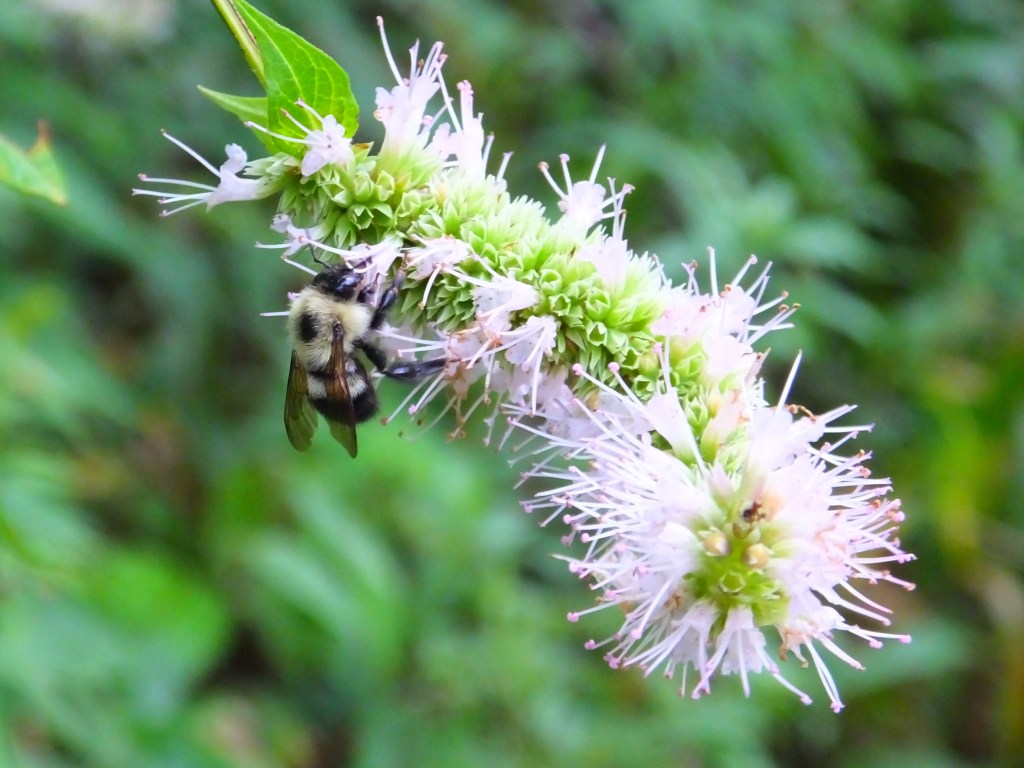
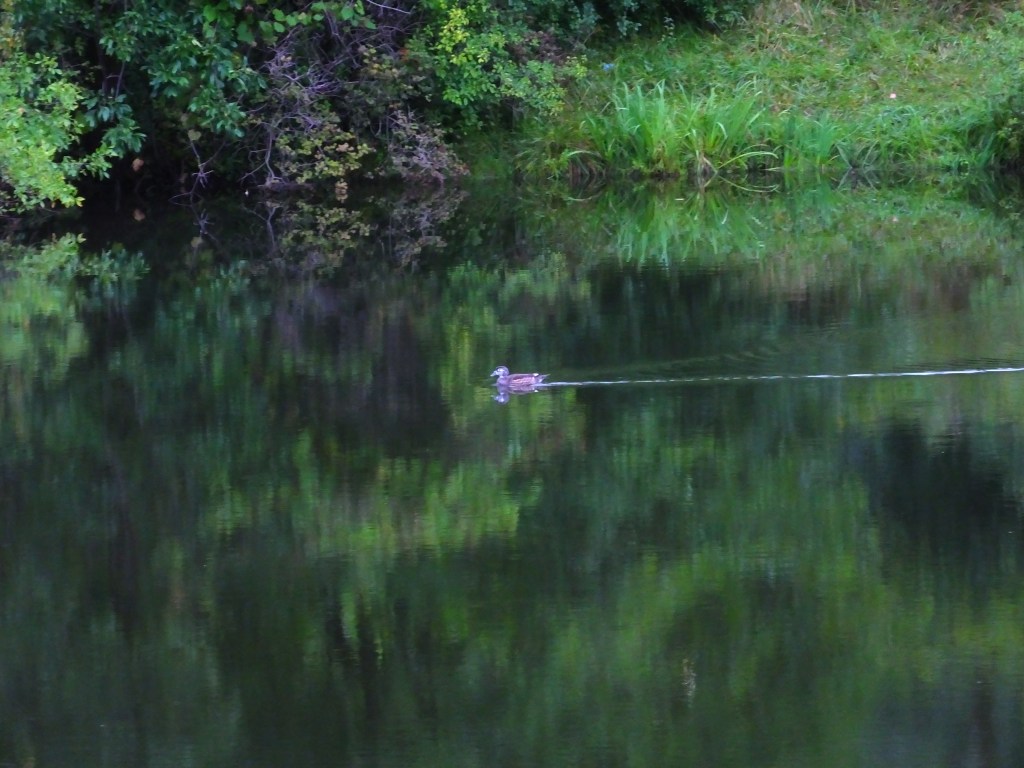
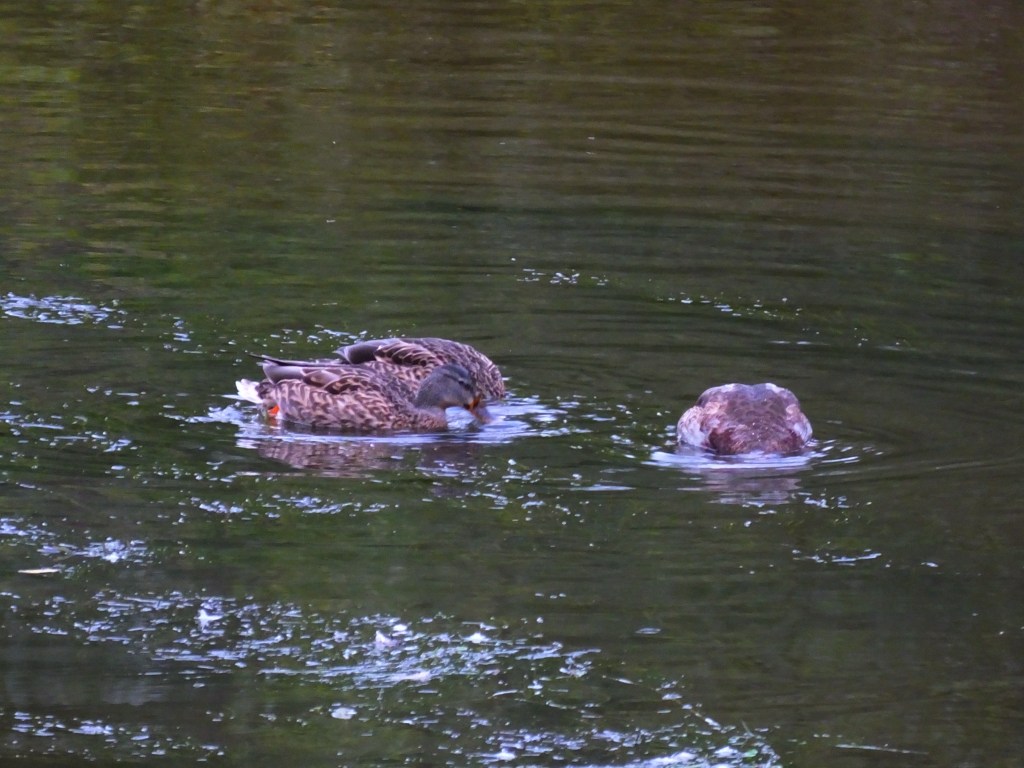
Those of you who read these words and don’t just look at the pretty pictures (and you know who you are) may recall me mentioning yesterday that there were no water fowl on the pond. Well, I found a whole bunch down on the river, instead!

Yesterday afternoon I spotted two families of mallards: one mom with a single teenage daughter, and another mom with five toddlers. They were all surprisingly willing to let me take pictures, and both moms took naps in the middle of the afternoon as I stood there taking more. What’s your guess, moms? Just plain exhaustion?

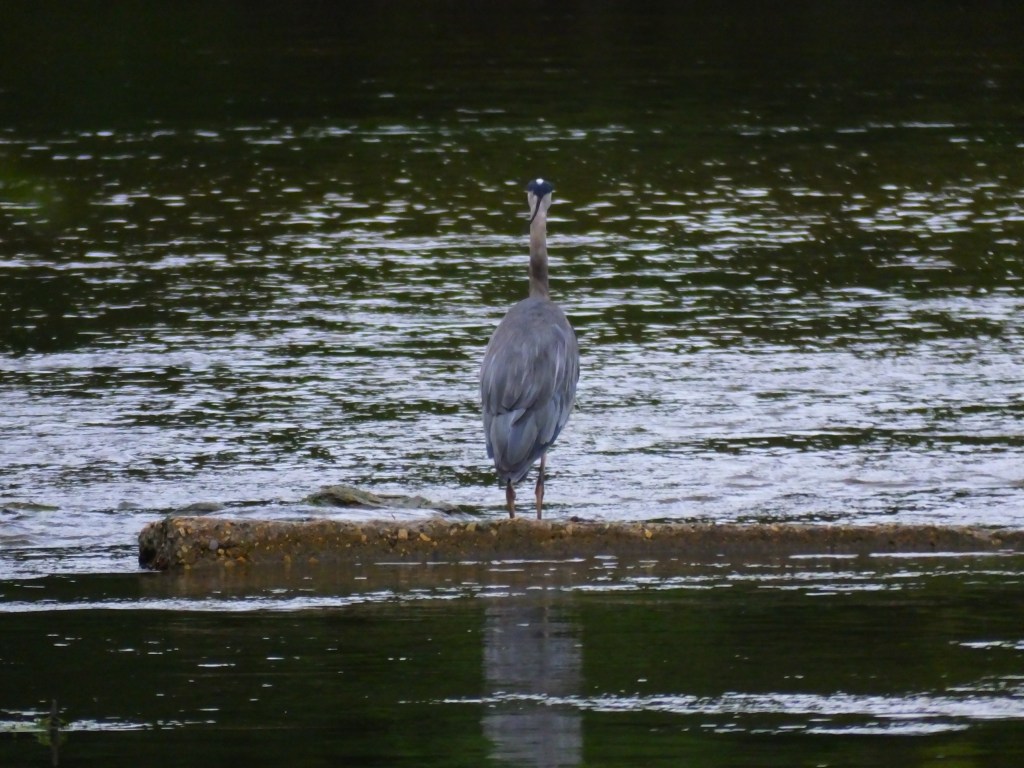
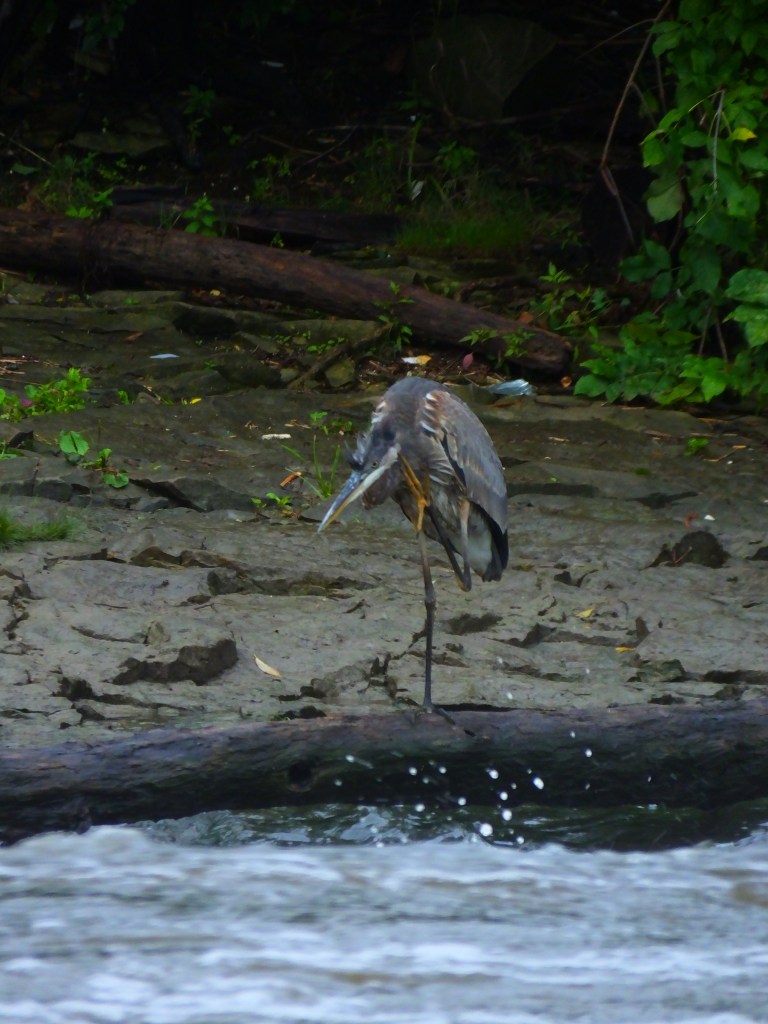
Also, down on the river, right by the waterfall, was our ol’ buddy, Blue, or maybe his cousin Bill. It’s hard to tell them apart.

Plus, there’s another butterfly in the wildflower meadow I mentioned a couple days ago. This one is an eastern comma (Polygonia comma) because “there is a silvery comma mark in the middle of the hindwing”, and man, was he shy. The instant he realized I was there; I never saw those beautiful flashy colors again. Good thing I’m finally learning to start recording even before I have a clean view, eh? And they say old dogs….

Anyway, back in the pond, there’s still plenty of action below the surface, the fish were particularly bold yesterday, and I finally got a decent image (left) of one that isn’t just a bright orange goldfish (Carassius auratus) (right), which “are rarely eaten”, I read, “although edible and closely related to some fairly widely eaten species.”

Any anglers out there? Might the fellow on the left be a bluegill (Lepomis macrochirus) mentioned in the Milwaukee urban fishing rules? He does appear to have a prominent blue gill, but he looks a lot sleeker than the pictures of bluegill I see online. Perhaps that’s just an optical illusion.

Finally, it seems that the musk thistle is now open enough to begin serving pollinators.

That’s all I have for you today. Stay tuned for exciting new images right here tomorrow.

Another good morning for sleeping in…
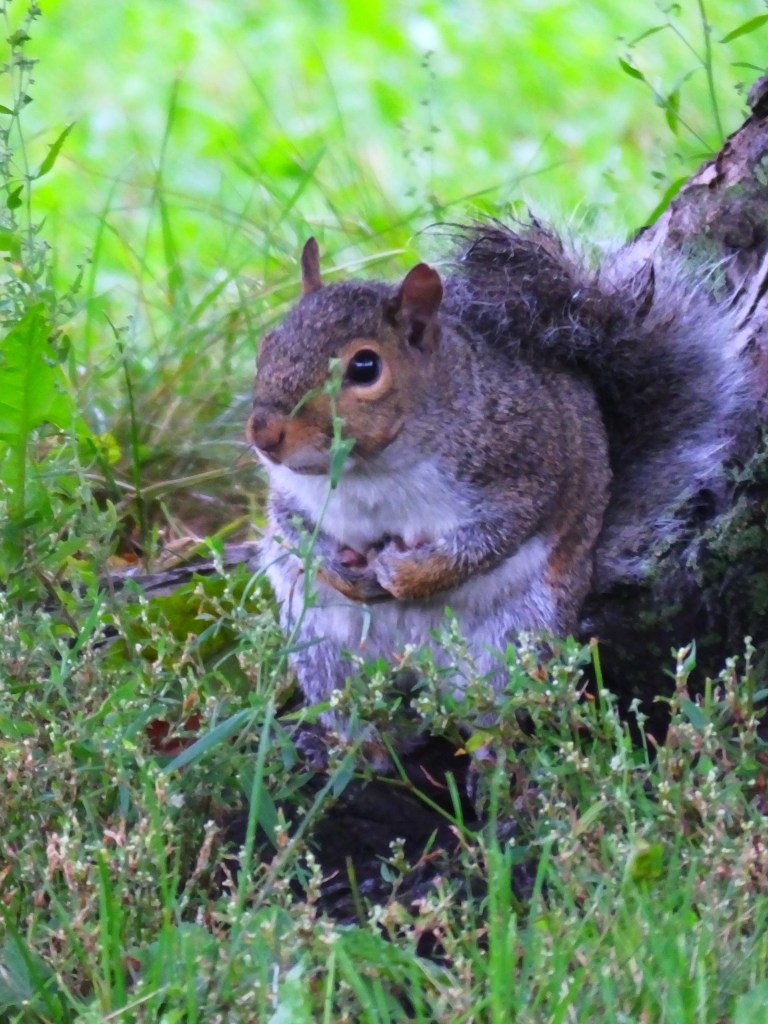
And most of the critters in the park seemed to see it that way, too. Sure, there were a couple of rabbits about, and plenty of birds were singing from the safety of their well foliated branches, but the pond was still, and I saw nary a mosquito even when on the trail beside the river.

One surprise guest, who was too quick for me, appeared to have been a raccoon loping up the trail ahead of me with that distinct gait they have. My work buddy, Greg with Friends of Estabrook Park, reported seeing one searching for delectables by the Benjamin Church House recently, so we know they’re here, but he didn’t manage to get a picture either.

Thus, we are stuck again with pictures I captured yesterday, and the first one is a beauty! All I had on me at the time was my phone, and thankfully, this butterfly let me crawl up to within about a foot for this nice close-up.

That’s an American Lady (Vanessa virginiensis), not to be confused with American Woman, a song by The Guess Who, who probably prefer not to be confused with The Who, who recorded Bald Headed Woman instead. Try to keep up.

Anywho, I spotted him or her on a dandelion blossom in the lawn just east of the beer garden, and it is of the same genus as the red admiral we saw back on the 12th. There is also a Painted Lady butterfly in the same genus, which looks just like our hero here, but only has black dots “on the underside of the hindwing” where the American Lady has “two large, black-ringed blue eyespots.”

Also out and enjoying the sun while it lasted was this striking female widow skimmer dragonfly (Libellula luctuosa), taking a break perhaps from chasing smaller bugs over the soccer fields.

Meanwhile, all this rain, of course, has induced some mushrooms to emerge. This one looks like it could be Conocybe apala, colloquially known as the white dunce cap, growing in the grass near the southern playground. Please note that “while it has not caused deaths, it is toxic, containing phallotoxins,” which just sounds bad, right? Therefore, please do not eat, smoke, or ingest in any way, just as with chlorine bleach.

Finally, some new blossoms are opening up, including common cinquefoil (Potentilla simplex) on the left and two-flower cynthia also known as two-flower dwarf dandelion (Krigia biflora) just opening its second set of petals on the right.

That’s all I’ve got for today, and let’s hope that a change in the weather will bring a change in the scenery, eh?

Cool Tuesday

It’s a cool and breezy morning with not much new to see. Instead, I propose we take a look at who else was out on Sunday afternoon, when the air was warm, and the breeze was mild.

First up is a silver-spotted skipper (Epargyreus clarus), of which we first saw an example just over a week ago. Prancing from flower to flower, this guy was putting on quite a show for somebody, probably not me, but I got to watch anyway. The Pedia of Wik reports that “adult males compete for territory to attract females,” and so that is probably what he was up to.

Oh, and the flowers he was prancing between are in an amazing patch on the, now-closed, northernmost, former parking lot. It’s got daisies and daisy fleabane, white and red clover, bird’s-foot trefoil, white campion, a patch of lance-leaved tickseed, yellow sweet clover, crown vetch, and some bright-blue tufted vetch. Here are some pictures in which I attempt to capture the spectacle, but don’t really do it justice. I hope you try to see it in person. Sometimes beautiful things like this don’t last.

Next, I spotted this amazing snowberry clearwing (Hemaris diffinis), a moth that mimics the appearance, but not the sting, of a bumblebee. It may also be called the hummingbird moth, but after watching a hawk moth sip nectar from blossoms, Anne’s hostas and sadly not yet in Estabrook Park, it is my personal opinion that they deserve that title more. Plus, besides the coloration, the snowberry clearwing pictured below is also the size and shape of a bumblebee.

This tiny pair, sharing a single daisy, just barely caught my eye: a tiny bee, possibly a squash bee (Peponapis pruinosa) because of its “very hairy thorax (region behind the head)” and tiny moth, maybe one of the 326 featured on this page (let me know if you spot it).

Also striking are the various stages of a nodding or musk thistle (Carduus nutans), an invasive species, I am sad to read, growing out of a crack at the north end of the middle parking lot.

Finally, some of the tadpoles in the pond have started sporting hind legs. Next thing you know, they’ll have forelegs, too, and start walking on land.

Meanwhile, the calendar votes just keep pouring in over at the pictures page. Any day now, we’ll have a statistically relevant sample size.

Sleepy Monday

It looked like it was going to rain on a quiet and sleepy Monday morning in Estabrook Park after all the excitement of Fathers’ Day and the Summer Solstice this past weekend. I did see a couple of the baby bunnies just north of the beer garden again, but there were no deer on the lawn nor waterfowl on the pond, and we’ve already seen all the birds I heard, so let’s let the sleeping critters lie and take a look at who was out struttin’ their stuff in the bright sun yesterday afternoon.

First up is this handsome common buckeye (Junonia coenia) by the pond. So handsome, in fact, that it was featured on the 2006 United States Postal Service 24-cent postage stamp. Who wouldn’t like to have that on their resume, right?

A little less flashy, perhaps, but just as deserving of our appreciation, don’t you think, is this common wood-nymph (Cercyonis pegala) little wood satyr (Megisto cymela) at the edge of the bluff north of the beer garden. Later in the day I saw plenty more of these, but none would sit still for me, so I feel pretty lucky that this one did.

There’s another sweat bee in the park, and this one is the bicolored Agapostemon (Agapostemon virescens), the official bee of Toronto, if you can believe it, on another lance-leaved tickseed (Coreopsis lanceolata) blossom that we first saw on the steep slope from the beer garden down to the river last Wednesday.

Finally, down on the river, I spotted this little caravan of Canada geese in various stages of adult coloration. It looks like a couple of scrawny teenagers shopping for school clothes with their mom, eh?

That’ll do it for today. Don’t forget to mosey on over to the pictures page and cast your votes for which you like to see in our forthcoming 2021 calendar. We’ve gotten some votes already, but we could sure use a few more.

Happy Days!

Happy Summer, everybody! I hope you all survived your raucous Solstice parties unscathed, or at least barely scathed.

Oh! And Happy Fathers’ to all the dads out there, including mine! I hope you are all enjoying your new neckties as much as our painted turtle buddy from Friday. You can just see the pride in his eye, right? Maybe his tie is on backwards after his own raucous Solstice party.

painted turtle (Chrysemys picta) with a striped leech on the back of its neck

Meanwhile, this little cutie approached me almost like a timid puppy. She walked up to within about 5 feet of me, and the reason her head is a little blurry, besides just my bad photography, is that she was bobbing it slightly as if trying to figure out if I was friend or foe. I gotta start carrying some deer treats in my pocket for situations like this.

I know we haven’t seen as many birds as we used to. First, the trees now have leaves, and second, I suspect their behavior has changed some as the mating season progresses. Nevertheless, this little house wren, which I first managed to photograph back in May, was distracted enough by his singing duties in the oak tree over the wren house, that I was able to capture one more presentable image.

Finally, I spotted a family of Canada geese out enjoying a family bath on a sandbar in the river. There appear to be 4 goslings, so Lord only knows how they might be related to the ones we all got to know and love on the pond, if at all.

Man, what a difference 57 days makes, eh?

Lastly, I think I have managed to set up a way for you all to vote on which pictures to include in our fundraising calendar. Just head on over to the pictures page and make your voice heard.