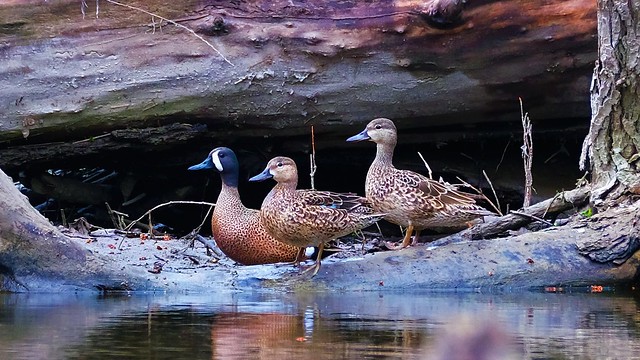
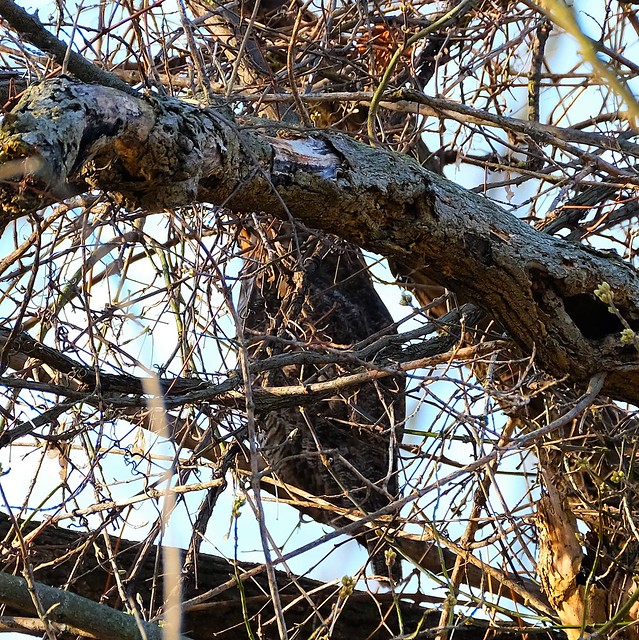
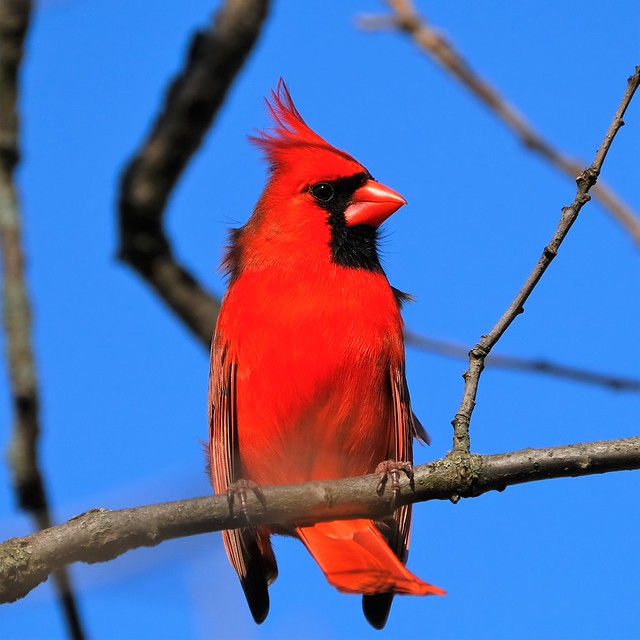
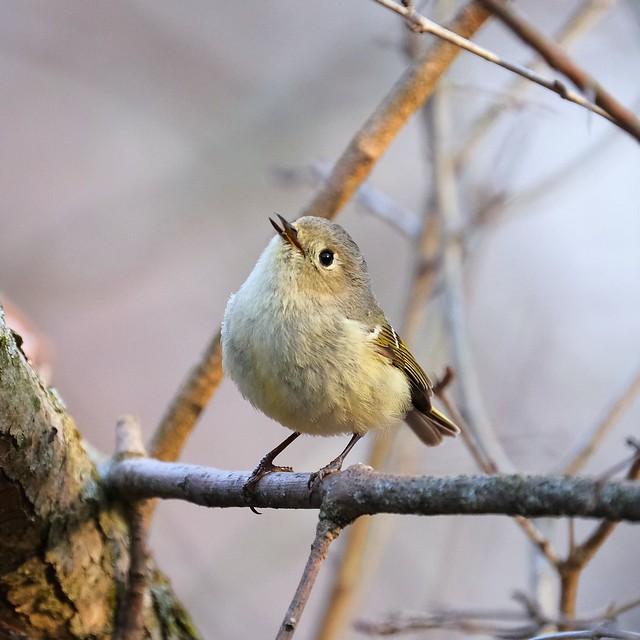
The green-winged teals are still around, I counted 8 today, and this handsome little devil was finally in the mood for pictures, at least for a moment.
The white-fronted geese are also still here, and this one posed long enough for the sun to come out from behind a cloud.
Finally, the goldfinches are still raiding the alder trees.
At some point, perhaps over the summer, I read or heard the name “collard-dove”, but that’s all I had, just the name. Then, on Sunday, as I rode by a farmhouse on the way from one open field to another, I spotted a few birds that I figured were wood pigeons or even rock pigeons, but something clicked in my head. “Oh! I bet that’s what a ‘collard dove’ would look like.” And just like that, we’ve got a new bird, the Eurasian collared-dove (Streptopelia decaocto)
Anyway, here’s another great spotted woodpecker, who I simply could not catch looking our way, even though the sun was lighting it up so nice and the sky was such a perfect blue. Oh well.
Finally, this speckled wood could be our last butterfly spotting of the season!
After the rain blew through yesterday morning, the sun came out, and the wind kept right on blowing. Oddly enough, I saw more little birds in the air than I think I’ve ever seen here, and maybe it was in spite of the wind instead of because of it. They got places to be!
In any case, only one opted to park where I could clearly see it, though that reed was waving in the breeze quite a bit, and I couldn’t believe my eyes when I finally got a good look at it. This is a “chat” or “stonechat” in the genus Saxicola and probably the superspecies Saxicola torquatus, the common stonechats. Beyond that, my best guess, based largely on location, is that this is a European stonechat (Saxicola rubicola), although I’m a little nervous about the white neck ring extending all the way under its chin. This is the first one I’ve ever seen.
Meanwhile, the great spotted woodpeckers continue to do their thing.
I don’t have any good words for you this weekend, but I did go out into the countryside for the therapeutic effect anyway, and now I’ve got these pictures burning a hole in my pocket, so here you go.
There are still many gadwalls around, and this drake was kind enough to show off his surprisingly-clean undercarriage, given the muck he’s standing on.
The number of tufted ducks seems to be growing, and I counted an even dozen this morning.
I saw a hand-full of shoveler hens, but no drakes, yet.
I was thrilled to get another chance to capture a decent green-winged teal portrait, though there is still room for improvement. They are nearly as shy as they are striking.
On Saturday, I spotted this ghostly bird out on the polder, just chillin’ amid the geese and the cows, and I was all excited that I had spotted someone new, maybe a gyrfalcon. Welp, it might be a new individual to the area, but it is merely a “pale morph” of the common buzzard, and we’ve seen plenty of its darker siblings over the summer. Nevertheless, it sure is pretty, eh?
Workers have been dredging a lot of the little canals that run through the fields lately, and the piles of canal gunk attract many birds, including grey herons, storks, and egrets. Here’s a grey heron, standing on said gunk, taking a break from hunting in the warm morning sun, perhaps because it now has a bellyful in need of digestion.
I only butterflies I saw this weekend were a few small whites, but the couple of dragonflies I saw looked more interesting, and this one appears to be a common darter.
Finally, there are still plenty of blue tits around, and this one was foraging furiously. It appears that they will stay with us through the winter, as their North American cousins, the chickadees, do, so that’s something to which we can look forward.
This one was even kind enough to take a second to pose for a portrait. Thinks, little buddy!
Plus, as with many of the mergansers, golden eyes, and buffleheads in Estabrook Park, this is their final destination. This is their Miami Beach, and I’ll try to remember that as I’m trudging to campus through freezing drizzle in January. Anyway, here’s a few who were kind enough to pose together as they sampled the fresh buffet of nice green polder grass succulently coated with heavy fresh dew.
Meanwhile, the starlings are starting to congregate, and here are two of the characters making their odd radio noises together as they warm up in the morning sun. I still have a hope of seeing a murmuration or two, but I haven’t seen any groups that big yet.
I did see another huge flock of cormorants flying over towards the coast this weekend, but the new sight was this flock of jackdaws amusing themselves in the updraft at the edge of a building.
Finally, I heard this group of goldfinches long before I saw them, as they noisily foraged for seeds on an alder tree and blended in with its valiant attempt at autumn coloration. It appears that we are in their “all year” range, so perhaps they are not planning to go anywhere and are just enjoying each other’s company on a beautiful fall day.
The Pedia of Wik claims, without evidence I might add, that “the bird gives its name to the blue-green colour [sic] teal,” instead of the other way around, if you can believe it. Anyway, here’s another scene, slightly down stream, with a little more action.
Meanwhile, the Eurasian widgeon was back, and he brought a lot of buddies with him.
Plus, here are a couple of tufted ducks, which we haven’t see for a while. Whatever the one on the right is shouting is making the one on the left’s head feathers stand up.
Finally, there are still plenty of gadwalls hanging around.
It will be fun to see which ones stay for the winter, and which ones are just passing through.
The sun didn’t rise until nearly 8 o’clock this morning, and the temps didn’t even break into the 60s today, but the skies were clear, the breeze wasn’t too strong, and the birds were out, so I was finally able to sneak up on one of the several great spotted woodpeckers searching for a soul mate. You may recall that I first noticed this new behavior last weekend.
I also caught a blue tit in the nice bright morning sunlight. You can tell it’s starting to get cold out when the little birds start looking so plump.
As luck would have it, a great tit stopped by with some especially fine plumage, which sure helps us distinguish between these two similar birds.
As I walked to work along the east side of the TU Delft campus, yesterday morning, I came across the largest flock of gadwalls I’ve ever seen. I don’t know if the body of water right beside the road would be considered a pond or just a widened canal, but I counted at least 50 ducks feasting on the mat of duckweed growing on the surface. I didn’t have my camera with me at the time, so this scene from farther out into the countryside on Sunday will have to suffice, but it gives you a sense of the density. It appears that the gadwalls are on the move, and there sure are a lot of them.
Similarly, the pheasants were plentiful this past weekend, although I don’t believe they’re heading anywhere, and here’s a rooster (or a cock, according to the FDA) rustling up some breakfast in the dim morning light.
On Sunday, this kestrel, who was hunting over the same field from which we saw our star catch a rodent on Saturday, took a break from hunting on this powerline tower. It could very well be the same bird, but I can’t be sure.
Finally, even though they really love the low light, and I don’t believe I’ve ever seen one in broad daylight, here’s another robin for Arlene.
And that, finally, is the end of the pictures I managed to accumulate over the weekend. Here’s hoping I have as much luck next weekend, eh?
Oh, and while I have your attention, let me plug a recent article in the New York Times by Margaret Renkl (which I realize may be behind a paywall for some of you, so I copied the key paragraphs below) that urges us all to help make migration a little less dangerous for the millions of birds on the move right now.
“Homeowners can do their part, too. If you can’t turn off all your lights, identify the ones that are truly necessary and reduce the wattage or reorient them in a way that is safer for wildlife. Lights triggered by motion detectors are far less dangerous for birds than continuously burning lights, for example. The same is true for hooded lights that direct the illumination downward rather than into the sky. Indoors, draw the curtains and close the blinds after dark. Turn off lights in empty rooms. Use lamps instead of overhead lights in the room you’re in.”
“Migration seasons don’t last very long, so it isn’t strictly necessary to make these changes permanently, but it would be better for wildlife, and better for the climate, if we did.”
As is often the case, once I notice a new creature for the first time, I start to see them everywhere, and the Eurasian jay is a perfect example. They really are shy birds, quite similar to the blue jays in Estabrook, but now that I know where to look, I’m getting closer to making a decent portrait anyway. This one is even looking our way! Yay! It’s a beauty, ain’t it?
Speaking of Corvids, they are more plentiful now than ever, and here’s a magpie foraging on the back of one of the many sheep drying out in the morning sun. Yeah, besides horses and cows, we’ve got a lot of sheep here, too. I read that we also have a lot of pigs, and Anne reports seeing a few, but I don’t know yet where they are all kept.
While we’re enjoying birds of a certain size, I was surprised to see and hear more great spotted woodpeckers this weekend than I believe I’ve seen for the entire rest of the summer combined. On at least three occasions, I first heard an individual calling incessantly, and could quickly spot it in the top of a distant dead tree. I have failed to get close enough for a picture, however, and hoped that this would be one when I saw it. Instead, it turns out to be another pretty song thrush, which I’ve only seen once before, so that’s fun anyway.
Finally, here’s a ubiquitous bird, in fact “the most widely distributed wild bird” in the world, that I knew must be here but haven’t manage to capture on film until now. You guessed it, that’s a pair of house sparrows, just like we see in Estabrook Park or your back yard.