A sunny September Saturday in South Holland

After a bit of a cold snap last weekend, the weather is back to near perfect here in South Holland, with temps in the 70s, clear skies, and a light breeze. Plus, the sun already doesn’t rise until almost 7am, so I even got to sleep in a bit this morning.

Once again, the birds on the water, which I mistook for mallards at first glance, turned out not to be mallards. This time, they were gadwalls, nearly a dozen of them, and here’s a drake and hen taking a break from breakfast together. We’ve seen both gadwall drakes and hens in Estabrook Park, but I haven’t seen them here before, and I don’t believe I’ve ever seen them together until now. Ta da!

Gadwall (Mareca strepera) drake and hen

This pretty lapwing was oddly tolerant this morning. They haven’t let me get this close since back in June.

Northern lapwing (Vanellus vanellus)

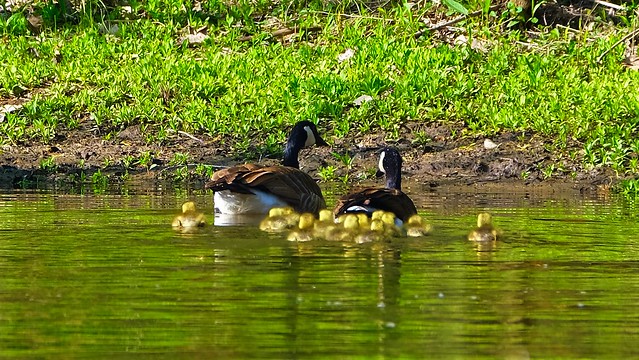
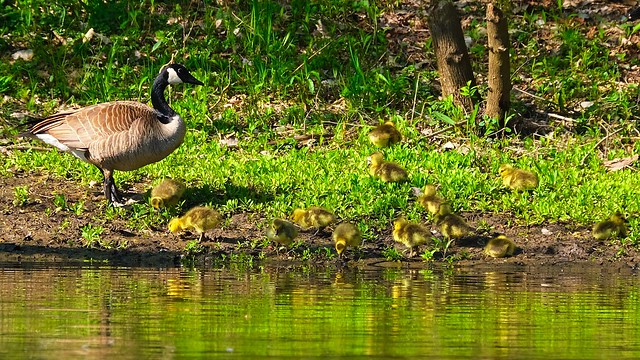
I could have sworn that I’ve already mentioned that there are Canada geese here, but I can’t find when I did, so today I finally have photographic evidence. It appears they have gotten here both on their own and with some help, but it was not clear into which category this one falls, and it would not say.

Canada goose (Branta canadensis)

Farther afield, here’s another buzzard, surveying the situation from eye level.

common buzzard (Buteo buteo)

As I was trying to get a presentable picture of the buzzard, I heard big whooshing noises, and I looked up to find that they were made by these huge mute swans cruising overhead at just a couple dozen feet. I read that “the mute swan is one of the heaviest flying birds. In several studies from Great Britain, males (known as cobs) were found to average from about 10.6 to 11.87 kg (23.4 to 26.2 lb), with a weight range of 9.2–14.3 kg (20–32 lb).”

mute swan (Cygnus olor)

Near the other end of the size spectrum, this great tit was busy gleaning seeds from an old blossom.

great tit (Parus major)

Finally, there are still butterflies around, and here’s another map, …

Map butterfly (Araschnia levana)

and here’s another speckled wood.

Speckled wood butterfly (Pararge aegeria)

Let’s see if the weather holds through tomorrow morning. That sure would be nice.

Birds & bunnies & butterflies, oh my!

I tried taking the route, which has been my regular route recently, in reverse order this morning, so counter-clockwise on a map. Thus, I hit the spot where we saw the robin late yesterday morning bright and early today, and our reward is a brand-new bird, for a change. This time, it’s a Eurasian jay (Garrulus glandarius).

DSCF5846

Here’s an even blurrier picture that shows a bit more of its face. Although it’s an “Old World jay,” and so not in the same genus as the blue jays in Estabrook Park, they are both in the Corvidae family, along with crows, magpies, and jackdaws.

DSCF5844

You may have noticed that the pictures above are blurrier than usual, and it turns out, unbeknownst to me at the time, that some blockhead had previously turned off the stabilization capability built into my lens. It’s not the longest lens by any means, but it’s long enough that taking a hand-held shot at maximum zoom produces less-than-optimal results, as you can clearly see above. And before we get into the whole blame game, let’s just say that the culprit has learned his lesson, and it shouldn’t happen again.

Anyway, while taking blurry pictures of the jay, I happened upon this little cutie on the path ahead.

DSCF5850

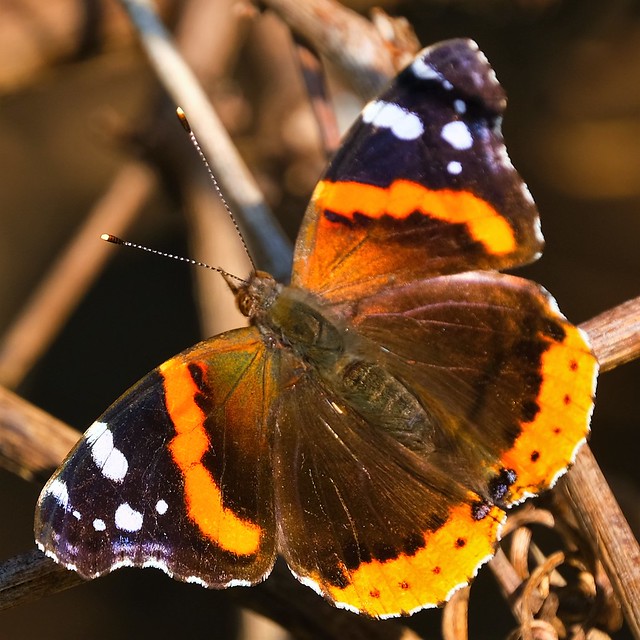
Luckily, I turned the image stabilization feature back on before I came across this stunning red admiral butterfly soaking up the morning sun.

DSCF5854

Closer to the ground, I came across the first frog completely out of water that I’ve seen so far, which finally gives me a decent shot at identification, and all indicators point to (Pelophylax kl. esculentus), the so-called “edible frog”, prized in parts of Northern Europe for its delectable legs.

DSCF5900

Another fascinating feature of this frog is that it is “the fertile hybrid of the pool frog (Pelophylax lessonae) and the marsh frog (Pelophylax ridibundus),” and thus “it reproduces by hybridogenesis (hemiclonally),” where “half of the genome is transmitted to the next generation clonally, unrecombined (intact); the other half sexually, recombined.” Will wonders never cease? Maybe that’s why their legs taste so good.

After the close-up with the frog, I took a glance out on the water behind me and saw what I thought were three mallards steaming along. For reasons I can’t explained, I took a closer look with my binoculars anyway, and I was stunned to see that only one of them was a mallard. The other two were sporting giant bills like this, which makes them northern shovelers, instead! I haven’t seen the likes of them since last September in Estabrook. I didn’t even know we had them here, but sure enough, they’re here, too.

DSCF5865

I saw another ruddy darter this morning, and I think this picture came out even better than yesterday’s.

DSCF5906

Finally, here’s a great tit showing off some serious acrobatic skilz.

DSCF5862

Late summer scenes…

It was nice and cool overnight with clear skies and calm winds, so most of the big fields were covered by thick blankets of fog this morning, and I couldn’t even see the water where I spotted the flock of spoonbills last weekend, so I had to make do, instead, with what I could find closer to the path.

I saw at least four bouquets of pheasants, and this trio was definitely the boldest.

DSCF5741

The others, such as this hen, kept closer to the ground.

DSCF5731

This one looks like a young male starting to show red on the side of his face

DSCF5734

The morning sun soon warmed things up, however, so the bugs come out, and here’s another map butterfly, looking nice and fresh this time.

DSCF5754

It only opened its wings just a bit and for just a moment, so don’t blink.

DSCF5752

Here’s a new dragonfly for us, and it looks like a ruddy darter (Sympetrum sanguineum).

DSCF5747

Here’s a brand new butterfly for us, a diminutive and shiny small copper (Lycaena phlaeas).

DSCF5814

Like the map above, it was also shy but did offer a brief glimpse of its dorsal side.

DSCF5807

Finally, back to the birds, here’s another European robin granting us a rare audience.

DSCF5774

And that’s it, until tomorrow.

Leftovers from the weekend…

I still have some pictures left over from the weekend, so I thought I’d put them into a post, and I’m happy to report that I think we’ve got another new bird hiding in the mix. As ebird so aptly states, it’s “rather retiring, like most [old world] warblers,” but this sure sounds like the little cutie below: “plumage brownish overall with bright rusty wings; grayer head has narrow whitish eyering and sets off white throat.” The location is right, too, and I certainly haven’t seen such a white throat before, so I’m gonna go with common whitethroat (Curruca communis), and now I’ll be on the lookout for an image with the throat all puffed out.

DSCF5689

Meanwhile, this little acrobat looks like another willow warbler, but not quite as yellow as last time.

DSCF5633

This one, at last, is an easy identification with that magnificent tail, tiny black beak, and hint of a bright yellow eyebrow: another long-tailed tit.

DSCF5642

As I was trying to get pictures of all these little birds, I was surprised to see and hear this female great spotted woodpecker, with no red on her head at all, swoop in for just a moment to check out that tiny branch, and then swoop right back out again.

DSCF5686

Here’s a buddy of the tufted duck I showed you on Sunday, but who either lost, doesn’t yet have, or has opted not to flaunt, his tuft.

DSCF5616

Finally, this appears to be a slightly roughed up male meadow brown butterfly.

DSCF5714

I’ll keep sifting, but that’s what I have for now.

Little Critter Day

I saw plenty of big birds this morning; herons, egrets, storks, and even about a dozen spoonbills at the Ackerdijkse Plassen; but they were all either too far away or just didn’t want to pose today. Luckily, these little characters were willing and able to pick up the slack.

This first one is another great tit, whom we’ve seen a few times before, but never in a pose quite so darling, eh?

DSCF5653

Next is a female chaffinch. We’ve seen a few males, but I believe this is our first female (or immature male whose blue head feathers are on backorder).

DSCF5660

This next one is a little harder to identify because its plumage is a bit drab to start with, and then it is all puffed up for preening. In any case, I’m going to go with a Eurasian reed warbler splurging on a tree branch this morning instead of sticking with the reeds along the canal below .

DSCF5663

Meanwhile, at water level, this frog, my guess is a marsh frog (Pelophylax ridibundus), was uncharacteristically tolerant of me looking its way. They usually sink like rocks if and when we make eye-contact.

DSCF5684

When I saw this dragonfly, I thought it was a common green darner, like the ones I see in Estabrook, but now that I can study the picture, the pattern of black on the blue tail isn’t quite right, so I’m gonna go with a southern migrant hawker (Aeshna affinis) instead.

DSCF5704

Finally, here’s another speckled wood butterfly, like the ones I saw at the beach back in July.

DSCF5724

Lastly, this one’s not quite so small, but still smaller than a mallard, and we haven’t seen a tufted duck in a while.

DSCF5622

PS. Happy Birthday, Honey!

Fun sized…

It was an interesting morning in South Holland. The weather was as beautiful as last weekend, with clear skies and calm winds, but there was a noticeable difference in the wildlife. I suspect that most of this summer’s chicks have fledged by now and are starting to take care of themselves. Thus, droves of parents aren’t out slaving away in the fields searching for food where I can see them. In the area where I saw about a dozen grey herons last weekend, I only saw two today, and I spotted at least a half dozen cranes out foraging in the middle of pastures.

Anyway, I still managed to spot a few critters within range, and here they are. First up is our favorite European woodpecker and the only one we’ve seen so far, a great spotted, hard at work.

DSCF5557

Here it is again taking a glance our way and showing off its “reddish crown”, which is supposed to indicate that it’s still a juvenile. “Welcome aboard, little buddy!”

DSCF5554

I didn’t see anybody I could capture on film for a while after that, and I even started composing in my head how I would explain coming up empty, as I have done so many times before, but then I came across this beauty.

DSCF5582

It was sticking deep in the tall weeds, so it was quite a trick to get a good look at it, and you might not recognize it yet. Luckily for us, it slowly turned around to sip nectar from the other side of that thistle blossom, and here we are.

DSCF5576

Ta da! It’s a nice-and-fresh looking red admiral, just like the ones we have in Estabrook Park, and cousin of the painted lady, that we’ve seen both here and there. I read that stinging nettle is its “main host plant,” and there sure is plenty of that about. Best of all, at least for me, is that it finally granted me a glimpse, if slightly askew, of its fascinating ventral side.

DSCF5561

After that, I started to make my way back to Delft, figuring that was all I was going to see, but this great egret had other plans. Despite not seeing one until two weeks ago, they were nearly as numerous as herons today.

DSCF5603

Finally, as I neared the southern edge of Delft, I spotted a little motion in the newly mown hay lying beside the bike path up ahead, and I quickly hit the brakes on my bike. As luck would have it, I still had my camera out and strapped to my chest, so I held my breath and swung it up to see if I could get lucky again. Well, I really should go and buy a lottery ticket today because get a load of this cute little rascal.

DSCF5606

That, ladies and gentlemen, is a stoat (Mustela erminea) also known as a short-tailed weasel or a Eurasian ermine. It’s a Mustelid, as are the mink and otters we see in Estabrook Park. I glimpsed one here once before while out riding my bike, but I didn’t have my camera with me, and it disappeared even before I could get a picture with my phone.

There were two of them poking their heads up out of the grass for just an instant at a time as they searched for something good to eat, and I didn’t dare move, so this is the only other presentable image I managed to capture.

DSCF5612

But I’ll take it! As with the fox from just last weekend, I can’t believe I was lucky enough even to get an image at all.

A rare glimpse…

As I stepped out the door from my apartment building after lunch yesterday to walk back to work, my heart skipped a beat when I spotted what I thought was a large butterfly fluttering by. I gave chase immediately, at least with my eyes, and I was thrilled to see it land on a brick wall nearby. Upon closer inspection, however, it wasn’t a butterfly after all, but a large brown moth.

I took a quick picture with my phone anyway, and then I ran back inside to get my camera. At first, it doesn’t look like much, except for its size, but that’s what it wants you to think.

DSCF5538

After it let me take a couple of shots, it moved, and before it got comfortable again, it gave us a glimpse of what it usually keeps under wraps: those amazing underwings.

DSCF5541

Thus, it’s an underwing moth, one of several dozen species, which I narrowed down to either the rosy (Catocala electa), the red (Catocala nupta), or the French red (Catocala elocata), and it’s probably the red. In any case, it reminded me of the Hermia underwing (Catocala hermia), which we saw in Estabrook back on August 29, 2020, and who opted not to let me get a picture of those amazing underwings.

Well, since we’re here, let me show you another grey heron from the previous weekend, when the clouds were dark and leaky, but in a more-compact pose than we usually see.

DSCF5432

Here’s one more look at one of those goldfinches, but while it was on break from murdering the gone-by thistle blossoms.

DSCF5454

And here are a couple more buzzard pictures, maybe one of the same birds I already showed you on Sunday, but in a different spot and this time talking quite insistently to another buzzard just out of sight.

DSCF5471

There seems to be a lot of that going on, this time of year, and I suspect much of it has to do with freshly fledged chicks learning that shouting “feed me” doesn’t work anymore.

DSCF5472

Finally, here’s one more parakeet picture showing a little of why they can be so hard to spot.

DSCF5481

Shy ones…

Here are a few more sights from this past weekend, and these critters all tend to keep themselves better hidden than others I see.

I stumbled upon another ring-necked pheasant hen tucked into the tall grass and holding perfectly still, unlike her boldly-colored counterpart who I often see strutting across open fields.

DSCF5383

Here’s another noisy-as-heck but super-hard-to-spot rose-ringed parakeet making a rare appearance.

DSCF5484

Here’s another moor hen and her good-sized chicks sticking close to the reeds at the edge of the water.

DSCF5372
DSCF5375

Finally, here’s a butterfly we’ve glimpsed before but not in South Holland until now.

DSCF5491
DSCF5490
DSCF5497

See that little white “smile” on the ventral (out-) side of its wing in the first picture? Well, that’s the “comma” after which the comma butterfly (Polygonia c-album) is named. I read further that “the angular notches on the edges of the forewings are characteristic of the genus Polygonia, which is why species in the genus are commonly referred to as anglewing butterflies.”

In any case, they sure are shy little stinkers, and I’ve only seen them in Estabrook Park twice before, first on June 25, 2020, and then again on July 14, 2021, and both times they stayed deep in some bush and at awkward angles.

I guess I have to admit, though, that spotting the ones who would rather not be spotted is half the fun.

Coots, young and old…

As promised, here’s a short story from Saturday that got bumped from my earlier reports, first by the fledging storks, and then by the fox. These are two very fresh coot chicks, maybe just a day or two old, judging by their size and their bright red hairdo, and probably a second brood for the summer. Well, today’s their day.

DSCF5419

As I mentioned earlier this summer, when I first saw the spectacle, studies suggest that coot chicks have bright red head feathers “to get more food out of the parents.”

DSCF5422

Anyway, when I arrived at the bridge under which the parents had assembled their floating nest, it must have been nearing nap time because the two chicks and one parent headed right towards it, even though it was also towards me, and it certainly provided no more protection or cover than they already had. I very much doubt that they just didn’t see me, but instead, they just didn’t care.

Anyway, here’s a good chance to compare the size of the tiny chicks to the size of their parents clownishly-large and colorfully-striped feet. (Remind you of anybody, Deb and Sue?)

DSCF5423

As the chicks made their way up the nest to some spot which seemed no dryer or more secure than any other, the parent had some preening to attend to first.

DSCF5424

Everyone’s getting close now, and one chick seems to have had just about enough of all the scratching with that thing.

DSCF5428

There we are, just one more scratch, and then everyone settles down.

DSCF5431

I don’t have that last picture, for some inexplicable reason, but I can leave you with this shot from earlier that morning of another parent feeding a slightly older chick, who has lost most of its red feathers.

DSCF5384

A fun thing about coots here, at least for me, is that they are nearly ubiquitous, similar to mallards, Canada geese, or even robins back home. If there is some standing water, and there’s at least one bird in it, as in the canals all through town and the countryside, you can pretty safely bet that it’s a coot. And not to knock ducks or geese, but an additional nice feature of coots is that they pretty much ignore people, stick to the water, and simply go about their business. They do make noise, as necessary, but I never hear them calling before dawn, so even a cranky old coot like John Gurda would approve.

Not outfoxed for a change…

It was another perfect morning in South Holland, and spurred by seeing all the storks yesterday, I headed first to my old stomping grounds on the east side of the Delftse Schie, where we watched the second stork nest for several weeks, in which I now read is called the Ackerdijkse Plassen, “one of the most important bird areas in the Netherlands.”

I had just barely entered the countryside on the south side of Delft when I spotted these two characters murdering a bunch of thistle blossoms that have gone to seed, just like their North American namesakes.

DSCF5446
DSCF5456

A bit further along, I glanced at the tree-line where I have seen a buzzard hangout a few times, and look who I spotted. I had begun to suspect that there might be two of them.

DSCF5458

Here’s one deciding that it has warmed up enough in the bright morning sun to go get some breakfast.

DSCF5460

Welp, by the time I reached the stork nest, it was empty, and it seems that both chicks must have already fledged. Oh well. I hope you got your fill of storks yesterday.
I continued on to the shallow ponds where I had photographed wading birds, such as ruffs, godwits, redshanks, and sandpipers, but the ponds were all dried up, and sheep were grazing on the fresh sprouts emerging from the mud.

So, then I headed back over to the west side, where I saw the curlews just yesterday, and here’s another picture, to refresh your memory, but I didn’t see any today.
DSCF5396

Before I even crossed the Delftse Schie, however, this stunner stopped me in my tracks.

DSCF5470

In case you don’t remember, that’s a Painted Lady, same as the one we saw back in July, but not nearly as roughed up.

Anyway, onto the main event. Oh sure, I saw a bunch of other pretty creatures, but I’ll save them for later in the week. Instead, let me show you what I saw today as I trapesed through the partial forest where I saw the long-tailed tit, the map butterfly, and the willow warbler back in July. The area looks like abandoned farmland that still has crisscrossing canals, although they are almost filled in, and strips of low brush that they mow once a year to keep trees from taking over completely.
Well, the herons love it, and now that it’s been mowed, I spotted one fishing on just about every little canal I walked by. At one point, I could see four herons all from the same spot, once I looked far enough down the canal. At the very next canal, I could see two with my naked eye, so I took a look with my binoculars to see if there were any more, and look who I found. See that little dark spot on the grass in the sun, far behind the blurry heron in the foreground?

DSCF5498

No? Here’s a close-up that might help.

DSCF5521

Here it is again, in profile this time.

DSCF5522

Hot diggity dog, I’m pretty sure those “upright triangular ears”, narrow muzzle, and that “long tail” held low all mean that that’s a fox, most likely a red fox, just like the one I spotted at the entrance to Estabrook Park last December. The tail isn’t as fluffy as I would expect, but its “paws are black” and its “chin, lower lips, throat and front of the chest are white,” so everything else matches. Plus, it was all by its lonesome, and I haven’t met any domestic dogs left on their own here yet, so I have a hope that’s not what it was.

That’s only the fourth wild mammal species I’ve spotted here so far, and only the second I’ve managed to photograph, after the hares. It’s always good to see a predator, so I sure am happy for the opportunity. I hope I get another.