Back in Estabrook, at least for a day…

Big Bend National Park and Terlingua in West Texas were amazing, and we saw a lot of wild life, but it is also always great to be back home and get a chance to visit Estabrook Park. I ship out back to South Holland tomorrow, so this might be my last post for a while.

Despite the freeze overnight, as anyone who ventured out on the Oak Leaf Trail this morning knows about, today got off to a gorgeous start in Estabrook with mild temps, almost no breeze, and plenty of sunshine. The first critter I saw taking full advantage of the situation was this musk rat just off the shore of the southern island, where we saw a beaver up on the ice back in December.

DSCF9053

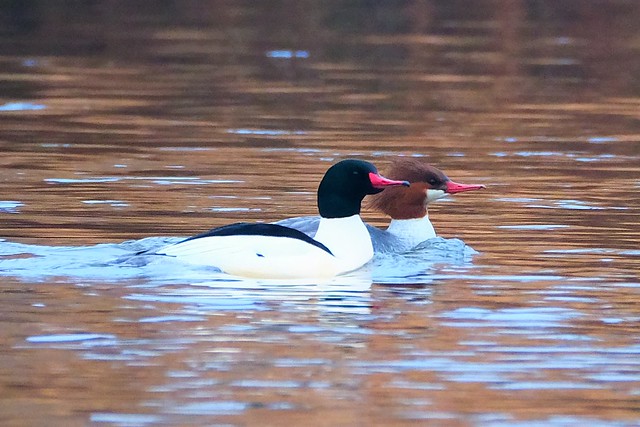
At the north end, I spotted a couple pairs of common mergansers, a single goldeneye drake, about a dozen geese, and a few dozen mallards. The surprise visitor, however, was this Cooper’s hawk right overhead.

DSCF9054

Out on the water and ice, a lone herring gull found itself a good-sized fish, perhaps already frozen
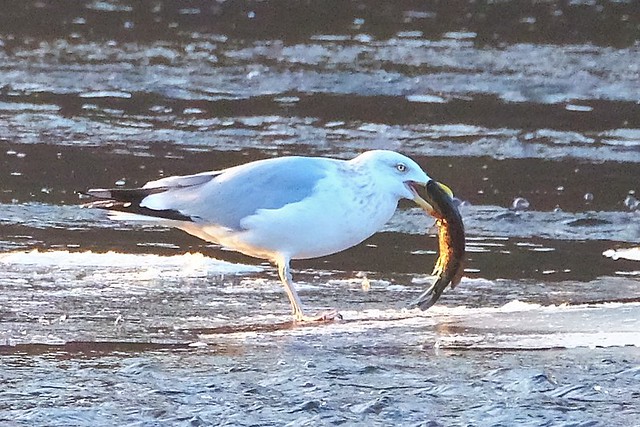
DSCF9056

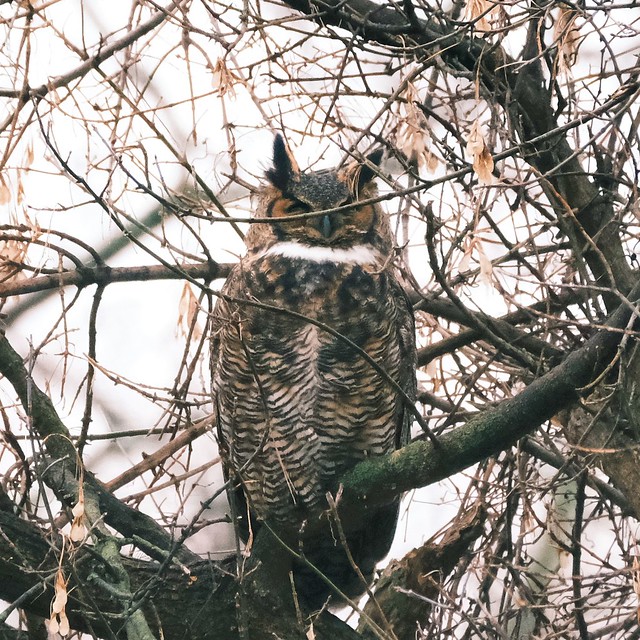
There was no sign of the great horned owl this morning, but up by the pond, the saw-whet owl was in its usual spot and as impossible to photograph as ever.

DSCF9059

Finally, I took one last swing by the river and arrived just in time to catch this beaver giving us a swim-by.
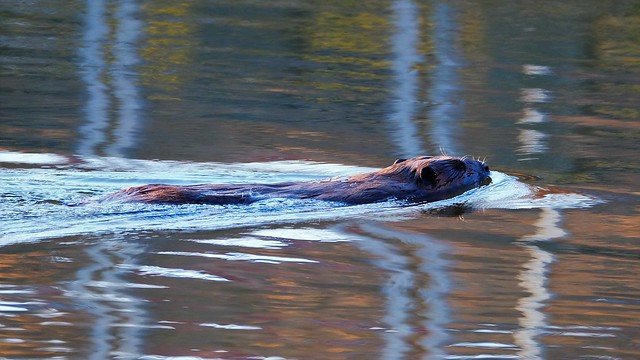
DSCF9062

That’s it for Estabrook today, so let me leave you with one more picture from Big Bend, a pyrrhuloxia perched in the bushes by Sam Nail’s old ranch, perhaps waiting for us to clear out so it can get a sip of water in peace. Welp, we’re gone now, so there you go, little buddy.

Pyrrhuloxia

Big Bend National Park, Day 3.

It was our third and last day in this amazing park, and the sights just kept on coming. We stopped first at one of the old, abandoned ranches, Sam Nail’s, and the old well acting as a water source worked as advertised. The place was abuzz with birds as the sun came into the valley. Here’s a female Phainopepla (Phainopepla nitens).
Female Phainopepla

And here’s her potential mate, a shiny black male Phainopepla. “The name “Phainopepla” comes from the Greek for “shining robe,” a fitting characterization of the shiny, jet-black plumage of the adult male.” “They are not related to North American flycatchers; their nearest common ancestors are the waxwings, which also have a glossy, silky look to their plumage.” “Phainopeplas have digestive tracts specialized for eating mistletoe fruit. These berries are low in nutrients, so the birds have to consume lots of them. The berries spend only about 12 minutes in a Phainopepla’s intestine, and the birds may eat 1,100 berries in a day.” Yikes!

Male Phainopepla

Here’s a spotted towhee (Pipilo maculatus), close cousin of the eastern towhee we see in Estabrook Park, and equally hard to photograph. Anne worked like crazy to help me capture this image. “It’s right there! The bright red bird near the ground,” she whispered fiercely.

Spotted towhee

Next up, we’ve got a bluebird, and imma gonna go with female/immature western (Sialia mexicana), but I’ve been told since is actually a mountain bluebird (Sialia currucoides).

Female/immature western bluebird

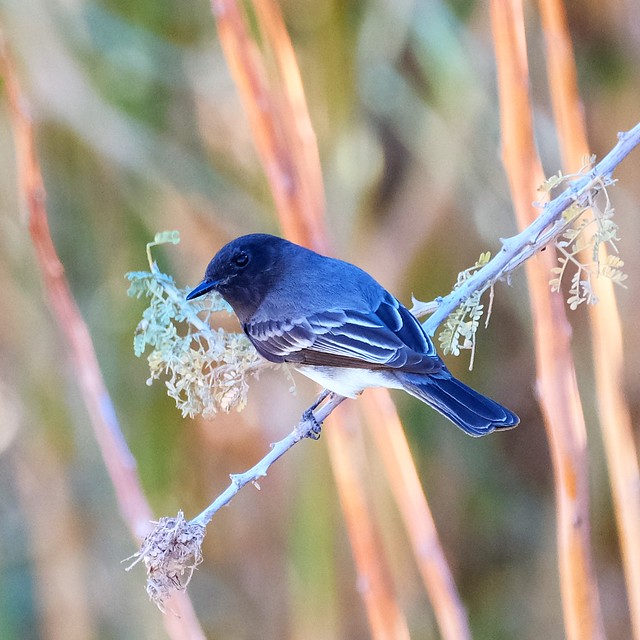
Then we drove the scenic road to the Santa Elena Canyon, and on our way back out, while I wasted my time taking yet another black phoebe picture, Anne spotted our first greater roadrunner (Geococcyx californianus). Now that is one cool bird!

Greater roadrunner

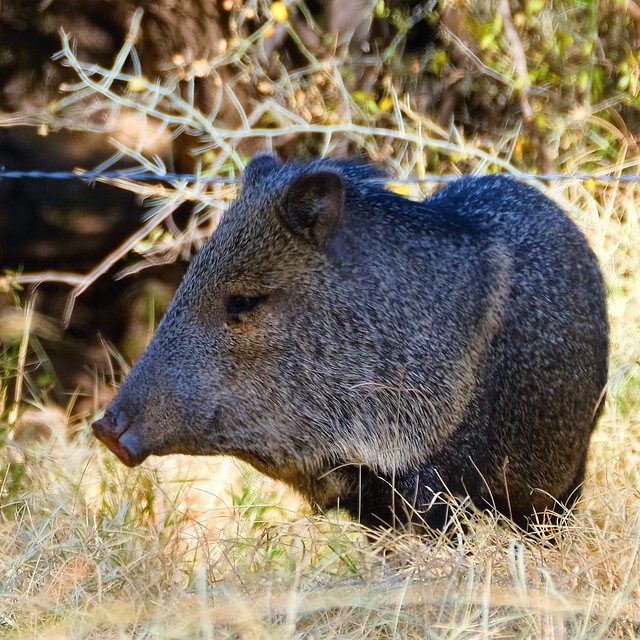
After that hike, Anne dropped me off at the Cottonwood campground to see what I could see while she grabbed us some lunch at the nearby camp store, and this is who I found: a Javelina! Aka a collared peccary (Dicotyles tajacu).

Collared peccary aka javelina

Finally, we hiked up the wash to the Lower Burro Mesa Pour-off, and a fellow hiker spotted this astounding creature, the first tarantula I’ve ever seen in the wild, likely a “Texas brown” (Aphonopelma A. hentzi). What a sweetheart!

Texas brown tarantula

Wow! What a day, eh? Tomorrow, we’ve gotta go home, sadly, so I probably won’t have anything for you, but I might be back in Estabrook the day after. Wish us luck!

Big Bend National Park, Day 2.

Today we took a “float” down the Rio Grand. Anne was surprised that we had to paddle, and I was surprised that we hit white water. Happily, neither surprise did us in, and we did see some more amazing sights. Here are a couple of the highlights.

There were several black phoebes (Sayornis nigricans) hunting along the sides of the river.

Black phoebe

They are close cousins of the eastern phoebes we see in Estabrook, and here it is again on a branch.

Black phoebe

There was a trio of cinnamon teal hens, and here’s one of them. That’s the third teal we’ve seen, after the blue-winged teals in Estabrook, and the green-winged teals in South Holland.

Female cinnamon teal

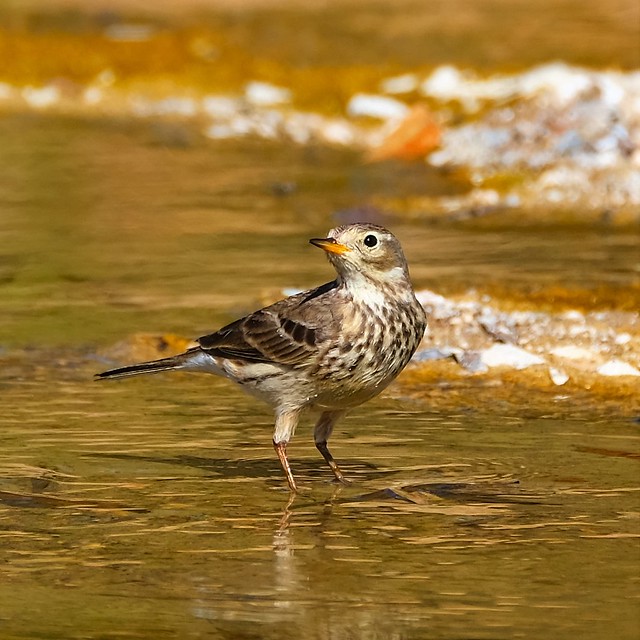
Another fun surprise was this lone American pipit (Anthus rubescens) foraging in the shallow water. It nests in either “Arctic tundra and alpine meadows,” and “if you don’t live in the Arctic or above treeline, look for these birds in winter.”

American pipit

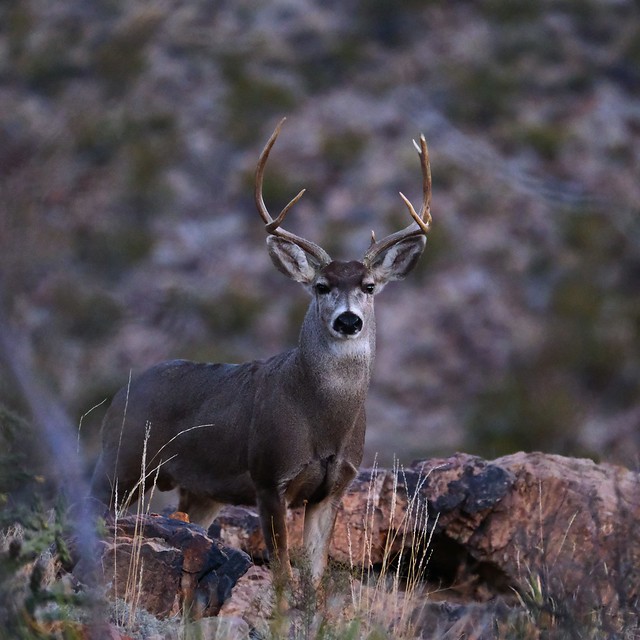
Finally, once we got back to our lodge, there was still a smidgeon of light, so I took a walk to see if the setting sun had brought anyone out, and look who I found:

Mule deer
Mule deer
Mule deer

That’s a full quartet of mule deer including a well-antlered buck. Cool, eh?

Big Bend National Park, Day 1.

We made it into Big Bend National Park today, did some great hiking in the Chisos Mountains, and saw some amazing sights.

Here’s a pyrrhuloxia or desert cardinal (Cardinalis sinuatus), close cousin to the Northern cardinals we see in Estabrook.

Pyrrhuloxia

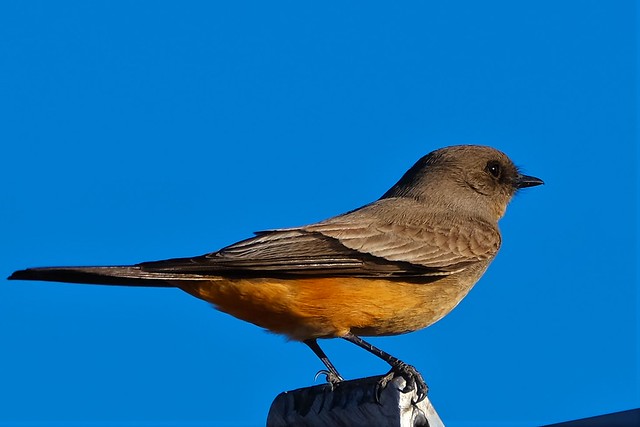
Here’s a Say’s phoebe (Sayornis saya) on the hunt for dinner out on the desert north of the mountains.

Say's phoebe

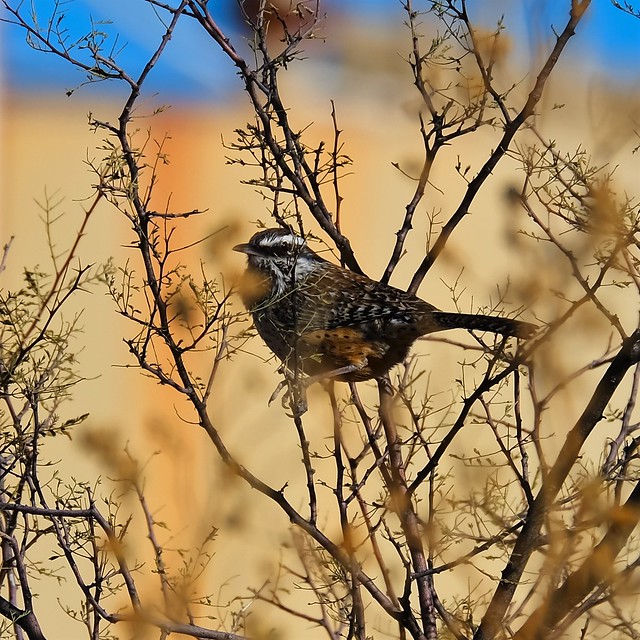
Here’re a couple more picture from yesterday at Terlingue. First is a cactus wren (Campylorhynchus brunneicapillus) trying to hide.

Cactus wren

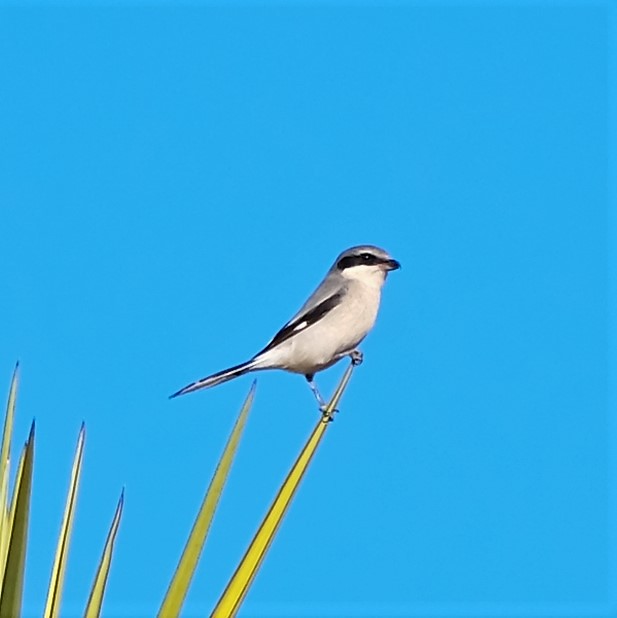
Second is a loggerhead shrike (Lanius ludovicianus) on the hunt and not hiding from anyone.

Loggerhead shrike

Finally, here’s a butterfly from the Chisos Mountains like I’ve never seen before. It is aptly named the American snout or common snout butterfly (Libytheana carinenta), and is said to migrate sometimes in quantities “so huge as to darken the sky in places.”

American snout butterfly

That’s it for now. Tomorrow we’re supposed to take a Rio Grand boat trip, so maybe I’ll have some water birds to show you.

Greetings from Terlingua, West Texas

Anne and I finally arrived this afternoon and immediately set out to see who we could see. In short order, we spotted 14 bird species, 8 of which are entirely new to me, and one butterfly. The wifi is kinda slow here, so I’ll just post a couple pictures to whet your appetite.

Here’s a handsome black-throated sparrow (Amphispiza bilineata)

Black-throated sparrow

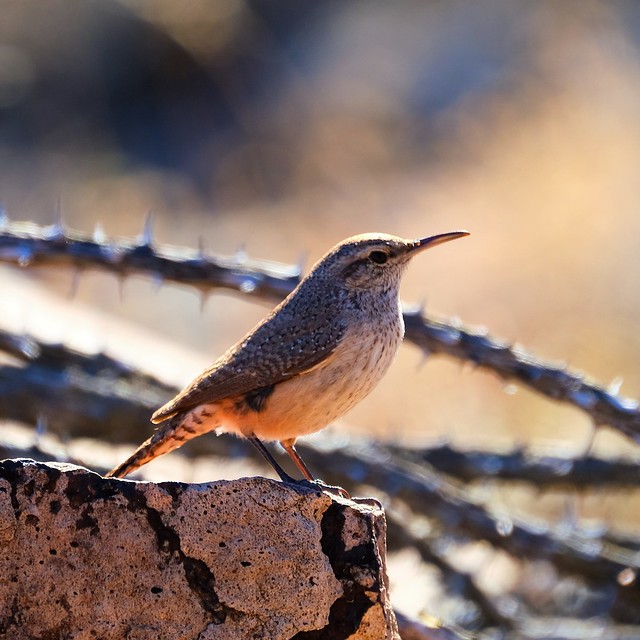
And here’s a rock wren (Salpinctes obsoletus)

Rock wren

That’s it for now. Tomorrow we venture into Big Bend National Park. Wish us luck!

Big and small…

After I got home from Estabrook yesterday, I got a cryptic message on the facebook that mentioned “saw-whet”, and then I saw on ebird that someone reported seeing a northern saw-whet owl (Aegolius acadicus) in our very own park, so I hustled right back over there. Then, as I was methodically checking the trees by the pond, I even got a text message which helped me narrow my search, and here’s the result of all that excitement: the smallest owl in eastern North America. In the picture below, from yesterday, it appears to be looking over its right shoulder, and you can just make out its dark right eye and its beak.

DSCF8359

I had hopes of getting a better image this morning, but the skies were just as dark as yesterday, and the little stinker wouldn’t even face our way today. Oh well.

DSCF8371

Anyway, elsewhere in the park, the great horned owl, the largest owl in all of North America, was back in its regular spot but a little less buried in the sticks than last time. What are the chances of seeing both owls on the same day, right?

DSCF8394

Finally, the male kingfisher was back to fishing in the river from the northern island.

DSCF8402

Anne and I fly south this afternoon, and I don’t know if I’ll have anything for you by tomorrow, but I’ll be sure to show you if I do.

An early January thaw…

It’s a damp and dreary morning in Estabrook Park, but the temps are mild, and the wind is light, so not a bad time to visit at all. There were plenty of birds out and about making the best of the situation, but I didn’t expect my camera to do well in the low light, so I left most of them alone. Luckily, I have a couple pictures left over from yesterday when the sun was trying to peak through the clouds.

First is this handsome male cardinal sampling some kind of berry.

DSCF8338

And here’s one of several starlings looking spectacular in the same tree.

DSCF8348

Finally, the great horned owl was back, looking regal as ever, and that is always worth a shot, even in the low light.

DSCF8354

That’s it for now, and I get one more chance tomorrow morning before Anne and I are off to Big Bend National Park for a few days. If I see anything there, I’ll let you know.

Happy New Year!

Now that the big storm is all cleared out, things are pretty quiet in Estabrook Park. There’s still some ice on the river, but not so much that ducks and mergansers are coming south in search of open water. Here are a few pictures from the last two mornings.

A black-capped chickadee by the pond,

DSCF8274

And a dark-eyed junco by the pond.

DSCF8277

I was very excited to hear the call of this male belted kingfisher over the river. I haven’t seen one since last May.

DSCF8280

Yesterday, there was also a pair of common mergansers on the river,

DSCF8285

And one hooded merganser drake.

DSCF8289

Today, there was one goldeneye drake and one common merganser hen, but they were both too far away from my equipment.

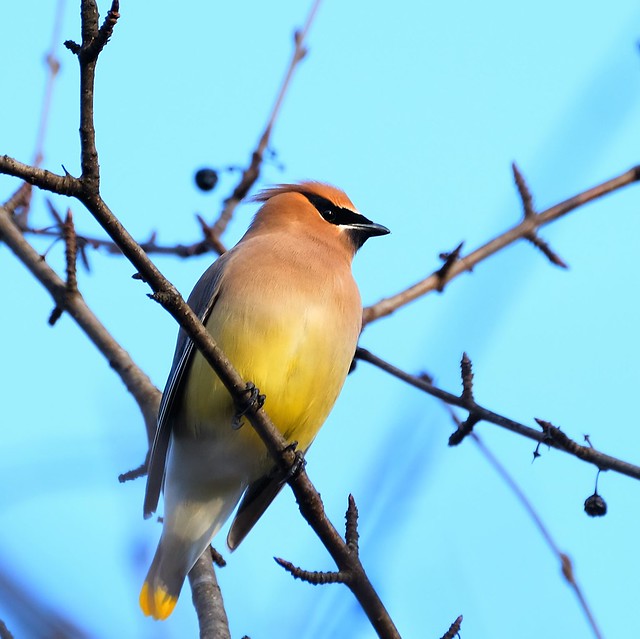
This morning, the sun tried a little harder to shine through the clouds, and here’s one of about a half dozen cedar waxwings picking berries.

DSCF8304

At the southern parking lot, this male, red-bellied woodpecker wolfed down a crabapple from a nearby tree as it continued to announce his presence from the top of a light pole.

DSCF8310

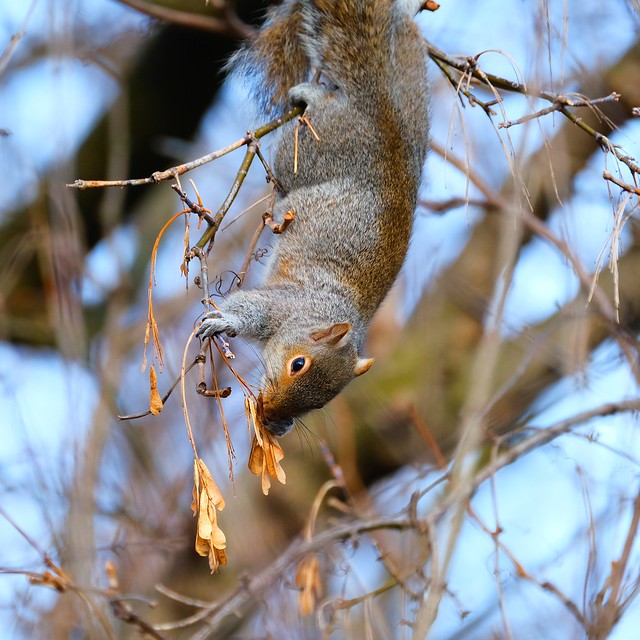
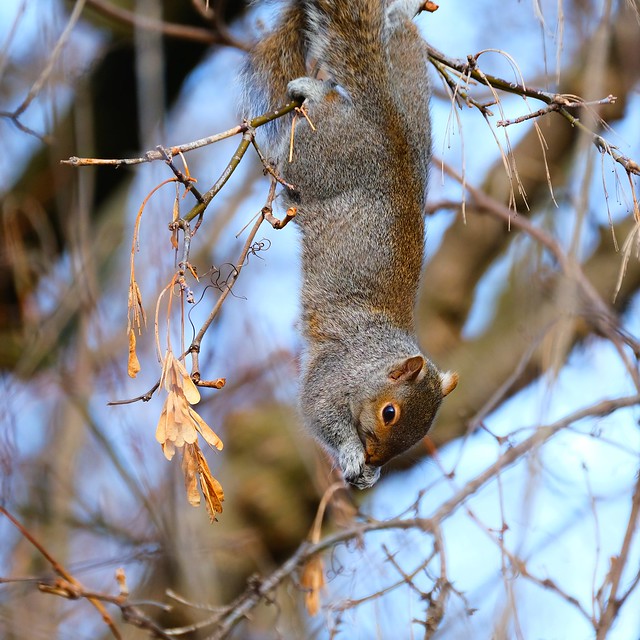
Finally, just as I was crossing the Oak Leaf Trail to exit the park, this grey squirrel caught my eye as it feasted on box elder seeds while hanging by its hind legs.

DSCF8328
DSCF8325

That’s it for now, and I hope your new year is off to a great start.

Sights from CT.

My trip to Connecticut is winding down, and I’ll be back in Wisconsin tomorrow. Before I go, however, I’ve got some pictures for you. There is a nice rails-to-trails linear park that follows the old Farmington Canal through town, and I was pleasantly surprise by the variety of wildlife I found there.

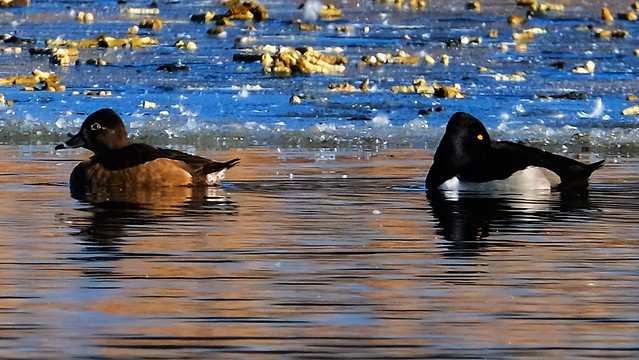
There is a pond near the north end, bigger than the one in Estabrook Park, which is supporting a pair of mute swans, a slew of Canada geese, a few mallards, and this pair of ring-necked ducks. I’ve only ever seen a single hen once before, on the Milwaukee River back in November, so it’s nice to see the pair together.

DSCF8175

When I visited that pond again this morning, the ring-necked ducks appear to have moved on, but they have been replaced by two pairs of hooded mergansers, and here’s one pair.

DSCF8228

The biggest treat for me, however, was spotting my first northern mockingbird (Mimus polyglottos), just chillin’ on a branch beside the trail. No song today, I’m afraid.

DSCF8232
DSCF8240

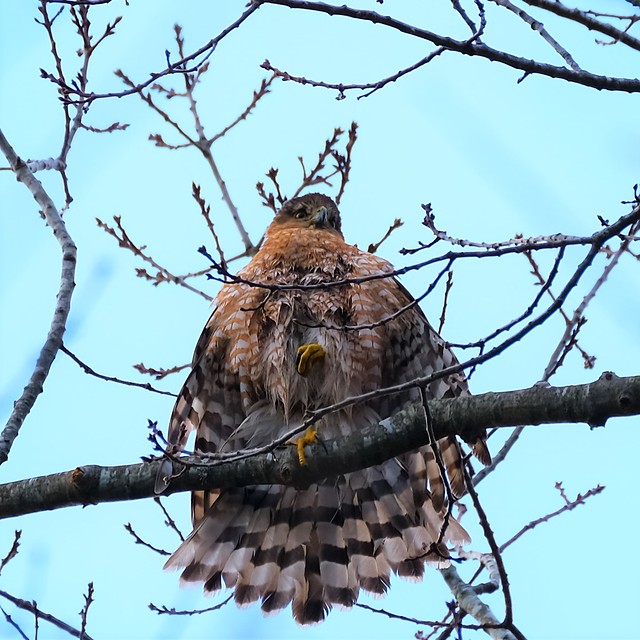
At the south end, I found another spectacle. From afar, it looked like a large clump of leaves, or even a squirrel drey high up in an oak tree, but I gave it a look with the binoculars anyway, and I was pleasantly surprised to find a hawk who appeared to be drying itself out. Sure enough, you can still see its wet breast feathers in the image below.

I believe it is a red-shouldered hawk (Buteo lineatus), which would be another first for me, if my ID holds up. It is not easy to distinguish it from a Cooper’s hawk in this image, but the fact that it just got itself wet and is drying off in a tree across the path from a long narrow pond fits the description: “you may find them hunting from a perch along stream or pond. “

DSCF8257

Meanwhile, in that long narrow pond across the path from the hawk, here are a pair of American black ducks keeping a close eye on it.

DSCF8264

Finally, there were also plenty of the regulars from Estabrook; downy, hairy, and red-bellied woodpeckers, chickadees, juncos, white-throated sparrows, nut hatches, cardinals, blue jays, crows, etc.; but the ones that eluded my camera, despite my best efforts, were the plentiful tufted titmice. The good news is that I got to hear plenty of their calls, and now I’m better equipped to spot one in Estabrook. At least I can hope, right?

The goldeneyes return!

The cold and wind are starting to back off a bit, and the sun was out, so it was a perfect morning in Estabrook Park. The river ice continues to form, however, so my wish came true, and the goldeneyes have begun to arrive. Here’s a hen on the rapids at the south end.

DSCF8096

And here’s a drake just a bit upstream.

DSCF8106

There were still plenty of mallards on the rapids, and a few Canada geese at the north end, but the common mergansers have moved on for now. Also at the north end, this red-bellied woodpecker was busy hunting up some frozen bugs for breakfast.

DSCF8118

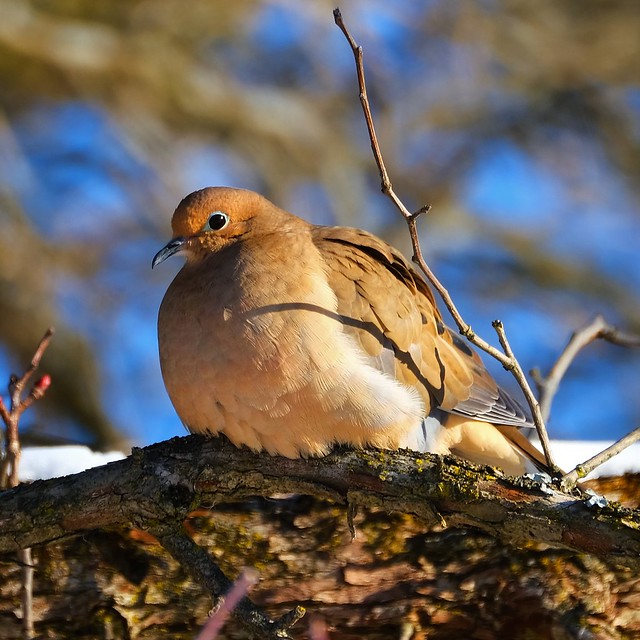
At the pond, this mourning dove posed perfectly in the bright morning sun.

DSCF8123

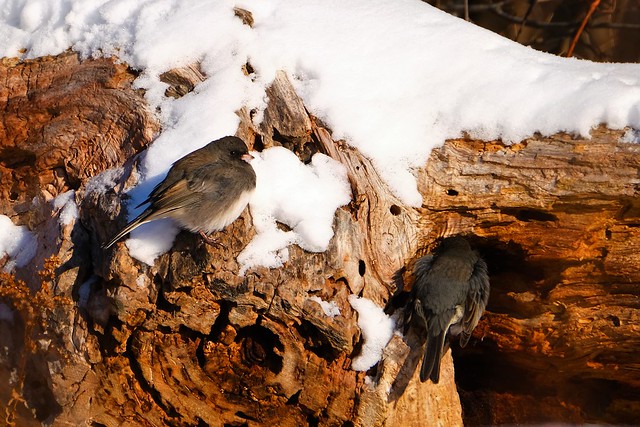
I couldn’t tell if this pair of dark-eyed juncos was looking for something to eat, hoping for sun warmth reflected off the log, or both.

DSCF8124

I was happy to see cedar waxwings still hanging around the pond.

DSCF8133

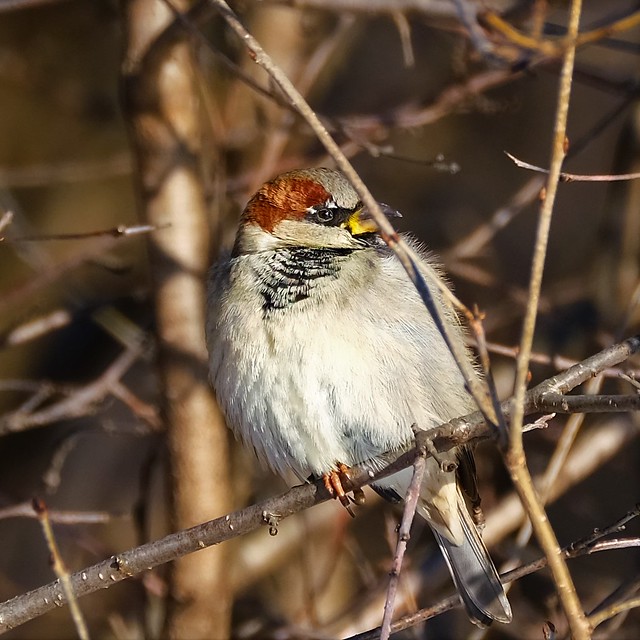
Finally, here’s a male house sparrow who must have strayed into the park from the surrounding suburbs.

DSCF8144

Lastly, thanks to those of you who wrote in to express concern for me in the cold, but you needn’t worry. I’ve managed to build up a good layer of insulation on my strict diet of dark bread and mature Gouda cheese.

Tomorrow, Anne and I are off to the east coast to see more family, so you’ll be on your own again, but I’m bringing my camera, and I have a hope of showing you some east coast critters.