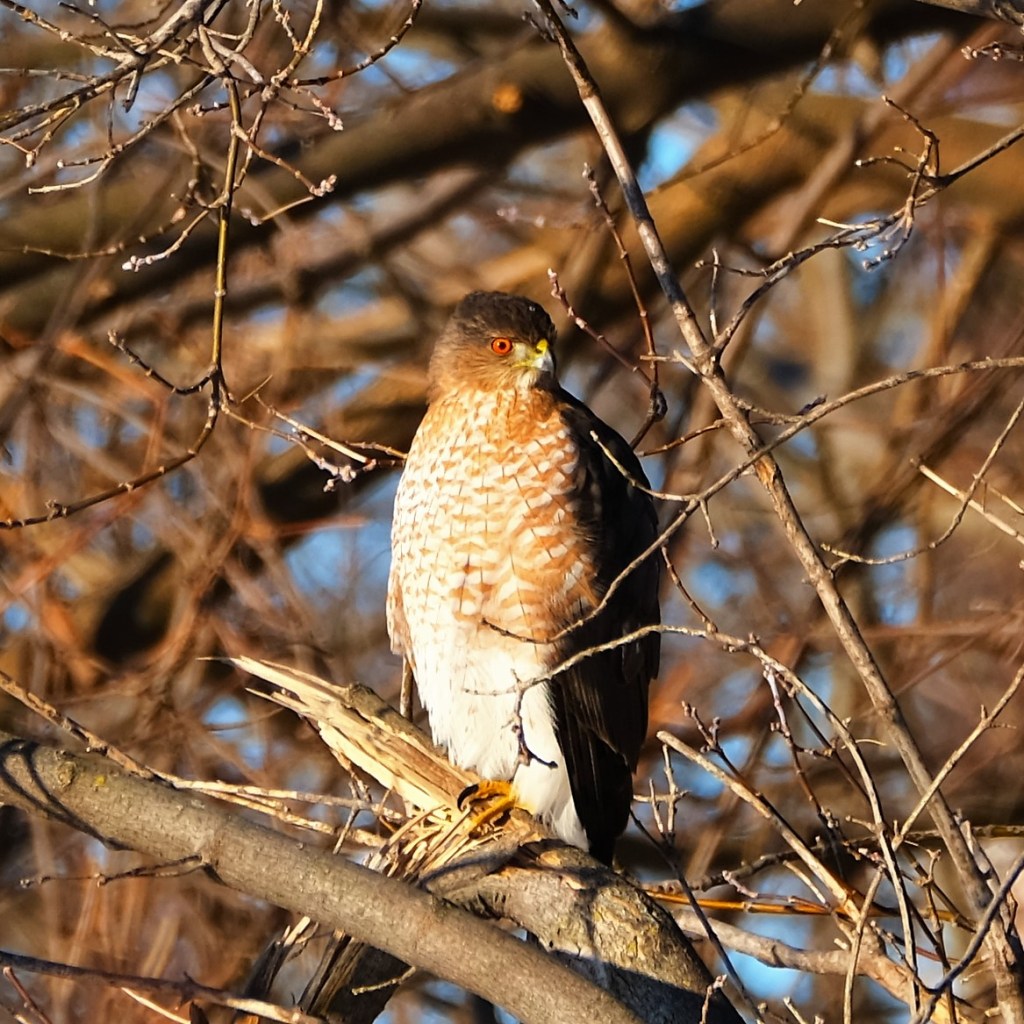
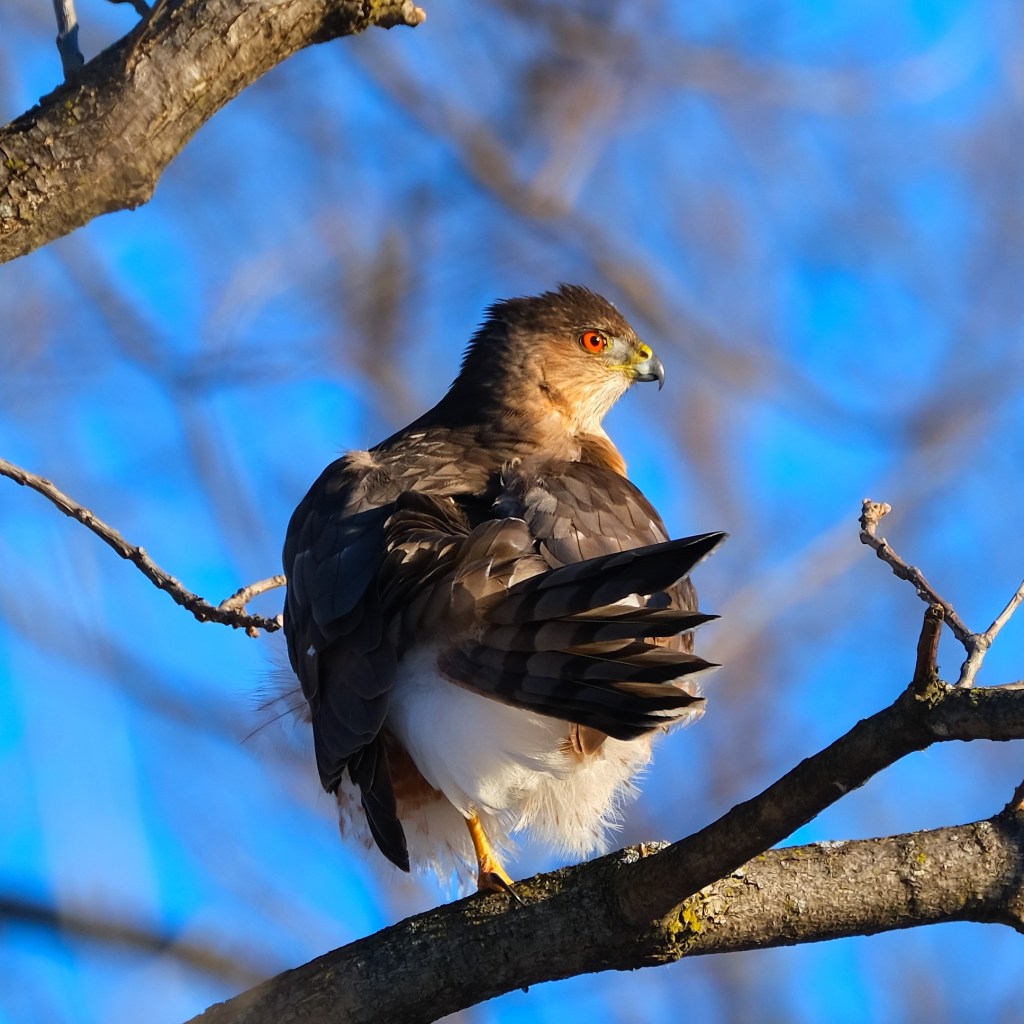
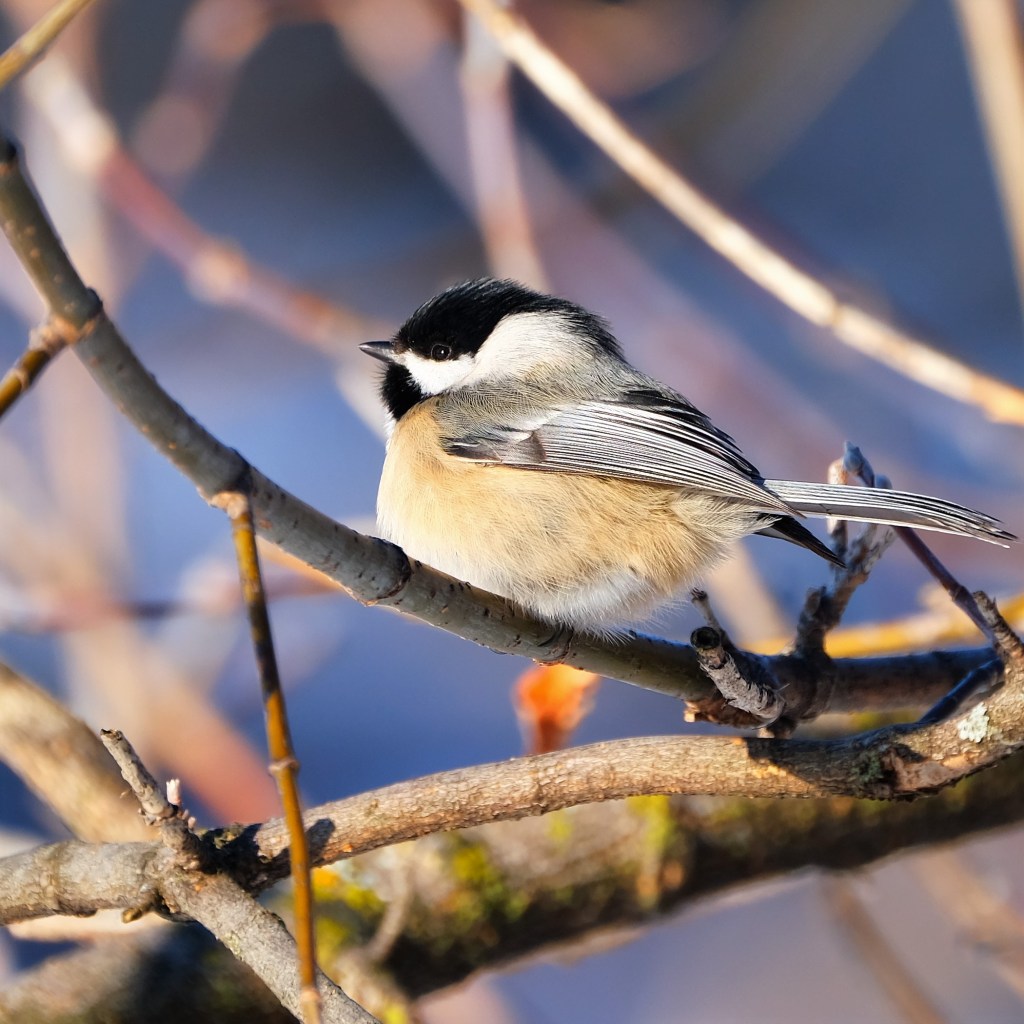
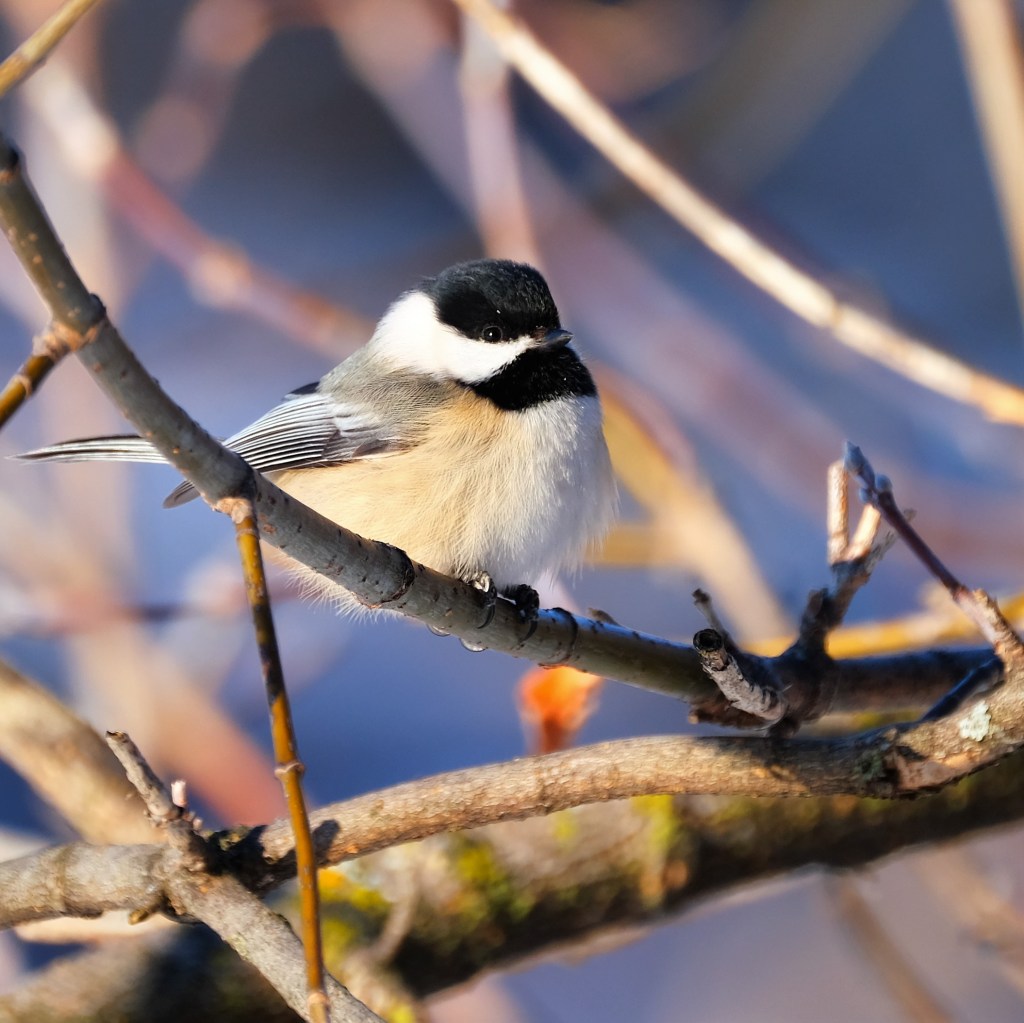
An early start for a change.

I hit the park a little earlier than usual this morning, before sunrise, and mostly because I was awake anyway, but also to see if I’d been missing anything lately. You may have noticed that I’ve been waiting for enough light to get good warbler and vireo pictures, but we know there’s plenty of action before then.

Well, the first sight to greet me was a great blue heron fishing in the mist where the rapids resume after the big, wide, slow part of the river below the falls. What an absolute treat.

Here’s a close-up, in case you’re viewing this on your phone and can’t even see the heron in the image above.

As I was busy trying to decide just how wide to make that shot and also trying to catch the heron with its neck in that picturesque s-shape so it’s all backlit by the reflection off the water, look who just happened to swim by.

Yup. That’s our old pal, the beaver, who we haven’t seen in weeks. I guess that’s what I’ve been missing, eh?
At the north end, the killdeer were back, and the sun had finally come up to light the scene.

Another heron, this one with full, mature plumage, was taking a break from fishing and perhaps also warming its bones in the warm morning sun. It was a cold morning.

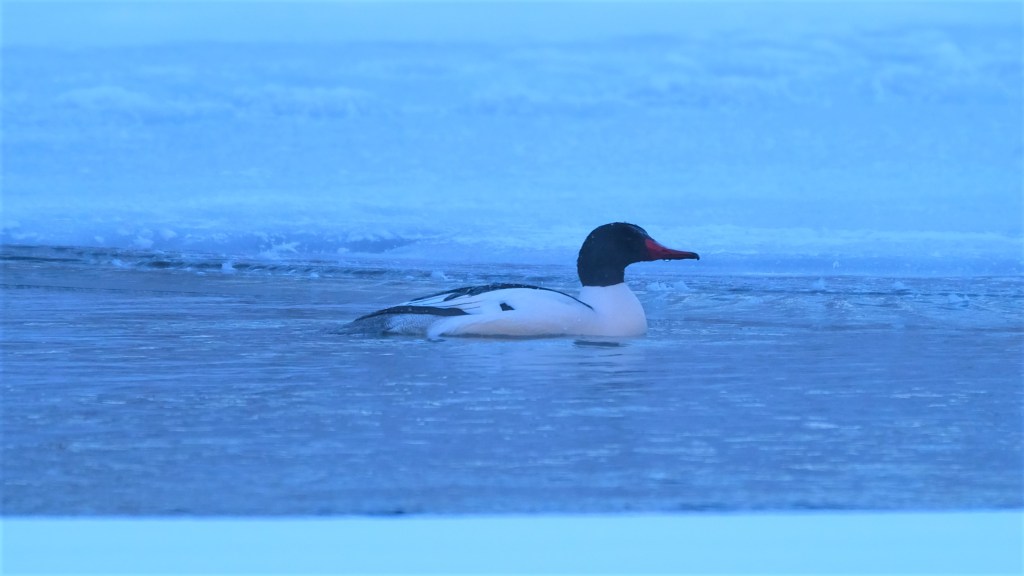
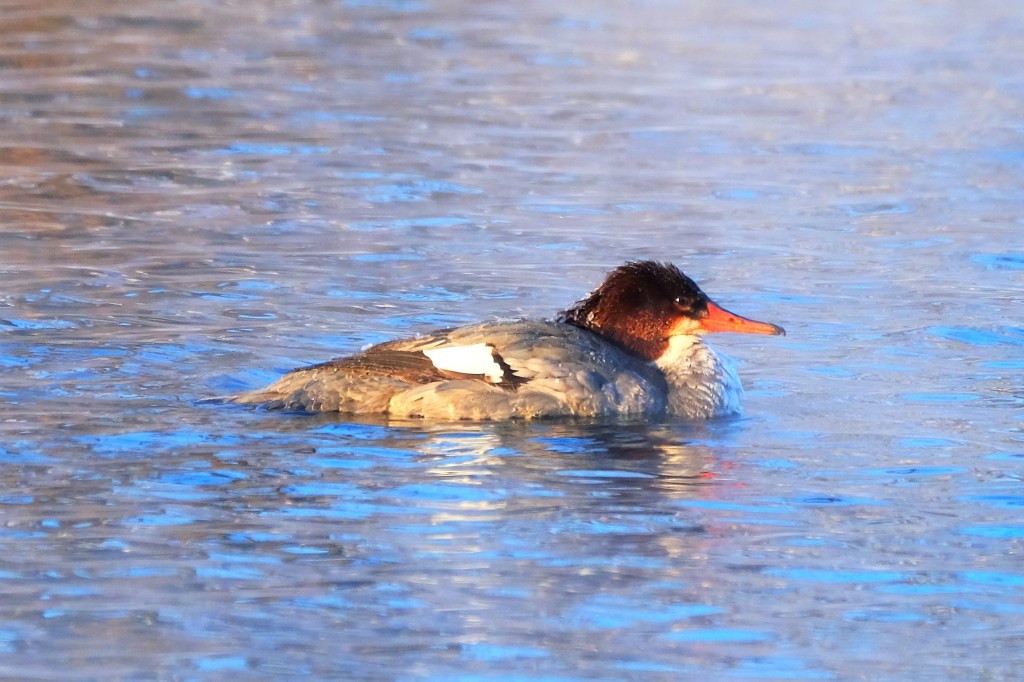
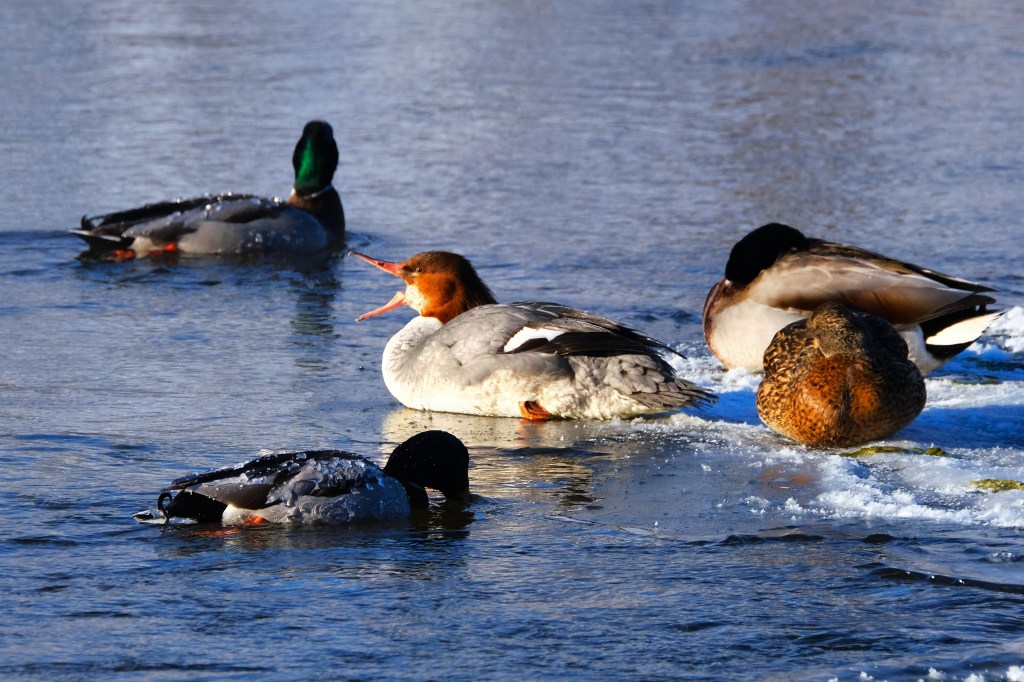
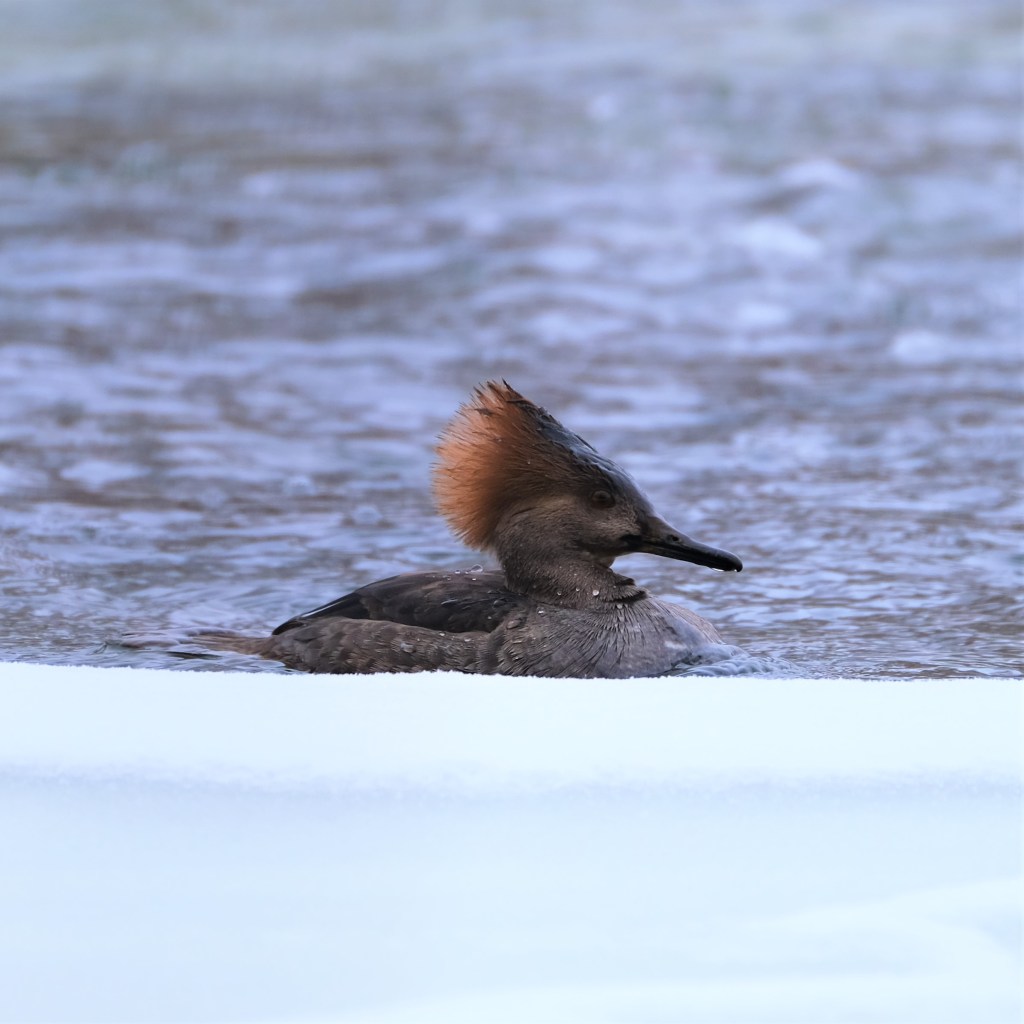
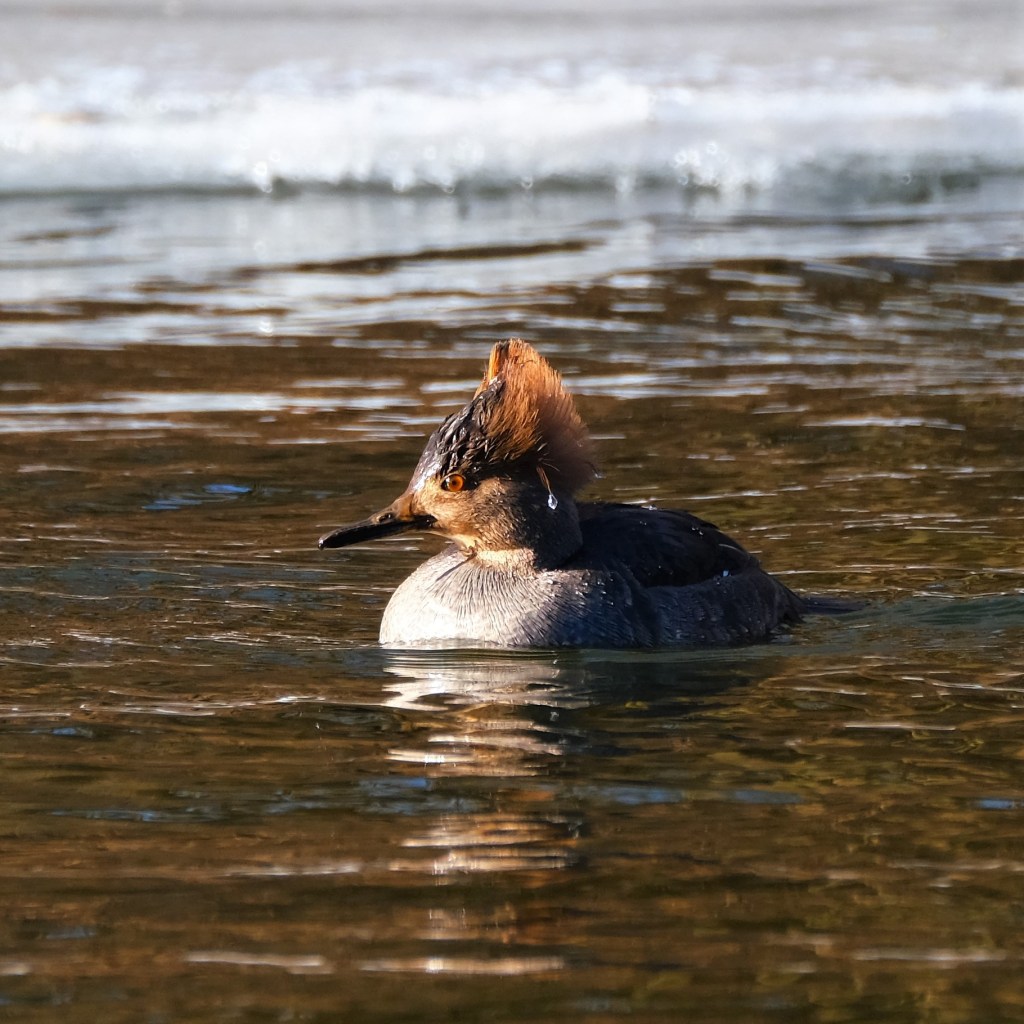
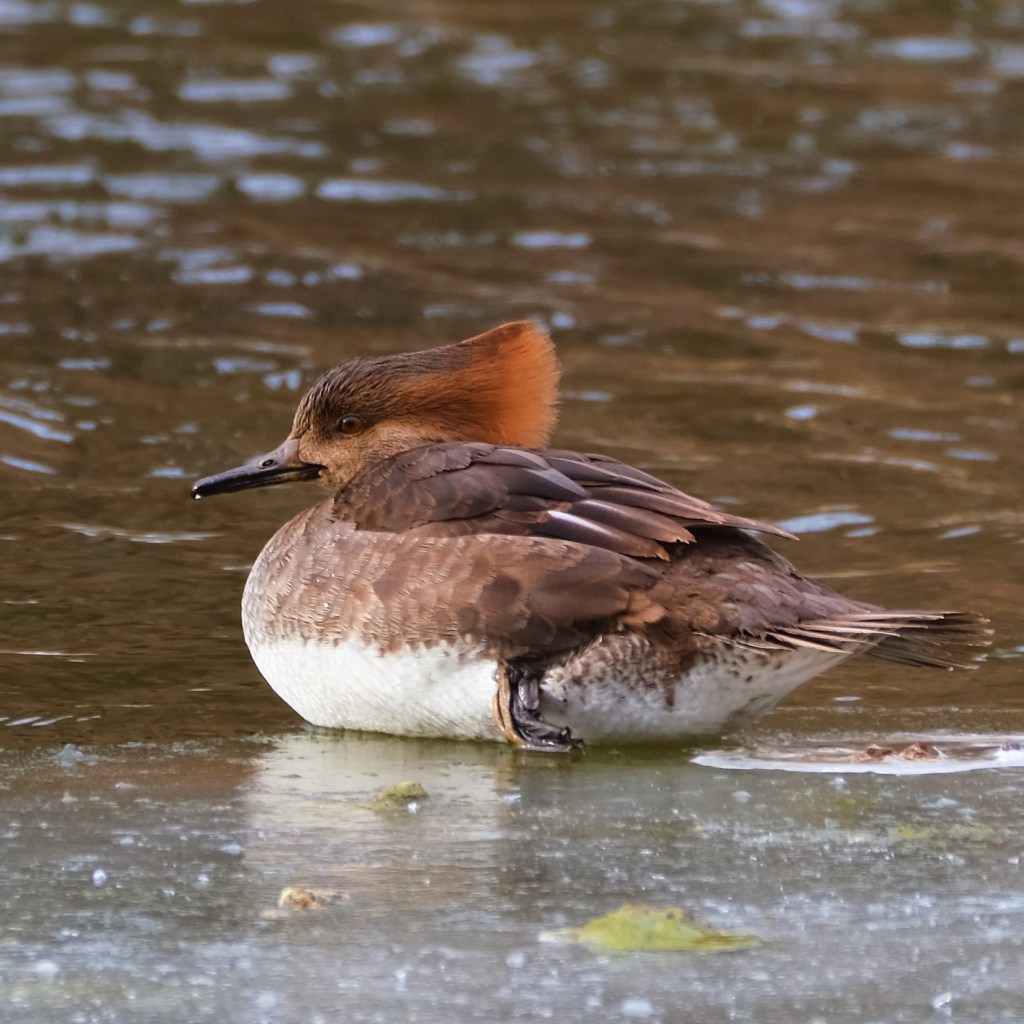
And a female hooded merganser, with quite the “hood” for a change, was busy fishing for crayfish, but I didn’t see her have any luck. Maybe that trio of youngsters ate them all a couple of weeks ago, but I hope not.

On shore, another young indigo bunting, with just a few hints of blue, was keeping tabs on me.

The big treat for me, though, was that there were more waterthrushes, and they were being way less coy than usual.

I’ve never seen one just stare me down like this before.

They’re on their way to southern Mexico or the rest of Central America, so maybe they were just super hungry.

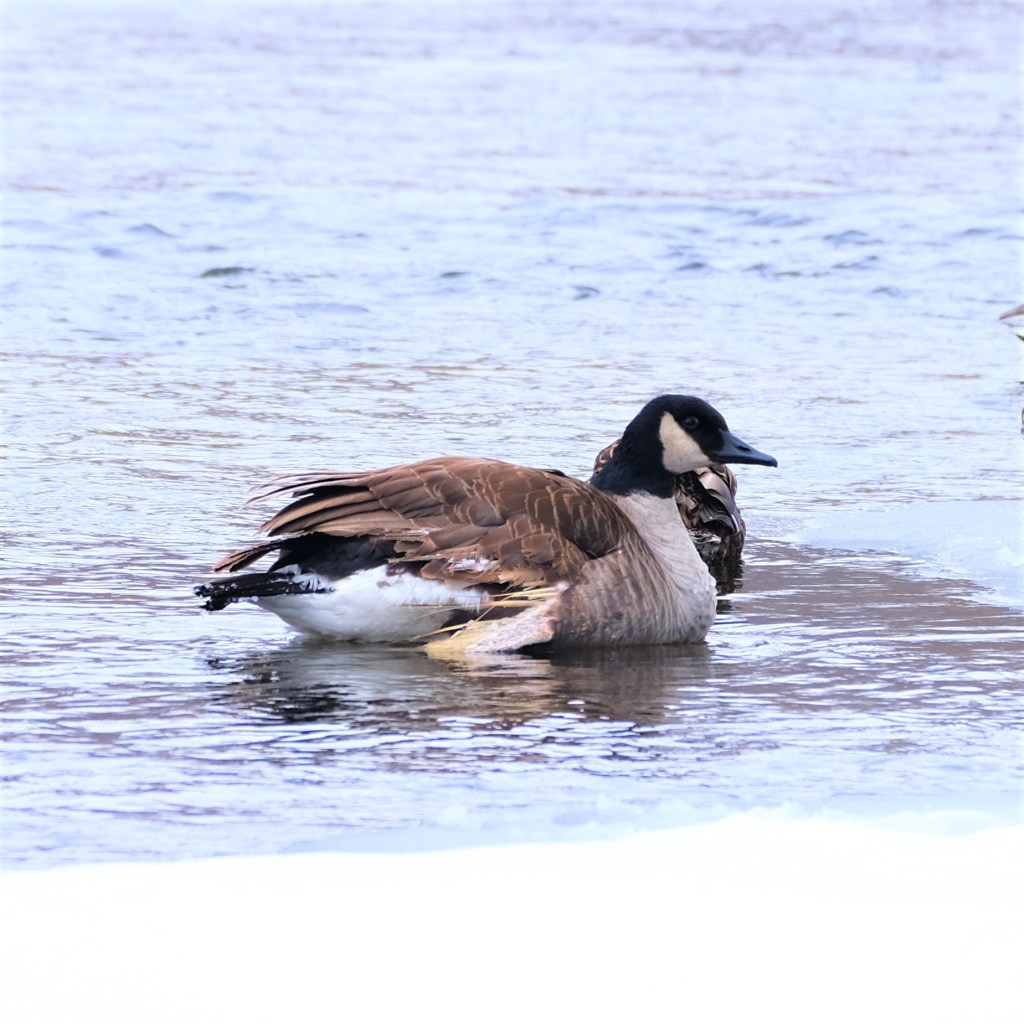
On my way back south along the river, I was happy to see our goose couple with three good wings between them still looking otherwise healthy. The injured one rested while the other foraged nearby with four others, and after I stood on the shore a while trying to compose the perfect picture, it came over to check in and maybe suggest that I just keep it moving, Buddy. Sure thing, Pal!

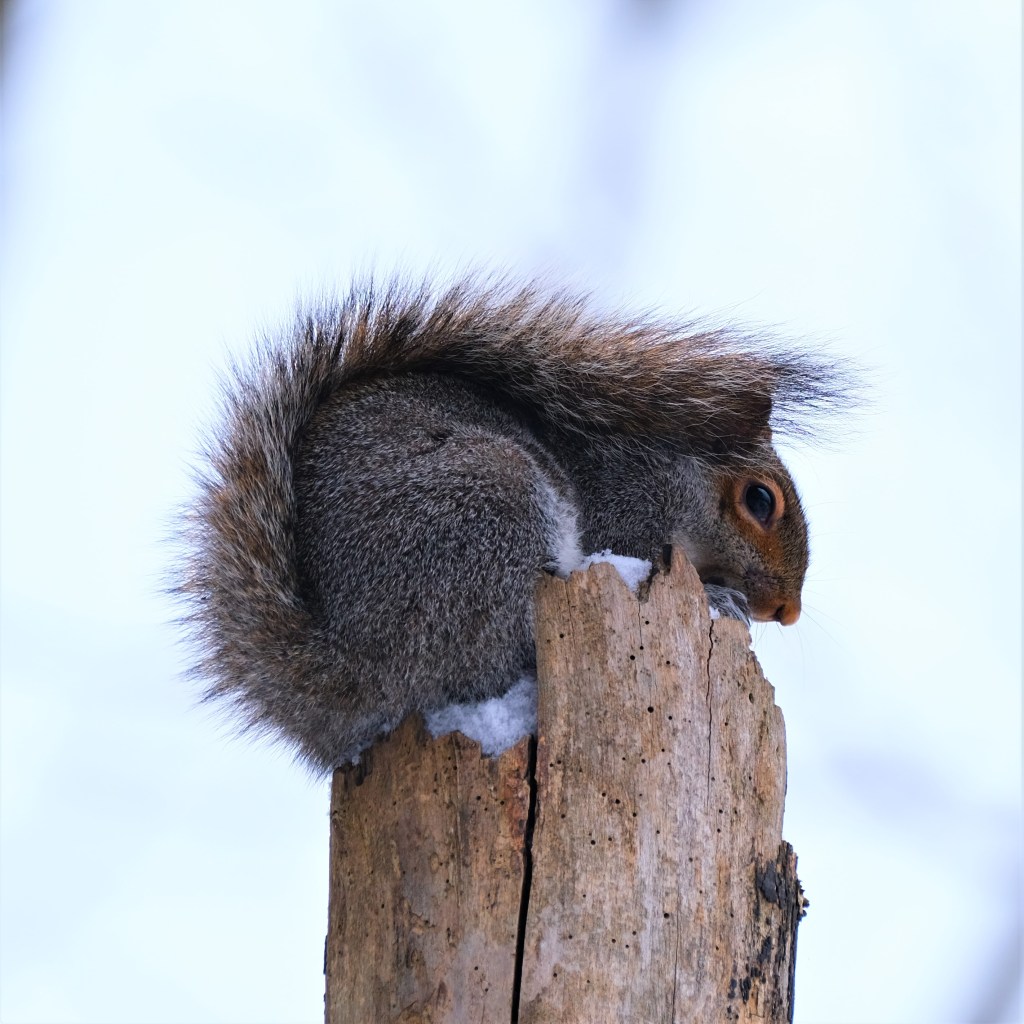
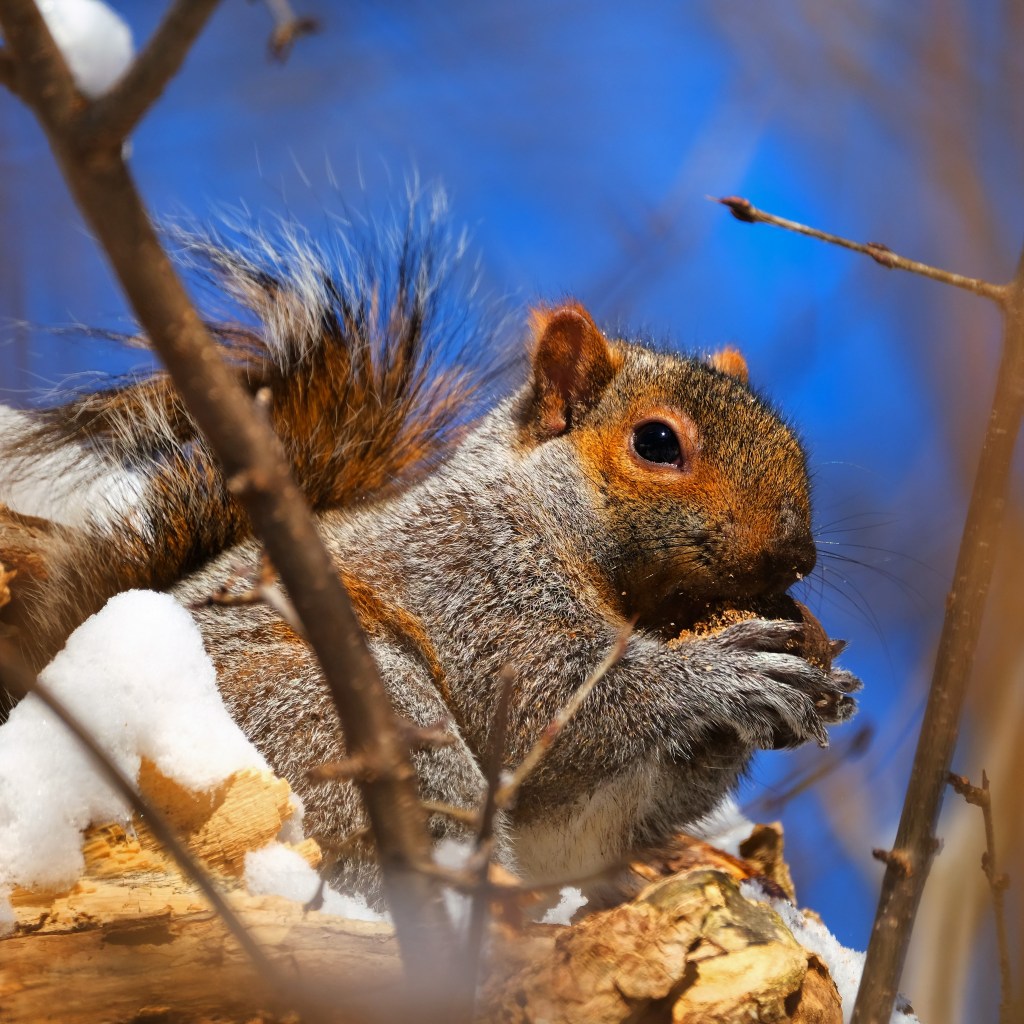
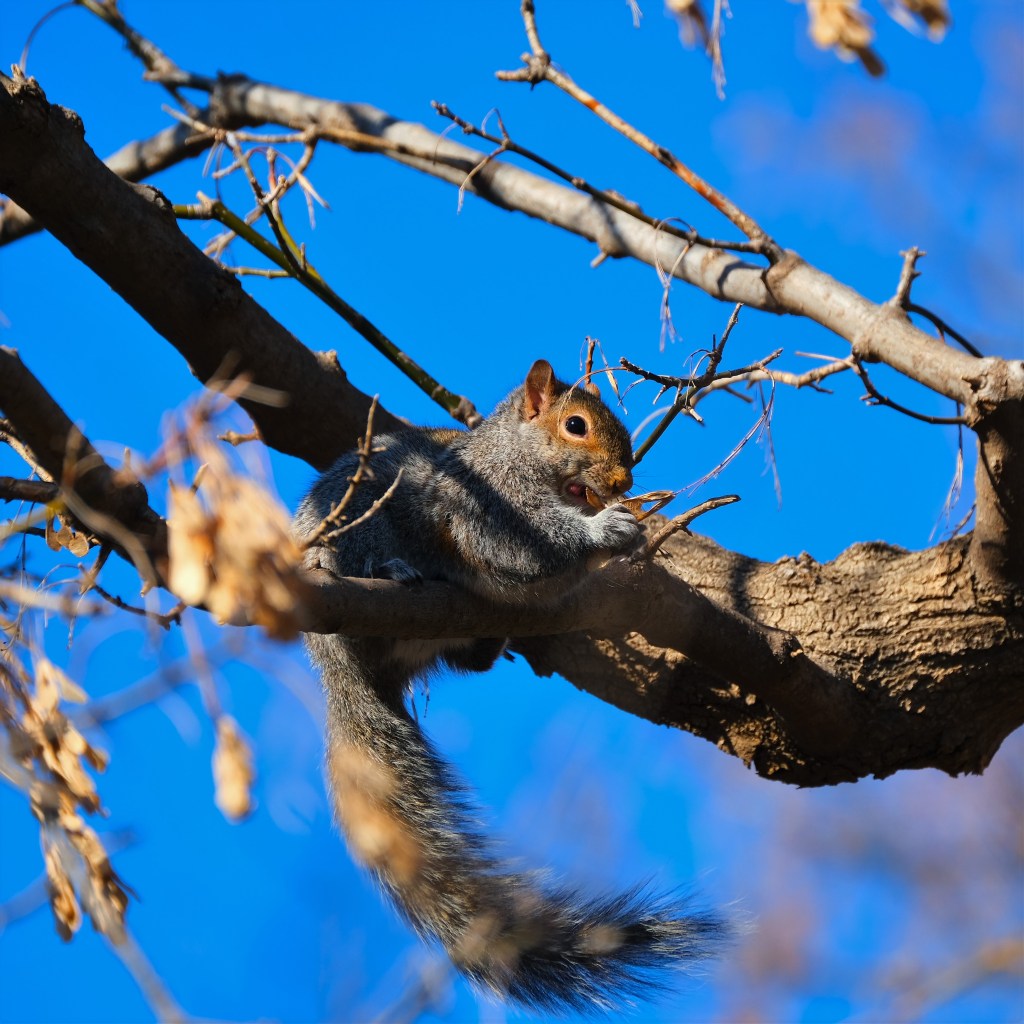
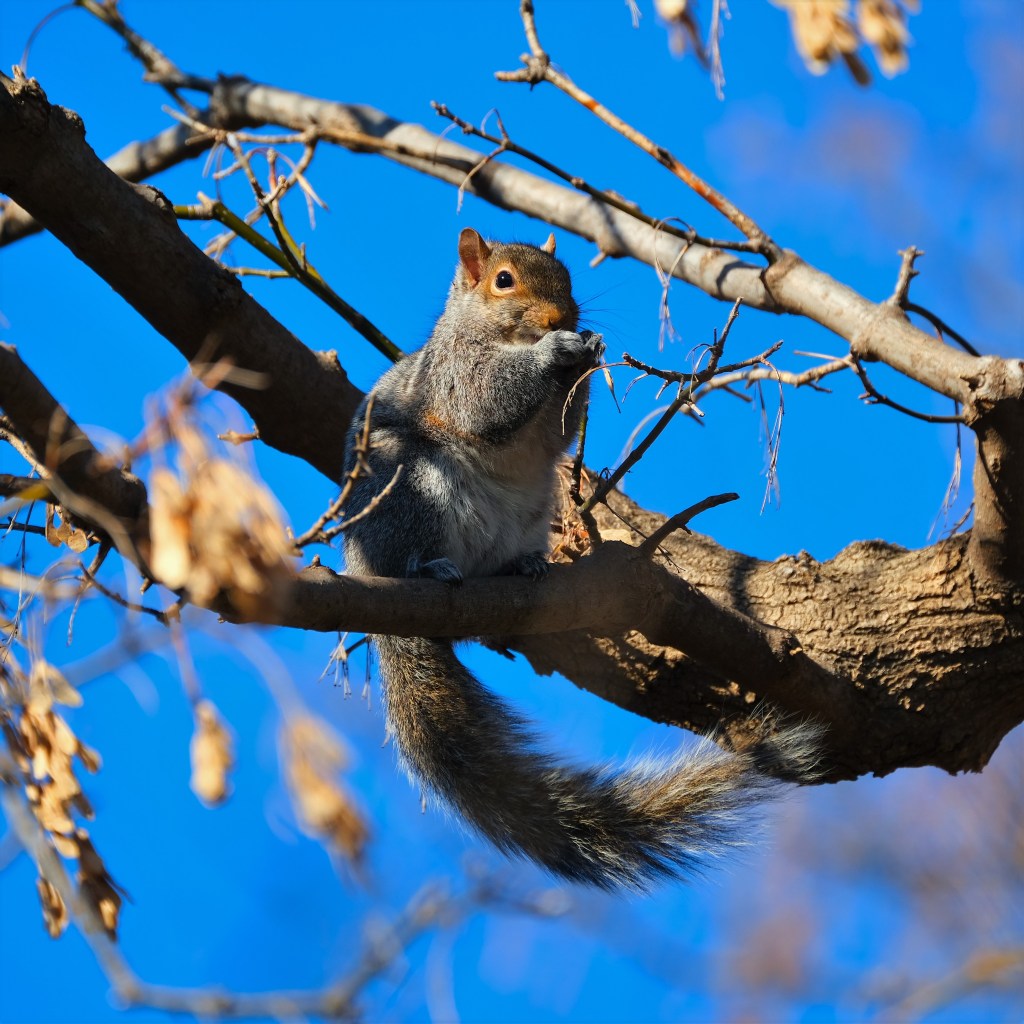
Finally, if you’ve been to the park lately, you know that the squirrels have a ton of nuts to eat or hide before the snow flies, and this one was doing its part.

As has been the norm lately, I got a ton of pictures this morning, and I won’t have time for the park tomorrow, so I saved a few to post then, so be sure to tune in to see who else was on the prowl today.

Lastly, the forecast for the Shorewood Fish & Feather Festival this Saturday is now “cloudy in the morning with scattered thunderstorms developing later in the day,” so if you’re planning on stopping by to say “hi”, and I sure hope you do, you might want to come earlier rather than later.

A swing back towards autumn

It’s not light out yet, but the forecast high temperature for today is 67°, so not so much like summer anymore. Plus, I’ve gotta go to school today, so here are some more pictures from yesterday.

Besides all the kingfisher antics, this great blue heron was having some luck of its own fishing on the river.

There was also a cormorant out there, and as I was trying to get a picture of the heron and cormorant together, the third kingfisher, who had caught the fish, photobombed the shot.

kingfisher mallard heron cormorant

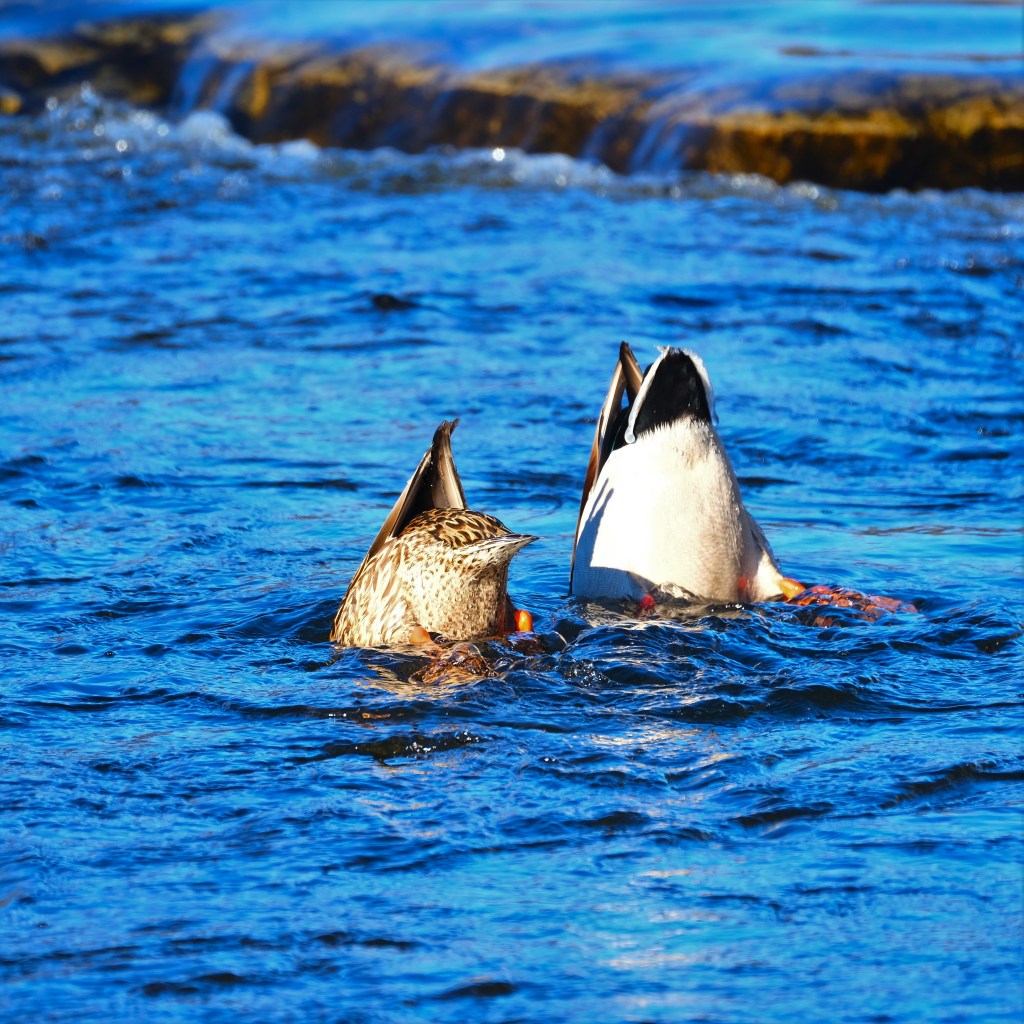
Unfortunately, the cormorant wasn’t ready, so here’s a better one of the cormorant with the heron and a bonus mallard hen, but without the kingfisher. It was a regular wild kingdom out there yesterday morning.

Meanwhile, back on shore, the little birds were keeping just as busy. Here’s another Lincoln’s sparrow, now that we know who they are.

Here’s another red-eyed vireo trying to rustle up enough calories to take it all the way to the Amazon.

On my way back south along the river, I found another yellow-rumped warbler with its bright yellow “rump” and just a hint of the yellow they are supposed to have on their sides.

This looks like another yellow-rumped warbler opting not to show us any yellow at all. What give’s, guys? That’s your signature move.

Here are a couple more acrobatic kinglet shots, just to keep the chickadees on their toes.

I finally had to tear myself away from the river and head inland, and that’s where I met this hermit thrush showing off its cinnamon tail, which the Swainson’s thrushes do not have.

Lastly, the pink-edged sulphur from yesterday also sampled some sow thistle.

At one point, things got crowded.

I think that’s finally all of them. Stay tuned for tomorrow when I get to go back to the park, and the forecast is for more cool and calm air with a bright sun and a blue sky. Perfection!

Another face we haven’t seen in a while.

It almost felt like summer again in Estabrook with temps starting in the 60s and quickly reaching the 70s under a warm sun and a picture-perfect blue sky.

The little yellow duckling was swimming around on the pond again this morning, along with nearly two dozen wood ducks, and here’s a handsome one.

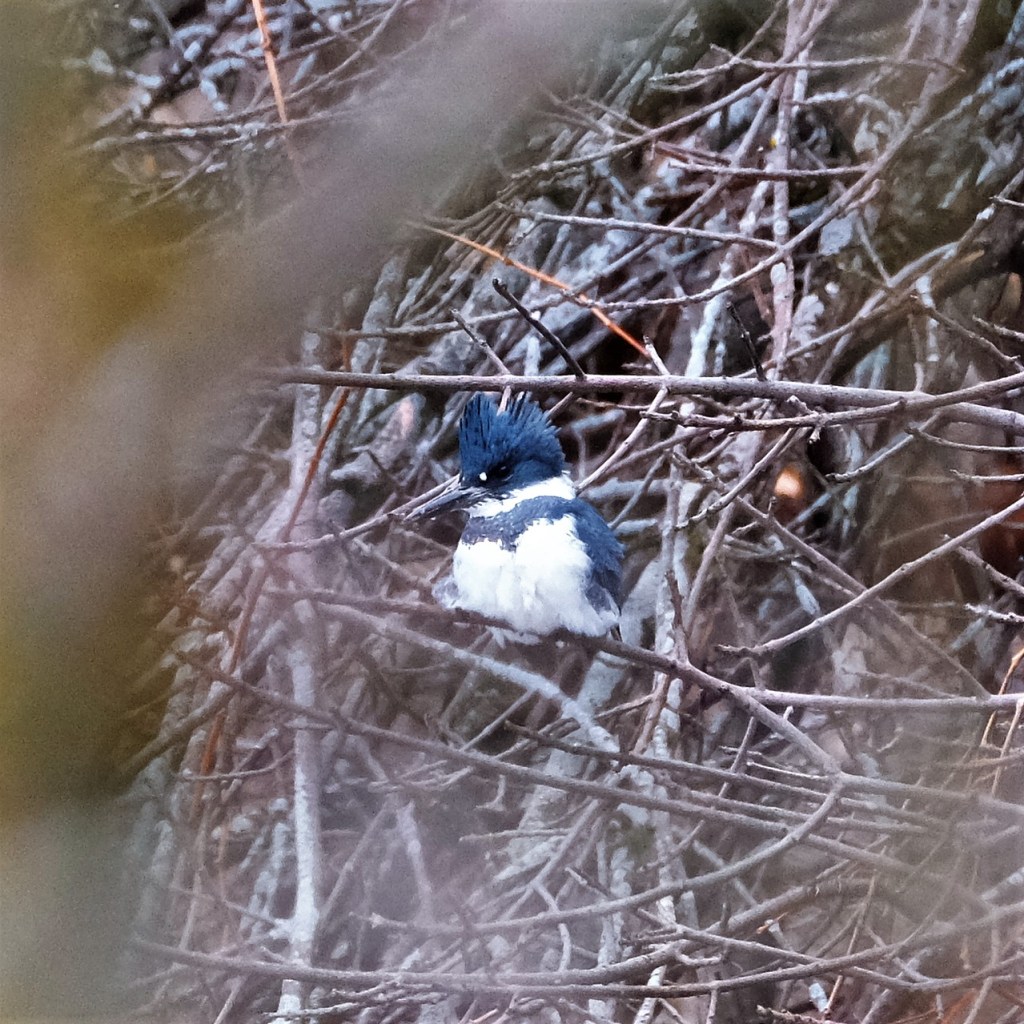
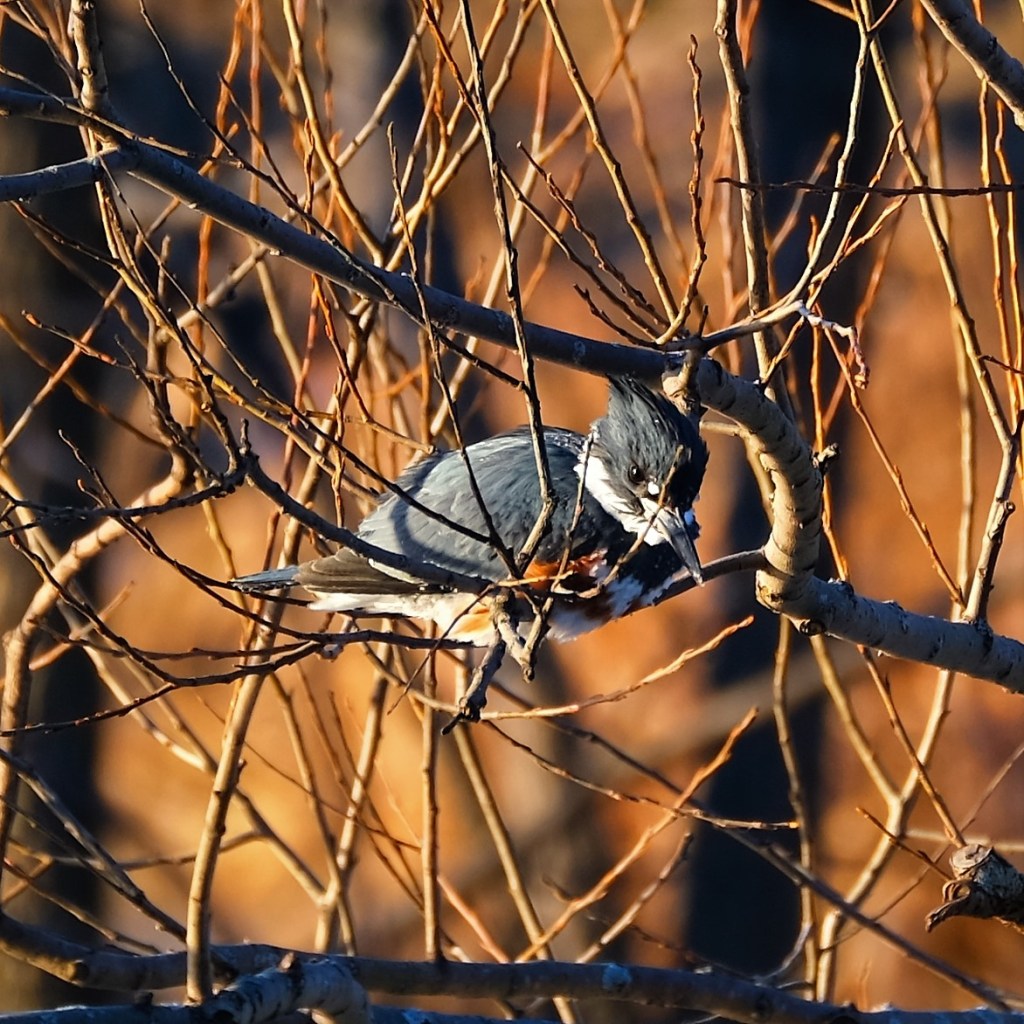
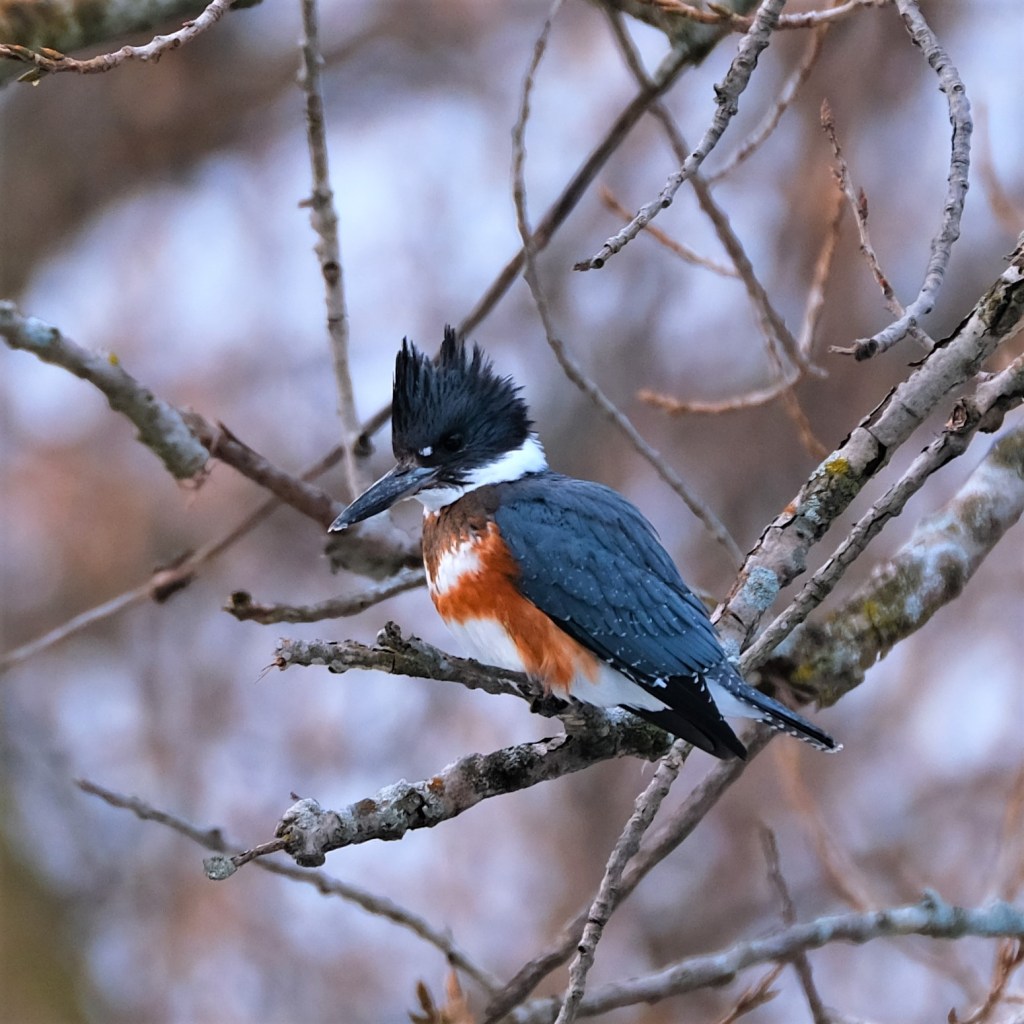
There were no herons or anything else new, so I quickly moved on to the river. At the north end, I spotted this male and female belted kingfisher having an animated conversation in the top of a tree over the island.

As I was watching that drama unfold, a third kingfisher caught a fish in the river and landed on this log to choke it down. First the kingfisher thrashed the fish a few times to subdue it.

And then down the hatch it went.

Meanwhile, back on shore, the little birds were getting their breakfasts, too.

A golden-crowned kinglet was too busy foraging to pose as nicely as the one last week, but it did take a moment to show us its golden-crown.

Here’s a dark-eyed junco just back from summering in Canada and already in its wintering grounds. You’re here, little buddy! Welcome back! You made it! Yay!

As I was doing my best to capture a decent junco image as they stuck to the shaded riverbank, a blue heron landed in a well-lit branch on the far shore.

About halfway between the north and south end, at the base of the stairs down from the middle playground and where the stream from the pond reaches the river, is a nice big and wide low area, and this morning it was really abuzz. The acrobatic chickadees were feasting on cutleaf coneflower seeds again, but I’ve already shown you pictures of them the previous two days. Instead, check out this pretty little Nashville warbler.

Without taking a step, I could also see this an “nonbreeding adult/immature” palm warbler.

And, just when I thought we might have seen the last of them for the season, here’s a green heron out on the river.

Finally, I stopped by the patch of asters I discovered blooming beside the Oak Leaf Trail yesterday to look for butterflies again, and there was just this sulphur today. The two spots and pink fringe suggest its probably a pink-edged sulphur, maybe the same one as before.

Lastly, since I’ve gotta go to school in the morning, and so many pictures came out presentable this morning, I’ve saved some for tomorrow. Check in then for the rest of what I saw today.

Lots of critters enjoying the weather…

It was another stunningly beautiful early autumn morning in Estabrook Park, and for reasons that it’s best I don’t get into, I skipped the pond and went straight to the river.

I didn’t even make it to the water before this chipper looking flycatcher, probably an eastern wood-pewee, caught my eye as it soaked up the morning sun.

Right below the pee-wee, so that I barely had to take a step, this female rose-breasted grosbeak helpfully showed us both sides to aid with our identification. What a sweetheart, eh?

Just around the corner, this chickadee was at it again.

And as I was trying to capture the full extent of the chickadee’s acrobatic prowess, this little chipmunk seemed to say, “sure, but who’s cuter?”

As I pondered that question, a movement caught my eye. Can you see who it was? Click here if you’re stumped.

Meanwhile, this bright red cardinal with a contrasting black ring around its beak scoffed, “disguises are for wusses!”

Phew! That’s a lot of action for 20 feet of trail. Luckily for me, things were pretty quiet from then on until I reached the north end. There, as I was trying to keep track of some darty little bird in a tree up ahead, I could hear something making a big ruckus on the water, and I turned just in time to catch this gorgeous sight.

When I mentioned big fish splashing in the water a week or so ago, long-time reader, Drew, wrote in to suggest salmon, so that’s my guess for today.

I had hardly returned my attention to the little bird in the tree when this majestic creature, who appears to be a red-tailed hawk, soared overhead.

I never did get a decent look at that little bird in the tree, but by then things had warmed up enough on the ground for the asters to be full of bumblebees…

and butterflies, like this green-eyed sulphur of some type. The two circles on its wings and hints of pink around the edges makes me wanna go with pink-edged sulphur.

On my way back south, the water below the falls was full of fly-fishing people, and so I was quite surprised to see this, usually very shy, great blue heron just above the falls and seeming to yawn in their direction.

I did want to check in on our new, yellow duckling, so I hiked over to the pond to find it alive, well, and sound asleep on the far shore.

While right offshore another blue heron stretched one of its huge wings.

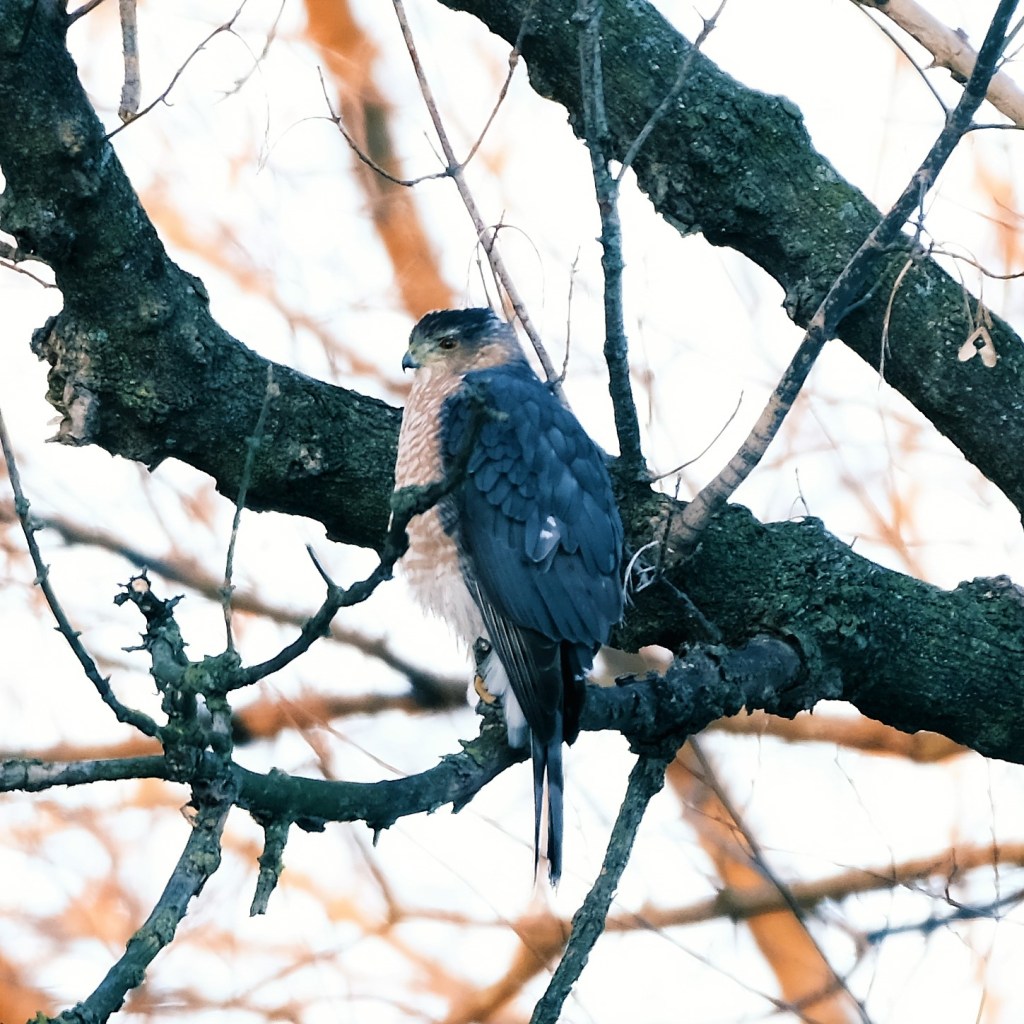
By then the farmers market was in full swing, so I headed down the Oak Leaf Trail to avoid the crowds, and I spotted another soaring raptor just across Wilson Dr. The picture’s not as good, so I’m including it just for completeness, but the prominent banding on its wings and tail, which you can still make out despite the blur, make me think that it’s a Cooper’s hawk.

Meanwhile, right at my feet, this tiny blue butterfly, which appears to be an eastern tailed-blue with its wing tails warn off, spread its wings to catch some sun.

Once again, I didn’t have to take a step to find another striking blue creature, this damselfly, who I believe is a common blue damselfly, aka common bluet, or northern bluet (Enallagma cyathigerum)

I know that’s a lot of pictures, but the forecast is for nice weather again tomorrow, so I expect even more pictures, and I’ve gotta get these out the door to make room. Plus, Tom assured me that I “never post too many pictures!” So here we are.

Oh yeah, before I forget again, one of my followers on instagram, chimed in on that sparrow I showed you on Friday and claims that it is an adult Lincoln’s sparrow, and sure enough, the pattern of gray, brown, and black stripes on its head matches. It ain’t from around here, and is just passing through on its way from the UP or Canada to the states along the Gulf of Mexico. Here’s our picture again, just to over do it, but remember what Tom said.

How you like them apples?

Saturday

From the comfort of my breakfast table, it looks like an absolutely beautiful morning out. The trees are still, the sun is bright, and the sky over Estabrook Park is crystal blue. My phone said it was 48° out at 6am, however, so maybe I don’t mind waiting for things to warm up a bit before I hike over for the Friends of Estabrook Buckthorn Weedout that starts at 9am.

Plus, I have all these pictures left over from yesterday’s excursion, so check out this great blue heron on the river at the north end right by the great egret I showed you yesterday.

Speaking of the great egret on the river, here are a couple of more shots.

Best of all, I received an email message already this morning from long-time reader and well-known super-sleuth, Mark, who saw it there again this morning. If you’ve always wanted to see one in the wild right here in Shorewood, today could be your day.

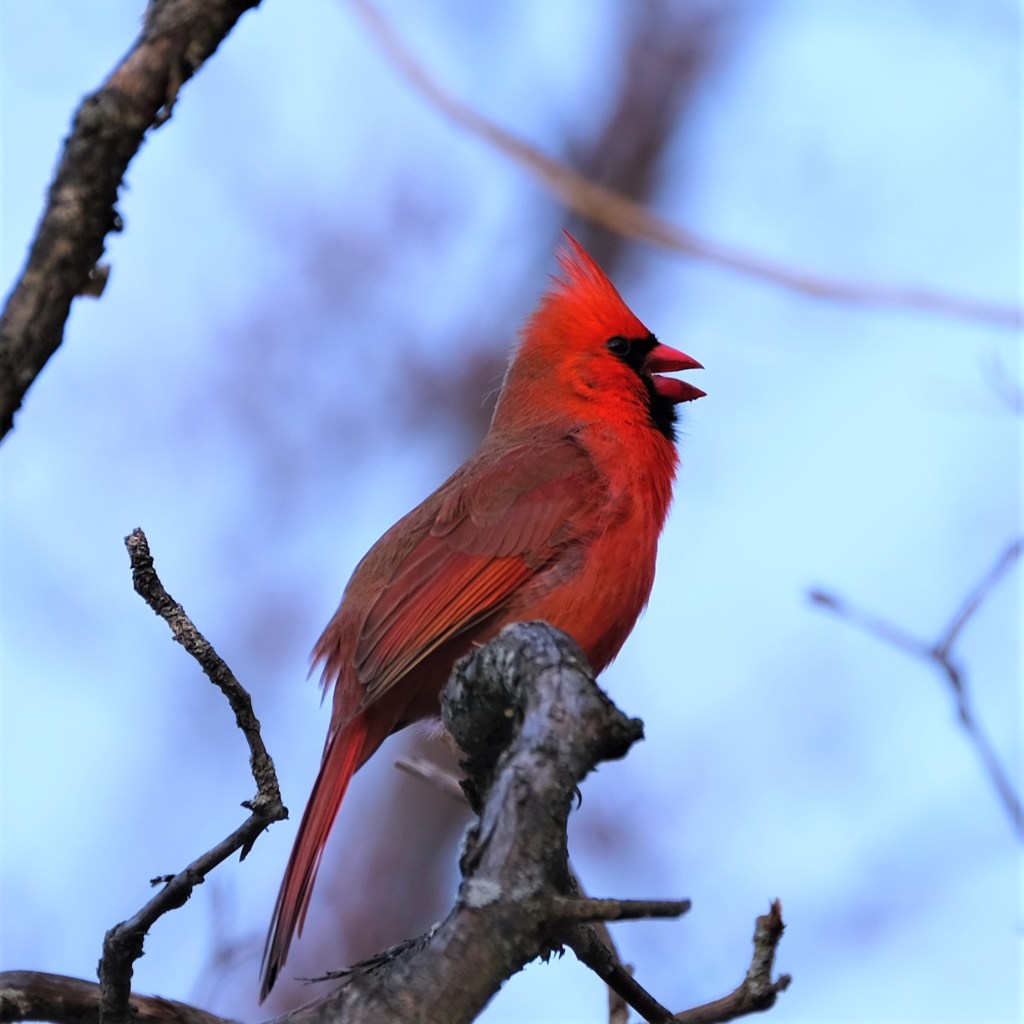
Here’s a northern cardinal looking quite dashing in it’s shiny new plumage at last. That must be a huge relief.

Here are a couple more shots of that pretty little bird from yesterday with a bright yellow patch on its lower back. Maybe a yellow-rumped warbler?

Here are a couple more shots of that amazingly acrobatic golden-crowned kinglet.

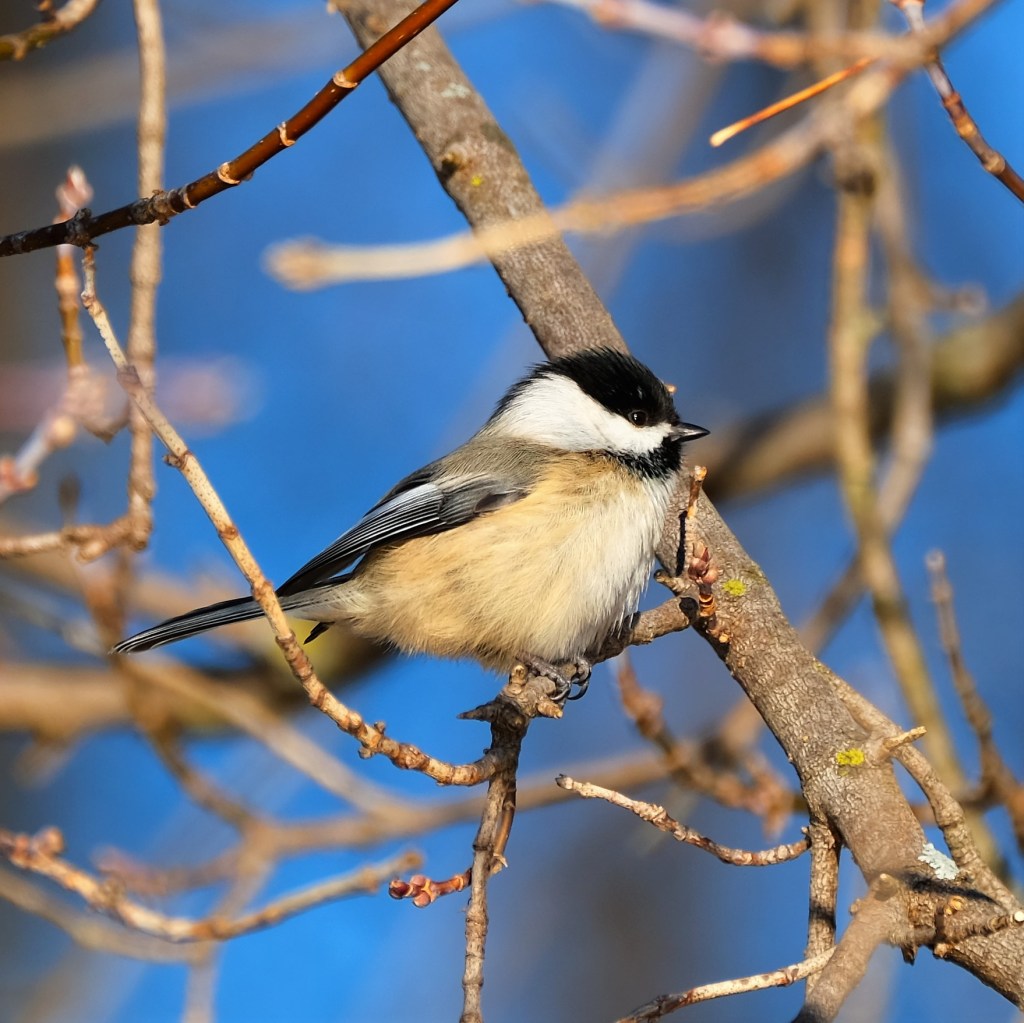
Just a bit farther along the river, this black-capped chickadee, asked “acrobatics? You want to see acrobatics? Watch this! I’m doing on stalks that sway like blades of grass what that guy’s doing on stiff little wooden branches. Who’s the acrobat now?”

And here are a couple more shots of that bright yellow female scarlet tanager.

Finally, like the dragonflies, the butterflies aren’t all gone yet. I did see a monarch yesterday and even have a picture of it on the lawn warming up in the sun, but this cabbage white on a small white aster, maybe awl aster, makes for a much prettier picture.

Lastly, that mushroom I showed you emerging from the grass on Thursday, which I actually saw on Wednesday, was opening up nicely when I saw it again yesterday.

Well, wish me luck at the weedout, and maybe I’ll see you there. If not this Saturday, then perhaps next Saturday, October 2, at the Shorewood Fish & Feather Festival in Hubbard Park from 11 to 3. I’ll be manning the Friends of Estabrook Park booth, and let’s hope the weather then is a nice as it is today.

Even more new faces!

Holy macaroni, what a fabulous fall morning in Estabrook Park! The cold, wind, clouds, rain, and even mosquitoes seem to have all departed, if only for this morning, leaving just birds, birds, birds,! And some squirrels and chipmunks.

The big surprise at the pond this morning was this little yellow cutie with a very pink bill that some person must have left there for us. Dr Google suggests that a duckling with such coloration might be of the domesticated but uncommon Aylesbury breed from the UK, of all places. It seemed to be contentedly swimming around and filling up on flies from the water surface, so no need to panic yet, I suppose, but it will be fascinating to see or hear what becomes of it.

The big surprise on the river was this great egret busy catching fish. I’ve only seen one of these magnificent creatures in Estabrook once before, and that was in the pond on Mother’s Day last year. The fine folks at the Cornell lab of Ornithology explain that “if you live outside of the species’ breeding range, [which their map suggests we do] you may still see Great Egrets in late summer as they move about widely before heading to their wintering grounds” on the Gulf Coast or “as far as the West Indies or southern Central America.

The egret was not the only fisher on the river this morning, and here’s a blue heron by the falls again.

I was afraid that all that wind yesterday would have blown all the warblers out of the park, and they’d all be sipping frozen piña coladas on the gulf coast by now, but perhaps the wind blew just as many in! Here’s one by the river that I’ve struggled to identify. It sure has a key marking of the yellow-rumped warbler, but none of the rest matches any pictures of them I can find, which all show yellow patches also on the neck and sides. Hmmm.

The rest of the bird looks like an immature pine warbler, but I can’t find a picture of a pine warbler with such a yellow patch on its lower back. Mysteries, mysteries…

This handsome devil, also by the river, appears to be a juvenile chirping sparrow an adult Lincoln’s sparrow. Thanks, Greg!

And here’s an old favorite from early in the spring, a golden-crowned kinglet being just as acrobatic as ever.

This one looks like a pine warbler wondering where the heck we keep the pine trees.

Finally, this one threw me for a loop at first because I didn’t factor in that she’s bigger than most warblers or vireos. Instead, as far as I can tell, she’s a female scarlet tanager, and she’s on her way “across the Gulf of Mexico” to South America.

Lastly, there are still dragonflies around, if you can believe it, and this striking one appears to be a white-faced meadowhawk (Sympetrum obtrusum)

Once again, I had too many pictures today for just one post, so I’ve saved some for tomorrow, which works out well because I need to be in the maintenance yard parking lot and ready to cut buck thorn with Friends of Estabrook Park by 9am tomorrow. Maybe I’ll see you there!

Travelers!

I’ve gotta go to school today, so no time to visit the park, but I was lucky enough to have too many pictures for yesterday’s post, so here are the rest now. You may recall that I had reached the north end of the parky, by the river where they planted flowers to restore the riverbank after taking out the Estabrook dam, and the birds were going crazy.

Usually, when I stumble upon a spot like that, where a few birds are chirping and flitting about, I have about 5 minutes, tops, before they have all magically drifted away, and I find myself alone with the empty trees. Yesterday, however, I must have enjoyed their company for a full 30 minutes, and they were still at it, hopping and flying from branch to branch and tree to tree, when I just couldn’t stay any longer and had to head back home. It was just incredible.

First up is this hungry red-eyed vireo, whom we’ve seen recently, and who is on its way perhaps from the southern shores of Hudson Bay all the way to the Amazon basin in South America. No wonder it was hungry!

Please, eat all the bugs you want and take some with you!

Next is a brand new bird for us, yay! It’s a blue-headed vireo (Vireo solitarius) with its blue-gray head, thick bill, “bold” white “spectacles”, olive-green back, yellow flanks, and white belly. That’s our fifth vireo, and it’s on its way from breeding grounds around Lake Superior to wintering along the Gulf Coast.

That’s it for the vireos. Now the warblers. First is this pretty little female or immature male magnolia warbler with gray head with white eye ring, yellow chin, faint gray band across its neck, dark streaks in a yellow breast, and two, narrow, white wing bars. It’s on its way from breeding grounds around Lake Superior to wintering in southern Central America or the Caribbean.

Say something funny here because you are boring them with all these details!

Here’s a non-breeding adult palm warbler looking relatively subdued and on its way from breeding grounds around Lake Superior to wintering along the Gulf Coast.

Here’s an immature male northern parula (Setophaga americana) with yellow chest, yellow-olive back patch, white eye crescents, and small, white wing bands. He’s on his way from breeding grounds around Lake Superior to wintering in Mexico, Central America, or the Caribbean. That’s our 17th warbler!

Here’s an immature blackpole warbler. pine warbler (Setophaga pinus), probably an adult female with pale yellow, a broken yellow eye ring, and two white wing bars. She’s also on her way from her summer breeding grounds around Lake Superior but only to the southern states along the Gulf of Mexico. That’s our 18th warbler!

Here’s a non-breeding male indigo bunting showing hints of his bright blue future and on his way perhaps from right around here to wintering areas from southern Florida to northern South America.

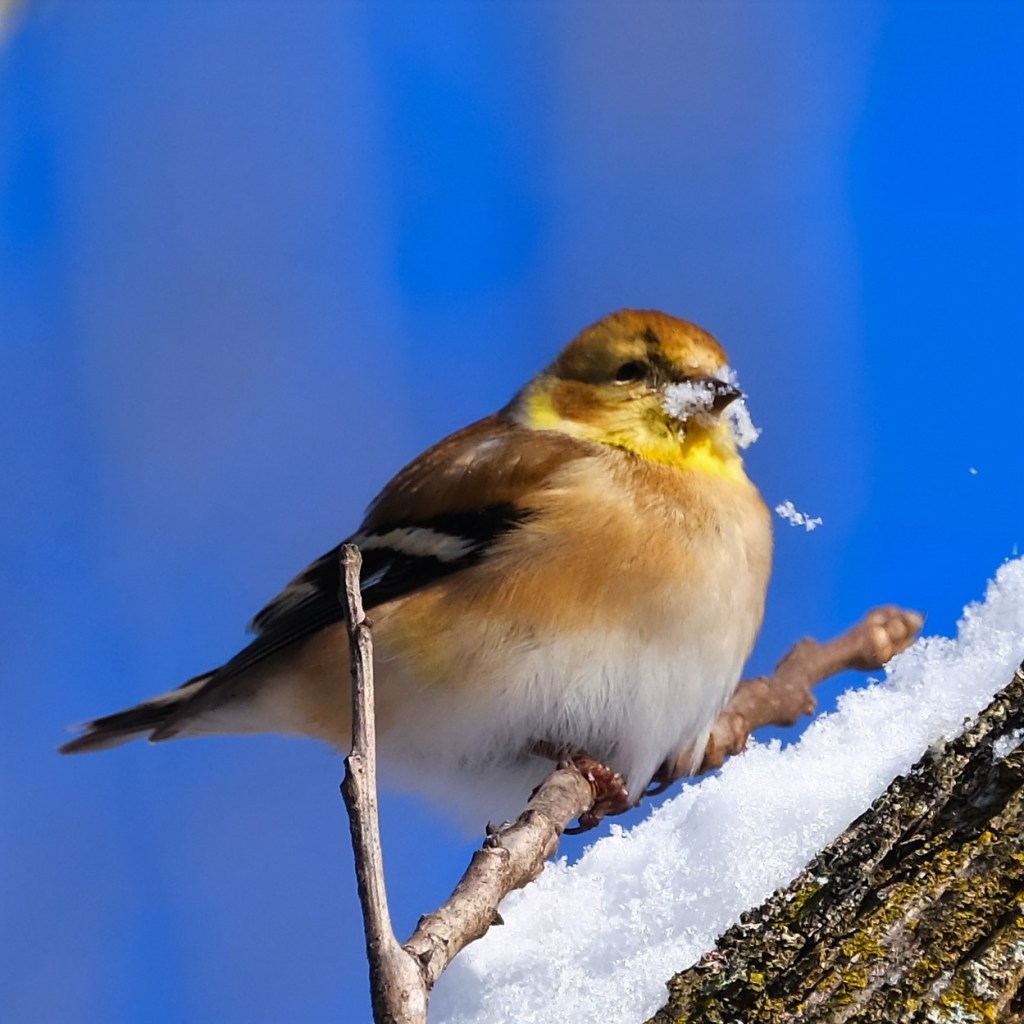
Finally, here’s an immature American goldfinch, who are often at that spot and who might stay right here with us through the entire winter.

Lastly, there are a bunch of new mushrooms up, and this one is at least three inches tall already.

Here’s a dryad’s saddle, aka pheasant back, mushroom that’s big as a dinner plate!

Phew! That’s a lot.

Before I go, here’s an announcement from Harold Schmidt, president of Friends of Estabrook Park.

FOE has a Buckthorn Weedout scheduled for this Saturday morning [, September 25] from 9 to 12.  We meet in the maintenance yard parking lot.  We need your help.  Attendees should wear long pants, long sleeves and sturdy footwear.  If you have favorite work gloves or a tool bring them.  Otherwise we can provide them.  Bring water.  Let me know if you will attend so that I can plan.

You don’t need to be a member to volunteer for the weedout, you can let Harold know at schmidhd @ yahoo dot com, and if you don’t manage to send Harold a message, I am sure it would be fine if you just showed up. I hope to see you at the weedout or at the Shorewood Fish & Feather Fest the following Saturday.

Autumn has arrived!

I needed a coat and hat this morning because Autumn is not messing around. Yikes!

There was a wood duck drake in full plumage on the pond again, trying to fit in with the regulars and perhaps get to know a nice hen.

Meanwhile our resident male wood duck ducklings are still going through some things.

Our sleepy, young night-heron was still in residence and trying to keep its eyes open, per usual.

And a ruby-crowned kinglet was back to foraging in the bushes at the north end.

I looked for our young sora, now that several folks have confirmed my ID, but didn’t see a sign of it this morning, so I hoped it was doing fine, and I headed to the river.

I was sure surprised to spot some dame’s rocket there still in bloom. I thought they’d all been replaced by asters by now.

Meanwhile, a cormorant was back to chillin’ out among the mallards on one of the “sand” bars.

A killdeer was back to foraging on the rocks and mud.

A hooded merganser was back to snoozing on a log.

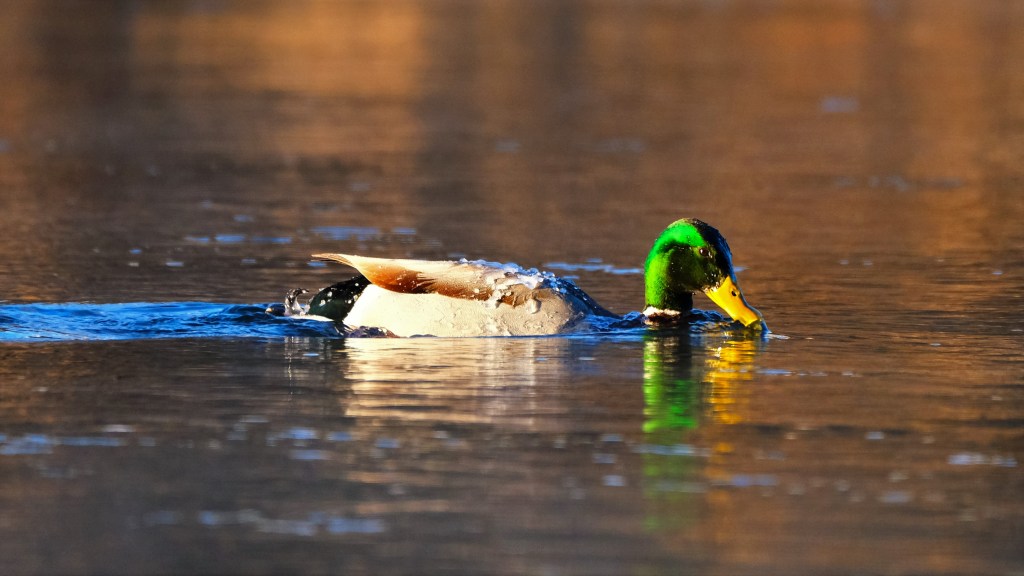
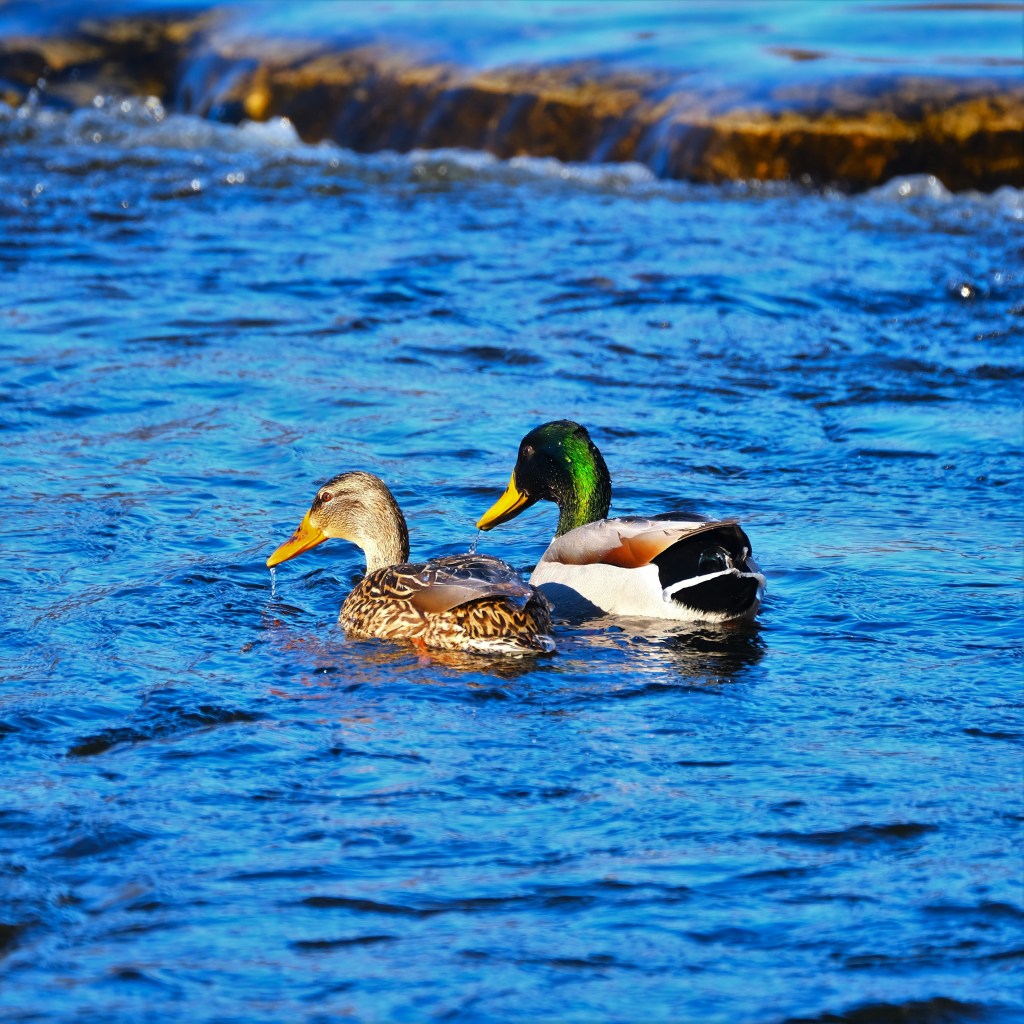
And the mallards on the water are starting to pair off.

Back on shore, where they planted flowers to restore the riverbank after taking out the Estabrook dam, the birds were going crazy. Usually, when I stumble upon a spot like this, where a few birds are chirping and flitting about, I have about 5 minutes, tops, before they have all drifted away, and I find myself enjoying the silence all alone. Today, however, I must have enjoyed their company for a full 30 minutes, and they were still at it when I had to head back home. Therefore, I simply have too many pictures to include today, so you’ll have to wait until tomorrow for the rest. Sorry! But here’s a sample, a white-throated sparrow in “tan striped” form posing perfectly on a birch tree branch, just to whet your appetite.

Before I go, though, don’t forget to mark your calendars for the Shorewood Fish & Feather Festival in Hubbard Park on Saturday, October 2 from 11 to 3. I’ll be manning the Friends of Estabrook Park booth, and I’d love to see you there.

A new face at the pond…

It wasn’t raining when I got up this morning, but it stayed pretty dark, so I took my time getting to the park in hopes that the forecast “partly cloudy” would come true. Well, it sure didn’t, and it even rained a bit, but the pond was hopping anyway!

I counted at least 15 wood ducks, and here’s five of them trying to perch on a log big enough to hold three of them, maybe.

Here’s a young male on a sturdier perch and really starting to show his colors.

Plus, there was a blue heron…

The young night-heron sleeping…

And a fishing green heron for the trifecta!

Most amazing sight of all, however, is this poor little guy huddled right on the path that goes around the pond. It’s about the size of a robin, and I first thought it might be a young starling but look at the size of its foot! The small wading birds around here that it could be include Sora (Porzana carolina), but their beaks look yellower in all the pictures I can find, and Virginia Rail (Rallus limicola), but their beaks are markedly longer, so I’m a bit stumped at the moment. If you can help sort out who this is, please drop me a line.

Right after I took this picture, I put my camera way and tried to get close enough to help it off the path, at least, but it wasn’t having any of that, and it got up on its own long legs and ran into the thick brush under the big oak tree. As I looked into the brush to check on it, it got up again and scampered farther in. So, the good news is that it is strong enough to run, it is now in a good hiding place, and let’s all hope that a parent is nearby to find and take care of it.

Phew! After that, I check in on the river, of course, and there was the usual contingent of mallards, a few geese, and one blue heron. The only picture I got is of another white-throated sparrow.

It’s raining pretty good now as I sit here typing this, so that’s all the pictures for today.

Familiar faces and a new sight or two

The way the beautiful weather has been repeating itself, it almost feels like I should be waking to the sounds of “I’ve got you babe,” but in the last part of the movie when he’s happy to get up and face the day.

Anyway, I beat the other old guys with cameras to the pond today, so I had the green heron all to myself.

Plus, all the young wood ducks…

and this pair of mallards, the likes of whom we haven’t seen on the pond in months.

Luckily, Lisa came along soon enough to point out the young night-heron in a new spot at the north end for a change.

The little birds were quiet, though, so I headed to the river to see if it was still as active as yesterday. Well, it wasn’t quite as energetic, but there were still some faces we haven’t seen in a while and another sight I haven’t seen before.

One new face for the season is this handsome killdeer busily foraging among the stones in the river. It’s only gotta make it to southern Illinois to get through the winter, so it’s got plenty of time to hang out with us.

Another is this white-throated sparrow with just a bit of yellow between its eyes and beak and fresh in from upstate. We’re already in its winter range, so maybe it’ll stick around until it’s gotta head back north in spring.

And here’s the sight I’ve not seen before, a squirrel taking a sip from the river.

I could hear and catch some glimpses of Swainson’s thrushes, but no pictures today, and I don’t think I caught even a glimpse of a warbler or vireo. Maybe the winds were favorable last night, and they all took the train south while the going was good.

Happily for us, some of the coolest sights are stationary, and here’s one of them. These appear to be sulphur shelf or chicken of the woods mushrooms (Laetiporus sulphureus), but please don’t eat them based just on my opinion! They’re big, too. Each semicircle is about six inches across, or more.

Lastly, as you probably realize by now, I’m a sucker for New England aster, and the honeybee on this one made it darn near irresistible.

Well, the forecast is for showers tomorrow morning, so maybe my alarm clock will play a different tune. We’ll see soon enough.