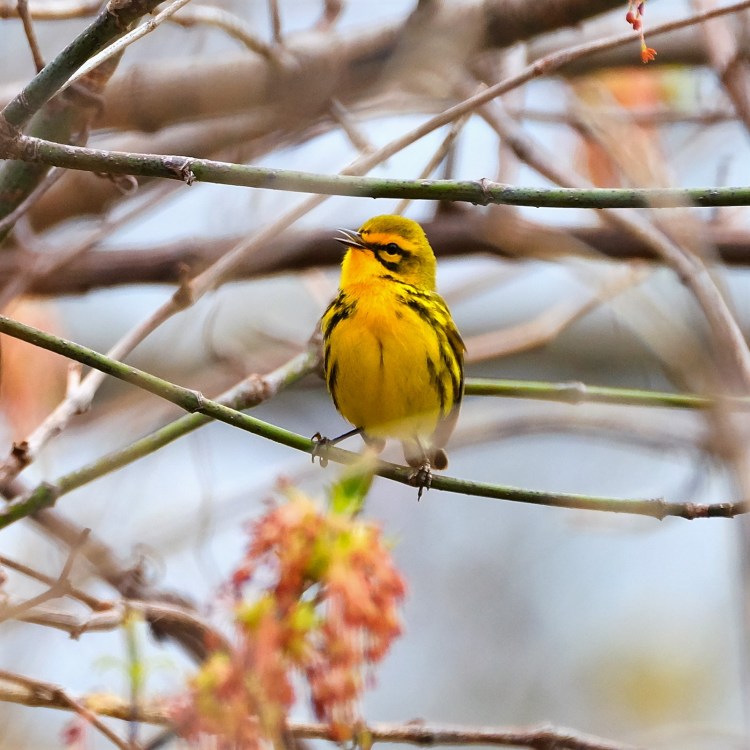
Here’s my best picture of the amazing prairie warbler that visited Estabrook Park for a few days back in May, 2022. He made me work hard for this picture and then seemed to get bored with the game and just started singing.
Here’s a violet-green swallow from Craters of the Moon National Monument and Preserve in Idaho, also in 2021. I had never heard of such a creature, and I could barely believe my eyes when I got a good look at it.
As I mentioned yesterday, I’m on the road again today, and to tide you over here’s a barred owl I saw in Glacier National Park back in 2021 on a hike up to Avalanche Lake, another great trip planned by Anne. It is my one and only barred owl and the only time, so far, that I saw an owl flying, watched where it landed, and could capture a picture of it where it perched. Truly a magical moment.
Oof, the sky was, and as I write this still is, dark today, but critters gotta eat, so I managed to take some pictures anyway, even if they’re a bit dark and moody.
There was quite a crowd of wood ducks on the pond, I counted eleven, and this drake appears to be sporting the new fall line already.
I was happy to see that not all the sandpipers have already left for warmer waters, and here’s a nonbreeding/immature spotted sandpiper, who’s spots have not yet arrived, foraging on the rocks at the top of the falls.
At the north end, there was even a killdeer foraging on the vegetation that grows in the river and is now exposed by low water. I also saw two fly over, heading southwest, and they exchanged a few calls with the one below, but they decided not to join forces and continued on their way.
I was happy to see that we still have wood ducks on the pond, and I counted six of them today. Here is a drake, on the left, and a hen, on the right, acting like an old couple on the outs.
On the river, I was also happy to see that the green herons have not yet flown south, either.
The great blue herons do stick around for the winter, and this one looks like it’s soaking up sun while it can.
We even still have a great egret, taking a break from fishing to scratch an itch.
As another enthusiast and I were watching the black chestnut trees for warblers, we were both quite sure we saw a pair of ketrels chasing each other as they soared overhead. Then, when I returned my attention to the river, I was excited to see that one had landed on a tree on the island. Upon closer inspection, however, it is clearly a juvenile peregrine falcon, and not one of the kestrels we were sure we saw. Plus, it’s sporting some nice jewelry.
Well, hold onto your hats, because the second raptor is neither a falcon or a kestrel, but a merlin, instead. Ach du lieber! I surely have not seen a falcon and a merlin in the same tree before.
After all that excitement, I returned my attention to shore, and look who stopped by to fill up on some of the goldenrod that is in blossom everywhere now, a monarch butterfly.
Now that was a fine welcome back to Estabrook Park, eh?
On our last morning in the Amazon, at Antonio’s Lodge, I had sort of a magical moment in which I just kept seeing one new bird after another. The previous morning, I had parked in the observation tower they have, in hopes of seeing birds at eye level or below, and I did see that hummingbird and the orange-winged parrot from there, but not much more. Walking around on the ground instead seemed to expose me to a lot more, even though I had to contend with a light sky background.
The first bird to catch my eye was this amazing green-backed trogon (Trogon viridis), and I couldn’t believe how nicely it posed. I had never even heard of “trogons” before. Have you?
This chestnut woodpecker (Celeus elegans), our third woodpecker of the trip, was energetically picking fruit from this tree nearly the whole time, and it was often half buried in leaves or branches, but not always.
When I spotted this stunner, I thought it was another blue dacnis, which we first saw just yesterday, and I even logged it as such. It was only in the process of sorting through all the pictures in order to write these posts, however, that I realized it was a completely different bird, a spangled cotinga (Cotinga cayana), and not even in the same family as the dacnis, though they are both passerines. Note that the color reproduction in my image may look fake or pushed too far to overcome the backlighting, but it is pretty accurate, and the Pedia of Wik describes them as “bright turquoise-blue with a large deep wine-red throat.” You can check out the ebird picture here for reference.
As if the green-backed trogon above wasn’t enough trogon for one day, check out this Guianan trogon (Trogon violaceus) sporting a yellow eye-ring instead of white. It too has a yellow belly, that you can just see a corner of, but it didn’t want to flaunt it.
This next bird, a chestnut-bellied seedeater (Sporophila castaneiventris), was the last bird I photographed that I knew was new to me at the time. After the “cotinga incident”, however, I should probably comb through all my pictures again, to see what else I might have missed, but not today.
Instead, let’s just enjoy another glimpse of a turquoise tanager from that last morning, …
a fun look at a female silver-beaked tanager digging breakfast out of a local fruit, and …
Even if I don’t find any new birds, I still have a few other pictures to sprinkle into future reports, but this concludes the Brazil-heavy portion of our program, for now. Thanks to Anne for planning the whole adventure and making it possible.
I couldn’t make it to Estabrook Park again today, so that means more room for Amazonian wildlife. As I mentioned yesterday, we traveled back to Manaus from the Dolphin Lodge, where we spent the night, and the next morning we started the four-hour boat-car-boat trip to “Amazon Antonio’s Lodge”. While the Dolphin is south of Manaus and not on true “black water“, Amazon Antonio’s is northeast of Manaus and is supposed to be on true “black water“. One big takeaway was that Amazon Antonio’s was not supposed to have any of the mosquitoes that Dolphin lodge had, which wasn’t too many anyway, and I’ve experienced way worse in Waterford, WI. A big visual difference was that there were no floating mats of vegetation around the trees growing out of the water and even white, sandy beaches in some spots.
Anyway, the wildlife was amazing but different. Let’s get to it.
Right away after we arrived, I spotted this stunner skulking about in the foliage over the bank down to the river, and he turns out to be a blue dacnis or turquoise honeycreeper (Dacnis cayana), I can also see a female in some of the images, but I wasn’t aiming at her, so they didn’t come out as nice.
On our second day at Amazon Antonio’s, our guide took us on a long hike deep into the forest. A big surprise was how much the forest changed as we got away from the river. Once we moved beyond the sandy riverbanks, which didn’t support tall trees, we came to small rolling hills covered with the kinds of tall trees we had seen at the previous lodge, and that’s when we spotted our second woodpecker of the trip, a yellow-throated woodpecker (Piculus flavigula)
We eventually reached a campsite with a nice clearing, little waterfall, and pool where our guide cooked us lunch. The soil in the clearing attracted a lot of butterflies, and here’s a trio of Florida or tropical whites (Appias drusilla).
Once we hiked back out to the lodge on the river, I finally got the best picture I was gonna get of this majestic-looking yellow-headed caracara (Milvago chimachima), seemingly saying to the fork-tailed flycatcher, “whadda you doin’ in my tree?” Since we had arrived at Anotnio’s, I had seen at least three individuals, perhaps a fledged family gliding from our shore to that tree and back, but I could not get a good picture, and this will have to do.
Here’s a couple of blurry pictures of a caracara snatching an eel or snake out of the river near the Dolphin lodge.
Estabrook Park eluded me again today, but I believe you know the drill by now.
On our last day at Dolphin Lodge, we visited another nearby family, and this one had befriended a white-throated toucan (Ramphastos tucanus) so that it stuck around. Thus, I was finally able to get a portrait of this amazing creature.
We’d been seeing these cuties, white-winged swallows (Tachycineta albiventer), swooping just above the water surface ever since we arrived a Dolphin Lodge, but I wasn’t able to get a decent picture until the last day.
As we were returning from our last boat excursion, and the sun was getting low in the sky, so around 5:30pm, I got crazy lucky to spot this yellow-tufted woodpecker (Melanerpes cruentatus) on the dark side of a dead tree trunk. Fortunately, by then, the guides were familiar with my shenanigans, and so they quickly slowed the boat and gently drifted us toward the bird so I could get this image, which is good enough for a positive ID. Woo Hoo! Our first woodpecker.
At some point on that last day, I found this tiny mystery hummingbird taking a sun bath, and it never moved enough for me to see any more of its plumage. The best google image search can suggest is a couple of birds that are native to Asia and have never been sighted in South America. Oh well. “Your secret is safe with us, Sweetie.”
Eventually our time at Dolphin Lodge came to an end, and on the trip back to Manaus, which required 4 boats and 4 automobiles, we saw a great egret (Ardea alba), …
my very first anhinga (Anhinga anhinga), which I thought at first was a cormorant drying its wings, as we’ve seen the do in Estabrook, but then I zoomed in and saw the light brown neck and head. Cool. I read that they are also called snakebird, darter, American darter, or water turkey, and anhinga comes from “the Brazilian Tupi language and means ‘devil bird’ or ‘snake bird'”, which is said to come from the fact that “only the neck appears above water” when they swim “so the bird looks like a snake ready to strike.”
Before we say goodbye to the Dolphin Lodge, here’s one more visitor to the dining hall screen, one of the leafwing butterflies, genus Zaretis, but I really can’t tell which one.
I couldn’t make it to Estabrook today, despite the nice weather, but I’ve still got plenty of Brazil pictures, so let’s dive into those. These first six pictures I took while just wandering around the Dolphin Lodge grounds, either before or after breakfast.
Here’s a female silver-beaked tanager, on the left, with a big green grub in its beak, and a youngster on the right begging to be fed. The females and young are a lot redder and have all black beaks.
While we’re on tanagers, here’s a palm tanager (Thraupis palmarum). They were not quite as bold as the silver-beaks, but they were a lot less flighty, so it was easier to get a nice portrait.
Speaking of close cousins, here’s one of the four king fishers native to the region, and the only one of which I managed to capture an image, a ringed kingfisher (Megaceryle torquata).
This next bird is more like a sibling than a close cousin. The house wren (Troglodytes aedon) “occurs from Canada to southernmost South America, and is thus the most widely distributed native bird in the Americas.” There are, however, “32 recognized subspecies,” with the northern house wren, Troglodytes (aedon) aedon group in Canada to southern United States, and the Southern house wren, Troglodytes (aedon) musculus group in southern Mexico, Central and South America.
Finally, what would a trip to the Amazon be without seeing a tarantula, eh? Well, here’s ours.


 Signs of Life in Estabrook Park