Our wifi is out, so I’m borrowing some, and I gotta make this short. There were a ton of birds in Estabrook Park this morning, but the clouds were extra thick, so there wasn’t much light, and the good pictures were few and far between.
At the pond, I was stunned to find not a single goose or duck, probably for the first time since the pond was frozen over, but there was one green heron, and it looked no happier for the solitude.
Here’s a goldfinch enjoying some dandilion seeds.
At the north end, the indigo buntings were singing like crazy, but still in no mood for pictures, so here’s a least flycatcher.
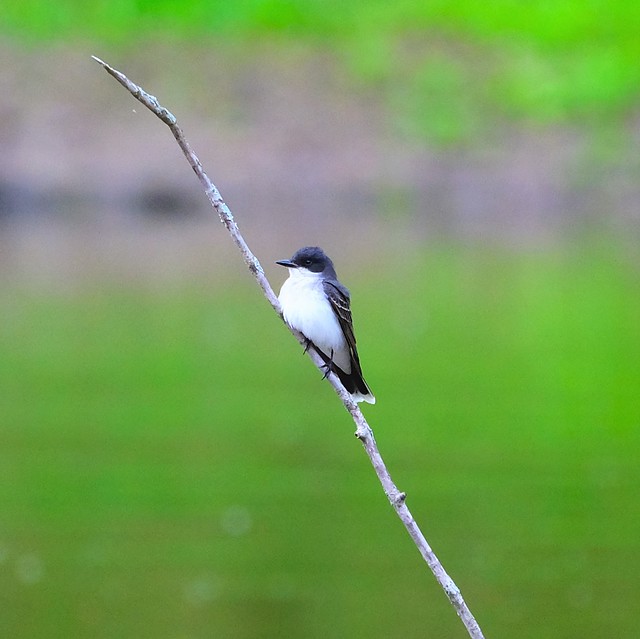
Speaking of flycatchers, the eastern kingbirds have arrived, and here’s one perched just off the tip of the southern island.
The fabulous blue skies are gone for now, but the clouds hadn’t started leaking yet, the temps were mild, and the air was still, so it was a pretty good morning for seeing wildlife in Estabrook Park.
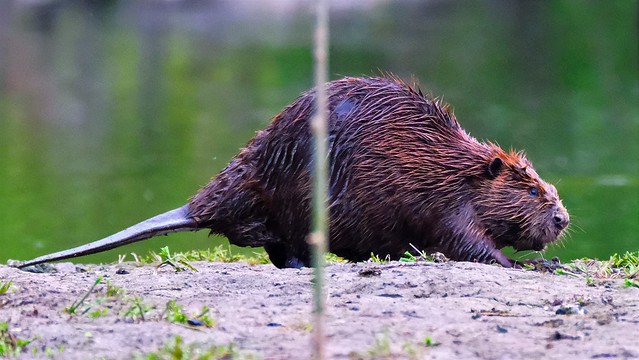
The deer were back in hiding, so the biggest critter I saw was this beaver on the prowl for some breakfast along the river below the southern playground.
It was about to sample these tasty looking saplings when it must have spotted me, crouching behind some other twigs about 25 yards farther up river, and opted to amble back into the water instead. “Sorry about that!”
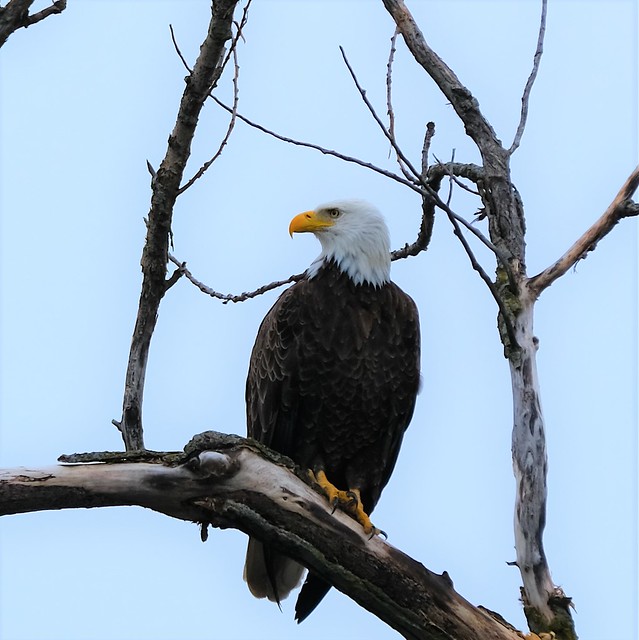
As I approached the north end, the geese and mallards sounded excited, and I was thrilled to spot the likely cause high in a tree on the northern Island. I used to see eagles only in winter, when they came south looking for open water, but perhaps their range is expanding southward, and I hope it means we’ll get to see more of them.
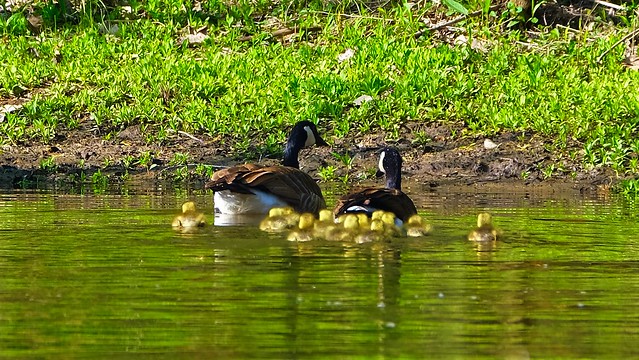
After the eagle continued south, I spotted this goose and her goslings swimming north.
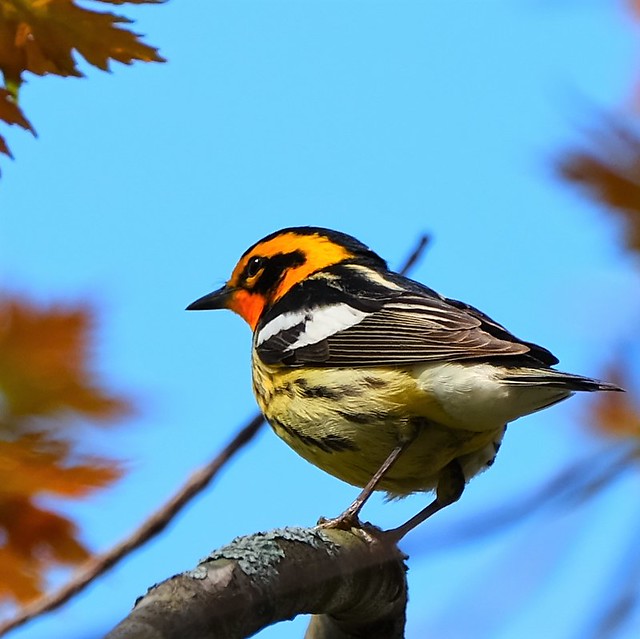
At the north end, across from that island, there was a lot of little-bird activity in the treetops. I heard and glimpsed a few indigo buntings, but they evaded my camera today. Instead, this magnolia warbler was more accommodating.
This redstart was a little less so, but we managed to work something.
Finally, little-bird-wise, this Nashville warbler opted for something more artsy.
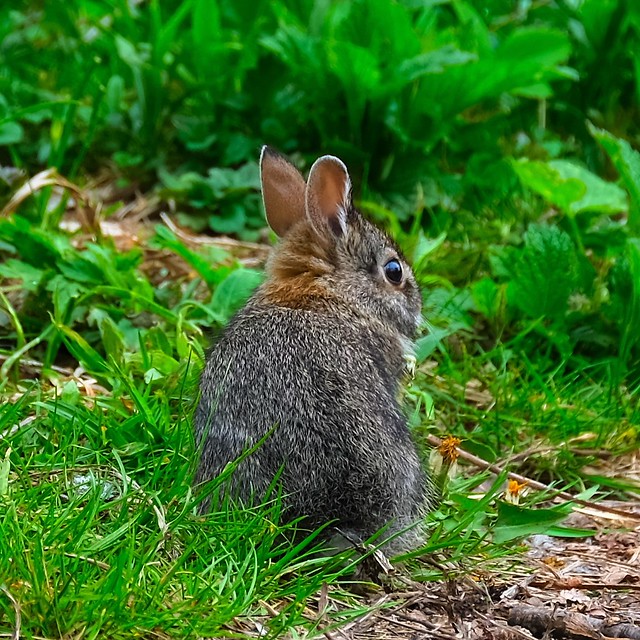
Back at the pond, I spotted my first baby bunny of the season, and I bet there are more from where that came.
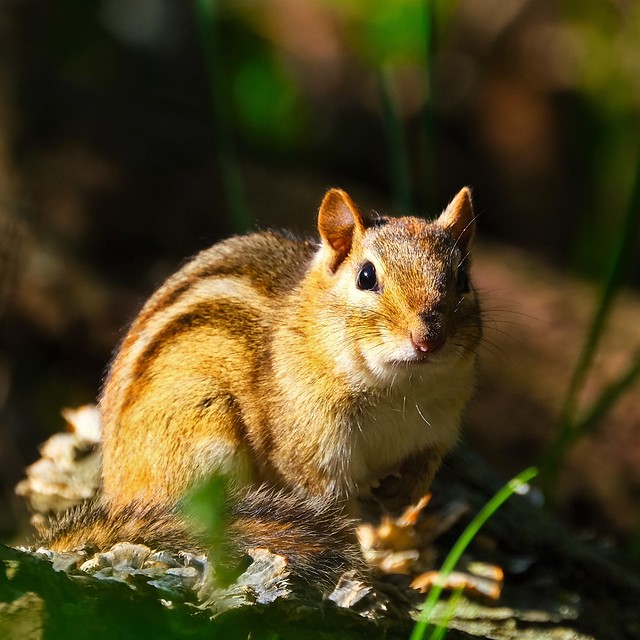
The chipmunks were feisty today, and after this one paused at the far side of the bridge at the north end of the pond, it continued right on towards me and then scampered into the bushes at my end.
Finally, the trillium were open and bright wait in a few spots throughout the park, and here’s a nice little clump right beside the river path.
The stretch of beautiful weather we’ve been enjoying lately has lasted for one more day, and it was just a perfect morning in Estabrook Park. Plus, with sunrise now at 5:35 am and no clouds to block the sun, I started my journey at 5:30 and enjoyed the park all to my lonesome for nearly an hour. What a treat.
It was nice to see the pair of deer again on the southern soccer fields after a couple-week break.
The toads were singing like crazy again this morning, you can even hear them up on the bluff, and it appears to have already paid off for some of them, like the happy couple below. There were hundreds of them in the river along the banks where the water is mostly still.
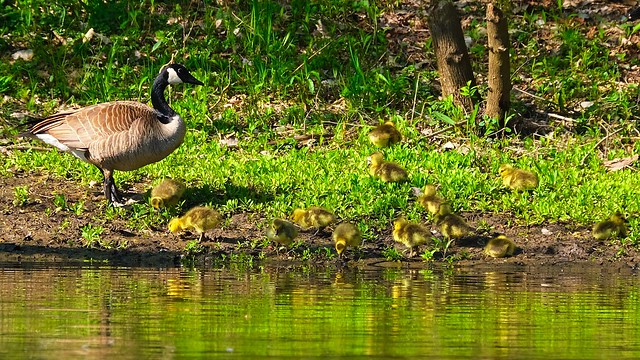
There was a notable absence at the pond this morning because the goose and gander must have decided overnight that the goslings were finally ready to make their annual march down to the river. If you’re desperate for a fix, you can still see a few families along the riverbanks, and here’s a picture I took on May 7th, but if you need to see them live at the pond, you’ll have to wait until next year.
Anyway, on my hike across the baseball field toward the river, there was a male northern flicker foraging in the grass along with the grackles and starlings, and as I tried to get a decent picture, it must have taken pity on me and hopped up onto this post for a moment, which really made my job a lot easier. He even showed off his namesake “yellow shafts.” “Thanks, buddy!”
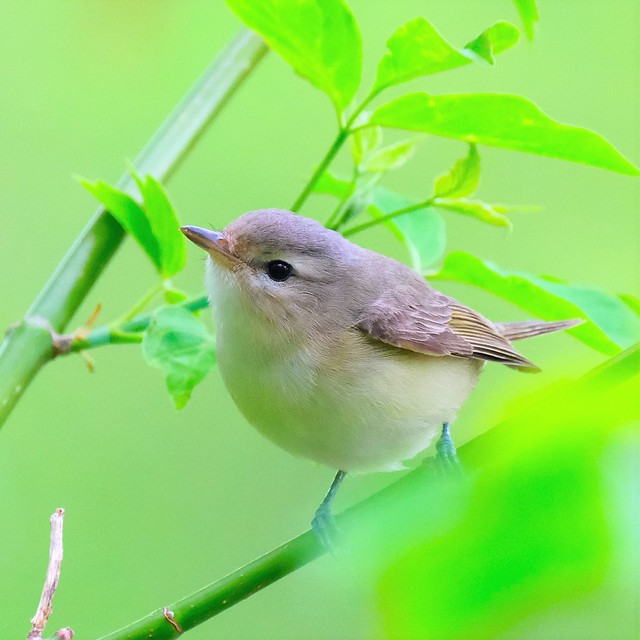
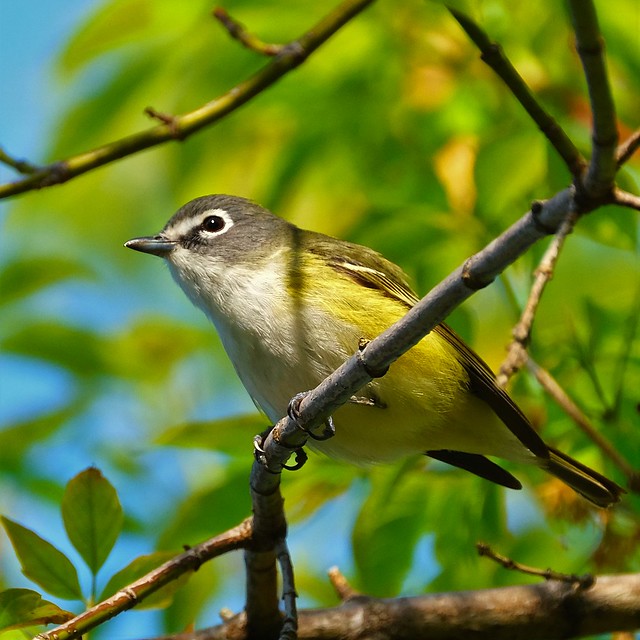
Back at the river, the sun was finally high enough in the sky to really light up this darling blue-headed vireo.
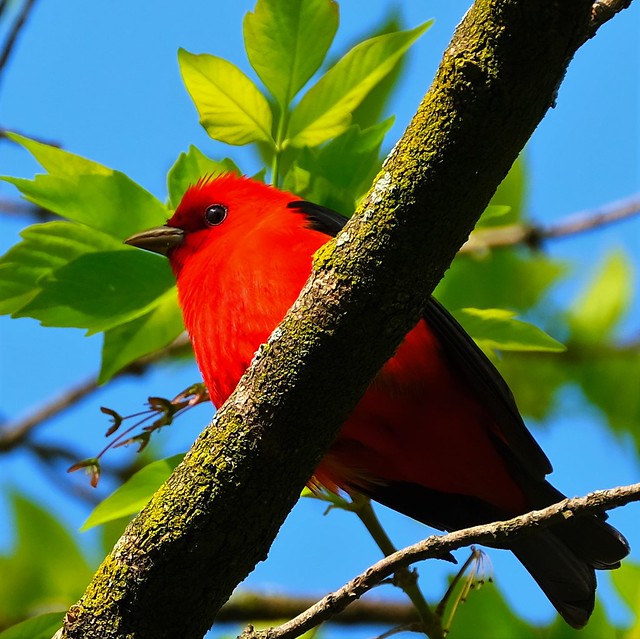
On my way back south and back up on the bluff, I finally hit pay dirt when I spotted our first scarlet tanager of the season. If I had a fake bird with little wire feet that I could wrap around any branch in the park, I don’t think I could have come up with a pose as perfect as this one.
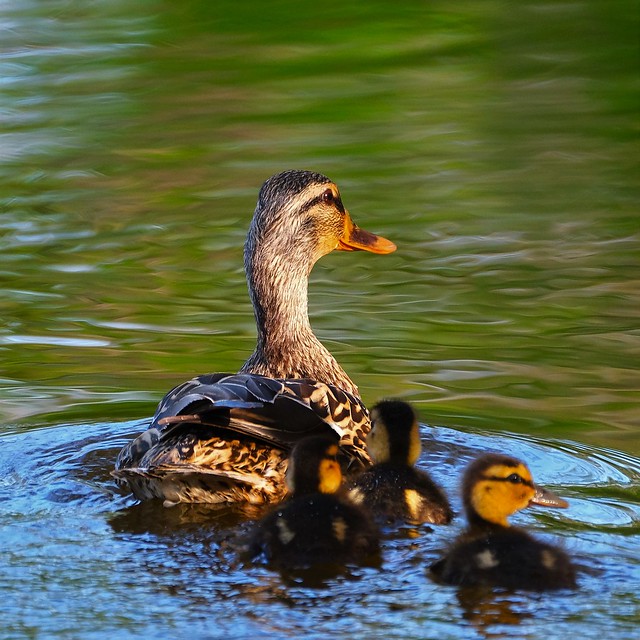
Back by the water, I spotted the trio of ducklings we last saw on May 8th.
There’s a new flower blooming on the slope down from the beer garden. Does anyone recognize it?
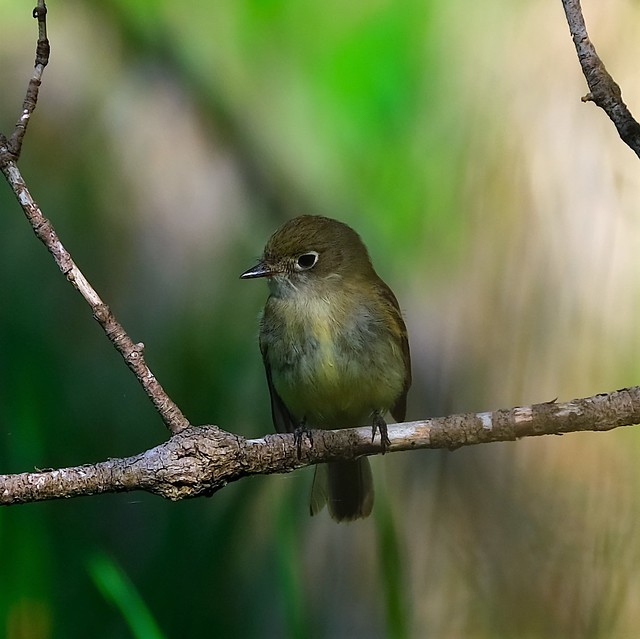
Over the swampy bottom at the base of stairway 8, which leads down to the river from the southern playground, I spotted this little flycatcher searching for its next morsel, and it appears to be a yellow-bellied flycatcher. By crazy coincidence, the last time I saw a yellow-bellied flycatcher was on May 11, 2022.
There was no fog, the sky was clear, and the air was nearly still, so it was a perfect morning for taking pictures in Estabrook Park. With nothing to block the sun, the light came nice and early, and I crossed Wilson Drive at 5:35am in hopes of beating the crowds.
First off, I was thrilled to find that the wild turkey from yesterday is still in the park and has moved down the bluff and a bit north.
The toads have begun singing along the river, but the crèche of seventeen goslings was at the spot on the river where I usually stop before heading up to the pond, so I skirted around them and went straight up the bluff instead. Things were quiet at the pond with just the regulars up and about; the family of Canada geese, a few wood ducks, and a couple of mallards; so I went back to the river.
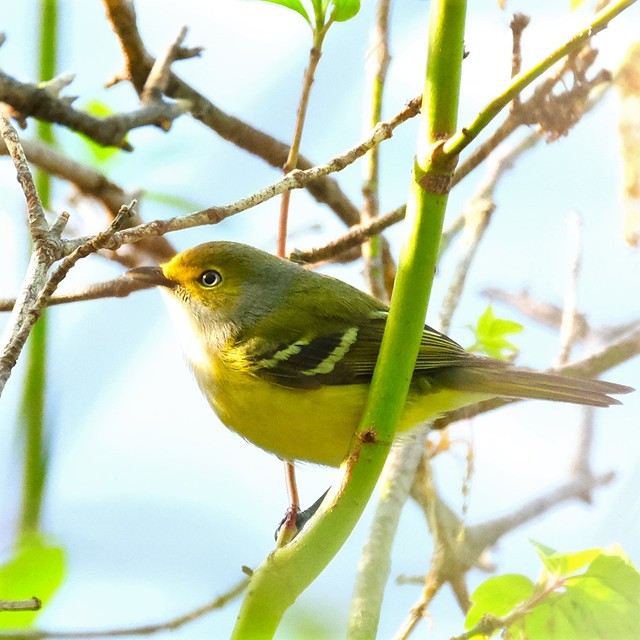
At the north end, I didn’t see anybody new or especially photogenic on the water, but I heard an unusual song in the trees along the shore, and I could barely believe my eyes when I found the singer. It was a white-eyed vireo (Vireo griseus), and we are just beyond the north end of their usual range, so they are considered rare here. How’s that for a treat!
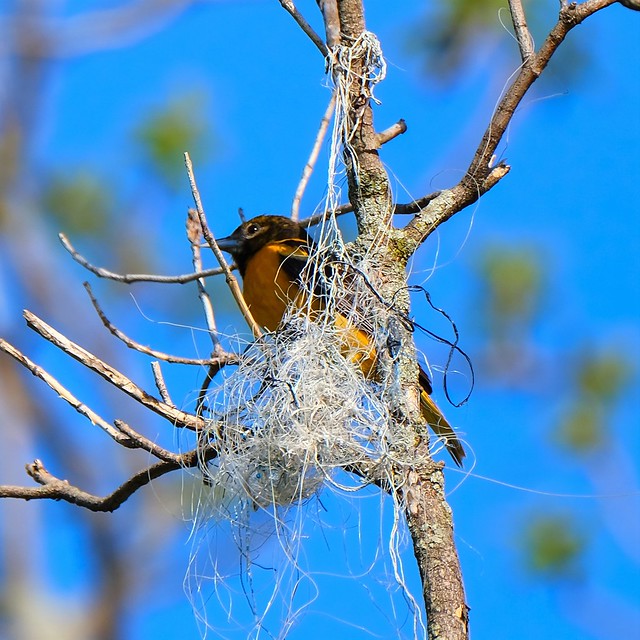
Also at the north end of the pond was this female Baltimore oriole, with a dark but not black head, working on a nest. I usually only see the nests in the fall, when the leaves are off the trees again, but this one is in a dead tree, so maybe we’ll get to see it all summer. One can hope, right?
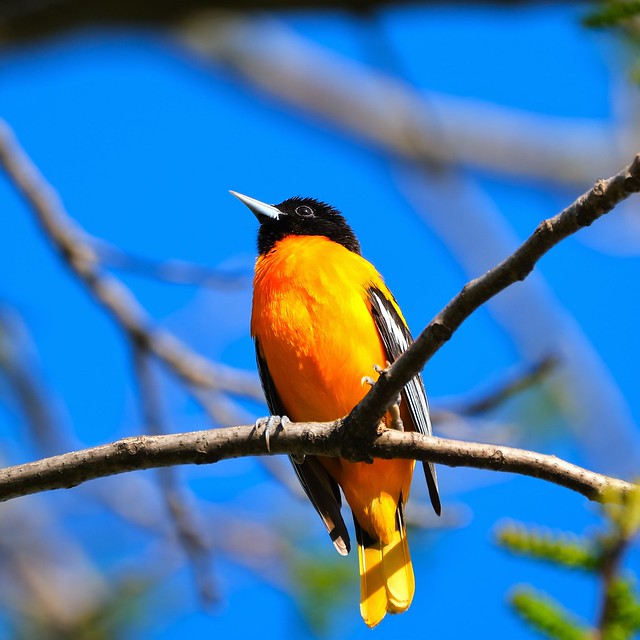
Nearby was a male Baltimore oriole, with a jet-black head, striking the best pose we’ve seen from one so far this year.
Wow! It sure was foggy in Estabrook Park this morning. When I arrived, just a little after “sunrise”, I could barely see across the soccer fields. Happily, I could see well enough to spot our first wild turkey of the year, if not capture a very clear image. I’ve only ever seen one in the park twice before, and I sure hope she sticks around.
Meanwhile, on the river, a pair of Canada geese must have heard about the “crèche of thirteen goslings and said, “hold my beer!” Here they are with seventeen (17!) and even conveniently stretched out into a row to facilitate counting.
I wasn’t kidding, was I? Anyway, the generator of the amazing sound was none other than this tiny blue-winged warbler (Vermivora cyanoptera), and it’s the very first one I’ve ever seen.
There wasn’t much new at the pond, and the lighting was bad anyway, so I continued on to the north end, where conditions were pretty much the same. On my way back south, however, the fog finally drifted away, the sun came out, and the sky turned bright blue. That’s when I spotted our first American redstart of the season. I haven’t seen one since last May.
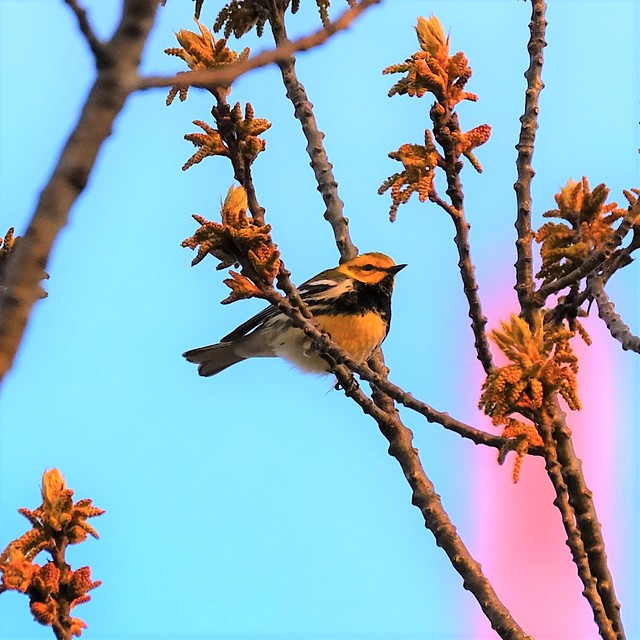
As luck would have it, I soon spotted a second bird for my very first time, and this little darling is a black-throated blue warbler (Setophaga caerulescens). It was quite a hopper, but it stayed mostly in the same tree, and I ended up tooking 90 pictures in an effort to get this one portrait.
After all that excitement, this palm warbler must have thought, “Fine, just take your pictures and then move along.”
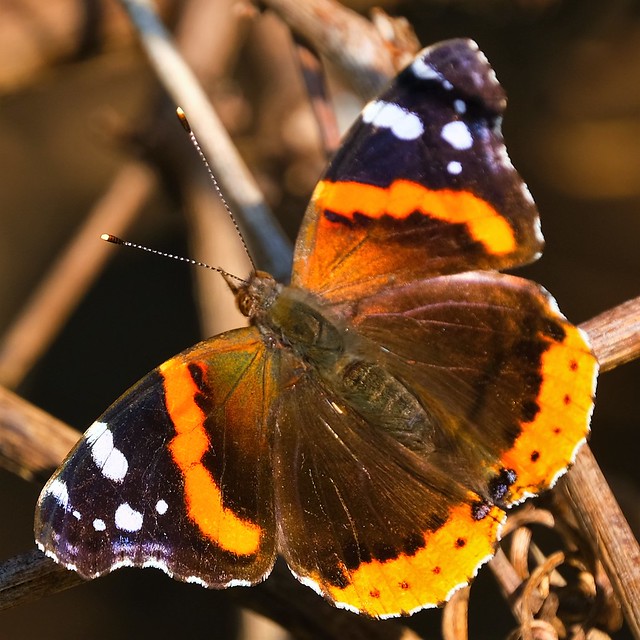
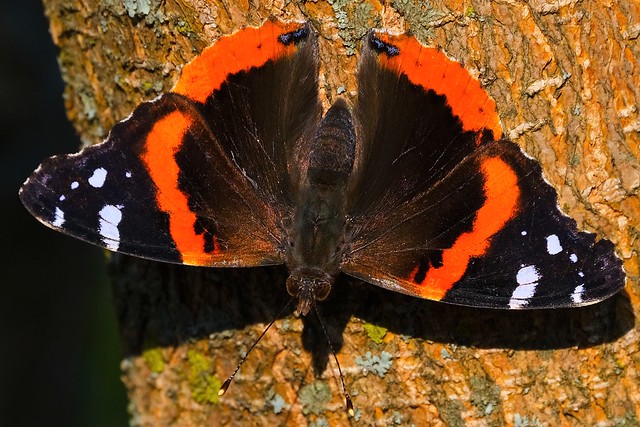
The warm sun soon brought out the butterflies, and here’s another red admiral soaking up some rays.
The heavy fog also coated the spider webs, and here’s one by the pond glistening in the sun.
Finally, I met long-time reader Jeff Bentoff in the park yesterday morning, and he agreed to send me a copy of the amazing screech owl picture he took in the Shorewood Nature Preserve last Sunday. Smart Alecs may recall that last Sunday is also when I visited the Shorewood Nature Preserve, but I didn’t come away with such a prize, and that’s why nobody likes smart Alecs.
There was barely enough light to read by, let alone take pictures, but the rain wasn’t due to start for a couple of hours, and I needed the exercise anyway, so I headed over to Estabrook Park to see what I could see.
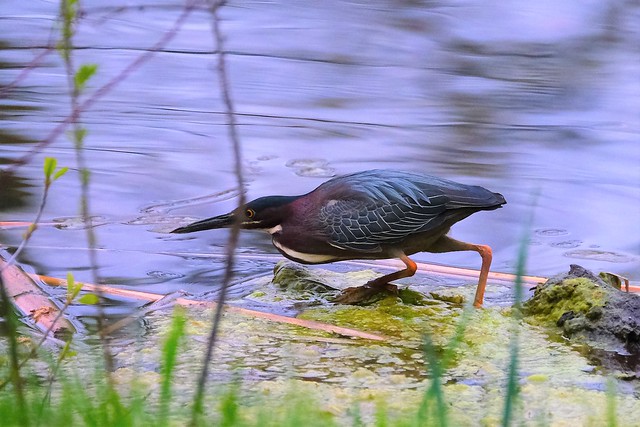
I was happy to find three green herons nearly in a row along the eastern shore of the pond, so I snuck around to the east side and arrived just in time to watch the middle one use that amazing neck and catch a nice little fish for its breakfast.
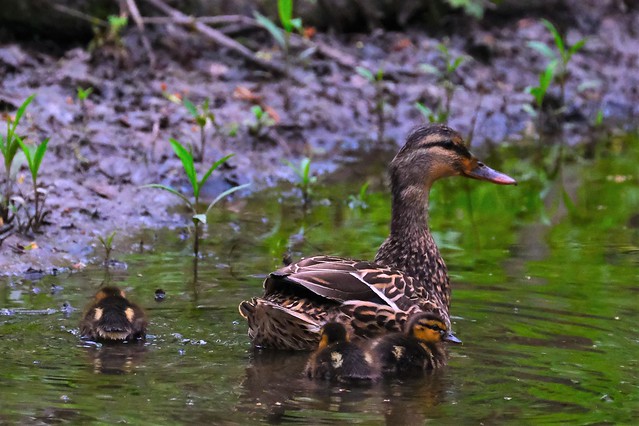
In the little channel beside the river near the north end, the trio of mallard ducklings were looking as healthy as ever, and after mom realized I was harmless…
they went right back to the breakfast buffet.
At the north end I finally caught a goldfinch sporting his fresh breeding plumage.
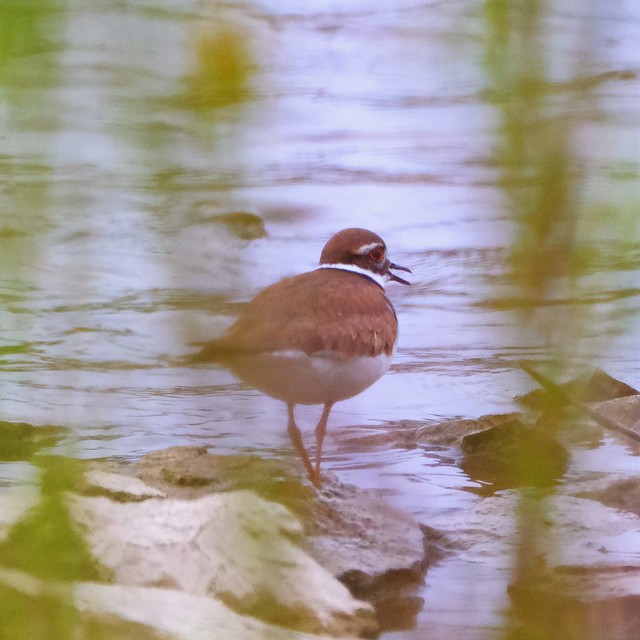
and I finally caught a glimpse of one of the killdeer I’ve been hearing for a while, even if it was hiding behind the weeds.
On my way back south, a pair of mourning doves were uncharacteristically unperturbed by me, so I took this portrait of one of them.
Finally, here’s a black-and-white warbler from yesterday morning. They are usually foraging along tree trunks and limbs so energetically when I see them, that I almost didn’t recognize this one just sitting there.
You know what happens when you let a spigot run for a couple of days? You get a boatload of whatever was coming out, and that’s what we’ve got in Estabrook Park right now, a boatload of new birds. I tried to count them all this morning, but I’m sure I missed some, and here are the ones I didn’t miss or at least made a nice picture.
There are Baltimore orioles singing in seemingly very corner of the park, and the blue sky this morning helped make a nicer portrait than the one I had for you yesterday. That one was more of a placeholder to commemorate the first sighting of the season.
The pair of green herons were on the pond again this morning, and this time one showed how long their necks really are.
Meanwhile, down on the river, we’ve got our very first batch of ducklings, a trio of mallards.
While the hens are all busy hiding in the bushes to incubate their eggs, the drakes are left to their own devices, and this pair were really getting into it.
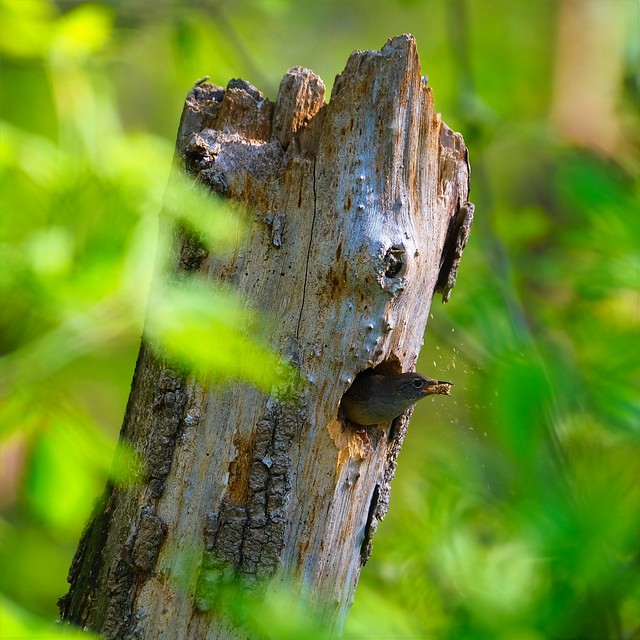
The house wrens have been around for a week or so, but they are elusive little stinkers, and I haven’t managed a decent picture until this morning. Here’s one excavating a nesting cavity.
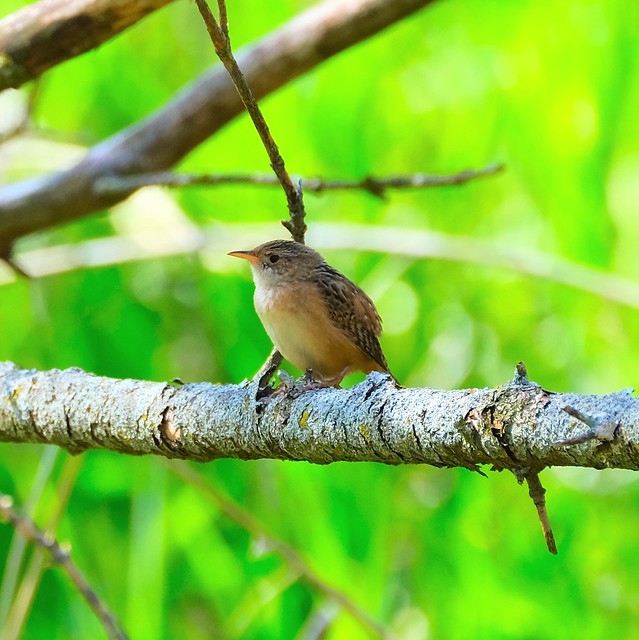
Finally, a brand-new bird for me today is this sedge wren (Cistothorus stellaris) checking out the wet field/shallow marsh beside the river. I sure hope it finds Estabrook Park to its liking and sticks around for the summer. Don’t you?
Sure, its a wet and dreary morning in May, but at least it’s not April. Am I right? Anyway, temps were in the 50s and there was a nice gap in the rain from about 8 till 11, so I popped over to Estabrook Park to see who might be out and about.
It was perfect weather for waterfowl, perhaps that’s how they got that name, and the geese on the pond were enjoying a little swim when I arrived
The big new arrival was this male Baltimore oriole checking out an old nest in this blossoming poplar tree. I’ve been hearing them along the river for a couple of days, so I’m glad to finally capture an image of one.
At the river I saw two more geese families, both of whom looked a bit newer, and here’s one mom with her three goslings. I don’t believe I have yet seen more than four goslings in a family this year, which seems a little out of character. In previous years, there have been sixes, sevens, eights, and even a nine. Let’s hope it’s not a bad sign.
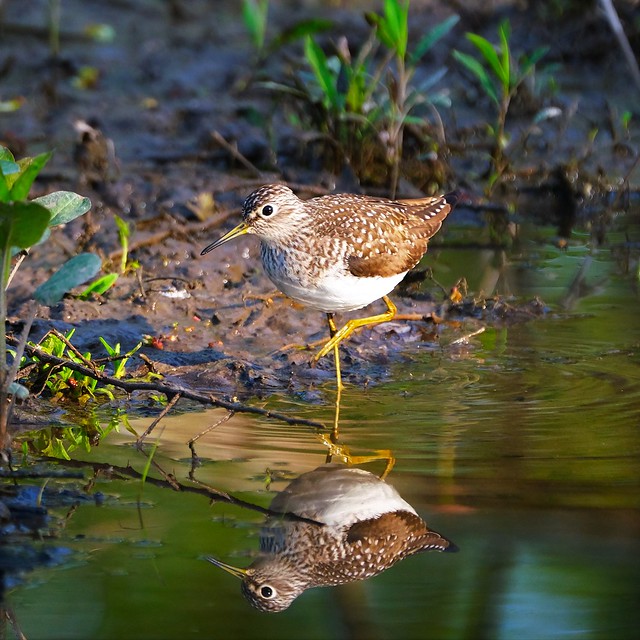
In any case, here’s a spotted sandpiper who was foraging along the riverbank, and whom we’ve seen already this month.
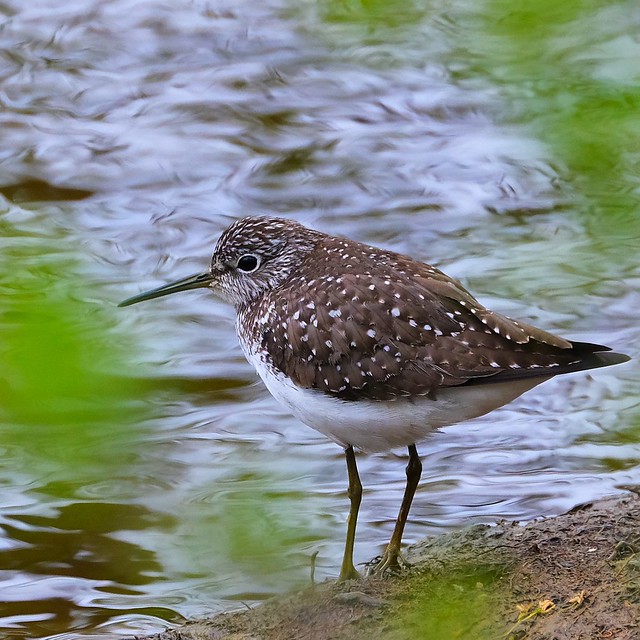
And here’s a solitary sandpiper, whom we have seen before, but not yet this year. It was fun to see both sandpipers in quick succession, and wasn’t it kind of them to strike similar poses to facilitate comparing their appearances.
I did see a few warblers today, but not nearly as many as yesterday, and here’s the best picture I managed this morning. Yup, you guessed it. That’s an aptly-named black-and-white warbler.
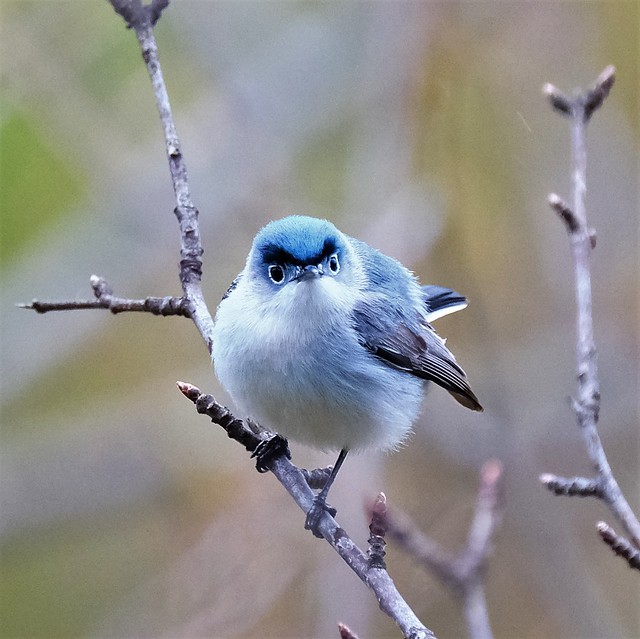
The blue-gray gnatcatchers were thicker than usual, and here’s a male with some of the most amazing eyebrows in the entire aves class.
Lastly, I’ve been seeing the female cowbirds searching for and checking out nests into which they can sneak their eggs, and here’s one from yesterday looking high and low.
Holy moly! The spigot has opened, and Estabrook Park is awash in new arrivals. Happily for them, the air was also full of flying insects this morning, and it felt like I was trailing a column of smoke as I walked across the soccer fields.
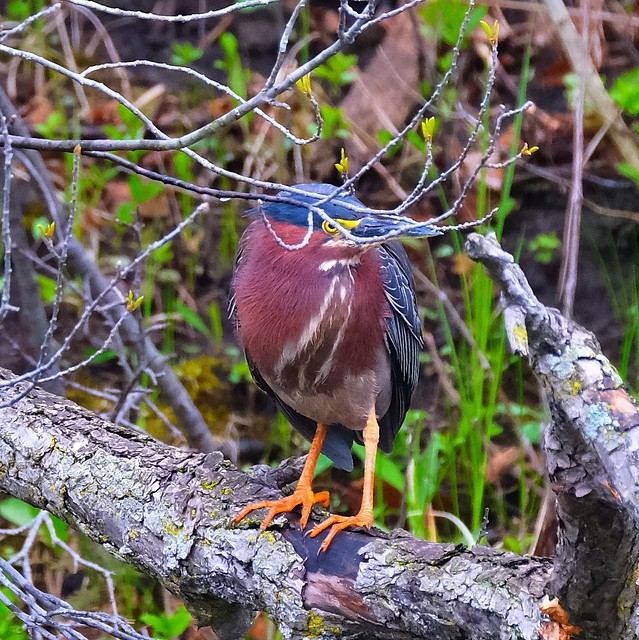
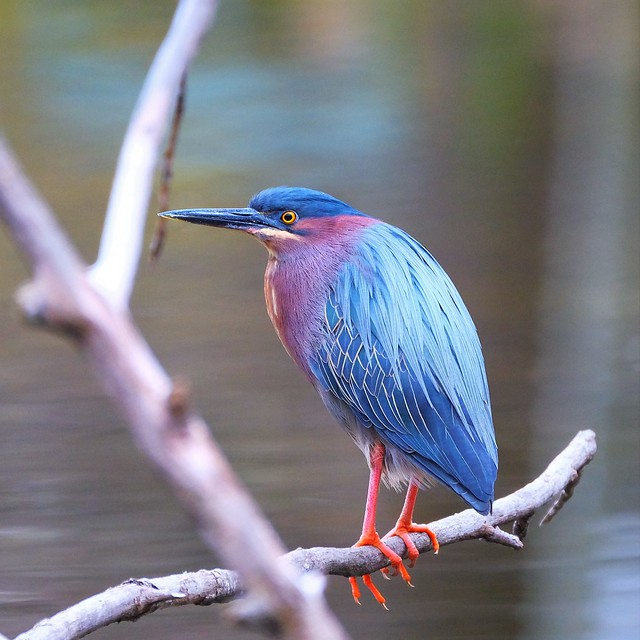
Let’s start at the pond, where there were two green herons for the first time this year, and they were hungry for some fish. “Welcome back, you grumpy-looking little gnomes!”
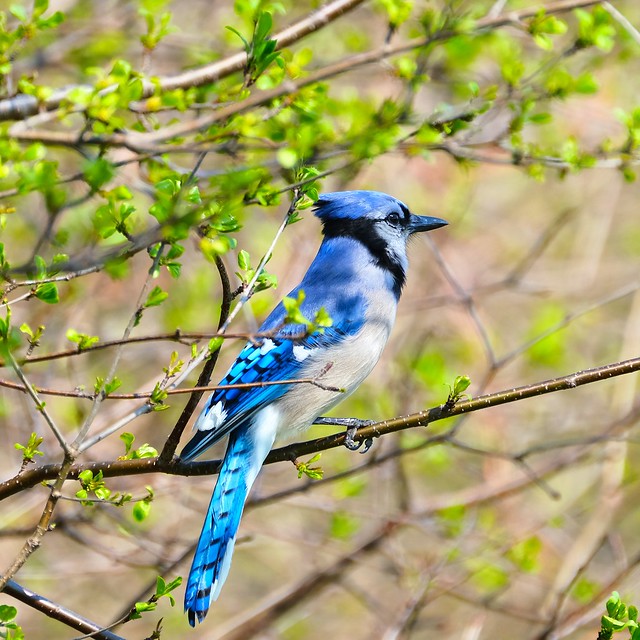
Finally, while not new arrivals, the blue jays, who are normally very shy, have been very noisy lately, and this one must have been distracted enough by other activity that I was at long last able to sneak a portrait.
Thanks to a high-pressure system parked nearby, the weather in Estabrook Park just keeps getting better. More importantly, the trickle of warblers we’ve seen over the past few weeks is turning into enough of a torrent that even I can find some of them.
All the usual suspects were at the pond, including a pair of blue-winged teals, but the most interesting picture, I thought, was of this trio of wood duck drakes sharing their breakfast with a grey squirrel. Huh.
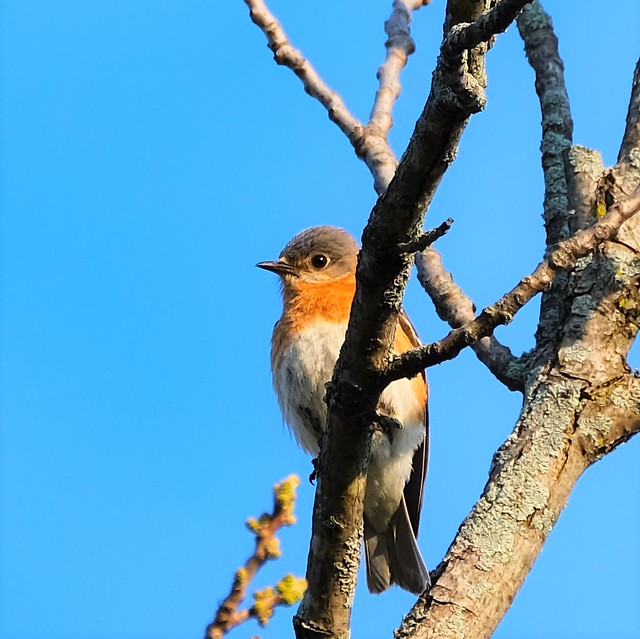
Oddly enough, another bird soon flew over, and I thought it was another bluebird, but it turned out to be a house finch instead. Huh.
When I finally reached the river, I was soon greeted by the second beaver of the morning. The first was in the slow water below the falls, and the picture ain’t so great, but this second one, above the falls and near the southern island, was a lot closer and swam right into some water with pretty lighting.
Farther out on the water, but with similar pretty lighting, was a second pair of blue-winged teals.
Back up on the top of the bluff, I found that the warm sun had already brought the butterflies back out again, and here’s a sharp looking red admiral.
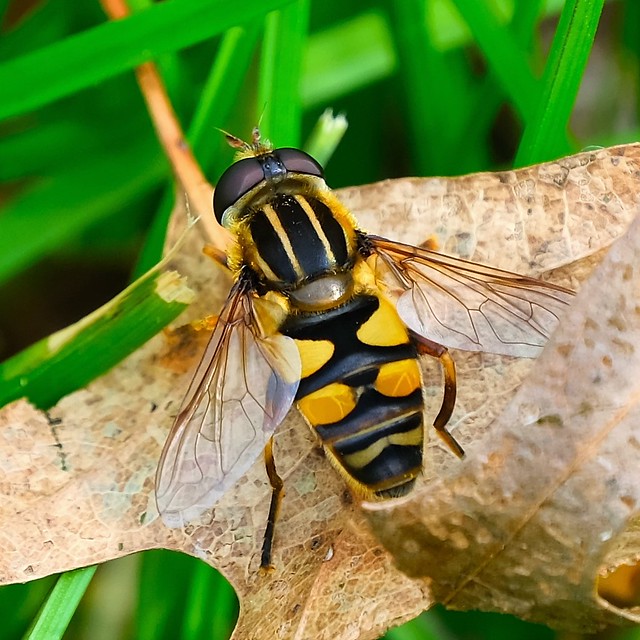
Finally, as I walked past the Benjamin Church House, I caught sight of something tiny zipping past out of the corner of my eye, and I couldn’t believe my luck when I found it perched nearby on this dead leaf in the lawn. It’s a hover fly, and although “about 6,000 species in 200 genera have been described”, my best guess is that this handsome devil is a Helophilus hybridus.















































 Signs of Life in Estabrook Park
#/media/File:Porzana_carolina_map.svg)