It’s a damp and dreary morning in Estabrook Park, but the temps are mild, and the wind is light, so not a bad time to visit at all. There were plenty of birds out and about making the best of the situation, but I didn’t expect my camera to do well in the low light, so I left most of them alone. Luckily, I have a couple pictures left over from yesterday when the sun was trying to peak through the clouds.
First is this handsome male cardinal sampling some kind of berry.
And here’s one of several starlings looking spectacular in the same tree.
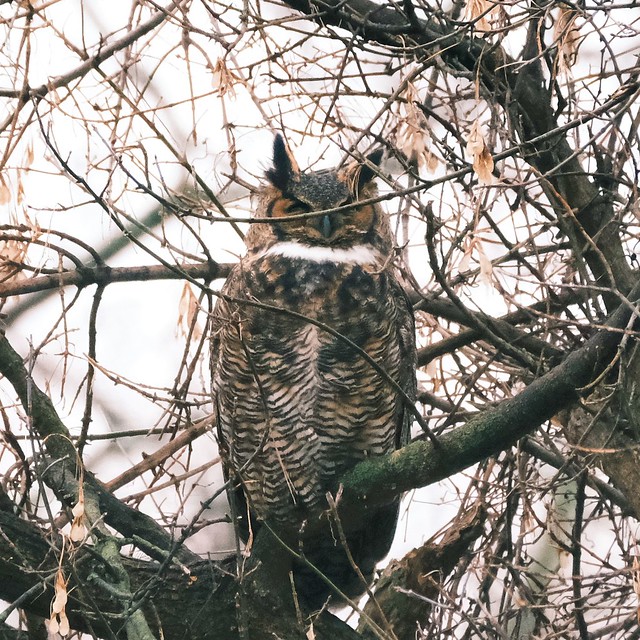
Finally, the great horned owl was back, looking regal as ever, and that is always worth a shot, even in the low light.
That’s it for now, and I get one more chance tomorrow morning before Anne and I are off to Big Bend National Park for a few days. If I see anything there, I’ll let you know.
Now that the big storm is all cleared out, things are pretty quiet in Estabrook Park. There’s still some ice on the river, but not so much that ducks and mergansers are coming south in search of open water. Here are a few pictures from the last two mornings.
A black-capped chickadee by the pond,
And a dark-eyed junco by the pond.
I was very excited to hear the call of this male belted kingfisher over the river. I haven’t seen one since last May.
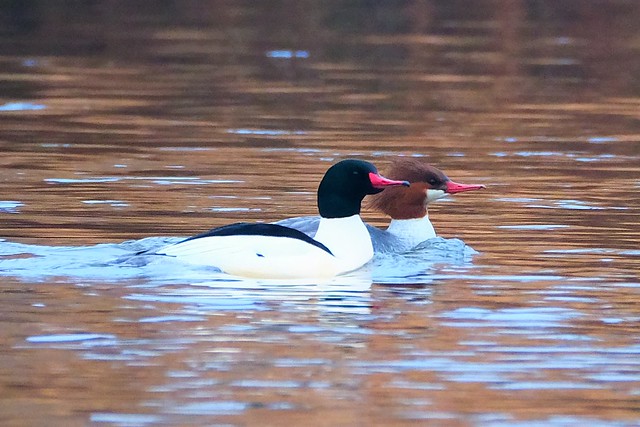
Yesterday, there was also a pair of common mergansers on the river,
And one hooded merganser drake.
Today, there was one goldeneye drake and one common merganser hen, but they were both too far away from my equipment.
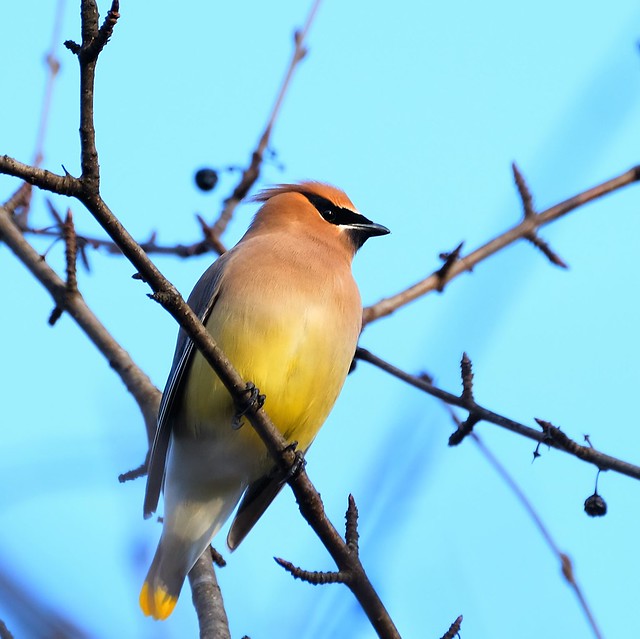
This morning, the sun tried a little harder to shine through the clouds, and here’s one of about a half dozen cedar waxwings picking berries.
At the southern parking lot, this male, red-bellied woodpecker wolfed down a crabapple from a nearby tree as it continued to announce his presence from the top of a light pole.
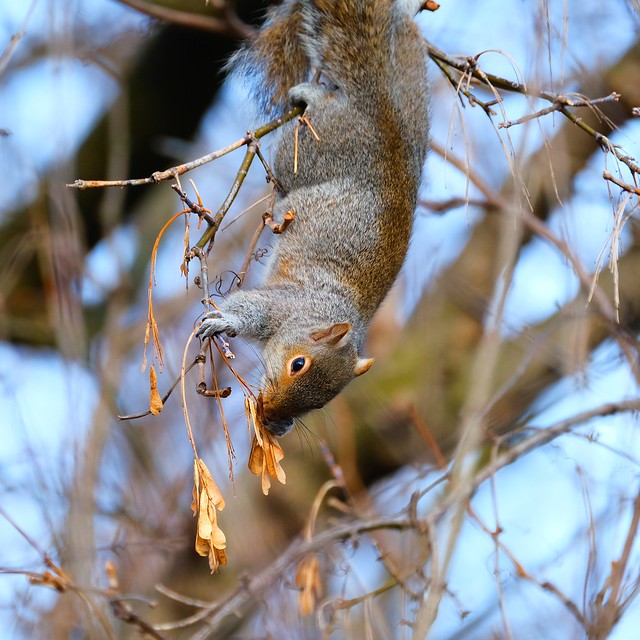
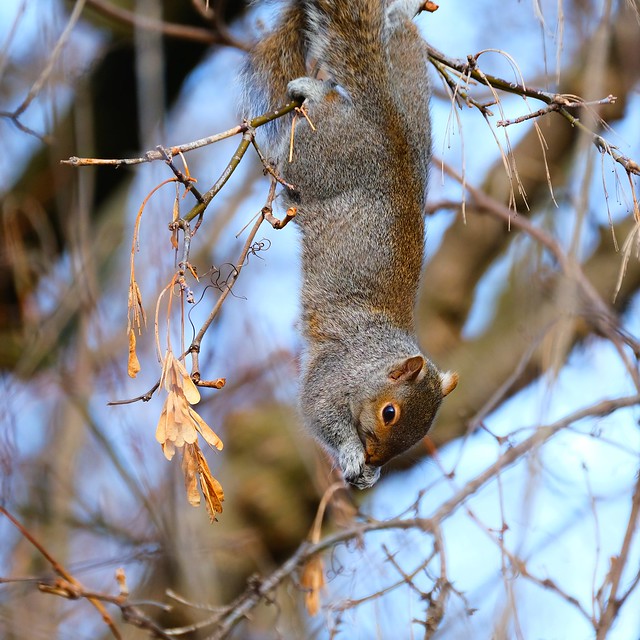
Finally, just as I was crossing the Oak Leaf Trail to exit the park, this grey squirrel caught my eye as it feasted on box elder seeds while hanging by its hind legs.
That’s it for now, and I hope your new year is off to a great start.
My trip to Connecticut is winding down, and I’ll be back in Wisconsin tomorrow. Before I go, however, I’ve got some pictures for you. There is a nice rails-to-trails linear park that follows the old Farmington Canal through town, and I was pleasantly surprise by the variety of wildlife I found there.
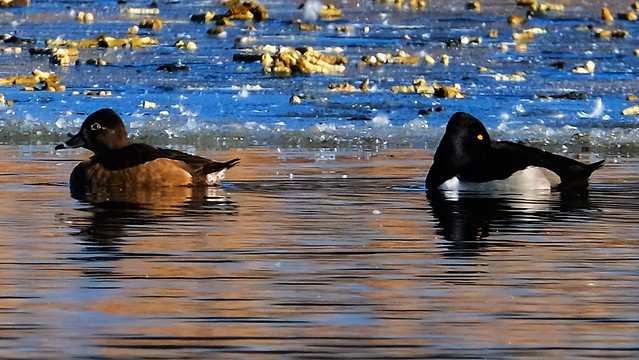
There is a pond near the north end, bigger than the one in Estabrook Park, which is supporting a pair of mute swans, a slew of Canada geese, a few mallards, and this pair of ring-necked ducks. I’ve only ever seen a single hen once before, on the Milwaukee River back in November, so it’s nice to see the pair together.
When I visited that pond again this morning, the ring-necked ducks appear to have moved on, but they have been replaced by two pairs of hooded mergansers, and here’s one pair.
The biggest treat for me, however, was spotting my first northern mockingbird (Mimus polyglottos), just chillin’ on a branch beside the trail. No song today, I’m afraid.
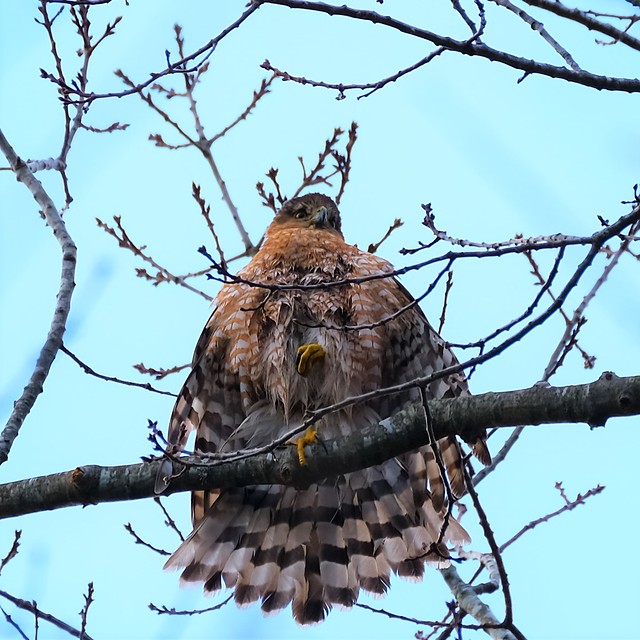
At the south end, I found another spectacle. From afar, it looked like a large clump of leaves, or even a squirrel drey high up in an oak tree, but I gave it a look with the binoculars anyway, and I was pleasantly surprised to find a hawk who appeared to be drying itself out. Sure enough, you can still see its wet breast feathers in the image below.
Meanwhile, in that long narrow pond across the path from the hawk, here are a pair of American black ducks keeping a close eye on it.
Finally, there were also plenty of the regulars from Estabrook; downy, hairy, and red-bellied woodpeckers, chickadees, juncos, white-throated sparrows, nut hatches, cardinals, blue jays, crows, etc.; but the ones that eluded my camera, despite my best efforts, were the plentiful tufted titmice. The good news is that I got to hear plenty of their calls, and now I’m better equipped to spot one in Estabrook. At least I can hope, right?
The cold and wind are starting to back off a bit, and the sun was out, so it was a perfect morning in Estabrook Park. The river ice continues to form, however, so my wish came true, and the goldeneyes have begun to arrive. Here’s a hen on the rapids at the south end.
And here’s a drake just a bit upstream.
There were still plenty of mallards on the rapids, and a few Canada geese at the north end, but the common mergansers have moved on for now. Also at the north end, this red-bellied woodpecker was busy hunting up some frozen bugs for breakfast.
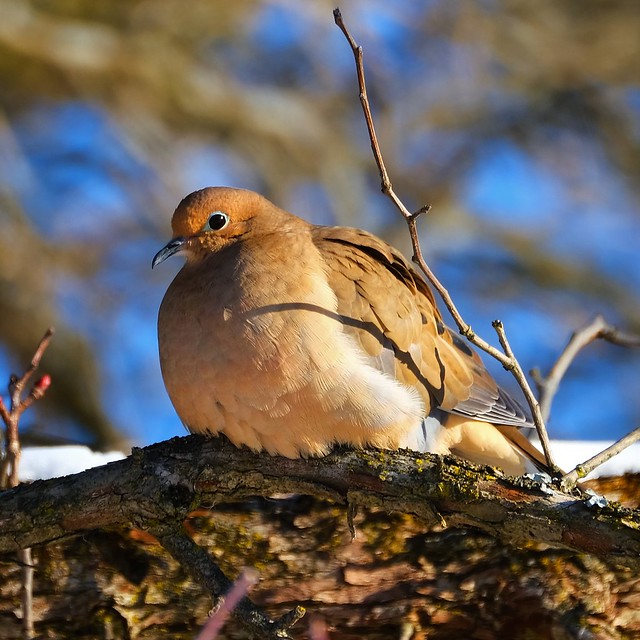
At the pond, this mourning dove posed perfectly in the bright morning sun.
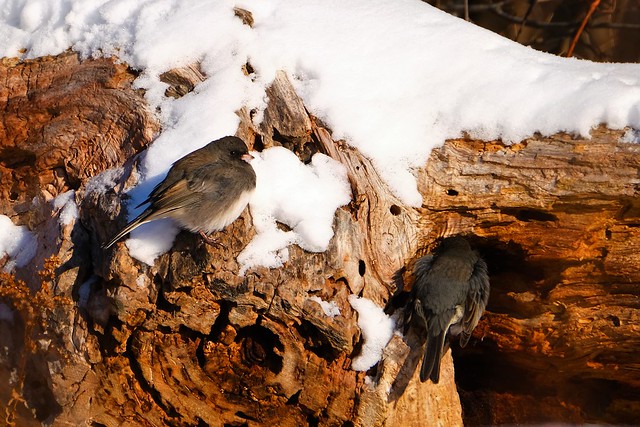
I couldn’t tell if this pair of dark-eyed juncos was looking for something to eat, hoping for sun warmth reflected off the log, or both.
I was happy to see cedar waxwings still hanging around the pond.
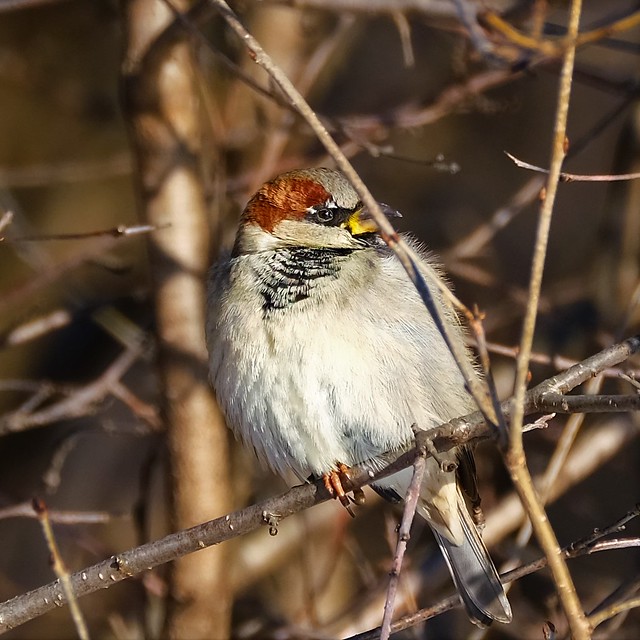
Finally, here’s a male house sparrow who must have strayed into the park from the surrounding suburbs.
Lastly, thanks to those of you who wrote in to express concern for me in the cold, but you needn’t worry. I’ve managed to build up a good layer of insulation on my strict diet of dark bread and mature Gouda cheese.
Tomorrow, Anne and I are off to the east coast to see more family, so you’ll be on your own again, but I’m bringing my camera, and I have a hope of showing you some east coast critters.
The thermometer said, “-7°F”, and the wind said, “let’s make that feel like -33°F”, but the snow was fresh, and the sun was out, so I hustled out the door this morning to see who might be out and about in Estabrook Park.
The river has frozen over below the falls, which has backed up the water so much that the surface drop at the falls is barely a foot, instead of the 3 or more foot drop I saw just yesterday. Above the falls, the river is completely frozen past the two islands and all the way to the Port Washington Road bridge at the north end of the park. Perhaps this will bring us some golden eyes, buffleheads, or scaups.
Today I only saw some common mergansers and a few mallards in the water and a few geese on the ice, same as yesterday, but the great horned owl was hiding someplace better protected from the wind, we can hope, so I hadn’t even taken a picture by the time I turned back south and headed over to the pond.
There, in the bushes and trees along the north shore, where the wind out of the northwest was blocked and the sun was doing its best to warm things up, the hardy little birds were having quite a party.
I saw a half dozen house finches, and I’m sure there were more. Here’s a male soaking up the sun.
The big surprise was about a dozen cedar waxwings.
Here are a couple amongst the berries overhanging the water, and I was happy to discover that the pond ice is thick enough to support me while I lined up this shot with the sun at my back.
Here’s a nice and poofy American robin.
There was a pair of downy woodpeckers, and here’s the male.
Finally, here’s a black-capped chickadee pausing for just a moment from its morning foraging.
I find it absolutely astounding that these little beauties can find enough calories every single day on those seemingly-bare sticks to fuel the little fires they must have under those feathers to keep from freezing all winter long. Right? If they didn’t prove it, year in and year out, there is no way I would believe it possible.
It was a gray morning in Estabrook, but the big storm hasn’t yet arrived, so temps where mild, the breeze was light, and the snow was on pause. I didn’t see anything notable on my walk along the river until I reached the north end, where two red-tailed hawks were perched in a tree over the northern island. This is the one that let me take a picture before they became annoyed with me and moved on.
While trying to focus on the owl buried in the sticks, I spotted a raptor soaring over the river between the islands and figured it was one of the red-tailed hawks I had just seen, but I gave it a look with my binoculars, just in case it was an eagle instead.
Well, it wasn’t an eagle, and it had a long tail and a bright white patch on its lower back, which makes it a Northern Harrier (Circus hudsonius), my very first. Sadly, I didn’t get a chance to take a picture before it was out of sight, but I’ll keep my eyes peeled in the coming days.
I had barely walked 10 yards, hadn’t even looked up the northern harrier yet, and was still on cloud nine from seeing the owl when look who else was out and about. Sure enough, one of our beaver was busily packing on one more pound before the river freezes for the winter and it’s stuck in its den for weeks.
I was starting to run out of time, but on my way home, I swung by the pond to find this cute little dark-eyed junco hoping I keep right on moving so it can go back to foraging amongst the fallen leaves.
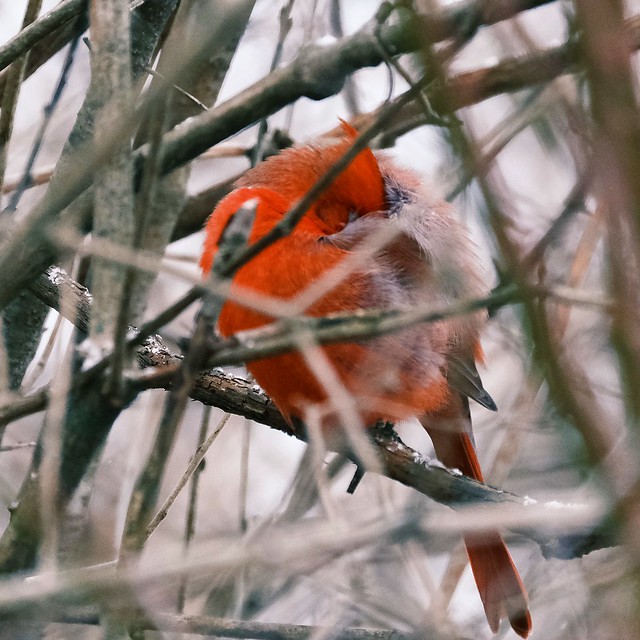
Finally, deep in the bushes, I spotted this male northern cardinal trying to get some shuteye. It took me a moment even to recognize what was going on because I’ve never seen a cardinal with its beak tucked into the feathers on its back before, as we just saw the mallards doing yesterday.
As I sit at our dining room table now typing this up, the snow is starting to fall again, so perhaps we will get some. If you’re in the path of this storm, I hope you can stay safe and enjoy the spectacle of it with me.
With temps in the single digits (°F), nearly still air, and a bit of sun shining down before it hid away behind thickening overcast, it was a fine morning for returning to Estabrook Park. The pond was frozen over, and the river was icing up, but there was still plenty of open water.
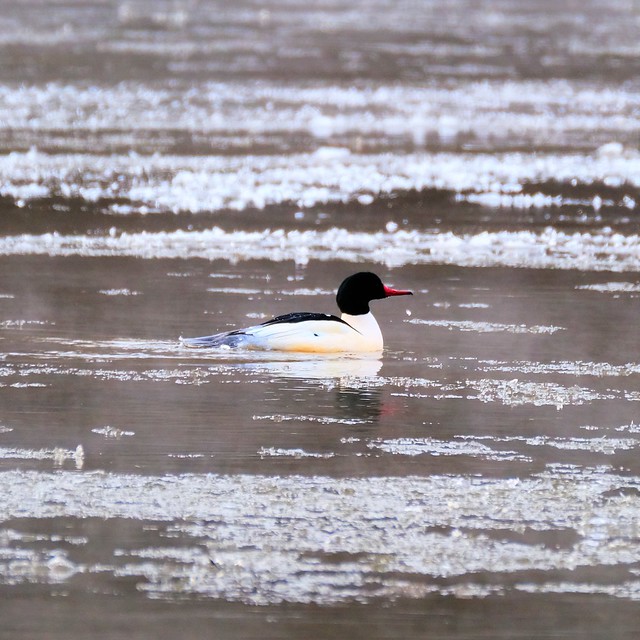
I was thrilled to see that a couple of winter visitors have already arrived. Dark-eyed juncos are here, of course, but they were too quick for me this morning. Instead, I managed to capture this common merganser drake amongst the ice out on the river between the islands.
Back on shore, the woods are full of chickadees, cardinals, nuthatches, and woodpeckers, as usual, but this cute little puffball close to the ground, a hermit thrush, really caught my eye.
Even better, it ignored me and climbed higher to gulp down some berries, and a bit of sunlight really brought out the cinnamon in its plumage.
Finally, there were a slew of mallards on the river, and here’s a pair keeping warm while napping with one eye on me.
Lastly, happy Winter Solstice to those who celebrate. The forecast is for snow showers tomorrow morning, which could make for some pretty pictures, if we have any luck.
Things seemed to have changed here, and the main symptom is that I’m finding it a lot harder to get nice pictures of the wild creatures. I went out both days last weekend and came home with only one picture that wasn’t even worth showing. This morning was a little better, but not by much. One culprit could be the weather. It was in the 30s last Saturday and the 20s last Sunday, with ice on some of the canals. It has also been very cloudy and rainy lately. I don’t know if the critters will be like this until the spring, but I suppose that possibility exists.
In any case, the temps this morning were in the low 40s and there were even glimpses of sunshine. It was great for birding, if not photography, and I spotted 50 species. Here are the few I managed to capture on film.
Of the four buzzards I saw, three were almost in range. Here’s one by itself, about 100 yards away, on a post at the edge of a field…
And here’s a pair on a gate, about 200 yards away, and in the middle of a field. I read that “females average about 2–7% larger than males linearly and weigh about 15% more,” so that’s probably her on the right and him on the left. The fourth bird was in a tree on the far side of that same field, so I didn’t even bother wasting film.
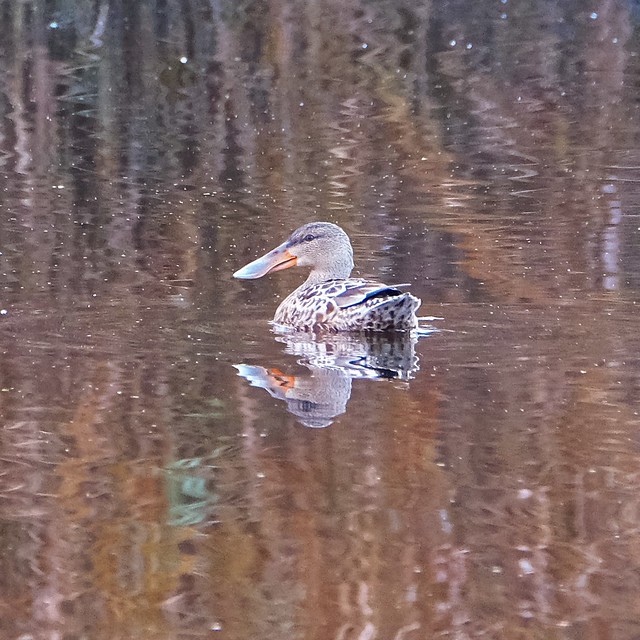
I was pleasantly surprised to spot a lone, female northern shoveler, dabbling with a few mallards and gadwalls, and even more surprised to capture a presentable image of her. There’s just something about them that always catches my eye.
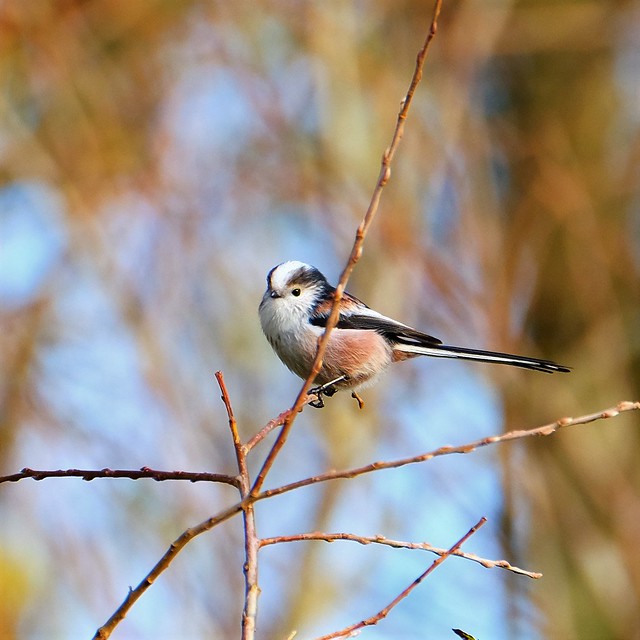
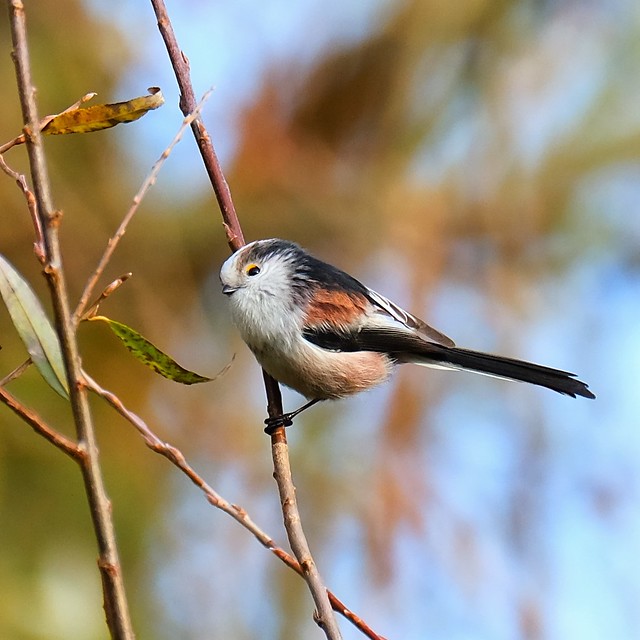
A very happy coincidence occurred when I stumbled upon a little group of long-tailed tits during one of the brief moments of sunshine with even some blue-sky in the background..
How could that face not brighten any mood, eh?
Finally, before the sun went back into hiding, a trio of blue tits were busy enough foraging on a birch tree to let me get one pretty picture.
And that’s all I managed for today, I’m afraid. The current forecast is for rain all day tomorrow, so I might not have anything more to show you, either, but I’ll check again in the morning. Sometimes the rain arrives late or leaves early, if we’re lucky. Keep your fingers crossed.
I had a wonderful time being back home for a bit, and it was great to see family, friends, and all the critters in Estabrook Park again, but now I’m back in South Holland, and it sure was a beautiful morning to visit the countryside. Even though we’re back to standard time, the sun still doesn’t come up till 8am, but the birds just don’t seem to notice, and they put on one heck of a show this morning. There were at least three redwings sampling the berry buffet along the bike path, and this is the one who let me take a picture.
Meanwhile, down by the water, this diminutive moorhen gave us a good look at its size-12 feet.
The grey herons were busy foraging this morning, and I counted 20 individuals.
As I was about the cross back under the train tracks, I spotted this Eurasian kestrel take a perch on the wires overhead, and I was surprised by how close it let me approach.
A train speeding our way, on the other hand, was an entirely different matter.
After all that excitement, I finally did cross under the train tracks, and as soon as I parked my bicycle on the other side, yet another raptor was beset by corvids, crows and magpies this time. This one was a sparrowhawk, and here it is catching its breath in a moment of piece. Since “the Eurasian sparrowhawk is a major predator of smaller woodland birds“, perhaps they are better suited to handle the harassment, or the other birds know better to keep a greater distance.
Once I had that picture, I finally headed into the small bit of woods and was immediately greeted by this female chaffinch foraging beside the path.
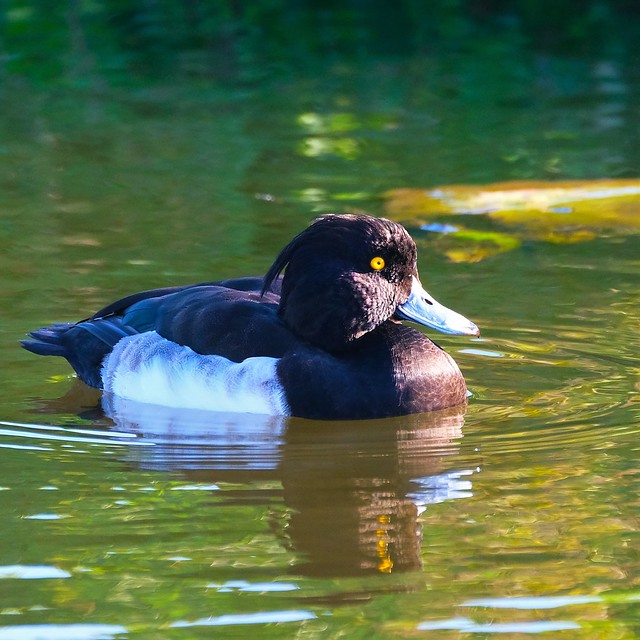
Back out of the woods, I spotted this pair of ducks, and they might be female greater scaups, but I’m not quite sure because….






















 Signs of Life in Estabrook Park


