I did find a mute swan in town yesterday, but it was taking a break from the water, so that could explain why I didn’t spot it Saturday when I merely looked down the canals.
It seemed perfectly content to sit right there, between a parked bicycle and a park car, and preen its feathers. It hardly paid any attention to passersby.
The water in the canal right there had a skin of ice on it, so perhaps our hero took the path of least resistance and hopped up on shore in hopes that the “heat” of the “day” would fix that problem, but I’m not sure the “sun” yesterday was up to the job.
Phew! Good thing I saved some pictures from yesterday, because the weather here has returned to its dark and dreary self this morning. In any case, on to the water birds, and the ubiquitous Eurasian coot deserves top billing. If there’s only one bird in a body of water around here, odds are that it’s a coot. Oddly enough, unlike the mallards and gulls, they seem to ignore human sources of food and stick to their strict diet of foraged greens. Probably a lot healthier, eh?
I was a little surprised by the number of great cormorants on the river Schie yesterday, but there was at least a half dozen, probably more, and here’s one drying out its feathers after a swim. It had its wings extended as I approached, but tucked them in when I tried to get a picture.
There was only one Egyptian goose, and it seemed lonely because it was calling from the top of this chimney.
By far the most common gull in town are these cute little black-headed gulls in their winter plumage. There were also a couple of herring gulls, whom we see in Estabrook, and they are nearly twice the size.
Every once in a while, one or two of the coots turn out to be moorhens. Besides the subtle visual differences, they are slightly smaller, and tend to stick near or up on shore.
There were about as many great crested grebes fishing in the river as cormorants, but they don’t need to dry out their feathers so I hardly ever see one out of the water.
The only ducks in town are mallards, or mallard-domestic hybrids, and this sweetie was keeping an eye on me, just as her counterparts in Estabrook do.
There is still one grey heron hanging (standing) around on the river bank. I haven’t caught it fishing in a while, but the fishing must be good enough to keep it here.
Finally, it appears that at least one grebe is getting a jump on breeding season and nesting already! I was surprised by how late into the summer/fall I saw them with chicks, and perhaps this is just the other side to that same coin. Anyway, this is about the only excuse I’ve seen a grebe use to get out of the water.
These are most of the critters I get to see as I walk along the river from my place to the north end of town and back, about 2.5 miles round trip. I nice variety, right? I had also hoped to see the pair of mute swans that I’ve seen on the canals in town lately, but they eluded me yesterday morning. Wish me luck today!
Well, miracles never cease, and the sun “rose” over clear skies in Delft this “morning”. I use scare quotes because the sun only breached the horizon at 8:37am and only reaches 18° above the horizon by noon. It will set again at 5:10pm. I think I’ve only seen the sun one other day since I’ve been back.
Anyway, I took advantage of the rare occasion and set out to see who else might be up and about. I was quite happy to find this surprisingly-obliging female Eurasian blackbird hunting up some berries for breakfast and appearing to be as shocked by the change in the weather as I was. They are usually quite shy, and I’ve only managed a couple other pictures of them since June.
There were also plenty of Eurasian blue tits flitting from branch to branch.
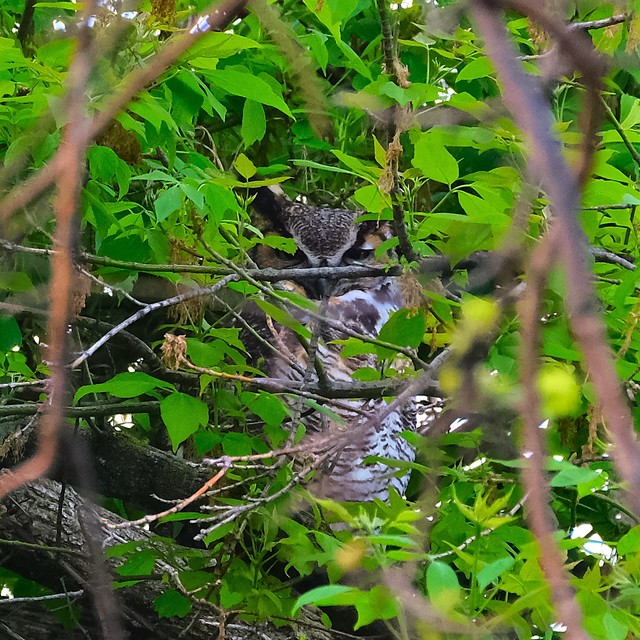
It turns out that my flight back to Delft leaves later today than I thought, so I did have enough time for one last quick visit to Estabrook Park this morning. I was happy to see the great horned owl near its usual spot on the river again, and it was a little less buried in the sticks than usual. Perhaps it is no more excited about getting soaked from brushing against all the water clinging to the branches than I am.
That’s all I had time for today, but here are some more pictures from west Texas. First is a white-throated sparrow, with its characteristic yellow-and-white eyebrow, near the Rio Grande. I also saw one in Estabrook just this morning, but couldn’t get a presentable picture.
Big Bend National Park and Terlingua in West Texas were amazing, and we saw a lot of wild life, but it is also always great to be back home and get a chance to visit Estabrook Park. I ship out back to South Holland tomorrow, so this might be my last post for a while.
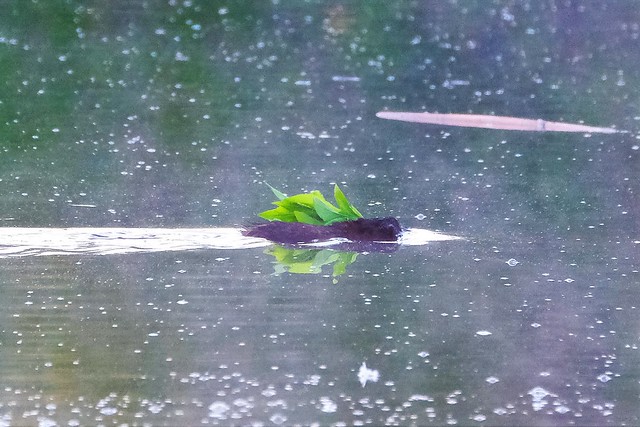
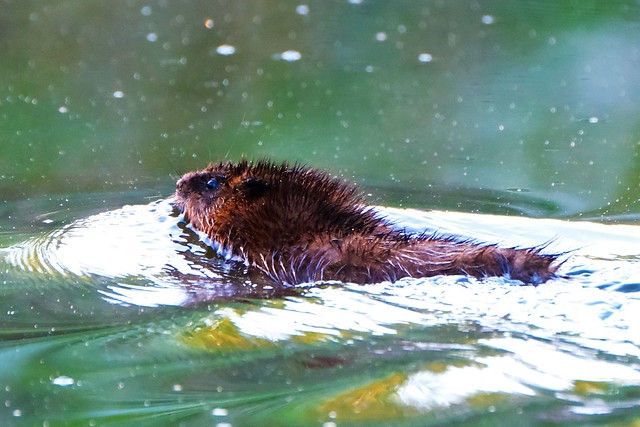
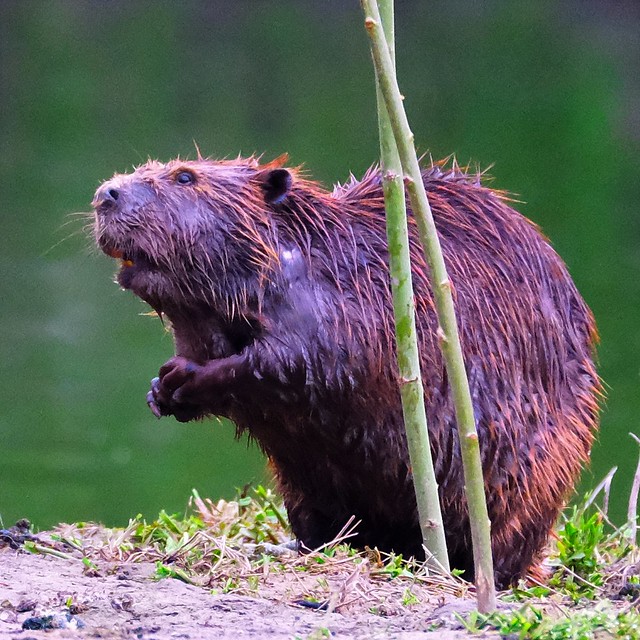
Despite the freeze overnight, as anyone who ventured out on the Oak Leaf Trail this morning knows about, today got off to a gorgeous start in Estabrook with mild temps, almost no breeze, and plenty of sunshine. The first critter I saw taking full advantage of the situation was this musk rat just off the shore of the southern island, where we saw a beaver up on the ice back in December.
At the north end, I spotted a couple pairs of common mergansers, a single goldeneye drake, about a dozen geese, and a few dozen mallards. The surprise visitor, however, was this Cooper’s hawk right overhead.
Out on the water and ice, a lone herring gull found itself a good-sized fish, perhaps already frozen
There was no sign of the great horned owl this morning, but up by the pond, the saw-whet owl was in its usual spot and as impossible to photograph as ever.
Finally, I took one last swing by the river and arrived just in time to catch this beaver giving us a swim-by.
That’s it for Estabrook today, so let me leave you with one more picture from Big Bend, a pyrrhuloxia perched in the bushes by Sam Nail’s old ranch, perhaps waiting for us to clear out so it can get a sip of water in peace. Welp, we’re gone now, so there you go, little buddy.
It was our third and last day in this amazing park, and the sights just kept on coming. We stopped first at one of the old, abandoned ranches, Sam Nail’s, and the old well acting as a water source worked as advertised. The place was abuzz with birds as the sun came into the valley. Here’s a female Phainopepla (Phainopepla nitens).
And here’s her potential mate, a shiny black male Phainopepla. “The name “Phainopepla” comes from the Greek for “shining robe,” a fitting characterization of the shiny, jet-black plumage of the adult male.” “They are not related to North American flycatchers; their nearest common ancestors are the waxwings, which also have a glossy, silky look to their plumage.” “Phainopeplas have digestive tracts specialized for eating mistletoe fruit. These berries are low in nutrients, so the birds have to consume lots of them. The berries spend only about 12 minutes in a Phainopepla’s intestine, and the birds may eat 1,100 berries in a day.” Yikes!
Finally, we hiked up the wash to the Lower Burro Mesa Pour-off, and a fellow hiker spotted this astounding creature, the first tarantula I’ve ever seen in the wild, likely a “Texas brown” (AphonopelmaA. hentzi). What a sweetheart!
Wow! What a day, eh? Tomorrow, we’ve gotta go home, sadly, so I probably won’t have anything for you, but I might be back in Estabrook the day after. Wish us luck!
Today we took a “float” down the Rio Grand. Anne was surprised that we had to paddle, and I was surprised that we hit white water. Happily, neither surprise did us in, and we did see some more amazing sights. Here are a couple of the highlights.
Another fun surprise was this lone American pipit(Anthus rubescens) foraging in the shallow water. It nests in either “Arctic tundra and alpine meadows,” and “if you don’t live in the Arctic or above treeline, look for these birds in winter.”
Finally, once we got back to our lodge, there was still a smidgeon of light, so I took a walk to see if the setting sun had brought anyone out, and look who I found:
That’s a full quartet of mule deer including a well-antlered buck. Cool, eh?
Anne and I finally arrived this afternoon and immediately set out to see who we could see. In short order, we spotted 14 bird species, 8 of which are entirely new to me, and one butterfly. The wifi is kinda slow here, so I’ll just post a couple pictures to whet your appetite.
After I got home from Estabrook yesterday, I got a cryptic message on the facebook that mentioned “saw-whet”, and then I saw on ebird that someone reported seeing a northern saw-whet owl (Aegolius acadicus) in our very own park, so I hustled right back over there. Then, as I was methodically checking the trees by the pond, I even got a text message which helped me narrow my search, and here’s the result of all that excitement: the smallest owl in eastern North America. In the picture below, from yesterday, it appears to be looking over its right shoulder, and you can just make out its dark right eye and its beak.
I had hopes of getting a better image this morning, but the skies were just as dark as yesterday, and the little stinker wouldn’t even face our way today. Oh well.
Anyway, elsewhere in the park, the great horned owl, the largest owl in all of North America, was back in its regular spot but a little less buried in the sticks than last time. What are the chances of seeing both owls on the same day, right?