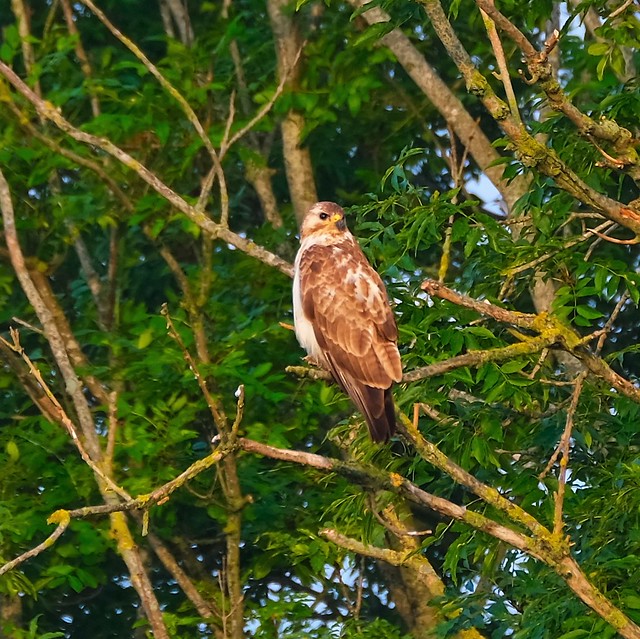
Once I got out into the countryside, I spotted our buzzard again, in its usual spot.
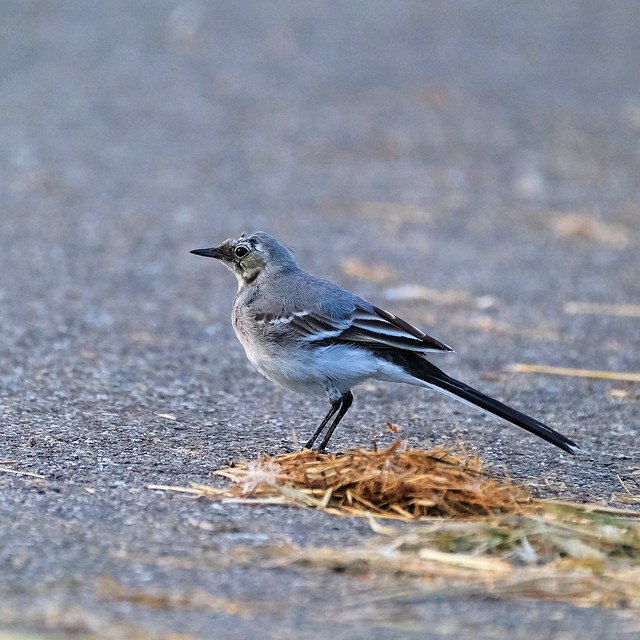
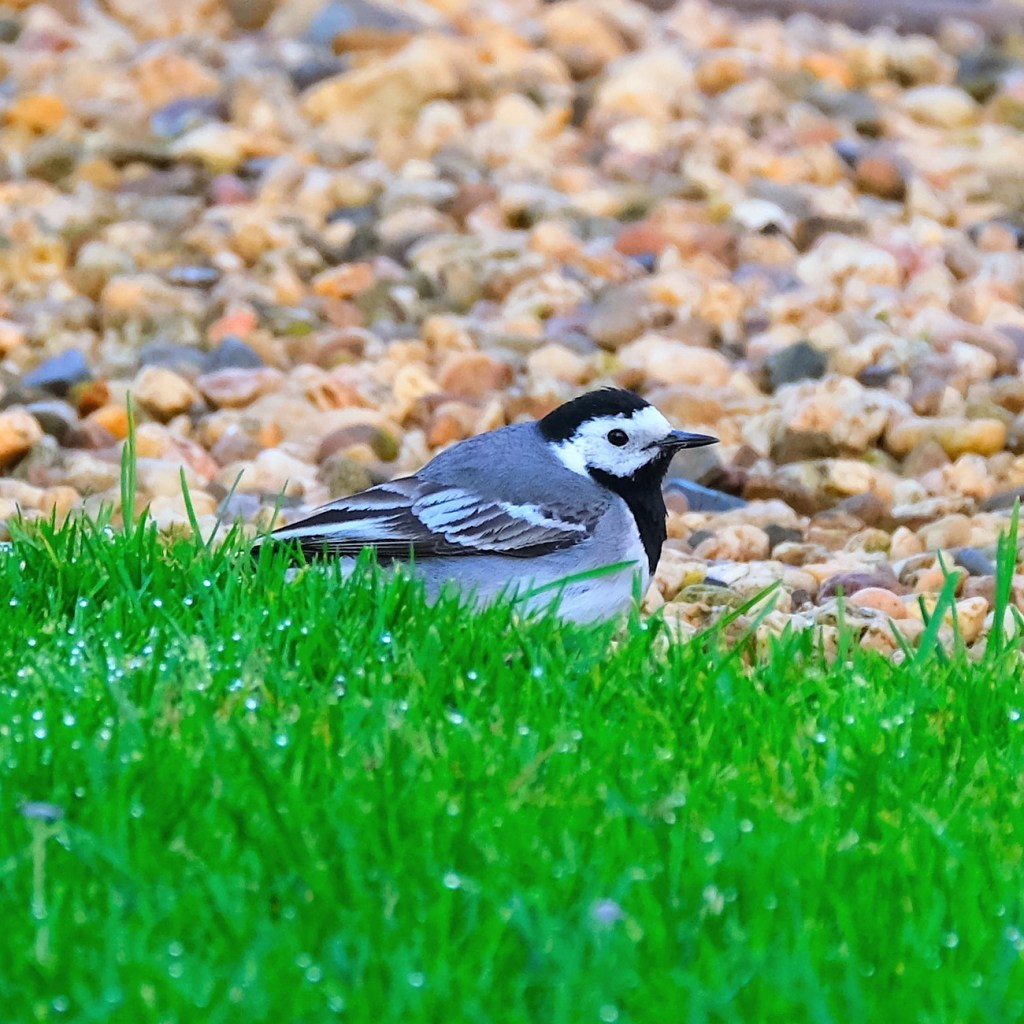
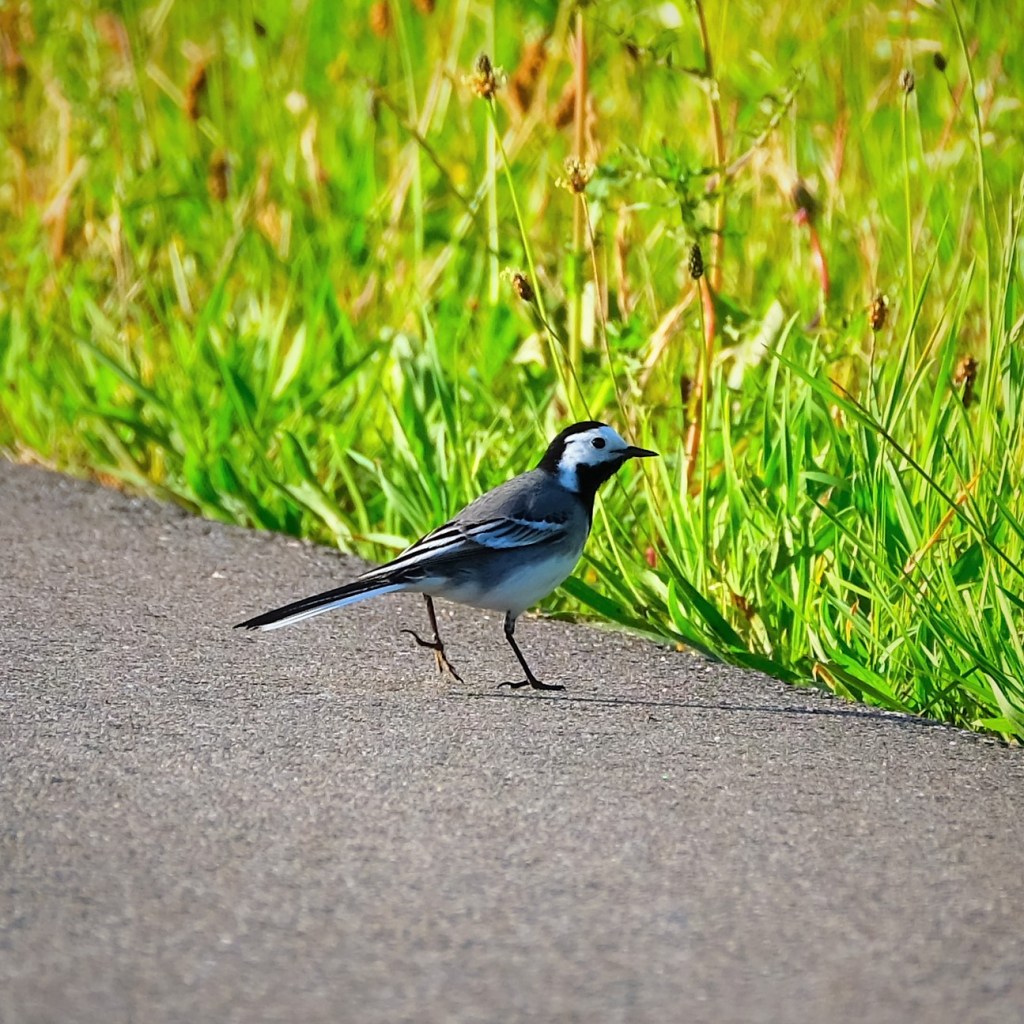
Just beyond the buzzard there were several small birds foraging along the edge of the bike path, and one was kind enough to let me have this close up. Based on its color and its behavior, I thought maybe it might be a grey wagtail, but they are surprisingly yellow. Instead, this little one turns out to be a juvenile white wagtail. The adult white wagtails I’ve seen also like to forage on pavement.
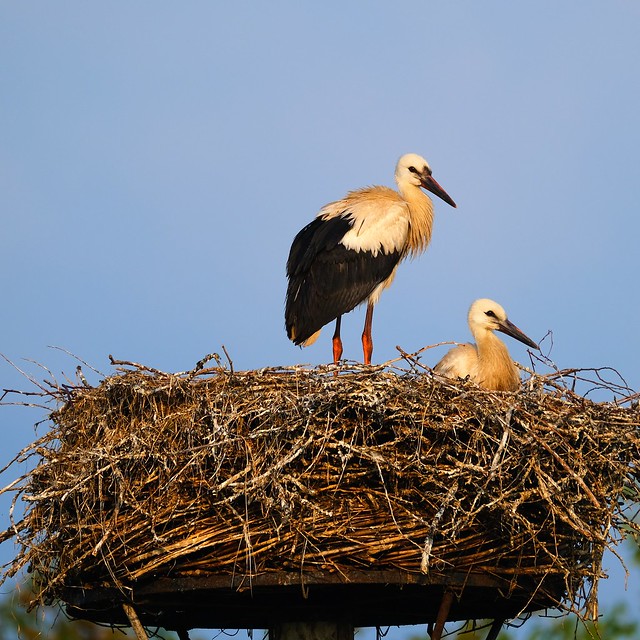
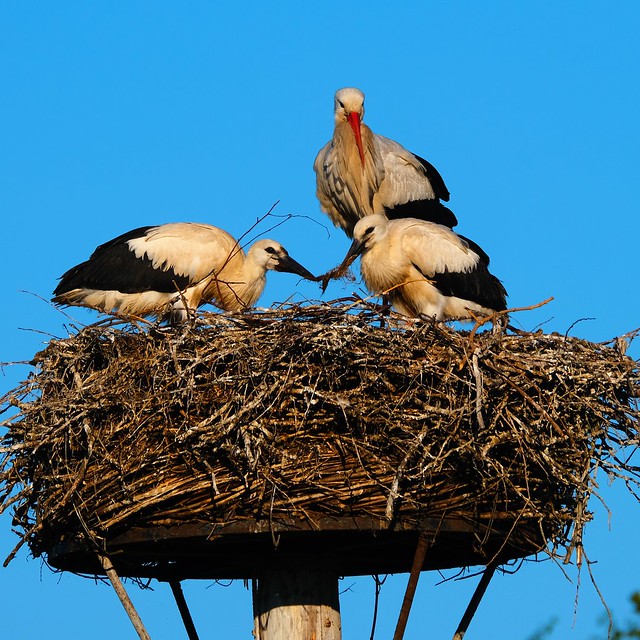
I reached the stork nest at last and found the two youngster starting to show a little orange in their beaks.
And one adult keeping an eye on things from the comfort of a nearby chimney.
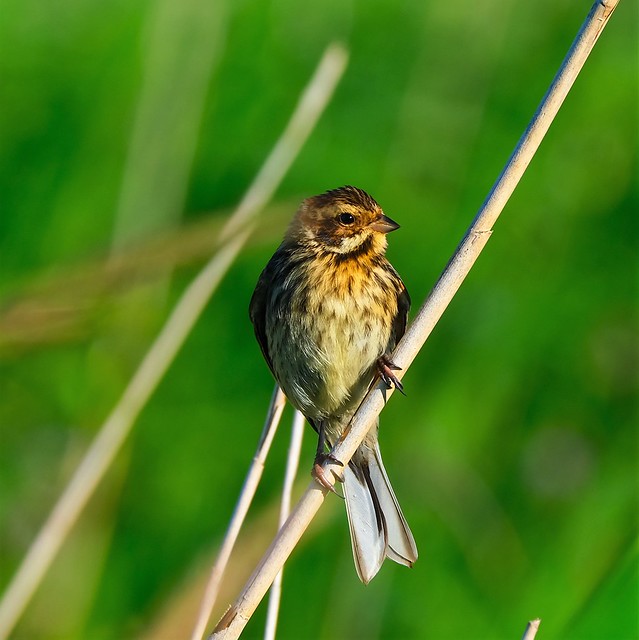
Finally, my old buddy Brian wrote in to suggest that mystery bird number 1 is a reed bunting, and at first I thought “no way!” I’ve already posted pictures of a reed bunting, and I checked the immature/female pictures online, and they were far too drab for our mystery bird. But then I scrolled a bit further, and sure enough, there’s our cutie. The first few pictures were just taken with a drab camera, I guess. Here’s one image again, to refresh your memory.
I’ve still got some pictures left from the weekend, so here we go.
I believe this little cutie is a chiffchaff granting me a more-intimate portrait than last time.
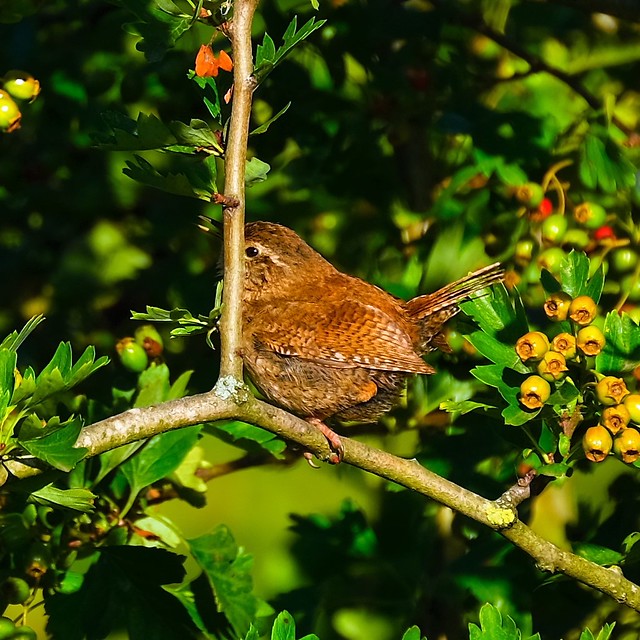
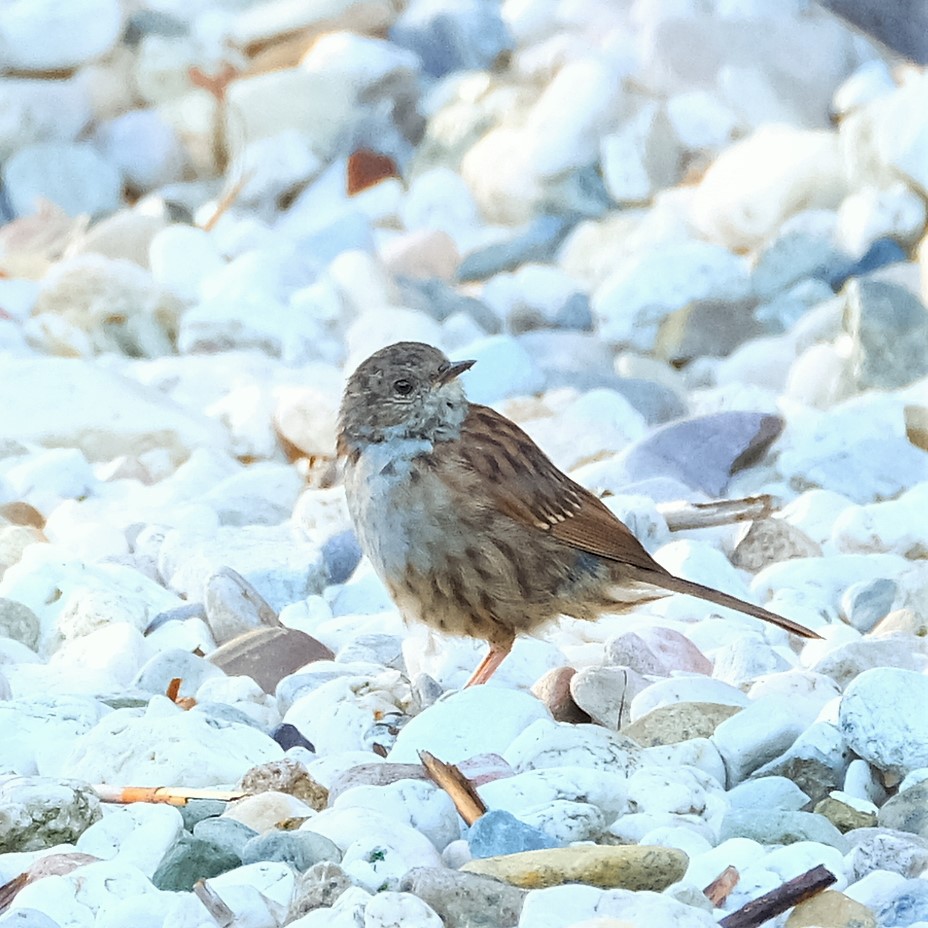
This, however, is mystery bird number one. It looks like a sparrow, or a bunting, but I can’t find a good match, even though it was kind enough to offer me such nice back and front views.
Same goes for this mystery bird number two. I thought for sure it was a young or female chaffinch or goldfinch, but I can’t get a match on this one either.
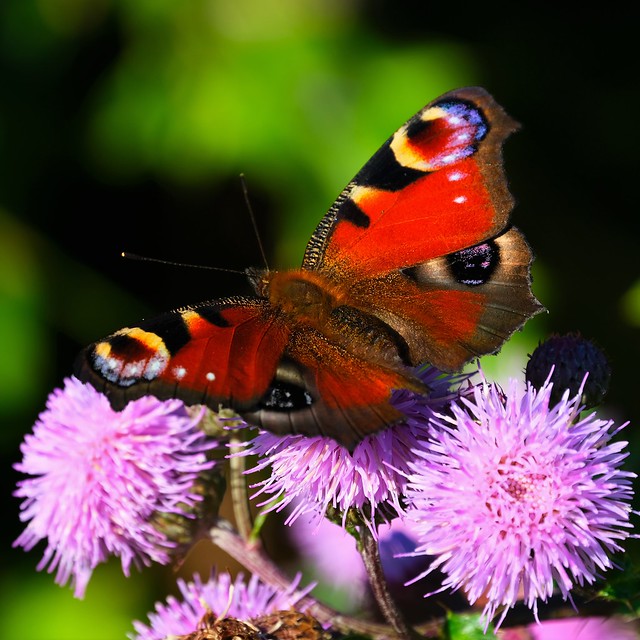
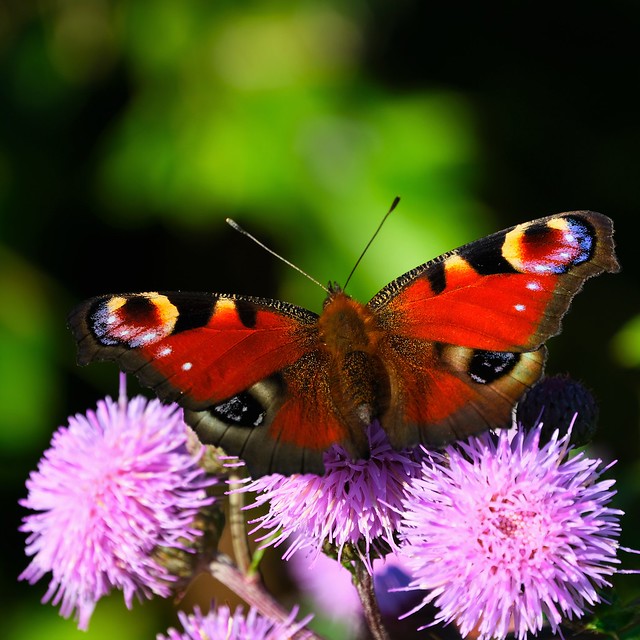
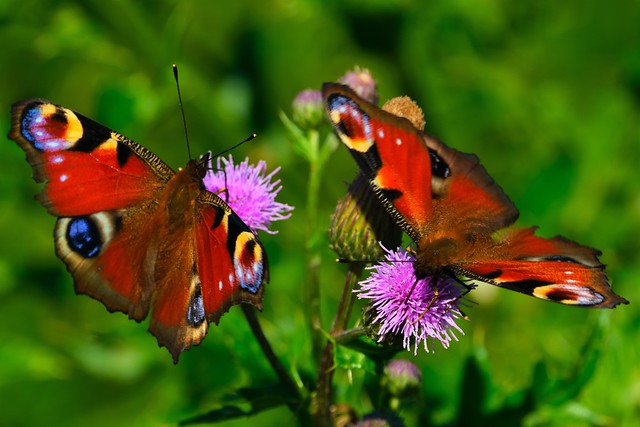
At least there’s no mistaking this peacock butterfly. Phew!
If you have any more luck than I have with identifying mystery birds one or two, please don’t hesitate to chime in.
Boy, could he sing. I’ve glimpsed them out in the countryside, too, near where I’ve captured the chaffinch and goldfinch, but I couldn’t get an image until Sunday.
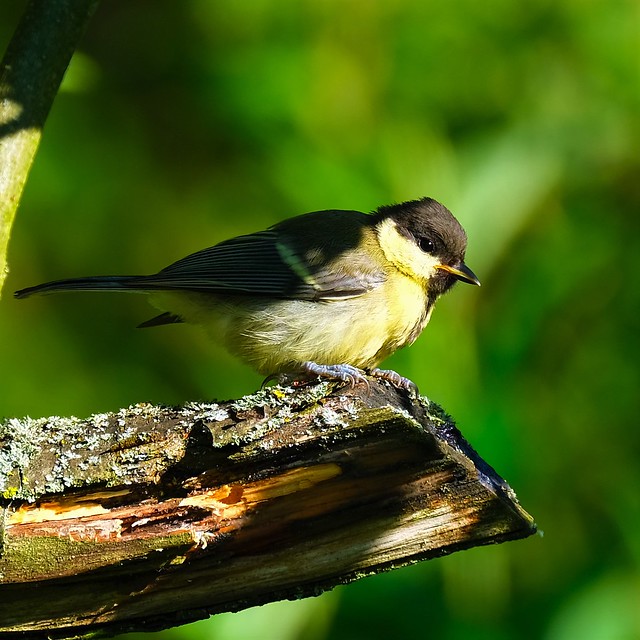
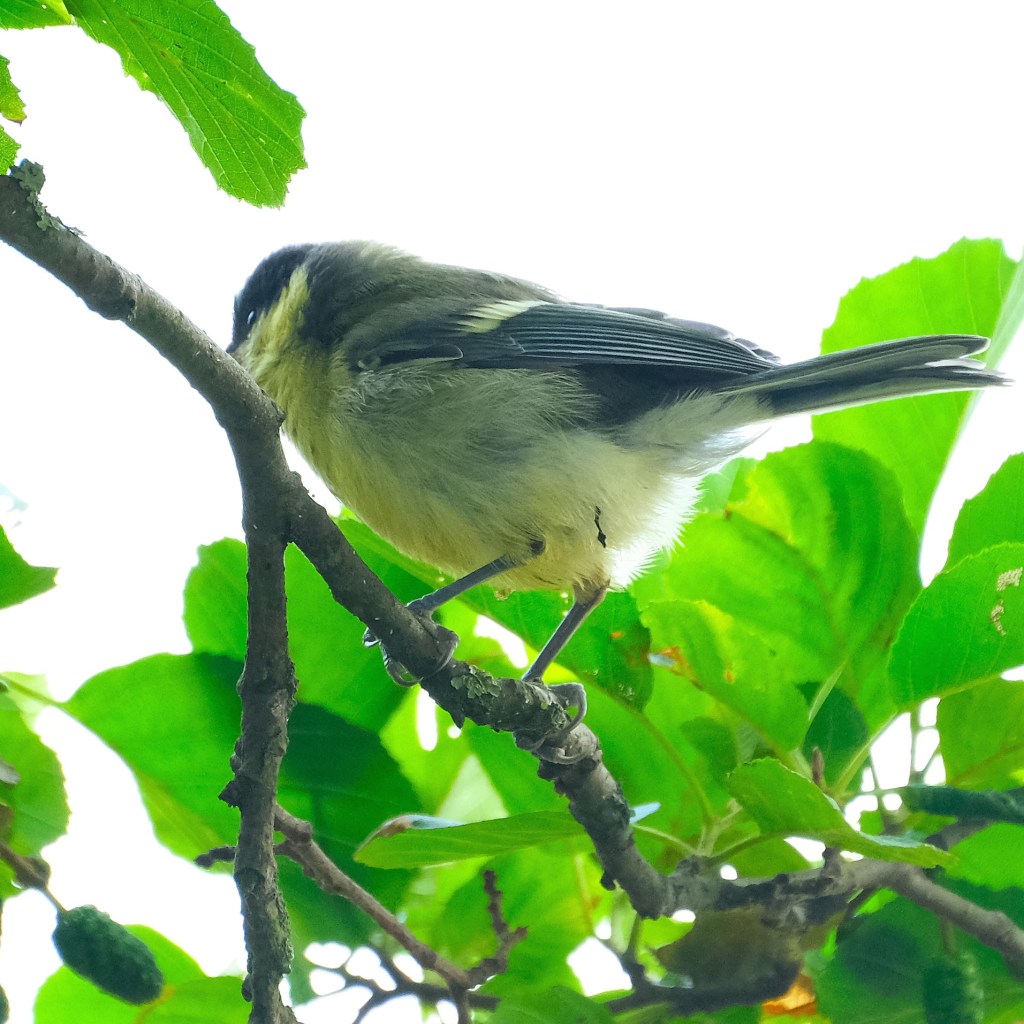
Here’s a typical view I get of a great tit, also in the cemetery. Not so great, but you can clearly see its white cheeks and black beard.
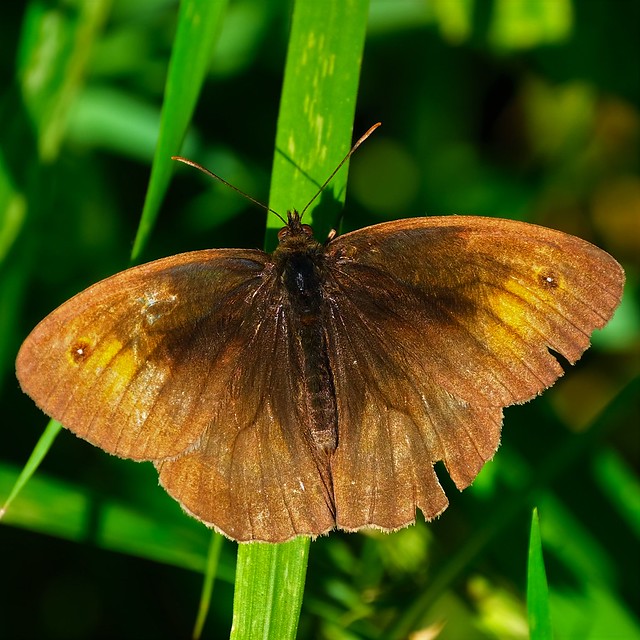
Here’s an image of another meadow brown butterfly showing the top (dorsal) side of its wings. Pretty enough, if you’re into earth tones, I guess, but not as nice as the bottom (ventral) side I showed you already.
For comparison, here’s yet one more look at a peacock butterfly, because I took so many, and because I just can’t help myself. They clearly chose a different path.
After taking pictures in the countryside and writing to you about it on Saturday, I went on a big bike ride to run some errands, so Sunday morning I needed a break from my bike saddle. Luckily, I’ve gradually noticed a big chunk of forest right in the northwest corner of the TU Delft campus, and it took me only about 10 minutes to walk there. It turns out to be a huge cemetery, surrounded by a moat except for one short gated part, and the gate was not locked. I haven’t been in a forest this deep and peaceful since following the Milwaukee River through Estabrook Park. Sweet!
I could hear birds, of course, but they hide a lot better in the leafy treetops than big birds can in the fields or on the water, so it took me a while to find them, but I did manage to spot a couple.
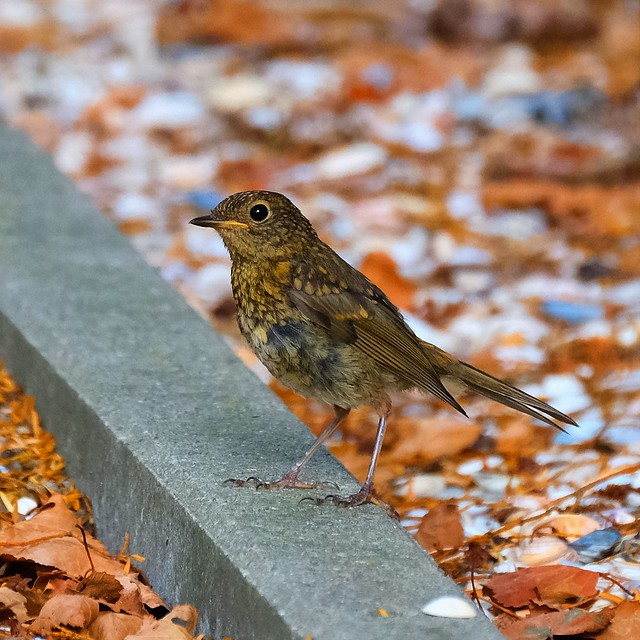
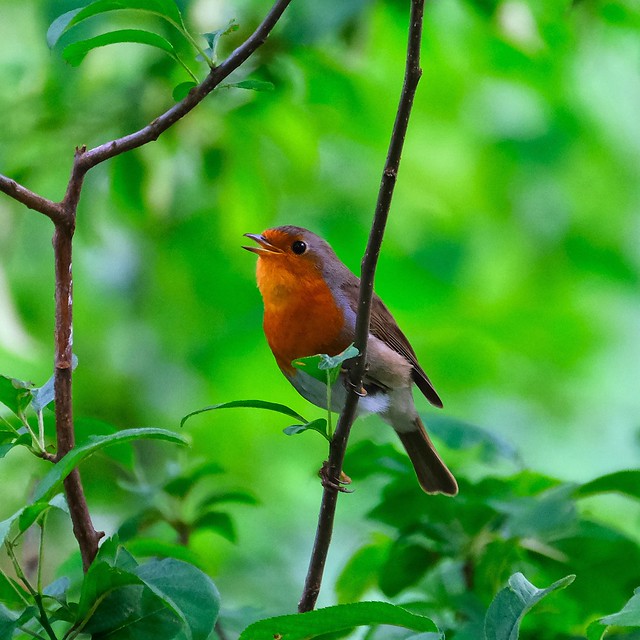
I’m thrilled to finally be able to show you a European robin (Erithacus rubecula). It is a lot smaller than the American robin and not even in the same family. The Pedia of Wik claims that “the distinctive orange breast of both sexes contributed to the European robin’s original name of ‘redbreast’,” since “orange as a colour [sic] name” was “unknown in English until the 16th century, by which time the fruit had been introduced.” Further, “in the 15th century, when it became popular to give human names to familiar species, the bird came to be known as robin redbreast, which was eventually shortened to robin.” Etymology seems almost as fun as entomology.
Finally, here’s one more look at one of the amazing peacock butterflies from Saturday.
Google maps thinks the cemetery is about 11.5 acres, almost the same size as Downer Woods on the UWM campus, and the total area bounded by roads is a whopping 23 acres, about the same as “the entire Downer Woods area“. Quite the little accidental urban nature preserve.
I spotted another chaffinch, now that I know where to look, and this one even appeared to be gleaning seeds from some chaff, supposedly the behavior for which it was named.
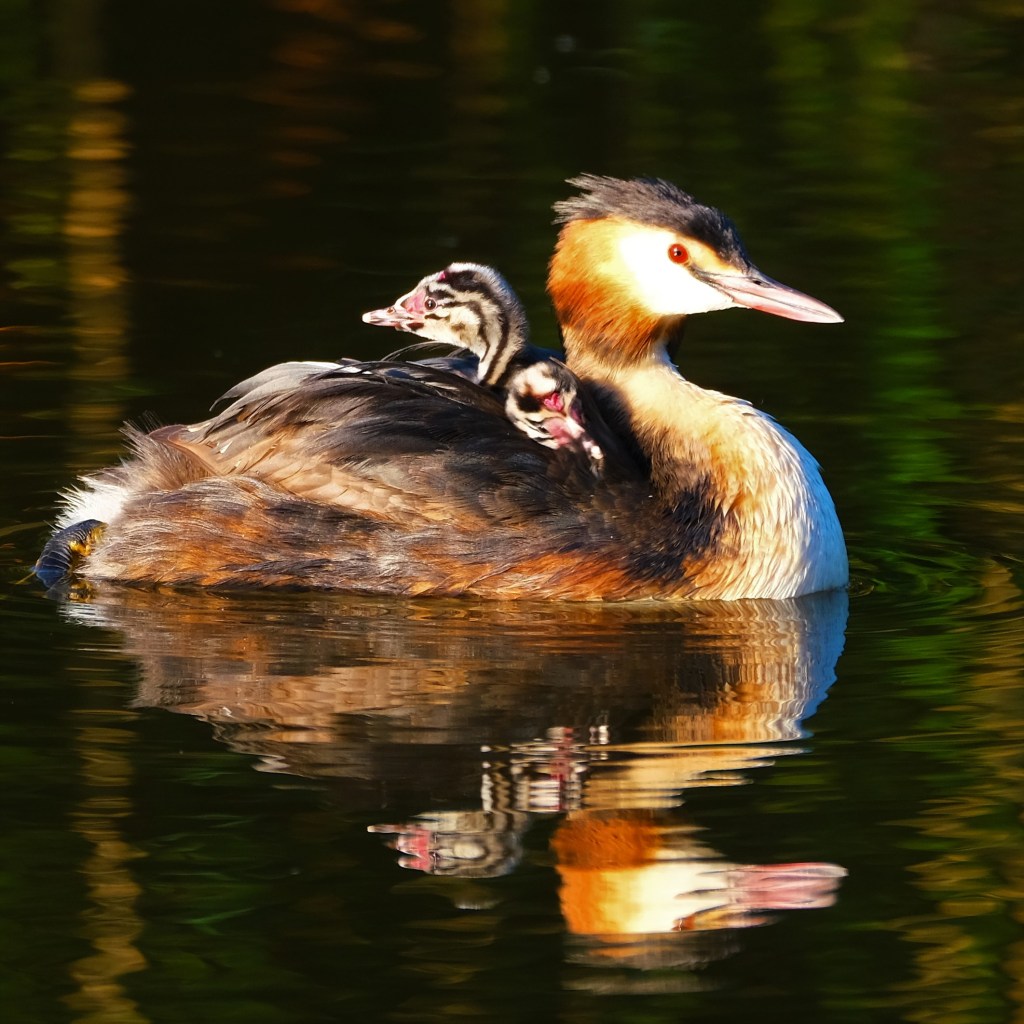
And here are a pair of great crested grebes doting on their chick. The adult on the right surfaced with some little morsel in its beak, paddled over and passed it to the adult on the left, who then fed it to the chick.
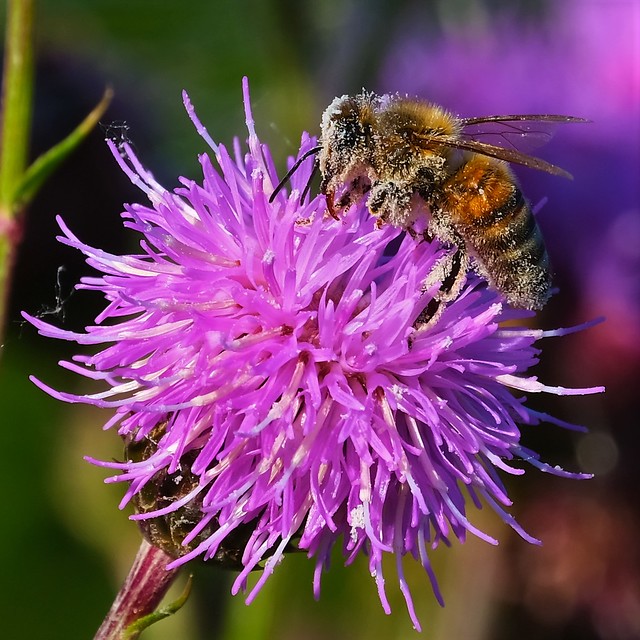
Finally, those thistle blossoms aren’t feeding only butterflies, and here’s one with a well-pollinated honey bee. Given its location, perhaps it is a “western honey bee or European honey bee (Apis mellifera),” “the most common of the 7–12 species of honey bees worldwide”
That’s it for now, and I’ll show you more tomorrow, if things go according to plan.
Well, I’ve been here for over a month, and I now have a local bank account into which I got paid and from which I paid my rent for July, so it looks like they’re going to let me stay a while. That’s cool ’cause now that I’ve had a taste, I’d like to see how this whole experiment turns out.
We had a beautiful morning here today, and my first stop was at the stork nest, where the chicks look healthy and appear even to be showing a little sibling rivalry.
There were new butterflies out today, and here’s a beautifully earth-toned, female “meadow brown” (Maniola jurtina) feeding on a thistle blossom on the berm between the bike path and the canal.
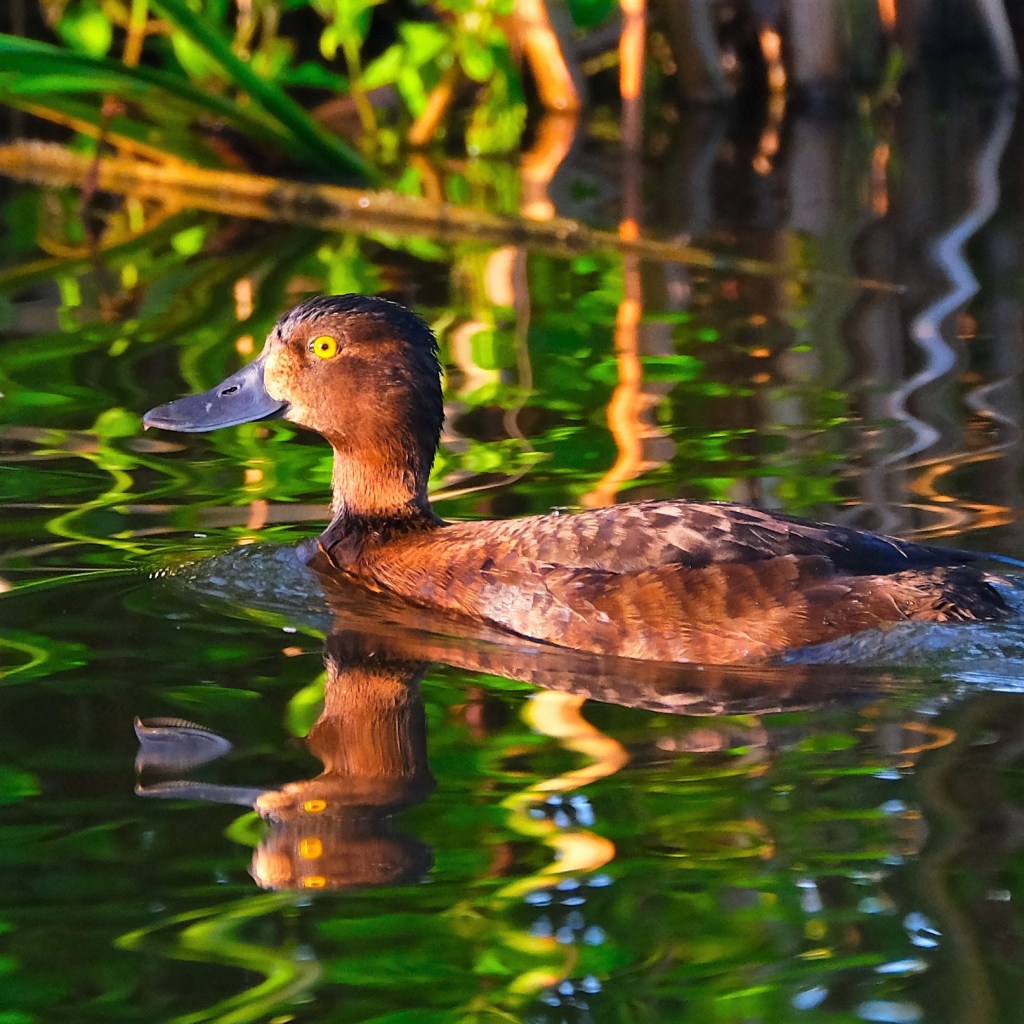
It did rain last night, as forecast, but the skies were mostly clear by morning, so out I went again. This time a female tufted duck was the first to greet me with a photo-op. I do see them around, from time to time, but I haven’t taken a picture of one since staying by the Kralingse Plas back in May.
I checked in on the storks again and found one parent and two chicks at home. You can see one chick peeking over the rim of the nest to help mom or dad keep eyes on me.
The stork nest is in the back yard of a house in a row of nice houses, and I often find little birds in the front yards. Here’s another white wagtail on someone’s garden path.
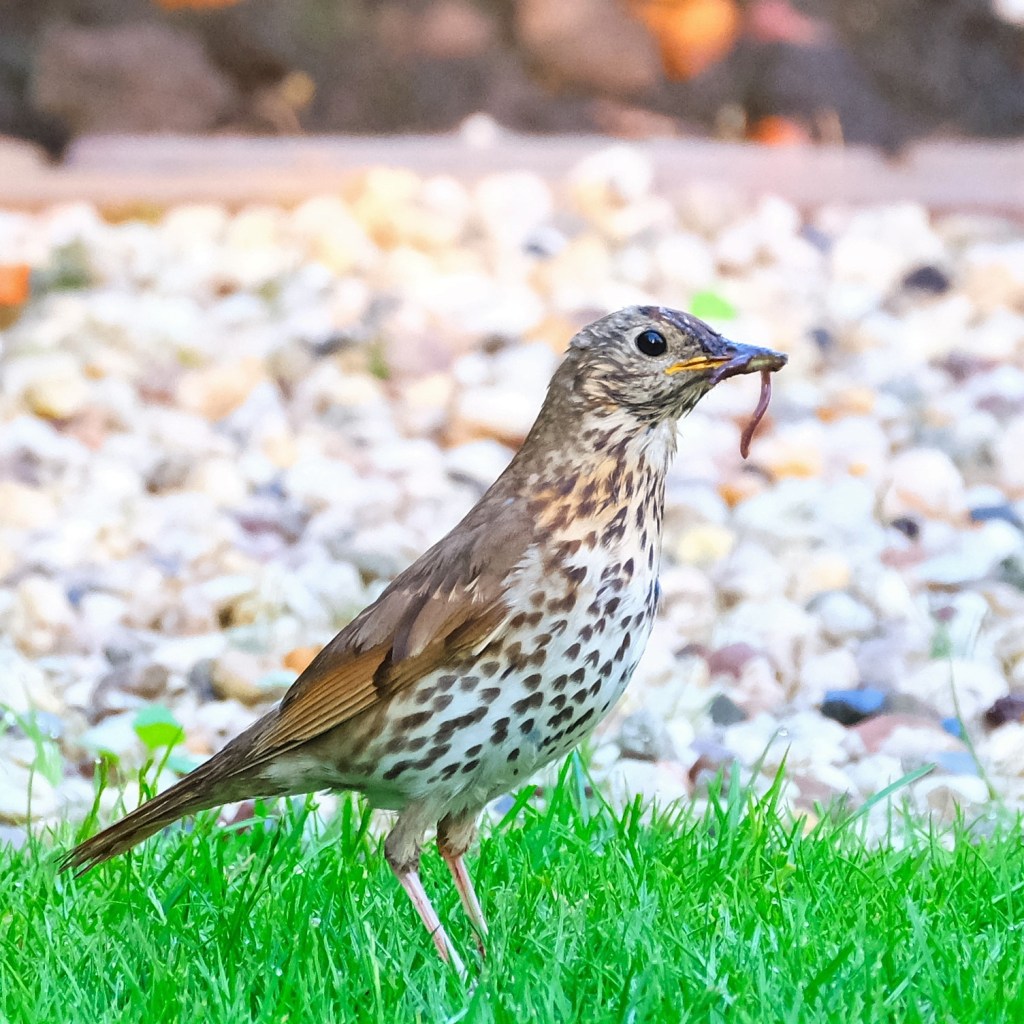
Here finally is a new bird for us, and I’m pretty sure it’s a song thrush (Turdus philomelos), although it might be a mistle thrush. I don’t recall seeing one before, but I spotted three different ones today. Oddly, it is in the same genus, Turdus, as the American robin, but the thrushes we see in Estabrook, the hermit thrushes and Swainson’s thrushes are not. Instead, they are in the genus Catharus. And, yes, this will all be on the final exam.
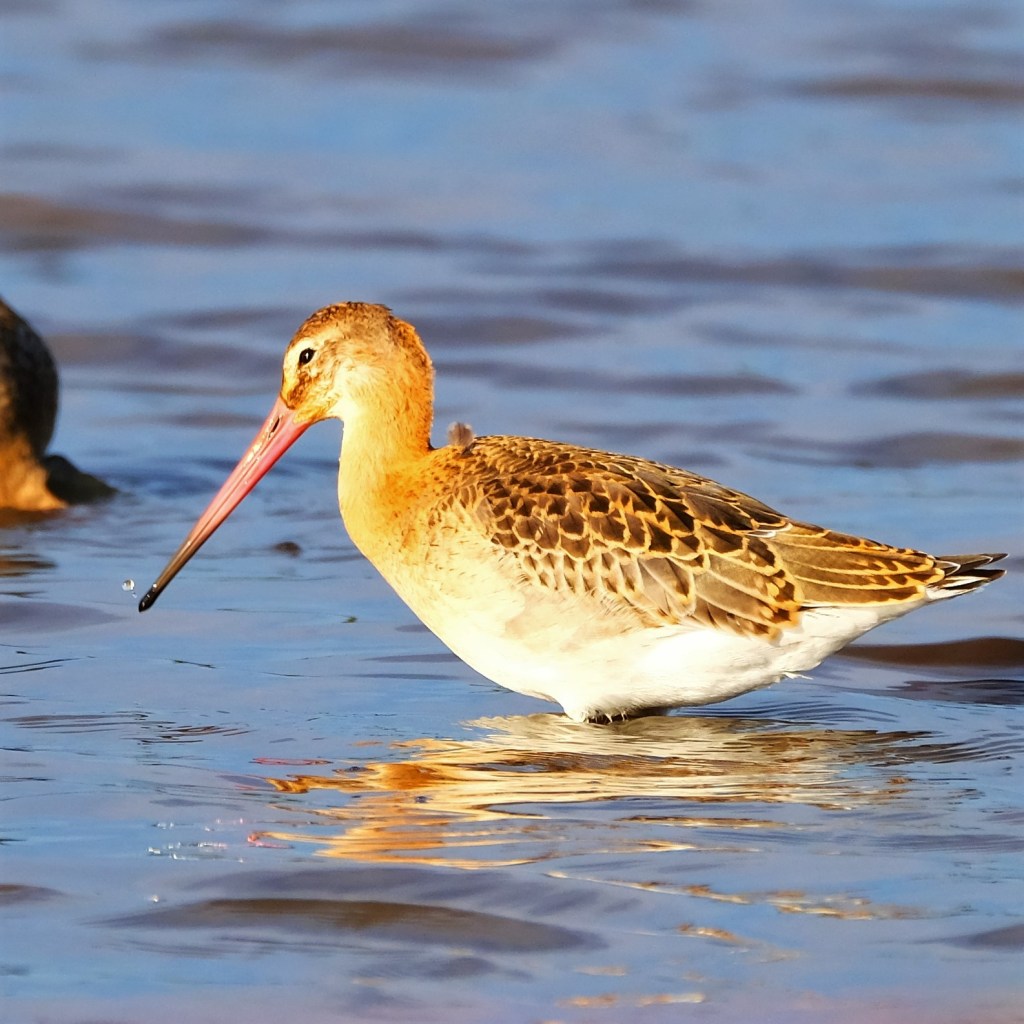
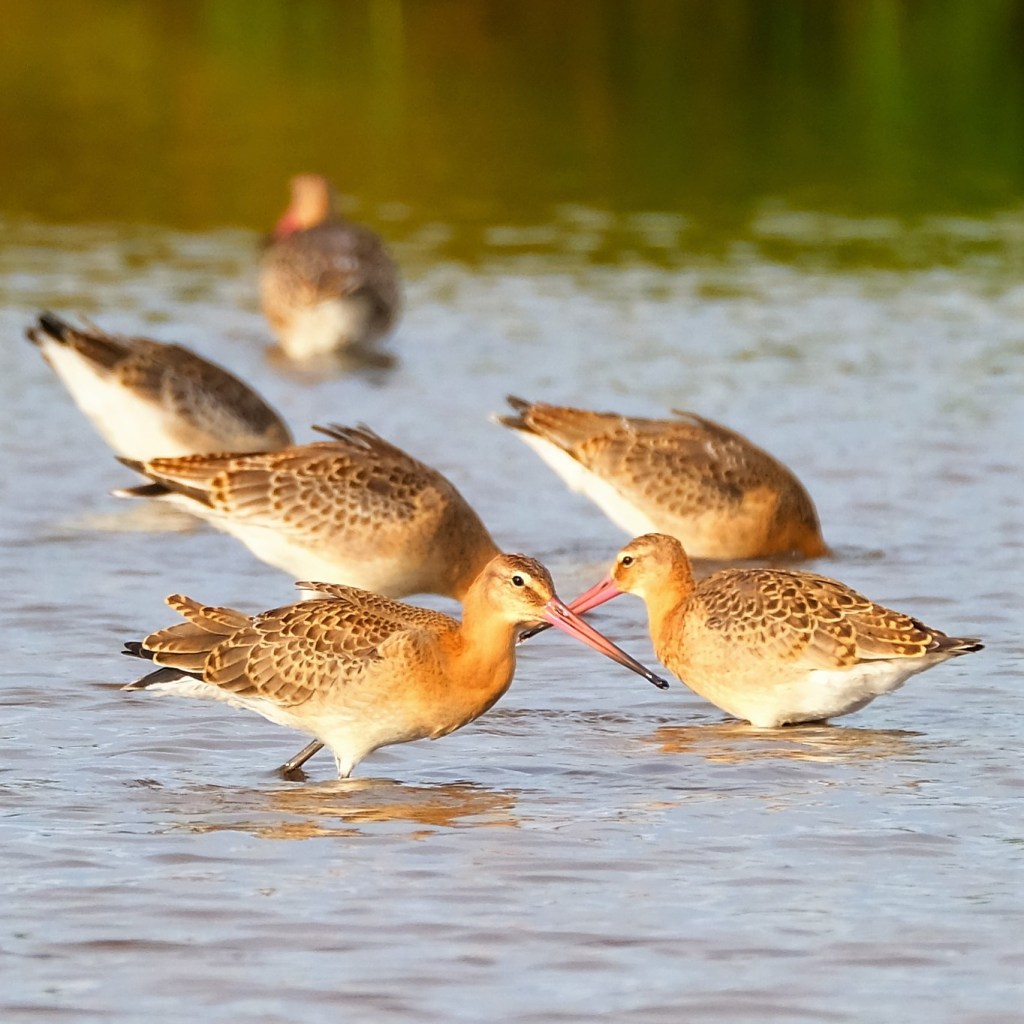
There was no sign of human activity this morning in any of the houses or yards in that row, but I didn’t want to hang out with binoculars and a long lens for long enough to cause some, so I tore myself away and continued on to the open water, which was still teaming with bar-tailed godwits. Here’s the one with the best pose this morning.
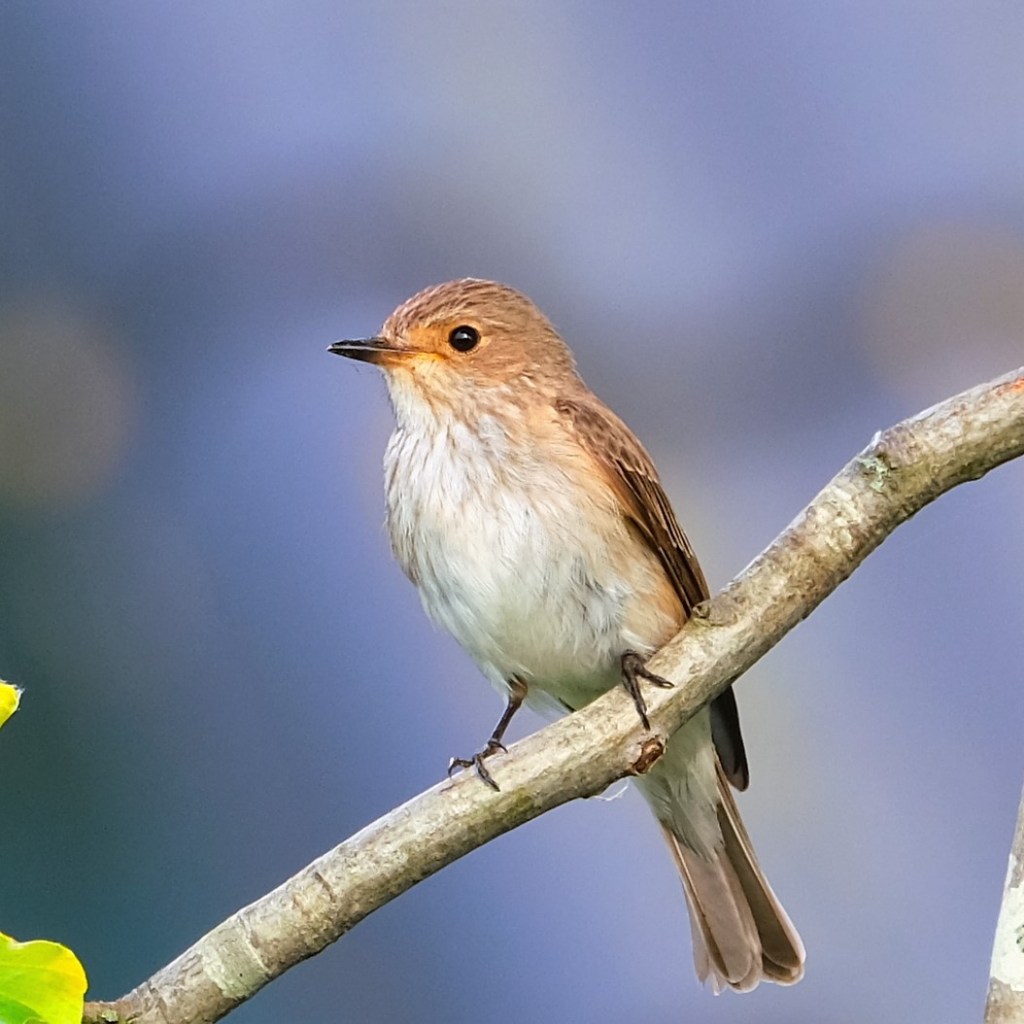
I didn’t see any new waders today, and I had to go back by the row of houses anyway, so I stopped to see if there was anyone new around, and that’s when I saw this spotted flycatcher (Muscicapa striata) flying sorties from and returning to the same spot on a branch, just like the flycatchers and phoebes in Estabrook Park. It’s an “Old World flycatcher“, however, so isn’t even in the same family, despite the “superficial” resemblance.
Then I finally struck gold in the form of this colorful European goldfinch (Carduelis carduelis). I’d been catching glimpses of that bright yellow wing for a while, but this is the first time I got a good look at one, let alone getting anything on “film”.
It rivals the chaffinch, doesn’t it? The guy who came up with “goldfinch”, however, must have felt like an idiot after he got a load of the American goldfinch. He should have gone with Ewijk finch, since the village of Ewijk uses the same, white-orange-yellow-and-black, color scheme in their flag.
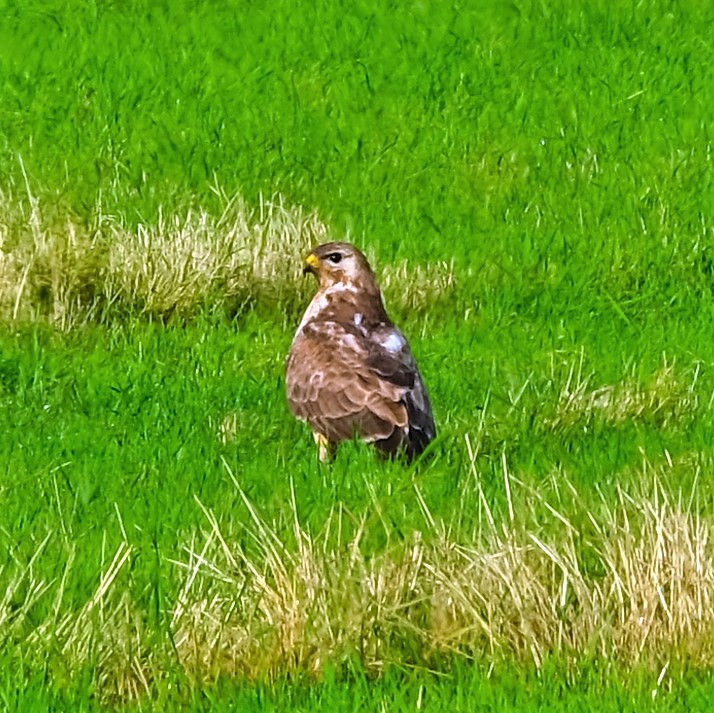
As I continued to make my way back to Delft, I spotted another bird of prey in the distance, and its large size, brown and white feathers, dark eyes, yellow and dark beak leads me to believe it is a common buzzard (Buteo buteo).
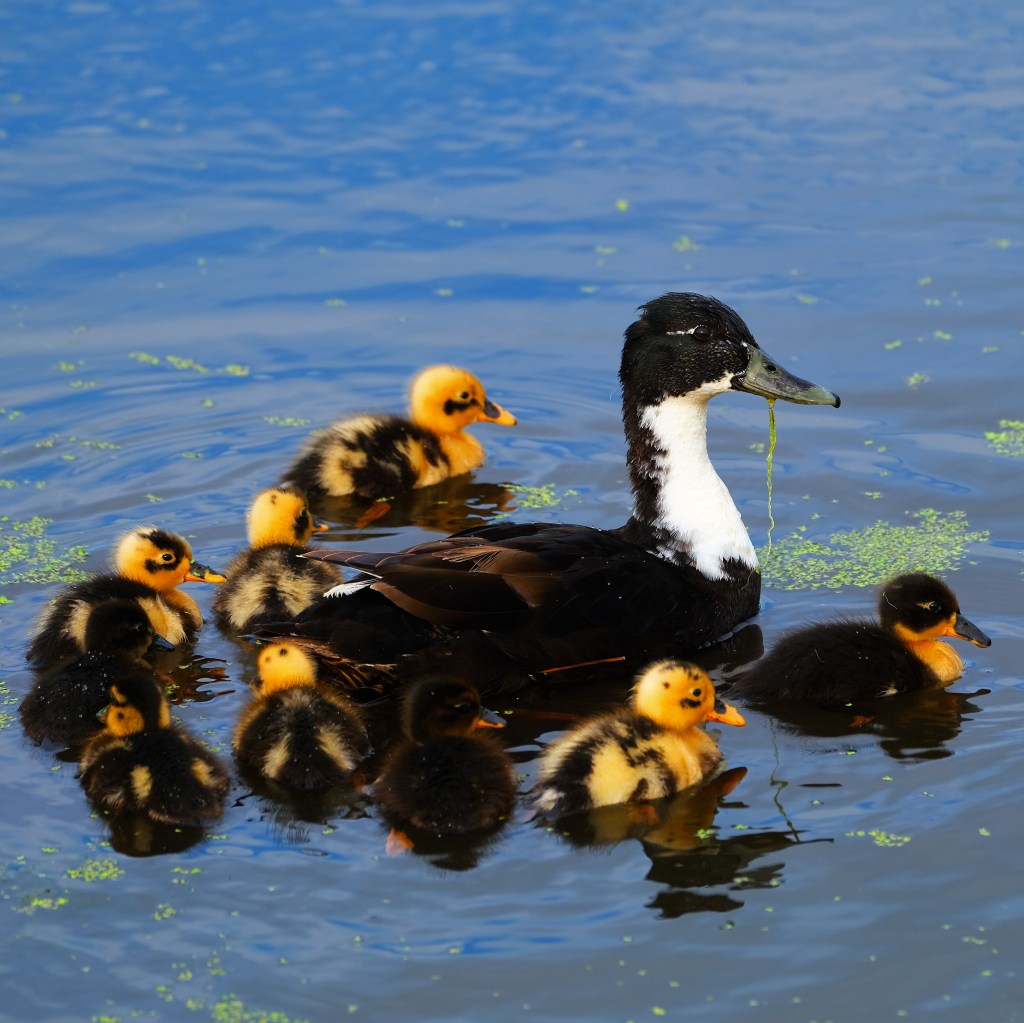
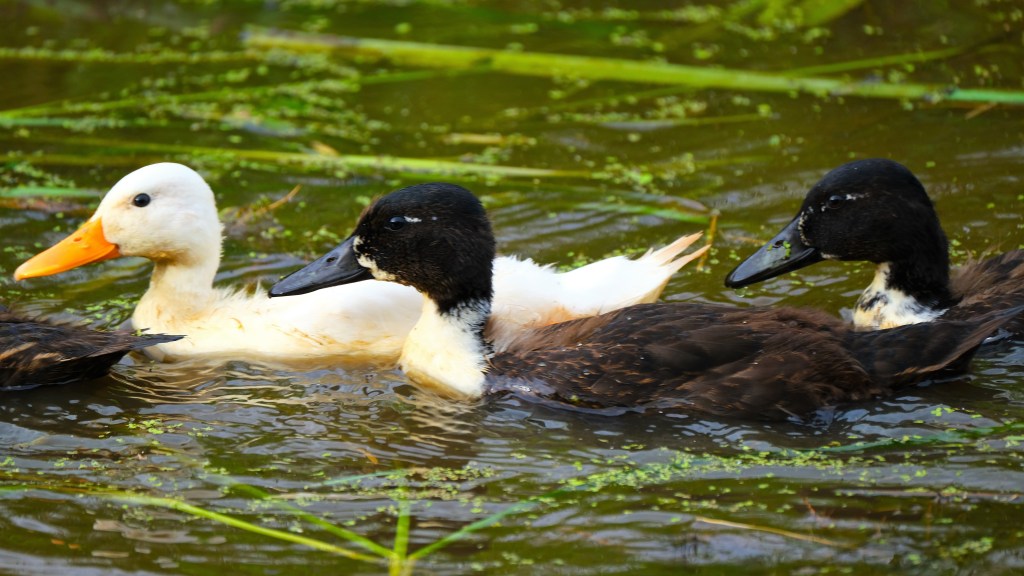
After the buzzard, I figured I was done for the morning, and I put my camera back in my backpack, but it didn’t take long before I had to take it back out again for another Swedish blue domestic hen with a fresh batch of nine (9!) ducklings.
Meanwhile, right behind me, on the other side of the bike path, a spoonbill was busy foraging a lot closer to me than the previous one did, so here you go. Go ahead and count those feathers.
WordPress wouldn’t let me upload these last two images because it claims I’ve used up the full 13GB of storage that comes with my subscription, so I’m trying something new. I’ve uploaded the images to my flickr account instead and just gave WordPress the url for each of them. They look fine now, as I edit this post, and I’ll be curious to hear if you can tell the difference.
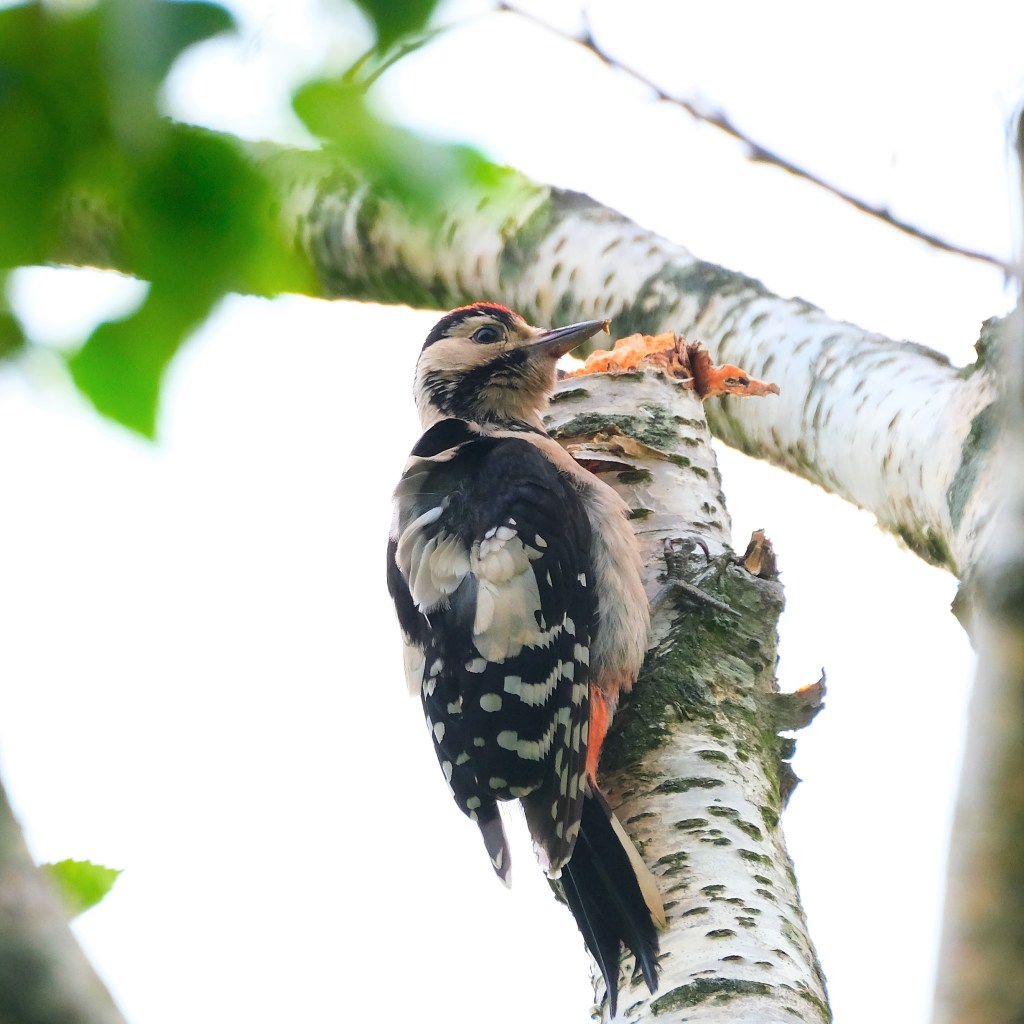
The clouds were pretty low and grey this morning but at least they weren’t leaking, so I rode out to the countryside to see what I could see, and I was soon greeted by this young great spotted woodpecker (Dendrocopos major) rustling up some breakfast in a birch tree that has seen better days.
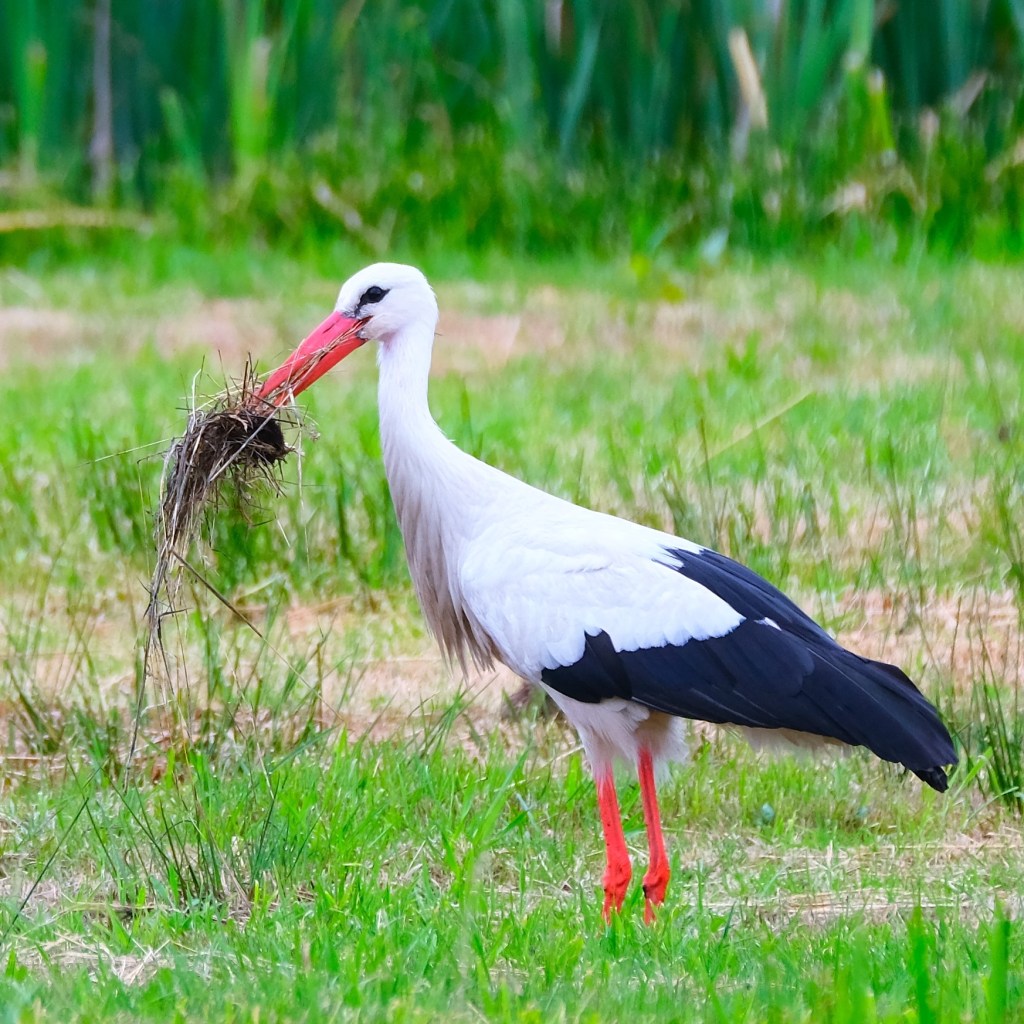
Anyway, moving on, I spotted one of the white storks, before I even reached their nest, with what looks like a beak full of dead grass.
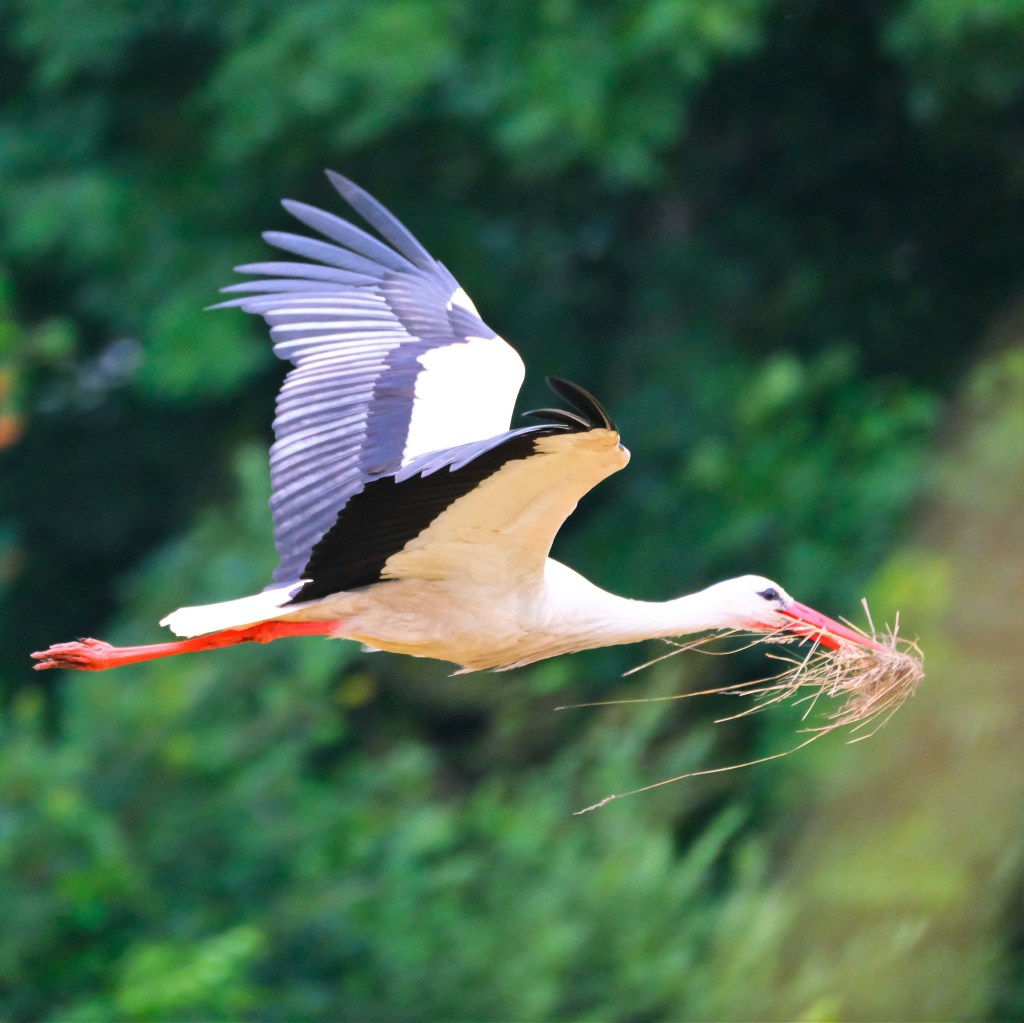
And I guess it really needed that because off it went.
I didn’t get to see what happened to the clump of grass, but at the nest today you can really see how much smaller the chicks are than the adults, half-sized or less, even though they already have adult-looking white and black plumage.
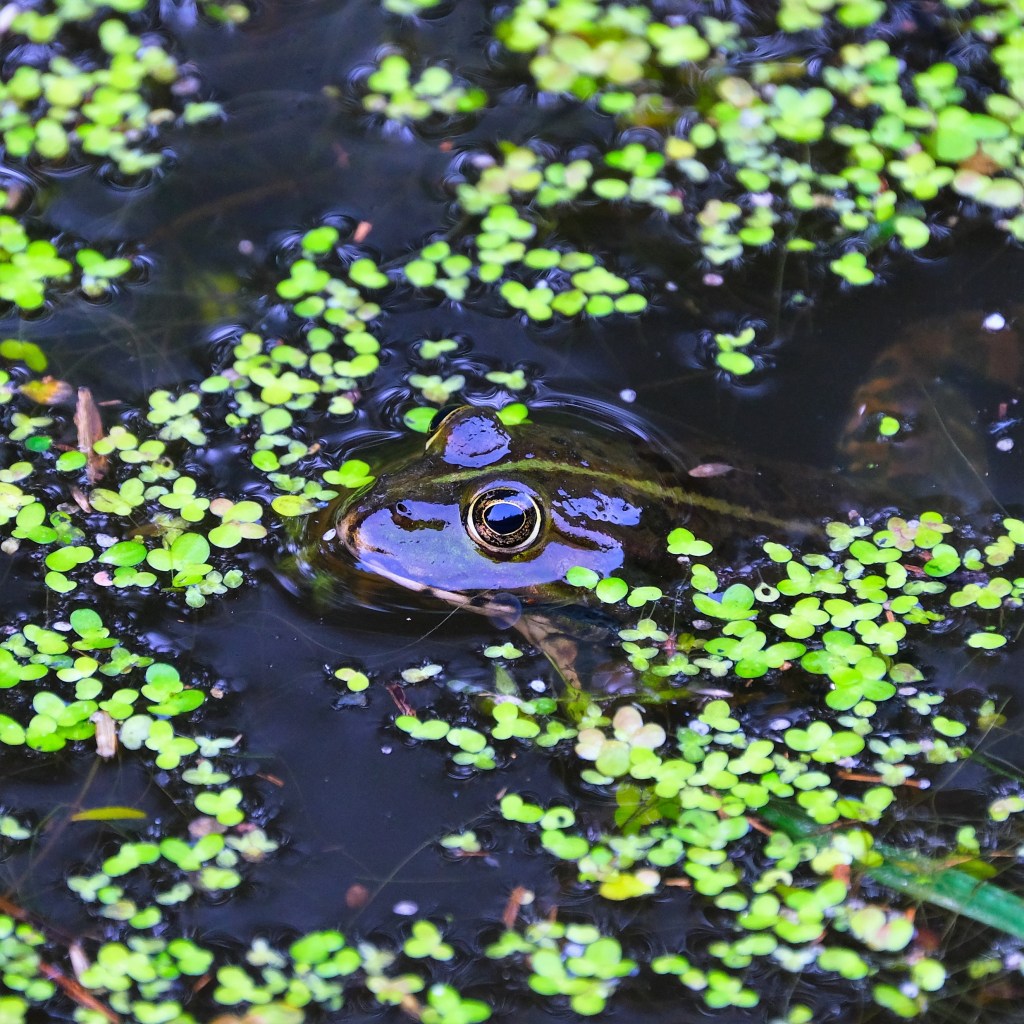
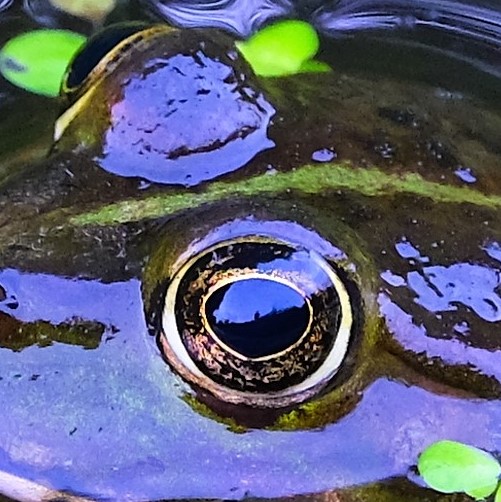
Meanwhile, in the canal right behind me, this pool frog (Pelophylax lessonae), based on the light stripe down its back, stopped singing when I approached, but did let me see what it looks like, for the first time.
Check out the reflection in its pupil of me standing on the edge of the canal. Ha! My first Dutch self-portrait.
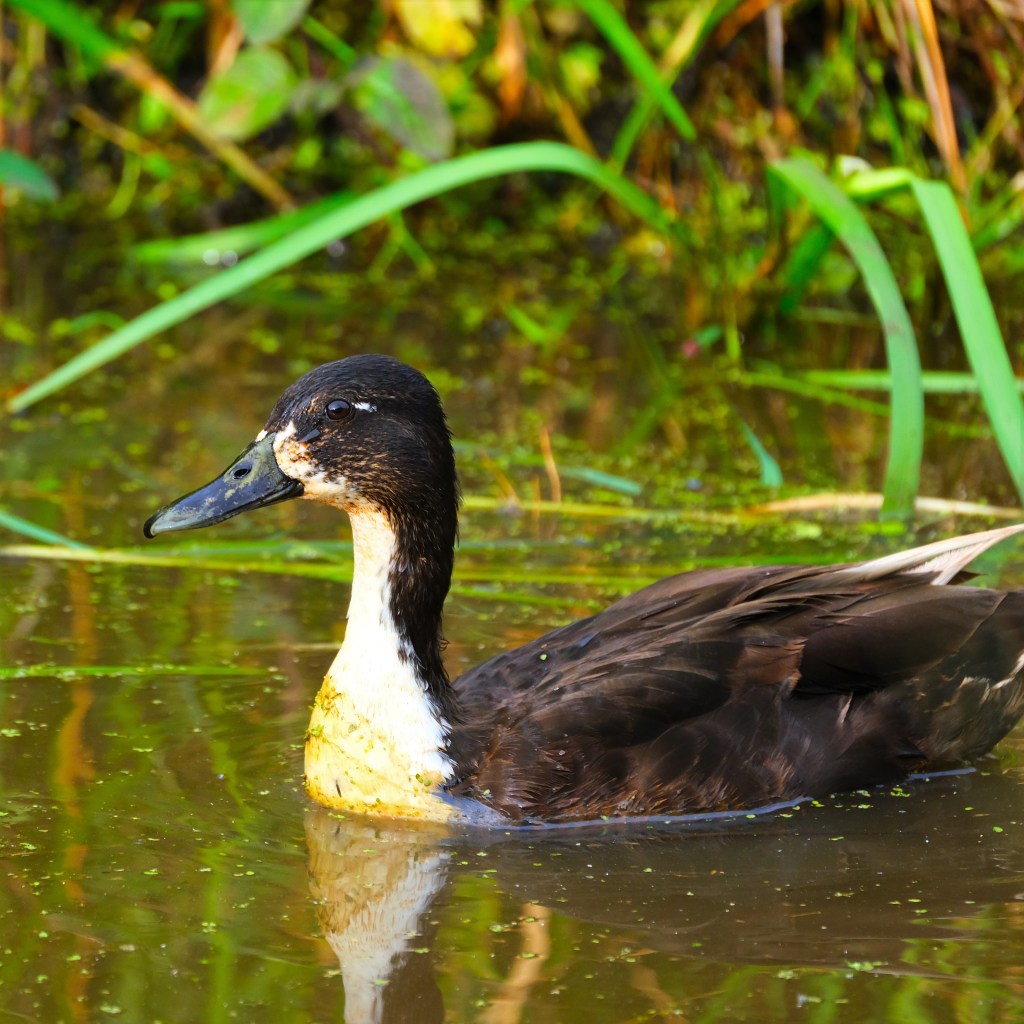
In another canal, I spotted a new duck, which appears to be a “Swedish Blue” domestic, and who perhaps is on maternity leave from some nearby barnyard…
’cause she had some ducklings in tow. I wonder if they know.
To round up our wader count to five, here’s one more grey heron behind some tall grass on the edge of a canal.
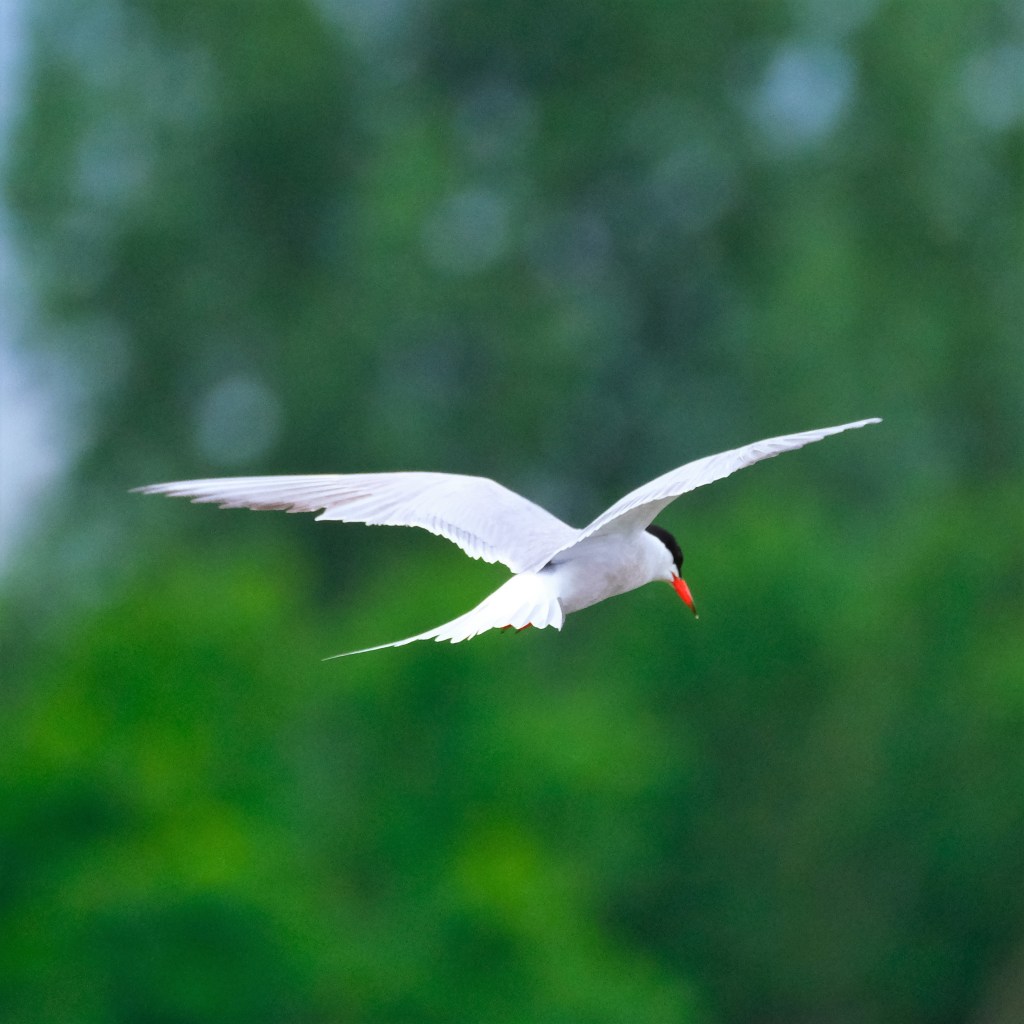
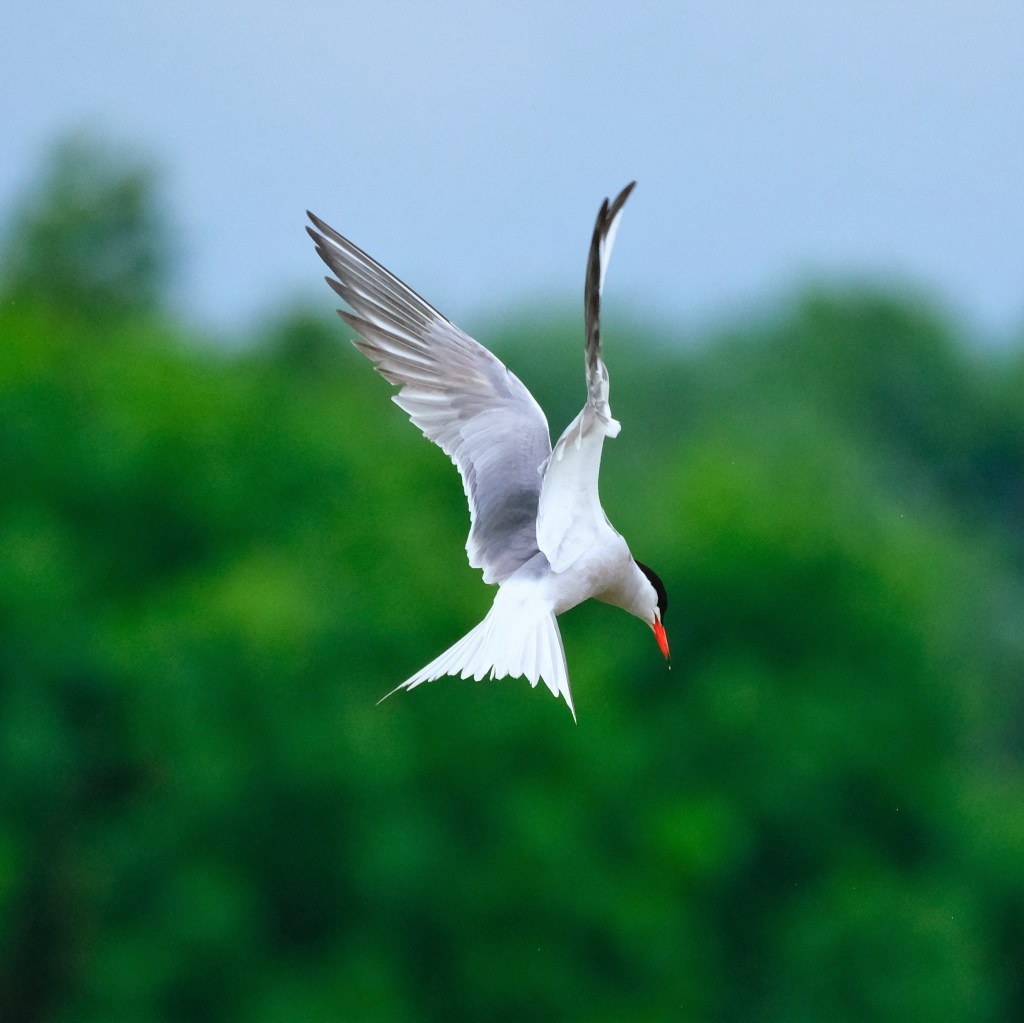
Finally, on my ride back to Delft, I captured some images, at last, of an elegant common tern (Sterna hirundo) as it hovered briefly over a canal to fish.
I see that the forecast is for rain all night, but back to partly cloudy by sunrise, so maybe I’ll have another chance to get some pictures this weekend. Wish me luck.
Sorry about the pause, but I’ve moved into a new place again, I hope for the last time on this trip, and I don’t have to commute across the open fields between Rotterdam and Delft any more. Instead, I’ve now gotta decide to ride out there on purpose, ideally before work, and this was the morning that I finally got around to it.
So fast, in fact, that here’s Mom or Dad, with a bright red beak and legs “from carotenoids in the[ir] diet,” getting some “me time” on a nearby chimney.
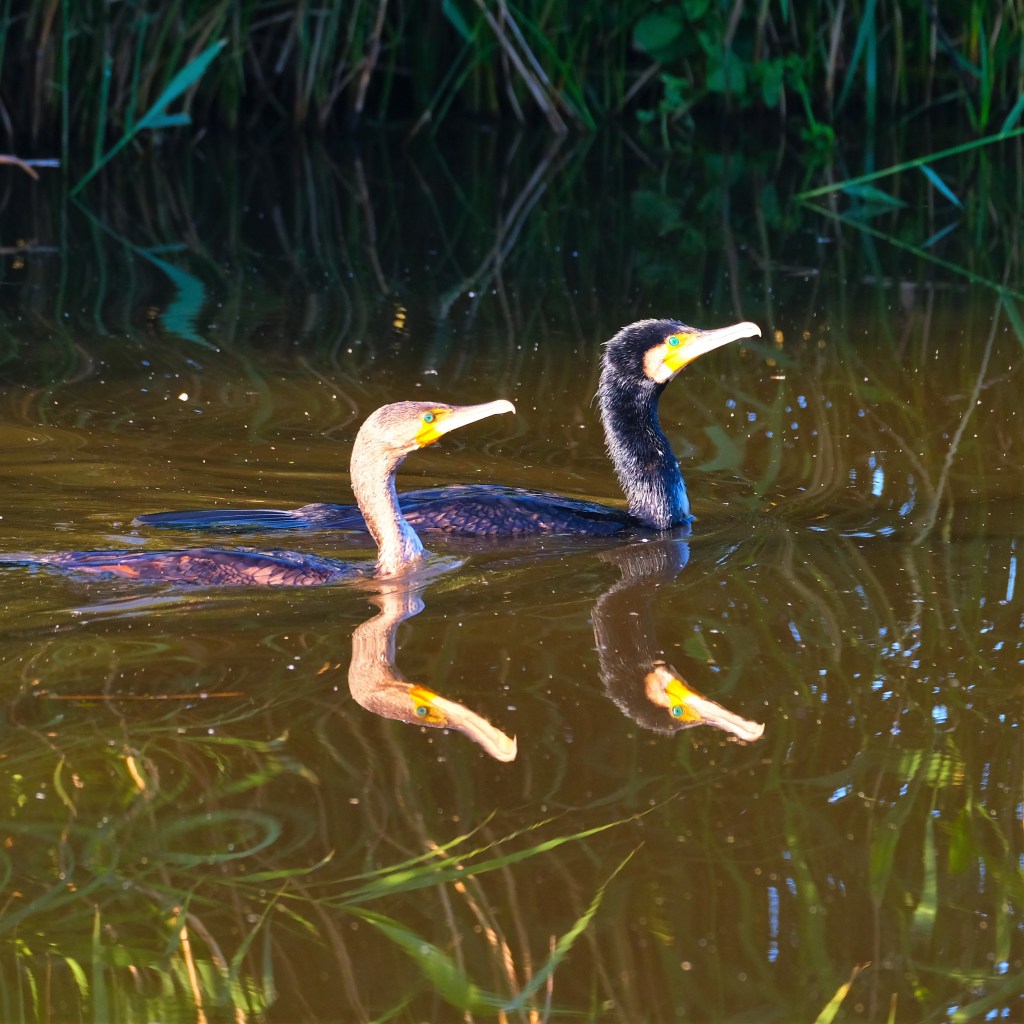
Back down on the water, there were a bunch of common cormorants, I counted six together at one point, all fishing in a canal together, and here are two of them. Their beaks are a bit bleached out in the image by the bright morning light.
Just above the cormorants, it appears that a pair of white-bellied barn swallow chicks have fledged, but were still lolling around expecting to be fed.
You may have noticed that I’ve been struggling a bit with little birds here. I think I’ve only shown you four so far, the chiffchaff, the sedge warbler, the reed bunting, and yesterday’s chaffinch.
In any case, this striking, little white wagtail (Motacilla alba) seems to have taken pity on me and posed right on the pavement where even I couldn’t miss it. Plus, it dawdled enough for me to get a pretty clean, if utilitarian, shot. Thanks, little buddy.
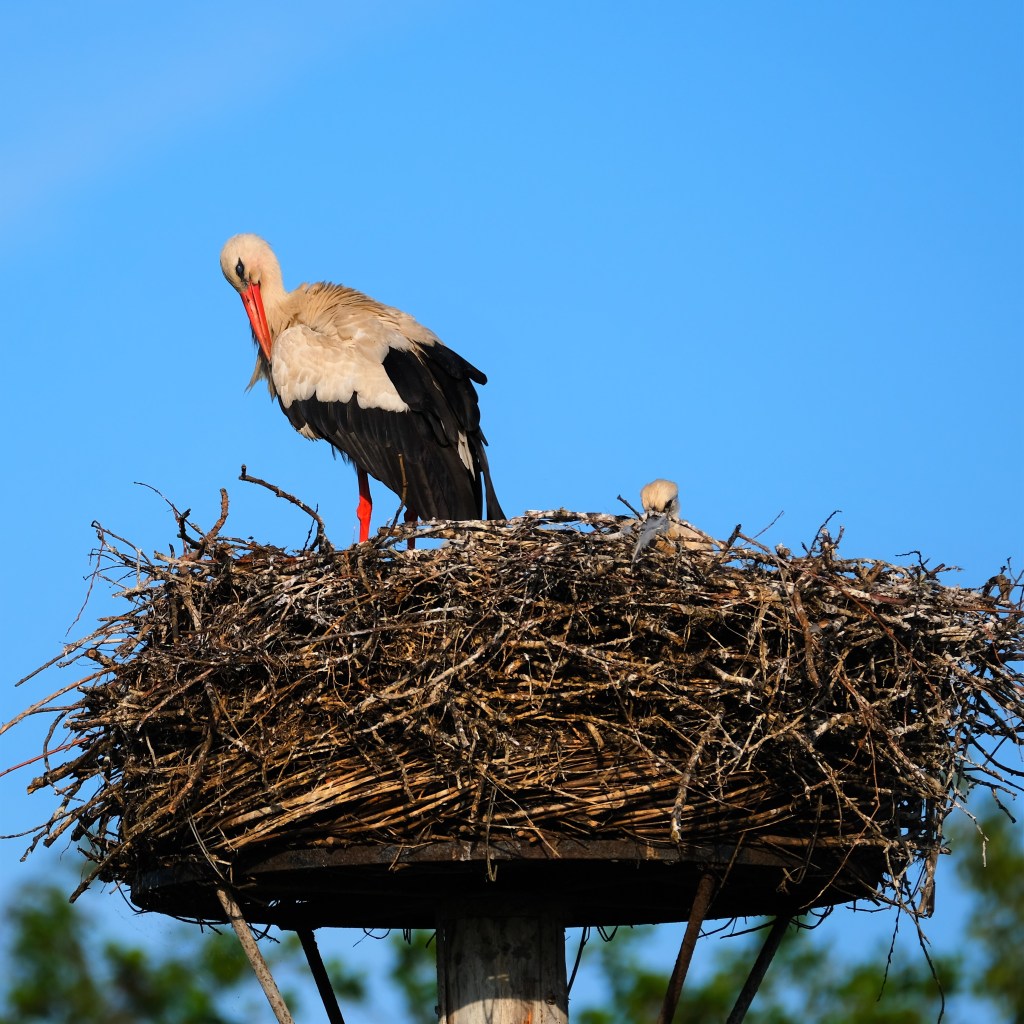
I spotted another massive stork nest, which I must have ridden past a dozen times before without noticing , and this one has not only an adult white stork (Ciconia ciconia) in it but also a little chick just peeking over the rim to see who’s staring at them now. Insert here your best joke about who brings stork babies.






























 Signs of Life in Estabrook Park


